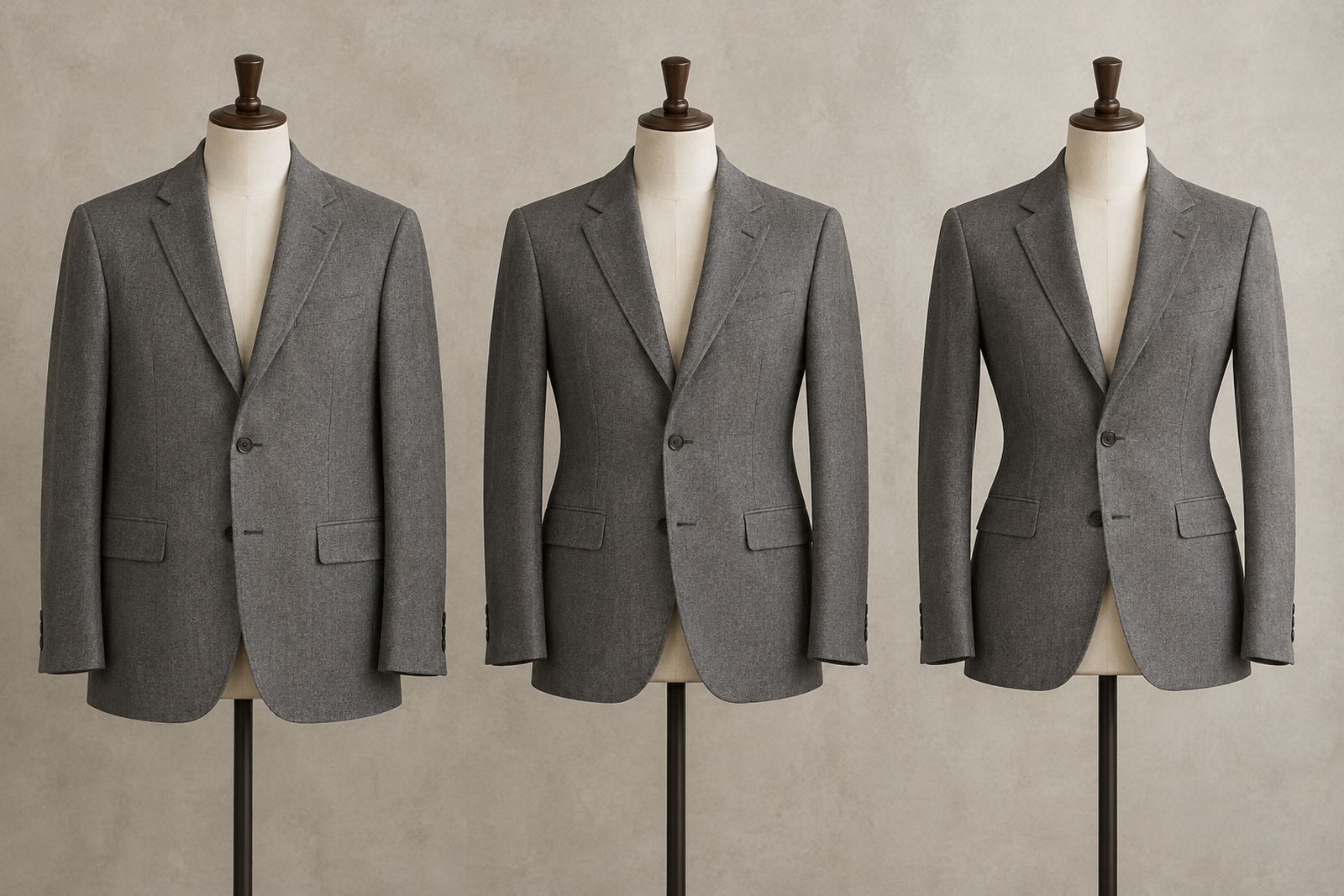
The short answer
Slim, tailored and classic fit are brand labels, not fixed standards. Typically, a classic fit has the most room, about 6 inches (15 cm) more than your chest, with a straighter waist and wide trouser legs. A slim fit has the least, about 3 to 4 inches (8 to 10 cm), with a shaped waist and narrow legs. A tailored fit usually sits between them.
- There is no industry standard: one brand's slim fit can be roomier than another's tailored fit
- Classic: most chest room, lower armholes, straighter waist, widest legs
- Tailored or modern: usually between classic and slim
- Slim: closer chest, higher armholes, shaped waist, narrower legs
- Compare garment measurements, not labels
- A tailored fit is a ready-to-wear label; a tailored suit is one altered or made for you
In this guide
- Slim fit vs tailored fit vs classic fit: the short answer
- What does classic fit mean in suits?
- What is a tailored fit, and is it tighter than slim fit?
- What is a slim fit suit?
- Modern, athletic, extra slim: the other labels
- Slim, tailored or classic: the three fits side by side
- Which suit fit is best for my body type?
- How to compare fits across brands
- Common mistakes with fit labels
- The tailor's view: fit labels and alterations
- Questions people ask
Walk into any suit shop and the racks are divided by fit: slim, tailored, classic, sometimes modern, athletic or extra slim. The labels suggest a shared system. There is none. Slim fit vs tailored fit vs classic fit is a question each brand answers for itself, and the same label can mean a few inches of difference from one shop to the next. What the labels do reliably tell you is the order of fits within one brand, from roomiest to closest.
Slim fit vs tailored fit vs classic fit: the short answer
Within a single brand, a classic fit is the roomiest, a slim fit is the closest, and a tailored or modern fit usually sits between the two. The differences show up in five places: chest room, waist shaping, armhole height, the trouser thigh and the trouser leg opening. The figures below are typical ranges, not rules; check each brand's measurements.
| Fit label | Chest room (jacket chest over body chest) | Waist | Armholes | Trouser leg opening, flat |
|---|---|---|---|---|
| Classic (or regular) | About 6 inches (15 cm) or more | Straight, little shaping | Lower and roomier | About 8½ to 9½ inches (21.5 to 24 cm) |
| Tailored (or modern) | About 4 to 6 inches (10 to 15 cm) | Moderate shaping | Medium | About 7½ to 8½ inches (19 to 21.5 cm) |
| Slim | About 3 to 4 inches (8 to 10 cm) | Clearly shaped | Higher and closer | About 7 to 7½ inches (18 to 19 cm) |
| Extra slim | About 2 to 3 inches (5 to 8 cm) | Strongly shaped | High and close | About 6½ to 7 inches (16.5 to 18 cm) |
Typical ranges only. Brands set their own patterns, so compare the garment measurements of the actual suit.
Scale from 1 in to 8 in, with cm below. Extra slim: 2 to 3 in. Slim: 3 to 4 in. Tailored: 4 to 6 in. Classic: 6 to 8 in.
What does classic fit mean in suits?
Classic fit, sometimes called regular fit, is the roomiest standard cut. The jacket has more room through the chest and back, lower armholes and a waist with little shaping, so it hangs fairly straight from the chest. The trousers have a fuller seat and thigh and a wider leg, usually with enough width to carry a half or full break.
Classic fits suit men who want comfort and freedom of movement, men with a larger frame or stomach, and anyone who dislikes a close cut. The risk is that a classic fit on a slim man billows: the chest collapses, the back shows loose vertical folds and the trousers flap. Taking in the waist and tapering the legs fixes much of that.
What is a tailored fit, and is it tighter than slim fit?
At most brands, a tailored fit is not tighter than a slim fit. It usually sits between classic and slim: more shape at the waist than a classic fit, more room in the chest and legs than a slim fit. Some brands call the same middle cut modern fit. Because there is no standard, a few brands place their labels differently, so always compare the measurements.
Tailored fit vs tailored suit
A tailored fit is a ready-to-wear label for a cut with moderate shaping. A tailored suit is one that has been altered or made by a tailor to fit your body. A tailored-fit suit off the rack still usually needs a tailor.
What is a slim fit suit?
A slim fit suit is cut close to the body. The jacket has less chest room, higher and smaller armholes, a clearly shaped waist and slimmer sleeves. The trousers are narrower through the thigh and leg, often with a lower rise. Slim fits suit slender builds and men who want a sharp, modern line.
Higher armholes feel snug when you first put the jacket on, but they let you lift your arms without the whole jacket riding up, so a well-cut slim jacket can move better than a loose one. What it cannot do is accommodate a broad back, big arms or strong thighs, which is where slim fits most often fail.
Modern, athletic, extra slim: the other labels
- Modern fit: usually the same middle ground as tailored fit, between classic and slim.
- Extra slim (or skinny, super slim): the closest cut a brand makes, with high armholes, strong waist shaping and narrow trousers. Suits a very slender build.
- Athletic fit: more room in the chest, shoulders, seat and thighs relative to the waist, for men with a muscular build. Often sold with a larger drop, the difference between jacket chest and trouser waist.
- Relaxed or comfort fit: roomier than classic at some brands, usually with more room in the seat and thigh.
- Portly, stout or executive fit: a smaller drop for men whose waist is close to their chest measurement.
The drop matters as much as the label. On a standard suit the trouser waist is 6 inches (15 cm) smaller than the jacket chest, so a 40 jacket comes with 34 trousers. Some slim and athletic lines use a drop of 7 or 8. The suit size chart explains drops and sizes in full.
Slim, tailored or classic: the three fits side by side
Slim
Closest
- About 3 to 4 inches (8 to 10 cm) chest room
- High, close armholes
- Clearly shaped waist
- Narrow sleeves
- Slim thigh, leg about 7 inches (18 cm) flat
- Best with little or no break
Tailored
Middle
- About 4 to 6 inches (10 to 15 cm) chest room
- Medium armholes
- Moderate shaping
- Medium sleeves
- Medium thigh, leg about 8 inches (20 cm) flat
- Quarter or half break
Classic
Roomiest
- About 6 inches (15 cm) or more chest room
- Lower, roomier armholes
- Little shaping
- Fuller sleeves
- Full thigh, leg about 9 inches (23 cm) flat
- Half or full break
Which suit fit is best for my body type?
Choose the fit that follows your shape without pulling, then let a tailor refine it. Use the matrix as a starting point, and trust the mirror over the label: the right fit is the one where the shoulders fit, the button closes without an X and the trousers do not strain when you sit.
| Extra slim | Slim | Tailored | Classic | |
|---|---|---|---|---|
| Slender | ||||
| Average | ||||
| Athletic, broad chest | ||||
| Strong thighs | ||||
| Fuller through the middle | ||||
| Tall and thin |
- Slender: slim fits follow your line; classic fits billow and need heavy alteration.
- Average: slim or tailored, depending on how close you like it.
- Athletic: start with tailored or athletic fits for the shoulders and chest, then take in the waist. Slim fits often bind at the back and thighs.
- Fuller through the middle: classic or a generous tailored fit that closes at the navel without pulling. Slim cuts strain at the button.
- Tall and thin: slim or tailored in long sizes; very loose cuts hang off a long, narrow frame.
How to compare fits across brands
Because labels are inconsistent, compare the numbers. Most good retailers publish garment measurements, the size of the suit itself rather than the body it is meant for. Compare them with a jacket and trousers you already like.
Comparing fit with a tape measure
- 1
Lay your best-fitting jacket flat
Button it and lay it on a table. Measure straight across the chest from armpit to armpit, then double it. That is the jacket's chest measurement.
- 2
Work out your chest room
Subtract your body chest measurement from the jacket chest. The difference tells you how much room you like: about 3 to 4 inches (8 to 10 cm) is slim, 6 inches (15 cm) or more is classic.
- 3
Measure the trousers
Lay the trousers flat and measure across the leg opening at the hem and across the thigh just below the crotch.
Tip: Check whether a brand quotes leg opening flat or as the full circumference; the circumference is double the flat figure.
- 4
Compare with the brand's chart
Find the garment measurements for the fit and size you are considering and compare them with your own garment. Choose the fit whose numbers are closest.
If you are measuring from scratch, how to measure yourself for a suit covers chest, waist and every other measurement.
Common mistakes with fit labels
- Sizing down to get a slim look. The shoulders and sleeves shrink too. Change the fit instead.
- Buying slim when the shoulders do not fit. A slim jacket that pulls at the sleevehead cannot be fixed. Move to a tailored fit.
- Ignoring the trousers. A slim jacket with full classic trousers looks mismatched. Suit separates let you choose the jacket and trouser cut independently at some brands.
- Choosing by the label alone. The only reliable comparison is the measurements, or trying the suit on.
- Mistaking tight for slim. A good slim fit has shape, not strain. X-shaped creases at the button mean the suit is too small, whatever the label.
The tailor's view: fit labels and alterations
To a tailor, the label matters less than where the room is. A classic fit can be made closer by taking in the waist and tapering the trousers, which is routine work. A slim fit can rarely be made roomier, because ready-to-wear seams carry little spare fabric. So when you are between two fits, the roomier one is usually the safer buy, provided the shoulders fit.
Made-to-measure and bespoke suits have no fit labels at all. The ease, how much room is built in, is set for your body and your taste, and it varies by house. Some tailors cut with deliberate fullness through the chest and back, such as the soft drape associated with Anderson & Sheppard; others cut closer and more structured. If you go that route, tell the tailor how close you like a jacket and show them one you like.
Whatever the label, the fit points do not change: shoulders at the bone, collar against the collar, button at the navel, cuff showing. The full list is in how a suit should fit, and shirt fit labels follow the same logic, explained in how a dress shirt should fit.
Questions people ask
What is the difference between slim fit and tailored fit?
At most brands, a slim fit is cut closer than a tailored fit: less chest room, higher armholes, more waist shaping and narrower trousers. A tailored fit usually sits between slim and classic. There is no industry standard, so compare each brand's garment measurements.
Is tailored fit tighter than slim fit?
Usually not. At most brands, tailored fit is roomier than slim fit and closer than classic fit. Because brands set their own definitions, a few may order their labels differently, so check the chest and leg measurements.
What is the difference between modern fit and slim fit?
Modern fit is usually a middle cut, similar to tailored fit, with moderate waist shaping and medium trouser legs. Slim fit is closer, with less chest room and narrower legs. As with all fit labels, the exact difference depends on the brand.
What does classic fit mean in suits?
Classic fit is the roomiest standard cut, with more room in the chest and back, lower armholes, little waist shaping and wider trousers. It typically allows about 6 inches (15 cm) or more of room over your chest. It suits larger builds and anyone who wants comfort over a close line.
Which suit fit is best for my body type?
Slender men usually suit slim fits, average builds slim or tailored, athletic builds tailored or athletic fits, and fuller builds classic or a generous tailored fit. Whatever your build, the right fit is the one where the shoulders fit and the button closes without pulling. A tailor can then refine the waist and legs.
Should I size down in a slim fit?
No. Sizing down shrinks the shoulders, sleeves and length as well as the chest and waist. If you want a closer look, keep your size and change to a slimmer fit, or have the waist taken in.
Can a tailor turn a classic fit into a slim fit?
Largely, yes. A tailor can take in the jacket waist and back and taper the sleeves and trouser legs, which brings a classic fit close to a slim line. The shoulders and armholes stay as they are, so the result is a slimmer classic fit rather than a true slim cut.
TailorGuide is independent. Our guides are written and checked by our team and carry no paid endorsements. How we work.