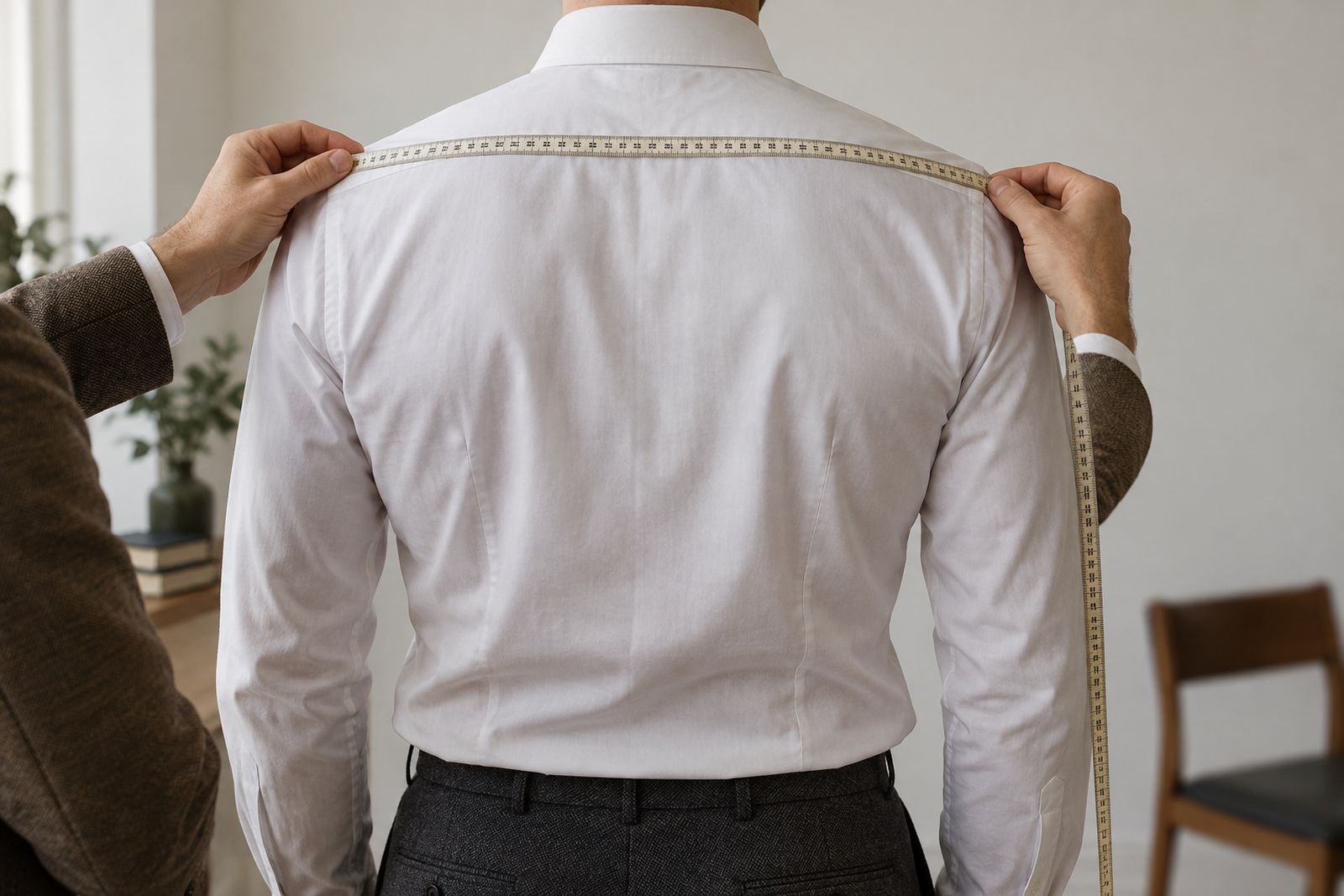
The short answer
To measure for a suit, stand relaxed in a thin shirt and hold a soft tape snug but not tight. Measure your chest, waist, seat, shoulders, sleeve, neck and jacket length, then your trouser waist, inseam, outseam, thigh and rise. Your chest in inches is roughly your jacket size. A tailor adds ease to these body measurements when cutting.
- Stand naturally, breathe normally and keep the tape level and snug, with room for one finger
- Your chest in inches is roughly your jacket size: a 40-inch (102 cm) chest usually wears a 40
- Shoulder, sleeve and jacket length need a helper
- Measuring a suit that already fits you is often more reliable than measuring your body
- Give body measurements when a form asks for them; the tailor adds the ease
In this guide
- What measurements do I need for a suit?
- Before you start: tools, clothing and posture
- How to measure for a suit jacket
- How to measure for suit trousers
- Your suit measurement sheet
- From measurements to your suit size
- Why a tailor's measurements differ from yours
- Common measuring mistakes
- Can I measure myself for a custom suit?
- Questions people ask
Most sizing mistakes start with a careless measurement: a tape pulled tight, a chest measured with a deep breath, a waist taken at the wrong height. Learning how to measure for a suit properly takes about fifteen minutes, a soft tape and, for three of the measurements, a helper. The twelve measurements below cover what any size chart or made-to-measure order form will ask for.
What measurements do I need for a suit?
For a ready-to-wear suit you need four: chest, waist, trouser waist and inseam, plus your height to choose short, regular or long. For made-to-measure, or to brief a tailor, take all twelve. The table shows where each is taken and what it is used for.
| Measurement | Where it is taken | Used for | Off the rack? |
|---|---|---|---|
| Chest | Fullest part of the chest, under the arms | Jacket size | Yes |
| Waist | Around the body at the navel | Jacket waist and button | Yes |
| Seat | Fullest part of the seat | Jacket skirt and trouser seat | Helpful |
| Shoulder | Across the back, shoulder bone to shoulder bone | Jacket shoulder width | No |
| Sleeve | Shoulder point to where the wrist meets the hand | Jacket sleeve length | Helpful |
| Neck | Base of the neck, where a shirt collar sits | Collar fit, shirt size | No |
| Jacket length | Base of the collar down the center back | Jacket length | No |
| Trouser waist | Where you wear your trousers | Trouser waist size | Yes |
| Inseam | Crotch to hem, inside the leg | Trouser length | Yes |
| Outseam | Top of the waistband to hem, outside the leg | Trouser length and rise | No |
| Thigh | Fullest part of the thigh, just below the crotch | Trouser thigh width | No |
| Rise | Crotch seam to the top of the waistband | Where the trousers sit | No |
Before you start: tools, clothing and posture
Use a soft tailor's tape measure, never a metal one. Wear a thin dress shirt and close-fitting trousers or underwear, and empty your pockets. Stand in front of a mirror so you can see that the tape is level, and have a helper ready for the shoulder, sleeve and jacket length.
- Posture: stand as you normally stand, weight even on both feet, arms relaxed at your sides, looking straight ahead. Do not straighten up for the tape; the suit has to fit the way you actually stand.
- Breathing: breathe normally and take body measurements at the end of a normal breath out. Do not puff out your chest or pull in your stomach.
- Tape tension: the tape should lie flat against the body, snug but not compressing it. One finger should slide under it without force.
- Level: for chest, waist, seat and thigh, keep the tape parallel to the floor all the way round. Check the back in the mirror.
- Recording: write each figure down straight away, to the nearest ¼ inch (0.5 cm). Measure twice; if the two readings differ, measure a third time.
How to measure for a suit jacket
Seven jacket measurements
- 1
Chest
Raise your arms slightly, wrap the tape around the fullest part of your chest, under the armpits and across the shoulder blades, then lower your arms. Keep the tape level and measure at the end of a normal breath.
Tip: The tape most often drops at the back. Check it in the mirror, or ask your helper to hold it in place across the shoulder blades.
- 2
Waist
Measure around your body at the navel, where a suit jacket's fastened button sits. Stand relaxed with your stomach as it normally is. If you carry weight below the navel, also measure around the fullest part of your stomach and note both.
Tip: This is your jacket waist, not your trouser waist. The two are often different.
- 3
Seat
Stand with your feet together and measure around the fullest part of your seat, keeping the tape level. Take it over thin trousers or underwear with empty pockets.
- 4
Shoulder
Your helper measures across your back from the outer edge of one shoulder bone to the other, following the curve of your upper back rather than cutting straight across.
Tip: To find the shoulder bone, lift your arm out to the side: a small dip forms at the point where the shoulder ends and the arm begins.
- 5
Sleeve
With your arm hanging relaxed, your helper measures from the shoulder point down the outside of the arm, over the elbow, to the point where your wrist meets your hand. Measure both arms; they often differ slightly.
- 6
Neck
Measure around the base of your neck where a shirt collar sits, just below the Adam's apple, keeping the tape snug and level. Add about ½ inch (1.3 cm) to get your shirt collar size; how to measure your shirt size covers collar and shirt sleeve in detail.
Tip: Do not slip a finger under the tape and also add the ½ inch, or the collar will come out a size too big.
- 7
Jacket length
Your helper measures from the base of the collar, at the prominent bone at the back of your neck, straight down the center of your back to where you want the hem, usually just below the curve of your seat.
Tip: As a check, the jacket length is often close to half the distance from that bone to the floor.
Sleeve and jacket length have their own detailed guides: suit sleeve length explains how much shirt cuff to show, and how long a suit jacket should be compares the length rules.
How to measure for suit trousers
Trouser measurements are easiest and most reliable when taken from a pair of trousers that already fits you well. Body measurements are given as an alternative for each.
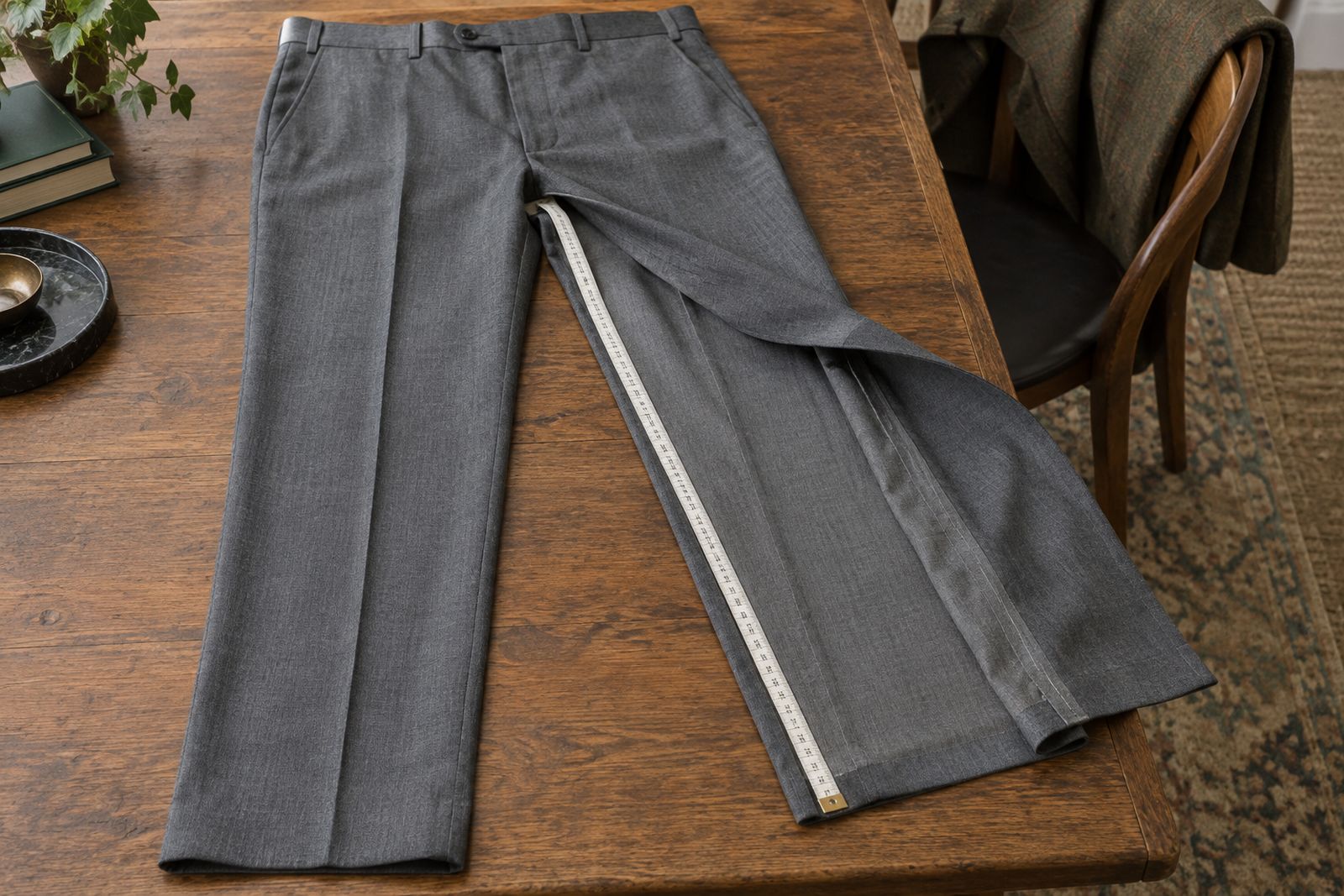
Five trouser measurements
- 1
Trouser waist
Measure around your body at the height where you wear your trousers, which may be at the navel or lower on the hips, with one finger under the tape. On trousers that fit, lay the fastened waistband flat, measure straight across and double it.
Tip: If you wear trousers low on the hips, your trouser waist can differ from your navel measurement by an inch or two (2.5 to 5 cm), in either direction.
- 2
Inseam
On trousers with the length you like, measure from the crotch seam down the inside leg seam to the bottom of the hem. On the body, stand in the shoes you will wear and measure from the crotch down the inside of the leg to where you want the hem to sit.
- 3
Outseam
Measure from the top of the waistband at your side, at the height you wear it, down the outside of the leg to the bottom of the hem. On trousers, measure along the side seam.
- 4
Thigh
Measure around the fullest part of your thigh, about 1 inch (2.5 cm) below the crotch, with your leg relaxed and the tape level. On trousers, measure flat across the leg at the same point and double it.
- 5
Rise
On trousers that sit where you like them, measure the front rise from the crotch seam up to the top of the waistband at the front. On the body, this is hard to do alone; your outseam minus your inseam gives a rough idea, and a tailor can take it properly.
Tip: The rise decides where trousers sit. If you like how a pair sits, record its rise even if nothing else about it fits.
The rise, seat and thigh decide how trousers feel when you sit and move, which is covered in how suit trousers should fit.
Your suit measurement sheet
Copy or print this sheet and fill in both units. Note the date, because measurements change with weight, training and age, and keep a note of anything unusual, such as one shoulder lower than the other.
| Measurement | Inches | Centimeters | Notes |
|---|---|---|---|
| Chest | |||
| Waist (at the navel) | |||
| Stomach (fullest point, if different) | |||
| Seat | |||
| Shoulder | |||
| Sleeve, left | |||
| Sleeve, right | |||
| Neck | |||
| Jacket length | |||
| Trouser waist | |||
| Inseam | |||
| Outseam | |||
| Thigh | |||
| Rise (front) | |||
| Height, in shoes and without |
From measurements to your suit size
Ready-to-wear jacket sizes in the US and UK are your chest measurement in inches: a 40-inch (102 cm) chest usually wears a 40. European and Italian sizes are usually the US or UK size plus 10, so a 40 is a 50. Your height then gives the length (short, regular or long), and a standard suit's trousers are 6 inches (15 cm) smaller than the jacket, so a 40R comes with 34-inch trousers.
| Your chest | US and UK size | EU and Italian size | Standard trouser waist |
|---|---|---|---|
| 36 inches (91 cm) | 36 | 46 | 30 inches (76 cm) |
| 38 inches (97 cm) | 38 | 48 | 32 inches (81 cm) |
| 40 inches (102 cm) | 40 | 50 | 34 inches (86 cm) |
| 42 inches (107 cm) | 42 | 52 | 36 inches (91 cm) |
| 44 inches (112 cm) | 44 | 54 | 38 inches (97 cm) |
| 46 inches (117 cm) | 46 | 56 | 40 inches (102 cm) |
Brands vary, so always check each brand's own chart. The full chart, with lengths and drops, is in our suit size chart.
If your chest falls between two sizes, try both and choose by the shoulders: the waist and sleeves can be altered, the shoulders cannot. The suit size chart has the full range of sizes, length guides and what to do between sizes.
Why a tailor's measurements differ from yours
Your tape measures your body. A tailor measures your body too, then adds ease when cutting the pattern, so the finished suit measures more than you do. That is why a size 40 jacket is not 40 inches round: for a 40-inch (102 cm) chest, the jacket typically measures about 43 to 46 inches (109 to 117 cm) round the chest, depending on how close the cut is.
Ease
Ease is the extra room a tailor adds to a body measurement so you can breathe, sit and move, plus any further room the style calls for. A slim cut has little ease; a classic cut has more.
This matters when you fill in an online made-to-measure form. If it asks for body measurements, give your body figures and do not add room yourself; the maker adds the ease. If it asks for garment measurements, measure a suit that fits you. Mixing the two is a common reason made-to-measure suits arrive too big.
A tailor also records what a tape cannot: whether your shoulders slope or sit square, whether one is lower, whether you stand upright or lean slightly forward, and how your seat and stomach are carried. These posture notes shape the pattern as much as the numbers, and they are the main reason bespoke fits differently from made-to-measure, as bespoke vs made-to-measure explains.
Common measuring mistakes
- Confusing waist and trouser waist. The jacket waist is at the navel; the trouser waist is wherever your trousers sit.
- Measuring shoulders on yourself. You cannot reach across your own back accurately. Use a helper or measure a jacket whose shoulders fit.
- Measuring sleeves with a locked arm. A rigidly straightened arm is not how you wear a jacket. Let it hang with its natural bend.
- Adding ease to body measurements. Give what the form asks for; adding your own room doubles it.
- Measuring once. Take each measurement twice and check the two agree.
Can I measure myself for a custom suit?
Yes, for made-to-measure, if you are careful and have a helper. Chest, waist, seat, neck, trouser waist, inseam and thigh are straightforward to take yourself. Shoulder width, sleeve length, jacket length and rise are where home measurements usually go wrong, and they are the ones to cross-check against a garment that fits or to leave to a professional.
Before you submit a made-to-measure order
- Every measurement taken twice, in a thin shirt, with the tape level
- Body and garment measurements clearly labeled, as the form asks
- Shoulder, sleeve and jacket length cross-checked against a jacket that fits
- Rise and inseam cross-checked against trousers that sit and break the way you like
- Posture noted if the form allows: sloping shoulders, one shoulder lower, upright or forward stance
- The maker's policy on remakes and alterations read before you pay
Bespoke tailors always measure in person and take many more measurements than these, then refine the fit over several fittings. Whichever route you choose, your measurements are the start, not the finish: the fit is judged on your body, point by point, as set out in how a suit should fit.
Questions people ask
How do I measure my chest for a suit jacket?
Wrap a soft tape around the fullest part of your chest, under your armpits and across your shoulder blades, keeping it level all the way round. Stand relaxed with your arms down and measure at the end of a normal breath, with one finger's room under the tape. The figure in inches is roughly your jacket size.
What measurements do I need for a suit?
For a ready-to-wear suit you need your chest, waist, trouser waist and inseam, plus your height to choose short, regular or long. For made-to-measure, add seat, shoulder, sleeve, neck, jacket length, outseam, thigh and rise, for twelve in total.
How do I know my suit size without trying it on?
Measure your chest in inches: that is roughly your US or UK jacket size, and adding 10 gives the usual European size. Choose short, regular or long by height, and expect trousers 6 inches (15 cm) smaller than the jacket on a standard suit. Check each brand's chart, because sizing varies.
Can I measure myself for a custom suit?
Yes, for made-to-measure, with care and a helper. Chest, waist, seat, neck and trouser measurements are easy to take yourself; shoulder, sleeve, jacket length and rise are best cross-checked against a garment that fits. Read the maker's remake policy before ordering.
Should I measure over clothes?
Measure over a thin dress shirt and close-fitting trousers or underwear, never over a sweater, jacket or thick trousers. Empty your pockets first. Bulky clothing can add an inch (2.5 cm) or more to the chest, waist and seat.
Why are my measurements different from my suit size?
Your suit size describes the body it is meant for, while the suit itself is cut larger to allow room to move. A size 40 jacket for a 40-inch (102 cm) chest typically measures about 43 to 46 inches (109 to 117 cm) around, depending on the cut. That extra room is called ease.
Do my two arms need separate measurements?
Yes, measure both. Arms often differ slightly in length, and a tailor can set each sleeve to its own length so that the same amount of shirt cuff shows on each side.
TailorGuide is independent. Our guides are written and checked by our team and carry no paid endorsements. How we work.