The short answer
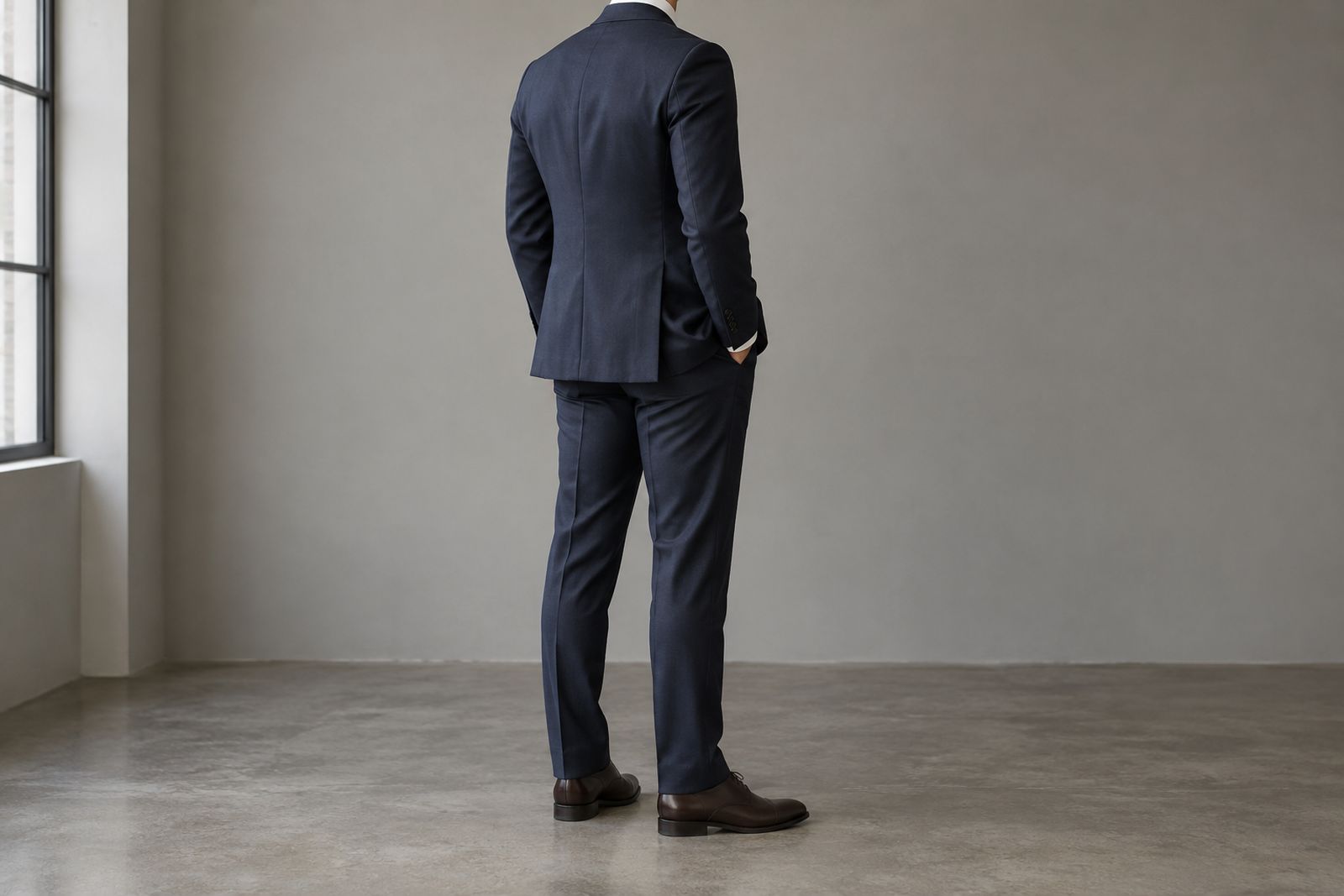
A suit fits when the jacket collar hugs your shirt collar, the shoulder seam ends at your shoulder bone, the fastened button sits at or just above your navel without X-shaped pulling, the jacket covers your seat, ¼ to ½ inch (6 to 13 mm) of shirt cuff shows, and the trousers hang cleanly from the seat with the break you chose.
- Buy for the shoulders: the seam should end at your shoulder bone, with no divots or ridges
- The jacket collar should hug your shirt collar, with no gap at the back of the neck
- The fastened button should sit at or just above your navel, with no X-shaped pulling
- Show ¼ to ½ inch (6 to 13 mm) of shirt cuff below the jacket sleeve
- The jacket should cover your seat; the knuckle check is a guide, not a law
- Shoulders, collar and jacket length are hard to change; sleeves, waist and trouser length are easy
In this guide
- How should a suit fit? The rules at a glance
- How should a suit fit in the collar and shoulders?
- How should a suit jacket fit in the chest and waist?
- How long should a suit jacket and its sleeves be?
- How should suit trousers fit?
- How should your shirt fit under a suit?
- How tight should a suit be?
- How do I know if my suit fits? A fitting-room checklist
- Signs of a bad fit, and what causes them
- What can a tailor fix after you buy?
- How should a suit fit different body types?
- Getting the fit right from the start
- Questions people ask
Most suits that look wrong are not badly made. They are the wrong size in one or two places: shoulders that overhang, a sleeve that hides the shirt cuff, trousers that pool over the shoe. Knowing how a suit should fit comes down to a short list of points, checked from collar to hem, and knowing which of them a tailor can change after you buy. Each point below has its exact rule and a link to a detailed guide.
How should a suit fit? The rules at a glance
A suit should follow the line of your body without gripping it. The jacket rests on your shoulders, closes over your chest and waist without strain, and is long enough to cover your seat. The trousers hang straight from the seat to the shoe. These are the rules a tailor works to.
Suit fit rules, collar to hem
- Collar
- Hugs the shirt collar with no gap; about ½ inch (1.3 cm) of shirt collar shows above it at the back
- Shoulders
- Seam ends at your shoulder bone, with no divots or ridges
- Chest
- Lapels lie flat; a flat hand slides in under the buttoned jacket
- Fastened button
- At or just above the navel, with no X-shaped pulling
- Waist
- Gently shaped toward the button, with no horizontal pull lines
- Jacket length
- Covers your seat; the hem often falls around the knuckles or mid-thumb
- Sleeves
- Show ¼ to ½ inch (6 to 13 mm) of shirt cuff
- Trouser waist
- Stays up without a belt and lies flat, with no gap at the back
- Seat and thigh
- Smooth drape, with no pulling and no sagging fabric
- Trouser length
- No break, quarter, half or full break, chosen to suit the leg width
How should a suit fit in the collar and shoulders?
Start at the top, because the collar and shoulders decide whether a jacket can be made to fit at all. Everything below them hangs from these two points, and both are difficult to alter.
The collar
The jacket collar should hug your shirt collar all the way round, with no gap between them when you stand naturally. At the back, about ½ inch (1.3 cm) of shirt collar should show above the jacket collar. A gap that opens at the back of the neck, or a horizontal ripple of fabric just below the collar, means the jacket is not balanced for your posture or the slope of your shoulders.
Check it from the side, using a second mirror or a phone camera, while standing as you normally stand. Pulling your shoulders back for the mirror hides the problem. A tailor can often close a small collar gap by reshaping and resetting the collar, but it is skilled work, and a large gap on a ready-to-wear jacket is a reason to try another size or cut.
The shoulders
The shoulder seam should end at your shoulder bone, the bony point at the outer edge of your shoulder, with no divots or ridges at the top of the sleeve. This is the point to judge first in any shop. If the shoulders are right, almost everything else can be adjusted.
Look in the mirror with your arms relaxed. A shoulder that is too wide extends past the bone, and the empty end of the pad collapses into a dent at the top of the sleeve. A shoulder that is too narrow pulls tight: your upper arm pushes against the sleevehead, and you see a ridge or dimples across it. A quick test is to stand side-on to a wall and lean in. If the shoulder pad meets the wall before your arm does, the shoulders are too wide.
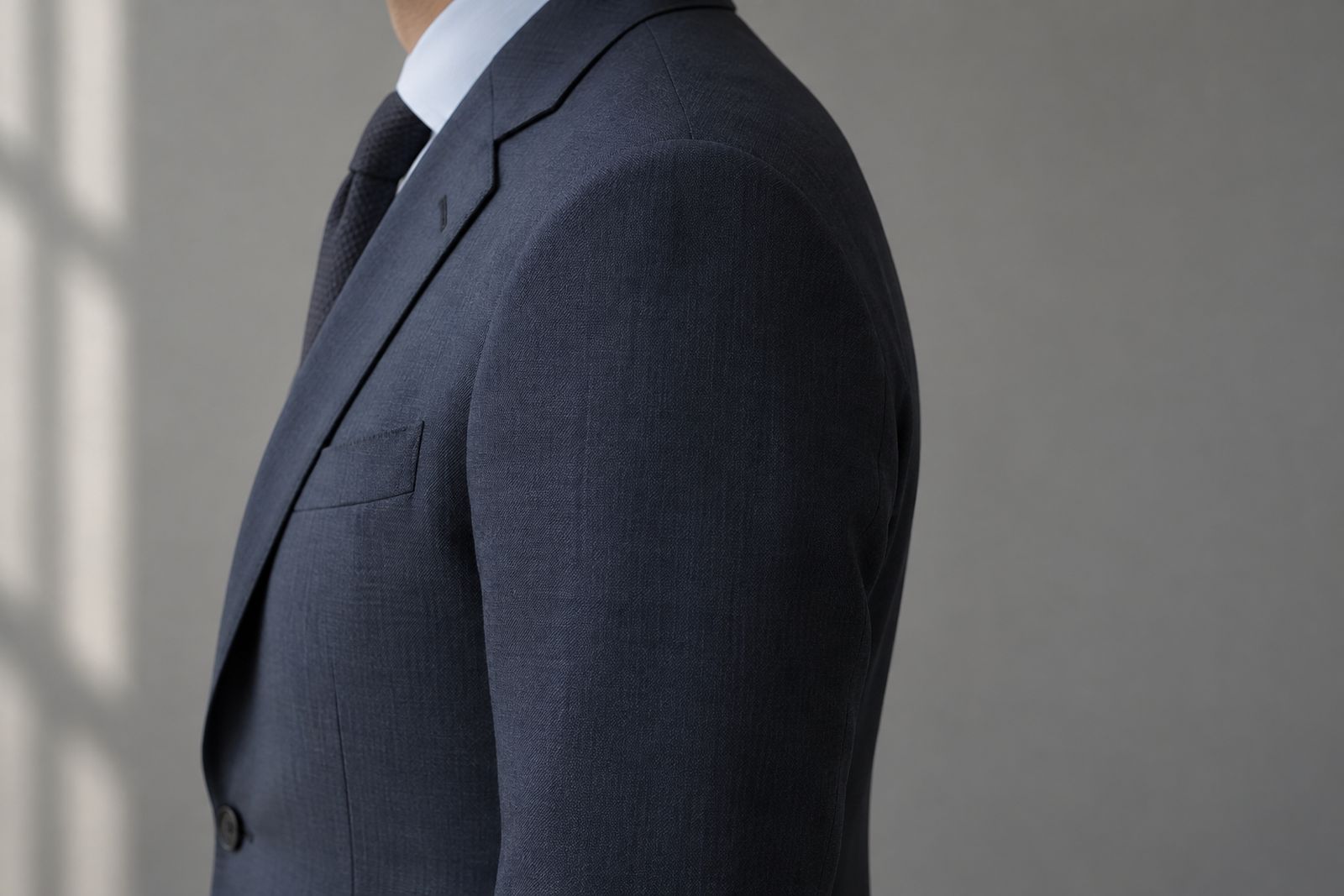
How the shoulder looks also depends on how it is built. An English jacket usually has a structured shoulder with some padding; a Neapolitan jacket may have almost none. Both can fit. What matters is where the seam ends and whether the sleeve hangs cleanly from it.
How should a suit jacket fit in the chest and waist?
Fasten the jacket and stand naturally. The lapels should lie flat against your chest, the front should close without strain, and the fabric should run smoothly from the chest to the waist. You should be able to slide a flat hand between the jacket and your shirt at the chest. If making a fist under the lapel pulls on the button, the chest is too tight.
Where should the fastened button sit?
On a two-button jacket you fasten the top button; on a three-button jacket, the middle one; on a one-button jacket, the only one. That fastened button should sit at or just above your navel, and there should be no X-shaped creases pulling out from it. Those creases mean the jacket is too tight at the waist or across the stomach. A button that sits well below the navel makes your torso look long and your legs short.
How much shape should the waist have?
The jacket should narrow gently from the chest to the button, then open slightly over the hips. Buttoned, it should show a clean line at the sides with no horizontal pull lines, and the vents should hang closed. Vents that split open, or hip pockets that flare, mean the jacket is tight across the hips and seat. Too much fabric shows as loose vertical folds down the back or at the sides, which a tailor can take in at the side seams and the center back seam.
Each of these points has a mirror test and a clear fixable or not-fixable verdict, set out in how a suit jacket should fit.
How long should a suit jacket and its sleeves be?
Jacket length
The jacket should cover your seat. A common check is that, with your arms relaxed at your sides, the hem falls around your knuckles or the middle of your thumb. Treat this as a guide rather than a law: arm length varies, and a man with long arms who followed it strictly would end up in a jacket that is too long. Many tailors also work by proportion, cutting the back of the jacket to roughly half the distance from the base of the collar to the floor.
A jacket that stops above the seat cuts the body off at the hips and leaves the seat on show; one that falls well past the seat shortens the legs. Length is hard to change afterwards. A tailor can usually shorten a jacket by about 1 inch (2.5 cm) before the pockets sit too close to the hem, and there is rarely enough fabric to lengthen one. Choosing a length for your height is covered in how long a suit jacket should be.
Sleeve length
With your arms hanging relaxed, about ¼ to ½ inch (6 to 13 mm) of shirt cuff should show below the jacket sleeve. The jacket sleeve usually ends around the point where your wrist meets your hand, and the shirt cuff carries on a little further. Showing no cuff makes the jacket look too big; showing an inch (2.5 cm) or more makes it look small, or the shirt sleeves too long.
Sleeve length is one of the easiest alterations, provided the buttonholes at the cuff are not working (cut open and functional). If they are, the sleeve has to be shortened from the shoulder end instead, which is a much larger job. The guide to suit sleeve length covers how to measure it and what to tell your tailor.
How should suit trousers fit?
Suit trousers (pants) should sit where they were designed to sit, stay there without a belt, and hang straight from the seat to the shoe. Check five things in the mirror, from the front, side and back.
- Waist: the waistband lies flat all round, with no gap at the back and no digging in when you sit. Two fingers should slide inside it without force.
- Seat: the fabric follows your seat smoothly. Horizontal pull lines mean it is too tight; loose folds below it mean there is too much fabric.
- Thigh: standing, you can pinch about ½ to 1 inch (1.3 to 2.5 cm) of fabric at the side of the thigh.
- Rise: the crotch sits close to your body without cutting in. A crotch that hangs low shortens your stride; one that is too short pulls when you sit.
- Leg: the front crease falls straight down to the shoe without twisting to one side.
Most trouser problems are fixable. The waist can usually be taken in or let out by about 1 inch (2.5 cm), sometimes more, and the legs can be tapered. The seat and thighs can be let out only as far as the seam allowance inside allows. The full wrinkle-by-wrinkle diagnosis is in how suit trousers should fit.
How long should suit trousers be? The four breaks
A trouser break is the fold or dent that forms where the hem meets the top of your shoe. There are four standard lengths: no break, quarter break, half break and full break. None is wrong. They suit different leg widths and different degrees of formality.
| Break | Where the hem sits | Works best with |
|---|---|---|
| No break | Just touches or clears the top of the shoe, with no fold | Slim, tapered legs and a deliberately modern look |
| Quarter break | Rests lightly on the shoe, making a slight dent | Modern business suits with a slim to medium leg |
| Half break | Makes one clear fold at the front | Traditional business suits with a medium leg |
| Full break | Makes one deep fold and covers more of the shoe | Wider, straight legs and classic cuts |
Whatever break you choose, the back of the hem should never touch the ground or catch under the heel. Have the length pinned while you stand straight in the shoes you will wear with the suit, and look ahead into a mirror: looking down at your feet changes how the fabric falls. The trade-offs between the four are set out in trouser break explained.
How should your shirt fit under a suit?
The shirt is part of the fit. Buttoned, its collar should leave room for two fingers between collar and neck, and it should stand high enough to show above the jacket collar at the back. The shoulder seam should sit at your shoulder bone, the body should be close enough that it does not bunch under the jacket, and the cuff should reach the base of your thumb so that it shows below the jacket sleeve.
A shirt that billows at the waist pushes the jacket out of shape, and a shirt with short sleeves leaves you showing no cuff however well the jacket is cut. Each point, with the tests to run, is in how a dress shirt should fit.
How tight should a suit be?
A suit should be close enough to show your shape and loose enough to move in. The test is movement, not the mirror. Sit down, reach forward as if shaking hands, cross your arms and climb a few stairs. The jacket should not pull hard across the back or at the button, the sleeves should not ride far up your forearms, and the trousers should not dig in at the waist or strain across the thighs.
How much room you want is partly taste. The labels slim, tailored and classic describe how much room a brand builds in, but they have no fixed standard, so one brand's slim fit can be roomier than another's tailored fit. The differences are compared in slim vs tailored vs classic fit.
How do I know if my suit fits? A fitting-room checklist
Wear a dress shirt and the shoes you will wear with the suit. Stand naturally in front of a mirror, then use a phone camera or a second mirror for the side and back views. Work down from the collar.
Suit fit checklist, collar to hem
- Jacket collar sits against the shirt collar, with no gap at the back of the neck
- About ½ inch (1.3 cm) of shirt collar shows above the jacket collar at the back
- Shoulder seams end at your shoulder bones, with no dents or ridges at the top of the sleeves
- Lapels lie flat on your chest when the jacket is buttoned
- The fastened button sits at or just above your navel, with no X-shaped pulling
- No horizontal folds across the upper back, and no loose vertical folds down it
- Unbuttoned, the fronts hang straight, neither swinging apart nor crossing
- Vents hang closed and hip pockets lie flat
- The jacket covers your seat
- ¼ to ½ inch (6 to 13 mm) of shirt cuff shows with your arms relaxed
- Sleeves hang straight, without diagonal twists
- The trouser waistband lies flat and stays up without a belt
- Seat and thighs drape smoothly, and you can pinch a little fabric at the thigh
- Front creases fall straight to the shoes
- The hem gives the break you want and does not touch the floor at the heel
- You can sit, reach and climb stairs without pulling anywhere
Signs of a bad fit, and what causes them
Wrinkles are a map. Fabric pulls toward the place where the suit is too tight and collapses where it is too loose, so each crease points to its cause. These are the ones a tailor reads first.
| What you see | Likely cause | Fixable? |
|---|---|---|
| Gap between jacket collar and shirt collar | Collar or upper back not balanced for your posture or shoulder slope | Often, if small; skilled work |
| Horizontal ripple just below the collar at the back | Collar and upper back out of balance with your posture | Often, by resetting the collar |
| Dent at the top of the sleeve | Shoulders too wide; the pad overhangs the bone | Rarely; costly |
| Ridge or dimples across the upper sleeve | Shoulders too narrow for your arms | Rarely |
| X-shaped creases from the fastened button | Too tight at the waist or stomach | Sometimes, if there is seam allowance to let out |
| Lapels bowing away from the chest | Chest too tight, or cut for a different build | Rarely |
| Vents gaping, hip pockets flaring | Too tight across the hips and seat | Sometimes, at the side seams |
| Diagonal twists down the sleeve | Sleeve pitch does not match how your arms hang | Yes, by re-setting the sleeves |
| Loose vertical folds down the back | Jacket too big through the back | Yes, at the center back seam |
| Pull lines fanning out from the crotch | Seat or thighs too tight, or rise too short | Sometimes, if there is allowance |
| Loose folds under the seat | Too much fabric in the seat for your build | Usually |
| Fabric pooling over the shoe | Trousers too long | Yes, easily |
What can a tailor fix after you buy?
Some fit problems take an hour at a tailor's; others mean the suit is the wrong size. As a rule, length and width are easier to take out than to add, because adding needs spare fabric folded inside the seams. Anything involving the shoulders or the collar is skilled and expensive.
| Alteration | Difficulty | What to know |
|---|---|---|
| Trouser hem | Easy | Decide on the break first; turn-ups (cuffs) need extra length |
| Trouser waist in or out | Easy | Usually about 1 inch (2.5 cm) either way, more if the back seam has generous allowance |
| Tapering trouser legs | Easy to moderate | Usually taken in from the knee down |
| Taking in the jacket waist | Easy to moderate | Done at the side seams and center back seam |
| Sleeve length, non-working buttons | Easy | Shortened or lengthened at the cuff, within the fabric folded inside |
| Sleeve length, working buttonholes | Hard | Has to be done from the shoulder end |
| Closing a collar gap | Moderate to hard | Small gaps only; needs a skilled tailor |
| Shortening the jacket | Hard | About 1 inch (2.5 cm) at most before the pockets look too low |
| Narrowing the shoulders | Very hard | Rarely worth it; buy the right size instead |
| Letting out the chest | Limited | Only as far as the seam allowance allows |
The full list, with what each job involves, is in what a tailor can and can't alter. If the shoulders, collar and jacket length are right, a ready-to-wear suit can usually be brought to a very good fit for a modest cost.
How should a suit fit different body types?
The rules above apply to every body. What changes is which sizes, cuts and alterations get you there with the least work.
| Build | What to look for |
|---|---|
| Tall | Long sizes, so the jacket covers your seat and the sleeves reach your wrists. A half or full break keeps a long leg from looking cropped. |
| Short | Short sizes. A jacket that just covers the seat and a quarter or no break keep the leg line long. Check the sleeves are not too long. |
| Athletic, broad chest and narrow waist | Fit the shoulders and chest first, then take in the waist. Cuts with a bigger drop (7 or 8 inches, about 18 or 20 cm, between jacket chest and trouser waist) save alterations. |
| Fuller through the middle | A jacket that closes at the navel without pulling, and trousers that sit at the natural waist so they stay up without a belt. Braces (suspenders) help. Avoid slim cuts that strain at the button. |
| Sloping or uneven shoulders | Ready-to-wear assumes level, average shoulders. A tailor can add a little padding on the lower side; made-to-measure and bespoke can be cut for it. |
| Full seat or strong thighs | Check that the vents hang closed and the trouser seat does not pull. Double vents and a fuller trouser cut help. |
Getting the fit right from the start
Fit starts with the right size. Jacket sizes are your chest measurement in inches plus a length, short, regular or long, so a man of average height with a 40-inch (102 cm) chest usually wears a 40R. The suit size chart converts US, UK and European sizes, and how to measure yourself for a suit shows how to take each measurement accurately.
Ready-to-wear suits are cut for an average body, and alterations get most men most of the way. Made-to-measure adjusts an existing pattern to your measurements. Bespoke drafts a new pattern for you and refines it over several fittings, which is the only route that can build in your posture, shoulder slope and collar from the first cut.
What a good tailor checks
- Your posture from the side: standing upright or leaning slightly forward changes how the back and collar need to be cut
- The slope of your shoulders, and whether one sits lower than the other
- Balance: the jacket hem should look level from the side, and the fronts should hang straight
- Sleeve pitch: the sleeve should follow the natural forward angle of your arms
- How the suit behaves when you sit, reach and walk, not only when you stand still
Start with the collar and shoulders, because they decide whether a suit can be made to fit. Then work down the checklist. For any point that fails, read its detailed guide above, and take the suit to a tailor with a clear list of what to change.
Questions people ask
How do I know if my suit fits?
Your suit fits if the jacket collar hugs your shirt collar, the shoulder seams end at your shoulder bones, the fastened button sits at or just above your navel without pulling, the jacket covers your seat and ¼ to ½ inch (6 to 13 mm) of shirt cuff shows. The trousers should stay up without a belt, drape smoothly over the seat and break on the shoe as you intend. Check in a mirror from the front, side and back, then sit and move to confirm.
How should a suit fit in the shoulders?
The shoulder seam should end at your shoulder bone, with the sleeve hanging cleanly from it and no dent or ridge at the top of the arm. A dent means the shoulders are too wide; a ridge or dimples mean they are too narrow. Shoulders are the hardest part of a jacket to alter, so choose your size by them.
How tight should a suit be?
A suit should follow your shape without gripping it. With the jacket buttoned you should be able to slide a flat hand in at the chest, and there should be no X-shaped creases at the button. You should be able to sit, reach forward and climb stairs without the jacket pulling across the back or the trousers straining at the thighs.
How long should suit sleeves be?
Suit jacket sleeves should end around the point where your wrist meets your hand, so that ¼ to ½ inch (6 to 13 mm) of shirt cuff shows with your arms relaxed. More cuff shows when you bend your arms, which is normal. Sleeves are easy to shorten or lengthen unless the cuff buttonholes are working.
Should a suit jacket cover your seat?
Yes, a classic suit jacket should cover your seat. A common check is that the hem falls around your knuckles or the middle of your thumb with your arms relaxed, though arm length varies, so use it as a guide. Fashion cuts are sometimes shorter, but a jacket that stops above the seat looks undersized on most men.
Can a tailor make a suit jacket smaller in the shoulders?
Only by a small amount, and it is one of the hardest and most expensive alterations. The tailor has to remove the sleeves, recut the top of the jacket and reset the sleeves, and many will not attempt it. It is almost always better to buy a jacket whose shoulders already fit.
Should suit trousers touch your shoes?
Most suit trousers rest lightly on the shoe, giving a quarter or half break, though a no-break hem that just clears the shoe is common on slim modern suits. The back of the hem should never touch the ground. Choose the break to suit your leg width: a narrow leg looks best with little or no break, a wider leg with a half or full break.
Is fit more important than how much a suit costs?
For how a suit looks on you, fit usually matters more than price. An inexpensive suit altered to fit at the shoulders, waist, sleeves and hem will generally look better than an expensive one that does not fit. Price buys better fabric and construction, which affect how the suit drapes and how long it lasts.
TailorGuide is independent. Our guides are written and checked by our team and carry no paid endorsements. How we work.