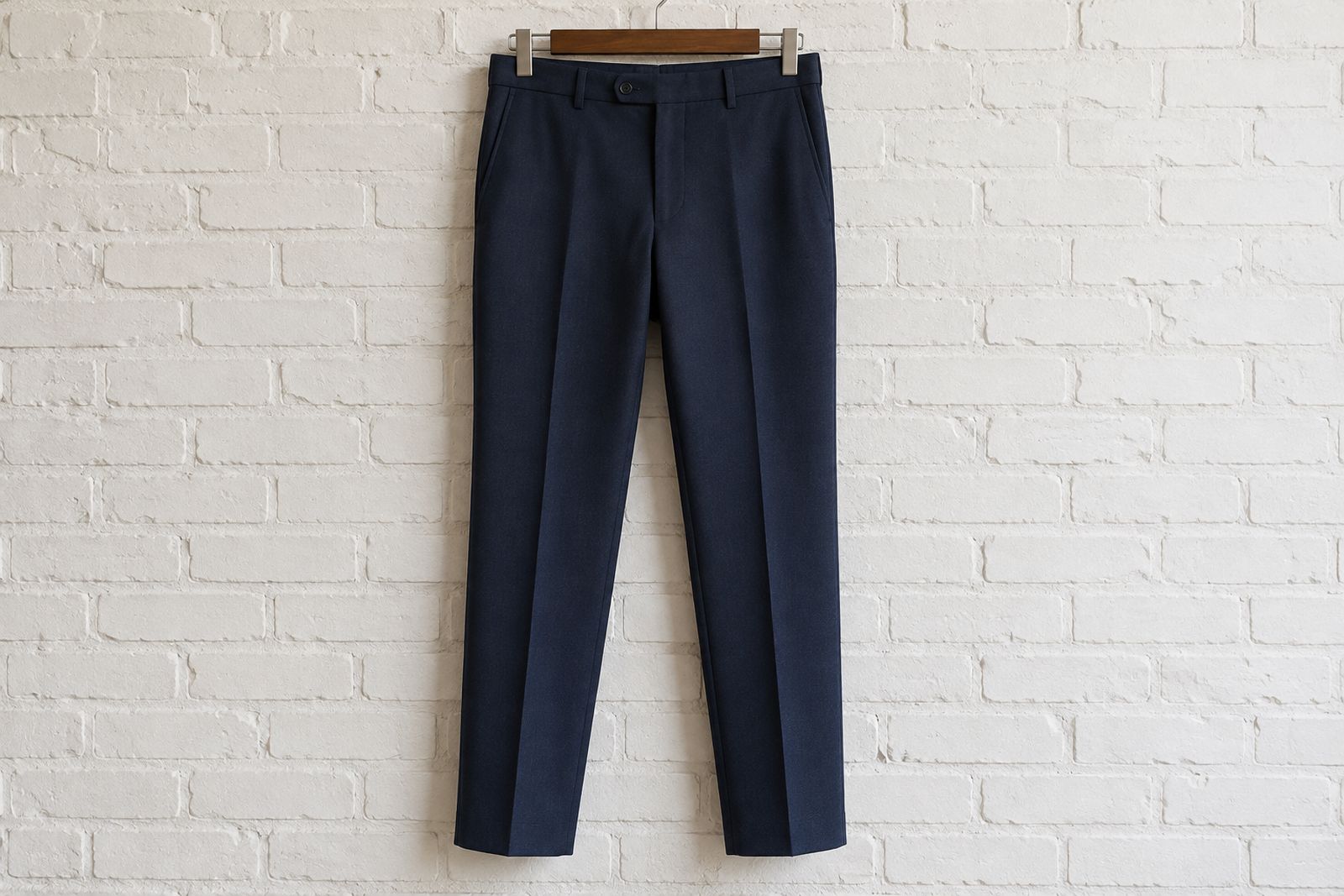
The short answer
Dress pants should sit at the height they were cut for and stay there without a belt, with a waistband that lies flat and leaves room for two fingers. The seat should drape smoothly without pulling or sagging, you should be able to pinch about ½ to 1 inch (1.3 to 2.5 cm) of fabric at the thigh, and the crease should fall straight to the shoe.
- The waistband should lie flat, stay up without a belt and leave room for two fingers
- Pinch about ½ to 1 inch (1.3 to 2.5 cm) of fabric at the side of the thigh
- Horizontal pull lines mean too tight; loose folds that pinch out mean too much fabric
- Sit, stride and climb stairs before you agree to alterations
- Waist, seat and leg width are adjustable within the seam allowance; the rise is hard to change
In this guide
- How should dress pants fit? The short answer
- Where should dress pants sit on the waist?
- How should suit pants fit in the seat?
- Why do my trousers wrinkle under the seat?
- How tight should dress pants be in the thigh and leg?
- How should the rise and crotch fit?
- What your trouser wrinkles mean
- The sitting and walking test
- Fit by build: pleats, flat fronts and cuts
- What a tailor can fix on suit trousers
- Questions people ask
Suit trousers get less attention than the jacket, but they are half of what people see. Knowing how dress pants should fit means checking five places: the waist, the seat, the thigh, the rise and the length. The waist and length are easy to judge in a mirror. The seat, thigh and rise need a back view, a pinch test and a few minutes of sitting and walking, which is where most fitting-room decisions go wrong.
How should dress pants fit? The short answer
Dress pants should sit where they were cut to sit, stay up without a belt and hang in a straight line from the seat to the shoe. They should be close enough to look clean and loose enough to sit, stride and climb stairs without pulling.
Suit trouser fit at a glance
- Waist
- Lies flat, no gap at the back, two fingers slide in, no belt needed
- Seat
- Smooth drape, no pull lines, no sagging folds, back pockets lie flat
- Thigh
- About ½ to 1 inch (1.3 to 2.5 cm) of fabric to pinch at the side
- Rise
- Crotch close to the body without cutting in or hanging low
- Leg
- Crease falls straight to the shoe without twisting
- Length
- The break you chose; the back of the hem clears the floor
Where should dress pants sit on the waist?
Dress pants should sit at the height they were designed for, which depends on their rise. Traditional suit trousers sit at or near the natural waist, around the navel. Many modern ready-to-wear trousers sit lower, at or just above the hip bones. Either can fit; the problems start when trousers cut for one height are worn at another.
Rise
The rise is the distance from the crotch seam to the top of the waistband. A higher rise sits nearer the natural waist; a lower rise sits on the hips.
Suit trousers work best with a mid to high rise, for a practical reason: the jacket's fastened button sits at or just above the navel. Trousers that sit low on the hips leave a triangle of shirt showing below the button and make the jacket look short. Higher trousers close that gap and lengthen the leg line.
Wherever they sit, the waistband should lie flat all the way round. Two fingers should slide inside it without force. The trousers should stay up without a belt; the belt, side adjusters or braces (suspenders) are there to hold them in place, not to cinch them. A gap at the back of the waistband is common in men whose seat is fuller than their waist, and a tailor fixes it by taking in the center back seam.
Belt, side adjusters or braces?
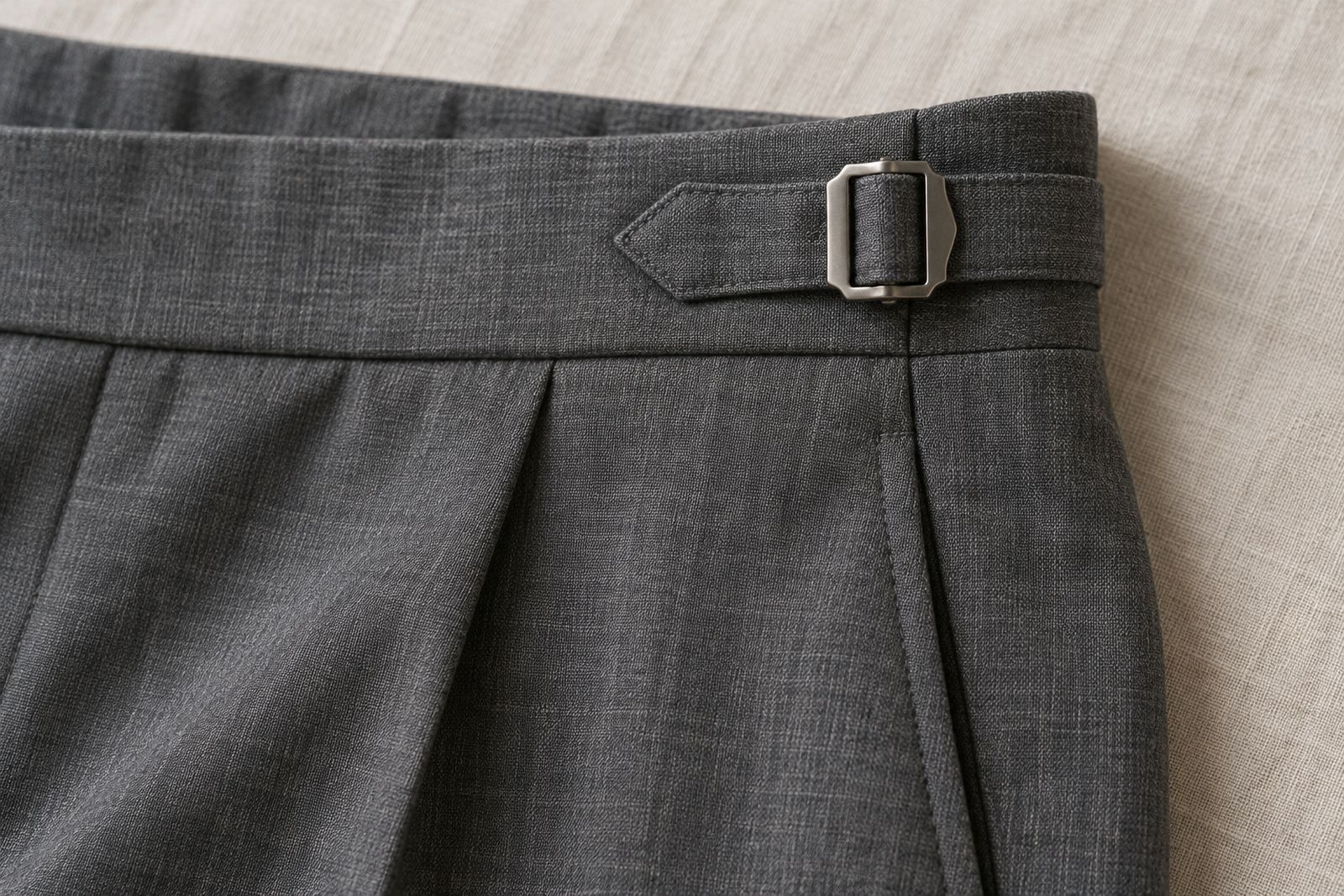
Belt loops are the default on ready-to-wear suit trousers. Side adjusters, small tabs with buckles or buttons at each side of the waistband, let you fine-tune the waist without a belt and give a cleaner line under a jacket. Trousers made for braces (suspenders) usually have buttons inside the waistband, a higher rise and sometimes a raised “fishtail” back. Because braces hold the trousers from the shoulders, they hang straighter, and the waist can be cut with a touch more ease.
How should suit pants fit in the seat?
The seat should follow the curve of your seat smoothly, with no pulling across it and no loose fabric sagging below it. From behind, the fabric should fall in a clean line from the waistband to the back of the thigh, and the back pockets should lie flat rather than gaping open.
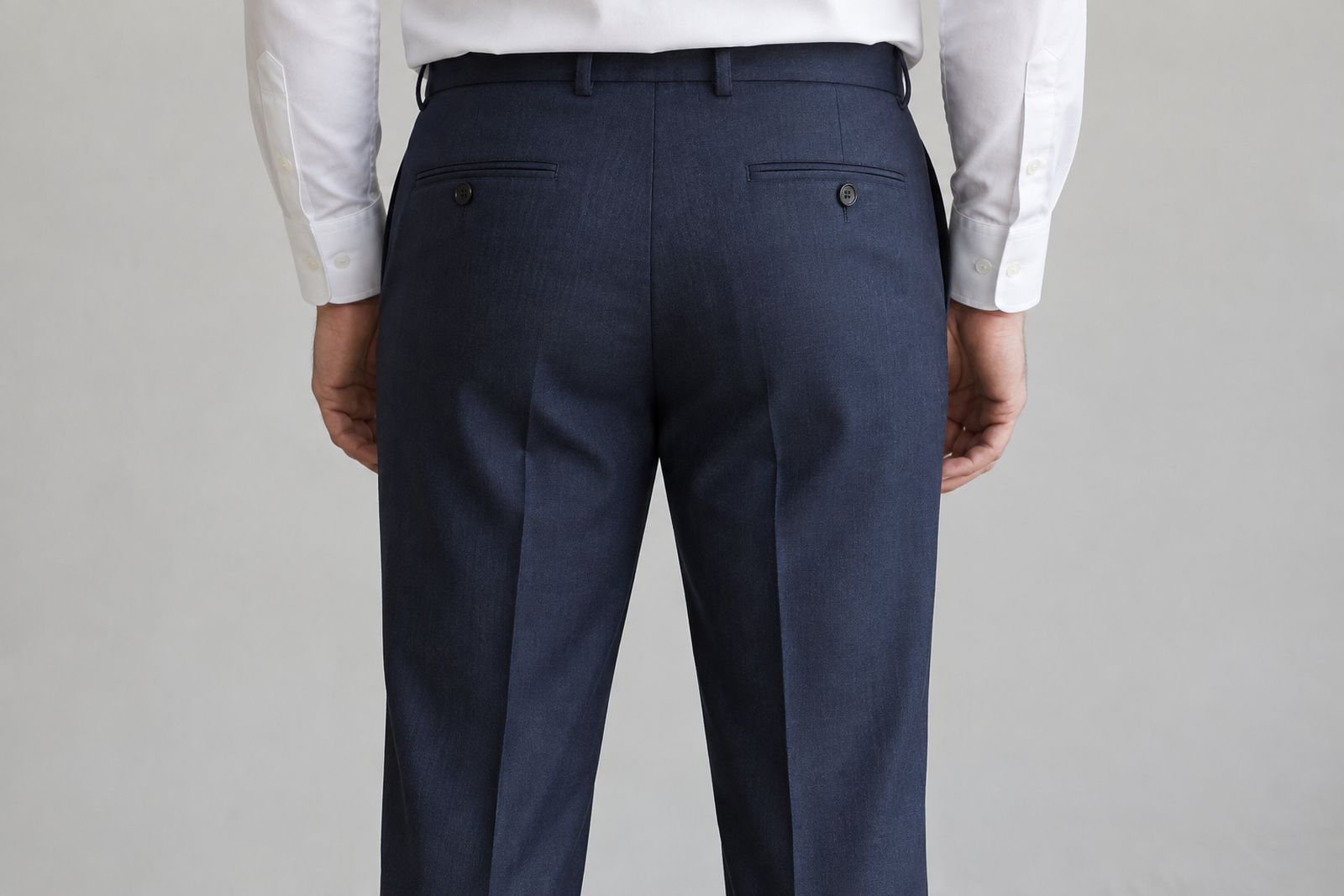
You cannot judge the seat from the front, so use a phone camera or a second mirror. Look for two opposite faults. Horizontal lines stretched across the seat, and back pockets pulled open, mean the seat is too tight. Soft, loose folds under the seat mean there is too much fabric. The seat should be close, but it should never look shrink-wrapped.
Why do my trousers wrinkle under the seat?
Wrinkles under the seat have two common causes, and they need opposite fixes. The quick way to tell them apart: loose folds can be pinched out with your fingers, while tension folds feel taut and get worse when you sit or stride.
- Loose folds that hang below the seat usually mean there is more fabric in the seat than your shape needs, which is common for men with a flatter seat. A tailor takes in the seat at the center back seam and reshapes it.
- Diagonal folds running from the back of the thighs toward the crotch usually mean the seat or back thigh is too tight, or the curve of the crotch seam does not match your shape. Letting out the seat, if there is allowance, or reshaping the crotch curve can help, but it is skilled work.
How tight should dress pants be in the thigh and leg?
Standing, you should be able to pinch about ½ to 1 inch (1.3 to 2.5 cm) of fabric at the side of the thigh. Less than that and the trousers will pull across the thighs when you sit, wear through faster and show every movement. Much more and they look baggy. Below the thigh, the leg should taper gently to the hem, and the front crease should fall straight down to the middle of the shoe.
The width of the leg at the hem, the leg opening, sets the character of the trousers and limits how much break they can carry. Brands usually quote it as the width measured flat across the hem.
Scale from 6 in to 10 in, with cm below. Slim: 6.5 to 7.5 in. Medium: 7.5 to 8.5 in. Full: 8.5 to 9.5 in. A common modern suit trouser: at 8 in.
A crease that twists to one side, instead of running straight down the front, usually means the leg was pressed off center or the leg is cut at an angle that does not suit your stance. Re-pressing the crease solves the first; the second is hard to correct on ready-to-wear trousers.
How should the rise and crotch fit?
The crotch should sit close to your body without cutting in. If it hangs low, the trousers restrict your stride, because the fabric between your legs pulls before your legs have finished moving. If it is too short or too tight, you see pull lines fanning out from the crotch across the front, and the trousers dig in when you sit.
The rise is the hardest part of a pair of trousers to change. A tailor can raise a low crotch a little by taking in the inseam near the top, and can sometimes reshape the crotch curve, but there is no way to add length to a short rise. Choose a rise that suits you in the shop.
What your trouser wrinkles mean
Fabric pulls toward a tight spot and collapses where there is too much of it, so every crease is a clue. Stand naturally, look from the front, side and back, and match what you see to the table.
| What you see | Likely cause | Usual fix |
|---|---|---|
| Horizontal pull lines across the front of the hips; side pockets pulling open | Too tight at the hips | Let out the side seams if there is allowance, or size up |
| Lines fanning out from the crotch across the front | Crotch or thighs too tight, or rise too short | Let out the seat and inseam if possible |
| Horizontal lines across the seat; back pockets gaping | Seat too tight | Let out the center back seam |
| Loose folds under the seat that pinch out easily | Too much fabric in the seat for your shape | Take in and reshape the seat |
| Diagonal folds from the back of the thighs toward the crotch | Seat or back thigh too tight, or crotch curve wrong for you | Let out the seat or reshape the crotch; skilled work |
| Gap at the back of the waistband | Waist larger than the seat shape needs | Take in the center back seam |
| Waistband rolling over at the front | Waist too tight, or rise too low for your stomach | Let out the waist, or choose a higher rise |
| Front pleats pulled open | Too tight across the hips or stomach | Let out, or choose a fuller cut |
| Crotch hanging low; stride feels short | Rise too long | Raise the crotch slightly at the top of the inseam |
| Crease twisting off the front of the leg | Pressed off center, or leg cut does not suit your stance | Re-press first; cut faults are hard to fix |
| Folds stacking above the shoe | Too long for the leg opening | Shorten to less break |
The sitting and walking test
Trousers that look perfect while you stand still can fail the moment you sit. Before you buy, and before you agree to alterations, run through these movements in the fitting room.
Five movements to test trouser fit
- 1
Sit down
Sit on a firm chair with your back straight. The waistband should not dig into your stomach, and the seat and thighs should not feel stretched tight. The hem will rise and show your socks; that is normal.
Tip: If the waist only feels tight sitting, ask for a little more room rather than buying a bigger size.
- 2
Cross your legs
Cross one knee over the other. The fabric should stretch over the knee and thigh without straining at the seams.
- 3
Take a long stride
Step forward as if crossing a wide puddle. If the crotch catches before your stride is finished, the rise is too long or the crotch too low.
- 4
Climb some stairs
Climb a few steps, or lift one foot onto a chair. The thigh and seat should allow it without pulling across the front.
- 5
Bend and pick something up
Crouch to pick something off the floor. The seat seam should not feel stressed and the waistband should not gape at the back.
Fit by build: pleats, flat fronts and cuts
The right trousers depend on where you carry size. Flat-front trousers give the cleanest line on a slim build. Pleats add room at the hips and the top of the thigh, which suits men with strong thighs or a fuller seat and makes sitting more comfortable. Men who carry weight at the stomach are usually more comfortable in a higher rise that sits above it, with braces rather than a belt. The choice is explained in pleated vs flat-front trousers.
| Build | What tends to work |
|---|---|
| Slim | Flat front, mid rise, slim to medium leg |
| Strong thighs or full seat | Single pleats or a fuller cut, medium leg, check the seat in a back view |
| Fuller through the stomach | Higher rise sitting above the stomach, pleats, braces (suspenders) or side adjusters |
| Short | Mid to high rise and a slim to medium leg with little break, to lengthen the leg line |
| Tall | Medium to full leg, which carries more break and balances a long frame |
What a tailor can fix on suit trousers
Suit trousers are among the most forgiving garments to alter, because the center back seam usually has spare fabric for exactly this job. The waist can usually be taken in or let out by about 1 inch (2.5 cm), sometimes more. The seat can be taken in, and let out within the allowance. The legs can be tapered and the hem shortened, or let down if there is fabric turned up inside.
What a tailor cannot do is add fabric that is not there. A short rise cannot be lengthened, a narrow leg cannot be made much wider, and a tight thigh can be let out only as far as the inseam allowance goes. Those are buying decisions. The full list is in what a tailor can and can't alter.
What a good tailor checks
A tailor's trouser fitting
- Where you wear the waistband, and whether you use a belt, side adjusters or braces
- Whether your hips are level: one higher hip makes that leg hang shorter
- The seat from behind, both standing and after you have sat down
- The creases, which should run straight down the front of each leg to the shoe
- Each leg's length, pinned separately
- Your stance: knees or feet that turn in or out change how the leg hangs and where the crease falls
A good tailor will also tell you when an alteration is not worth doing. If the seat needs more room than the seam allowance holds, or the rise is wrong for your body, the honest advice is a different size or cut, not a compromise that pulls the moment you sit.
Once the waist, seat and thigh are right, set the length last: trouser break explained covers the four options and how to pin them. For how the trousers work with the jacket and shirt, read how a suit should fit.
Questions people ask
How tight should dress pants be?
Dress pants should be close but never tight. You should be able to slide two fingers into the waistband, pinch about ½ to 1 inch (1.3 to 2.5 cm) of fabric at the thigh, and sit and climb stairs without the fabric pulling. Horizontal pull lines across the hips, seat or thighs mean they are too tight.
How should suit pants fit in the seat?
The seat should follow your shape smoothly, with no horizontal pull lines across it and no loose folds sagging below it. The back pockets should lie flat rather than gaping. Check from behind with a phone camera or a second mirror.
Why do my trousers wrinkle under the seat?
Usually either too much fabric in the seat, which shows as loose folds you can pinch out, or too much tension, which shows as taut diagonal folds from the back of the thighs toward the crotch. The first is fixed by taking in the seat; the second needs more room. A good tailor will tell them apart before making any change.
Where should dress pants sit on the waist?
Dress pants should sit at the height they were cut for. Traditional suit trousers sit at or near the natural waist, around the navel; many modern ones sit lower, near the hip bones. With a suit, a mid to high rise works best because it closes the gap below the jacket's fastened button.
Should dress pants need a belt to stay up?
No. Well-fitting suit trousers should stay up on their own, with the belt, side adjusters or braces (suspenders) only keeping them in place. If you need to cinch a belt to hold them up, the waist is too large and should be taken in.
Can a tailor make trousers bigger?
A little. The waist and seat can usually be let out by about 1 inch (2.5 cm) using the spare fabric in the center back seam, and the thighs only as far as the inseam allowance allows. A short rise or a narrow leg cannot be made much bigger.
How wide should suit trouser legs be?
Most modern suit trousers have a leg opening of roughly 7 to 8½ inches (18 to 21.5 cm), measured flat across the hem. Slimmer legs, around 7 inches (18 cm), suit little or no break; fuller legs, around 9 inches (23 cm), suit a half or full break. The leg should taper gently from the thigh, not cling to the calf.
TailorGuide is independent. Our guides are written and checked by our team and carry no paid endorsements. How we work.