The short answer
A dress shirt fits when two fingers slide between the buttoned collar and your neck, the shoulder seams sit at your shoulder bones, the body follows your torso without pulling at the buttons or billowing at the waist, the tails stay tucked when you raise your arms, and the cuffs reach the base of your thumbs, showing ¼ to ½ inch (6 to 13 mm) below a jacket sleeve.
- Two fingers should slide between the buttoned collar and your neck
- Shoulder seams sit at your shoulder bones, not up on the shoulder or down the arm
- Buttons lie flat with no gaps; you can pinch a little fabric at the side of the chest
- The tails stay tucked when you raise both arms overhead
- Cuffs reach the base of the thumb and show ¼ to ½ inch (6 to 13 mm) below a jacket
- Body and sleeves can be altered; collar and shoulders cannot
In this guide
- How should a dress shirt fit? The short answer
- How tight should a shirt collar be?
- Where should dress shirt shoulder seams sit?
- How much room should a dress shirt have in the chest and body?
- How long should a dress shirt be? The tuck test
- How long should dress shirt sleeves be?
- How should shirt cuffs fit?
- Slim fit vs classic fit dress shirts
- How should a dress shirt fit under a suit jacket?
- Dress shirt fit by build
- Common shirt fit problems, and what can be fixed
- Questions people ask
A dress shirt sits closer to your body than anything else you wear with a suit, so its fit shows at the collar, at the cuffs and at the waist every time you take your jacket off. Knowing how a dress shirt should fit comes down to six checks, each with a quick physical test you can do in a fitting room: collar, shoulders, chest and body, length, sleeves and cuffs.
How should a dress shirt fit? The short answer
A dress shirt should be close enough to look clean under a jacket and loose enough to move, sit and breathe without pulling. Each fit point has a simple test.
Dress shirt fit at a glance
- Collar
- Two fingers slide inside when buttoned
- Shoulders
- Seam at the shoulder bone
- Chest
- Buttons lie flat; a little fabric to pinch at the side
- Waist
- No billowing over the waistband
- Length
- Stays tucked with arms overhead
- Sleeves
- Cuff reaches the base of the thumb
- Cuffs
- Snug enough not to slide over the hand
- Under a jacket
- ¼ to ½ inch (6 to 13 mm) of cuff shows
How tight should a shirt collar be?
A buttoned shirt collar should leave room for two fingers, laid flat, between the collar and your neck. It should close without pinching, leaving red marks or pushing a fold of skin over the top, and it should not stand away from the neck so far that the tie knot drags it open. The collar is the one part of a shirt that cannot be fixed later, so it decides the size.
The two-finger test: button the collar, look straight ahead and slide two fingers flat between the collar and the side of your neck. If they go in without force, the collar fits. If you can only fit one, it is too tight; if three slide in easily, it is too big.
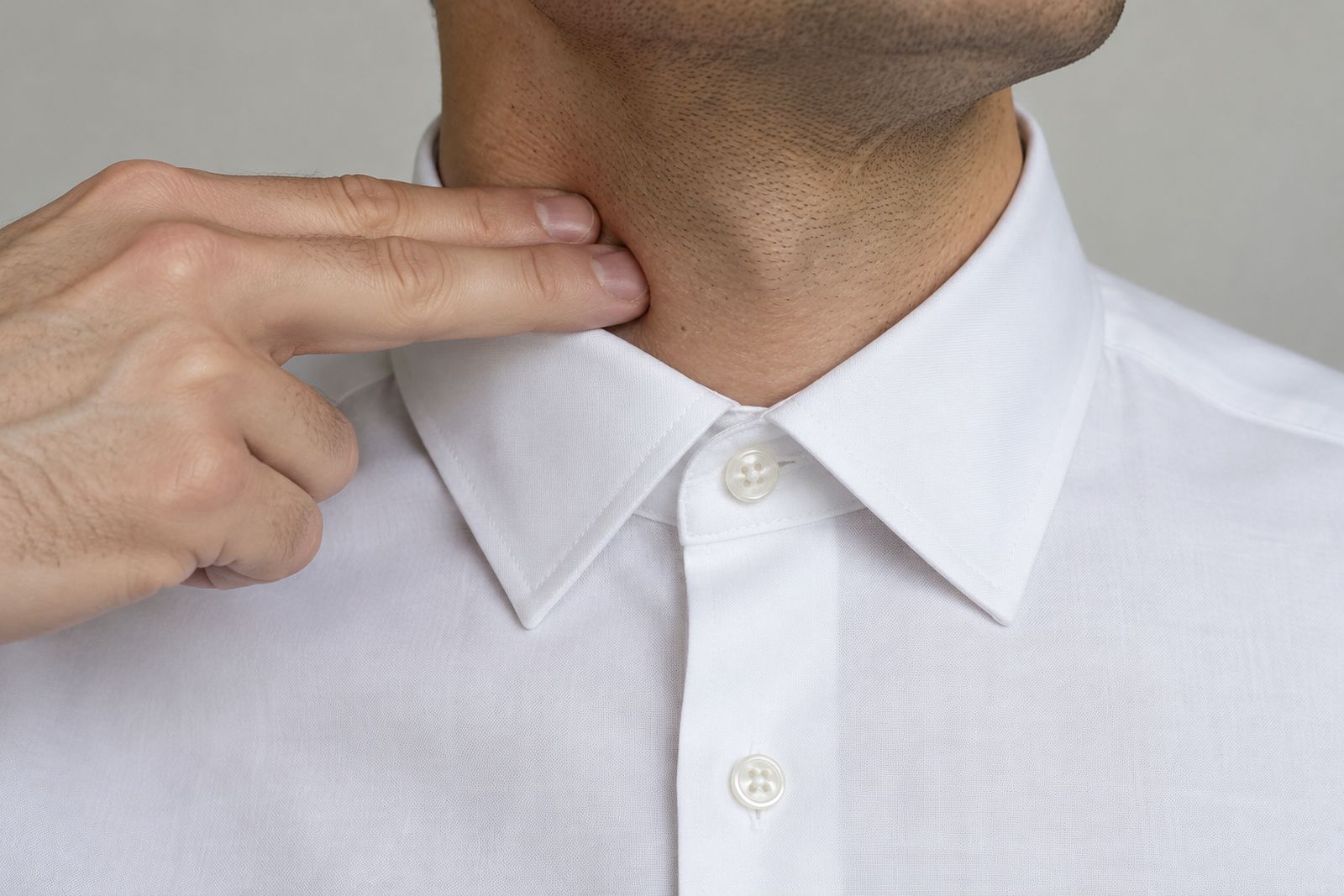
Shirt collar sizes are given in inches or centimeters, measured around the inside of the collar from the center of the button to the far end of the buttonhole. A collar size is usually about ½ inch (1.3 cm) larger than a snug neck measurement, which is what makes room for the two fingers. Measuring is covered in how to measure your shirt size.
Reading a shirt size label
US dress shirts are usually labeled with two numbers: the collar size and the sleeve length, both in inches. A shirt marked 15½ 34/35 has a 15½-inch (39 cm) collar and a sleeve that fits a 34- or 35-inch (86 or 89 cm) arm, measured from the center back of the neck, over the shoulder, to the wrist. European shirts usually give the collar in centimeters, so a 15½-inch collar is roughly a 39 and a 16-inch collar roughly a 40 or 41. Shirts sold only as small, medium and large have no exact collar size, which makes them a poor choice to wear with a tie.
Under a jacket, the collar has a second job: it should stand high enough to show about ½ inch (1.3 cm) above the jacket collar at the back, and its points should tuck under the jacket lapels. Collar height and spread vary by style, which is explained in shirt collar types.
Where should dress shirt shoulder seams sit?
The shoulder seam of a dress shirt should sit at your shoulder bone, the outer edge of the shoulder, or very slightly beyond it. If the seam falls down your upper arm, the shirt is too big and the extra fabric will bunch inside a jacket sleeve. If it sits up on top of the shoulder, the shirt is too small and pulls across the back when you reach forward.
Look at the area between the collar and the armpits as well. Diagonal folds running from the collar down toward the armpits usually mean your shoulders slope more than the shirt was cut for. A ready-to-wear shirt cannot be recut there, but a made-to-measure or bespoke shirtmaker adjusts the shoulder slope as a matter of course.
How much room should a dress shirt have in the chest and body?
A dress shirt should follow your torso with a little room to spare. The buttons should lie flat down the front with no gaps opening between them, and you should be able to pinch about 1 to 2 inches (2.5 to 5 cm) of fabric at the side of the chest. If the placket pulls into small horizontal gaps at the buttons, the shirt is too tight; if fabric balloons out at your sides, it is too big.
- The hug test: cross your arms and reach forward as if hugging someone. The shirt should feel some tension across the back without the buttons straining or the seams pulling.
- The sitting test: sit down. The buttons over your stomach should not gape open.
- The waist test: tucked in, the shirt should not billow over your waistband in a ring of loose fabric. A small amount of blousing is normal and lets you move; a balloon is not.
The back controls much of the body fit. Darts (two vertical seams in the back) take out fabric at the waist for a closer shape. A box pleat or side pleats below the yoke add room across the shoulder blades for movement. Neither is better; they suit different builds and fits.
How long should a dress shirt be? The tuck test
A dress shirt should be long enough to stay tucked in when you raise your arms, bend and sit. Dress shirts are cut longer than casual shirts, with curved tails at the front and back, so they can be tucked well into the trousers. A shirt that pulls out every time you reach for something is too short, and there is no way to lengthen it.
The tuck test
- 1
Tuck it in properly
Tuck the shirt in fully and fasten your trousers at the height you normally wear them.
- 2
Raise both arms overhead
Lift both arms straight up as far as they go. The shirt should stay tucked in at the front, sides and back.
- 3
Reach forward and bend
Reach forward at shoulder height, then bend as if to touch your knees. The tails should still be in the waistband.
- 4
Sit down
Sit on a chair and lean back. If the shirt has pulled out anywhere, it is too short for you.
Tip: A shirt that pulls out only at the back may be short in the back length, which is common for tall men; look for long or tall sizes.
How long should dress shirt sleeves be?
With your arms relaxed, a dress shirt cuff should reach about the base of your thumb, covering the wrist bone. When you stretch your arms straight out in front of you, the cuff should still reach your wrist. Under a suit jacket, that length leaves about ¼ to ½ inch (6 to 13 mm) of cuff showing below the jacket sleeve.
Sleeve width matters too. You should be able to pinch about 1 inch (2.5 cm) of fabric at the upper arm. Much more and the sleeve bunches inside a jacket; less and it binds when you bend your elbow. The armholes should be high enough that lifting your arm does not drag the whole shirt up. How shirt and jacket sleeves work together is covered in suit sleeve length.
How should shirt cuffs fit?
A buttoned cuff should be snug enough that it does not slide down over your hand, but loose enough to turn freely on your wrist. That snugness is what keeps the cuff in place at the wrist and stops it disappearing up your jacket sleeve. Leave a little more room on the cuff that goes over your watch; many cuffs have two buttons side by side so you can adjust it.
French cuffs (double cuffs) fold back on themselves and are fastened with cufflinks, so they are thicker and usually sit a little looser than barrel cuffs. They are worn with suits and are the traditional choice with black tie. If you wear them, check your jacket sleeves with them, because the extra bulk can change how much cuff shows.
Slim fit vs classic fit dress shirts
Shirt fit labels work like suit fit labels: they describe how much room a brand builds into the body and sleeves, and there is no shared standard. Within one brand, extra slim is closest, classic is roomiest and slim sits between. Collar sizes and sleeve lengths usually stay the same across the fits.
| Fit label | Chest room over body chest | Body and sleeves | Best for |
|---|---|---|---|
| Extra slim | About 2 to 3 inches (5 to 8 cm) | Strongly tapered waist, narrow sleeves, high armholes | Very slender builds |
| Slim | About 3 to 5 inches (8 to 13 cm) | Tapered waist, slimmer sleeves | Slim to average builds |
| Classic (or regular) | About 6 to 8 inches (15 to 20 cm) | Straight body, fuller sleeves, lower armholes | Larger builds, or anyone who wants more room |
Typical ranges only. Each brand sets its own patterns, so compare garment measurements, especially chest and waist.
Choose the fit that passes the pinch, hug and sitting tests without billowing at the waist. If you wear a shirt mainly under a jacket, err toward the closer fit, because extra fabric bunches at the waist and sleeves. The same logic for suits is set out in slim vs tailored vs classic fit.
How should a dress shirt fit under a suit jacket?
Under a jacket, a dress shirt should fit a little closer than one worn on its own. Loose fabric at the waist pushes the jacket's front out of shape at the button, and full sleeves crowd the jacket sleeve. The collar should stand about ½ inch (1.3 cm) above the jacket collar at the back, and the cuff should show ¼ to ½ inch (6 to 13 mm) below the jacket sleeve, so the shirt frames the jacket at both ends.
Shirt checks with your jacket on
- Collar shows about ½ inch (1.3 cm) above the jacket collar at the back
- Collar points sit under the jacket lapels, not on top of them
- Tie knot fills the space between the collar points without forcing them apart
- No bunched shirt fabric showing at the jacket's fastened button
- Cuffs show ¼ to ½ inch (6 to 13 mm) below the jacket sleeves, evenly on both sides
- No shirt fabric bunching inside the jacket sleeves when you bend your arms
Dress shirt fit by build
The tests are the same for everyone; what changes is which fit and size passes them. Start from the collar, then use this as a guide to the body.
| Build | What to look for |
|---|---|
| Slender | Slim or extra slim fits, so the body does not billow. Check the sleeves are not too wide. |
| Athletic, broad chest and arms | A fit with room in the chest, back and upper arm; a box pleat or side pleats help movement. Take in the waist if it billows. |
| Fuller through the middle | Classic fits, or slim fits that pass the sitting test without gaps between the buttons. A slightly longer body stays tucked more reliably. |
| Tall | Long or tall sizes for sleeve and body length, so the shirt stays tucked and the cuffs reach the thumb. |
| Long arms, average body | Look for shirts sold by exact sleeve length rather than a two-length range such as 34/35. |
Common shirt fit problems, and what can be fixed
Shirts are less forgiving than suits. A tailor can take in the body and shorten the sleeves, but the collar, shoulders and length are fixed when the shirt is cut. Buy for the collar and shoulders, then alter the rest if the shirt is worth it.
| Problem | Likely cause | Fixable? |
|---|---|---|
| Collar too tight | Collar size too small, or shrinkage | Barely: moving the collar button gains a fraction; buy a larger collar |
| Collar too loose | Collar size too big | Not practically; buy a smaller collar |
| Gaps between buttons | Chest or stomach too tight | No; size up or choose a fuller fit |
| Fabric billowing at the waist | Body too full for your build | Yes: take in the side seams or add back darts |
| Shoulder seam down the arm | Shoulders too wide | Not practically |
| Sleeves too long | Sleeve length too long | Yes: shortened by removing and resetting the cuff |
| Sleeves too short | Sleeve length too short | No |
| Sleeves too wide | Full cut | Yes: taper the sleeve seam |
| Shirt pulls out of trousers | Body too short | No; buy longer or tall sizes |
Start with the collar: if it passes the two-finger test, check the shoulders, then run the pinch, tuck and sleeve tests. A shirt that passes all six will make any jacket look better. For the rest of the outfit, from jacket collar to trouser hem, read how a suit should fit.
Questions people ask
How tight should a shirt collar be?
A buttoned shirt collar should leave room for two fingers, laid flat, between the collar and your neck. It should not pinch or leave red marks, and it should not stand away from your neck. If you can fit three fingers, the collar is too big.
Where should dress shirt shoulder seams sit?
The shoulder seams should sit at your shoulder bones, the outer edge of each shoulder, or very slightly beyond. A seam that falls down your arm means the shirt is too big; one that sits up on the shoulder means it is too small. The shoulders cannot be altered, so choose a size whose shoulders fit.
How much room should a dress shirt have?
You should be able to pinch about 1 to 2 inches (2.5 to 5 cm) of fabric at the side of the chest, and the buttons should lie flat without gaps. When you sit or reach forward, nothing should strain. At the waist, the shirt should not billow over your trousers.
What is the difference between slim fit and classic fit dress shirts?
A slim fit shirt has less room in the chest and waist, slimmer sleeves and higher armholes. A classic fit is cut straighter and fuller, typically with about 6 to 8 inches (15 to 20 cm) of room over your chest. There is no industry standard, so compare each brand's measurements.
How long should a dress shirt be?
A dress shirt should be long enough to stay tucked in when you raise both arms overhead, bend and sit. If it pulls out of your trousers during those movements, it is too short. Tall men often need long or tall sizes.
How long should dress shirt sleeves be?
With your arms relaxed, the cuff should reach about the base of your thumb, covering the wrist bone. When you reach forward, the cuff should still reach your wrist. Under a jacket, this leaves ¼ to ½ inch (6 to 13 mm) of cuff showing.
Can a tailor alter a dress shirt?
Partly. A tailor can take in the body at the side seams, add back darts, taper the sleeves and shorten them by resetting the cuffs. The collar, shoulders and overall length cannot realistically be changed, so buy for those.
TailorGuide is independent. Our guides are written and checked by our team and carry no paid endorsements. How we work.