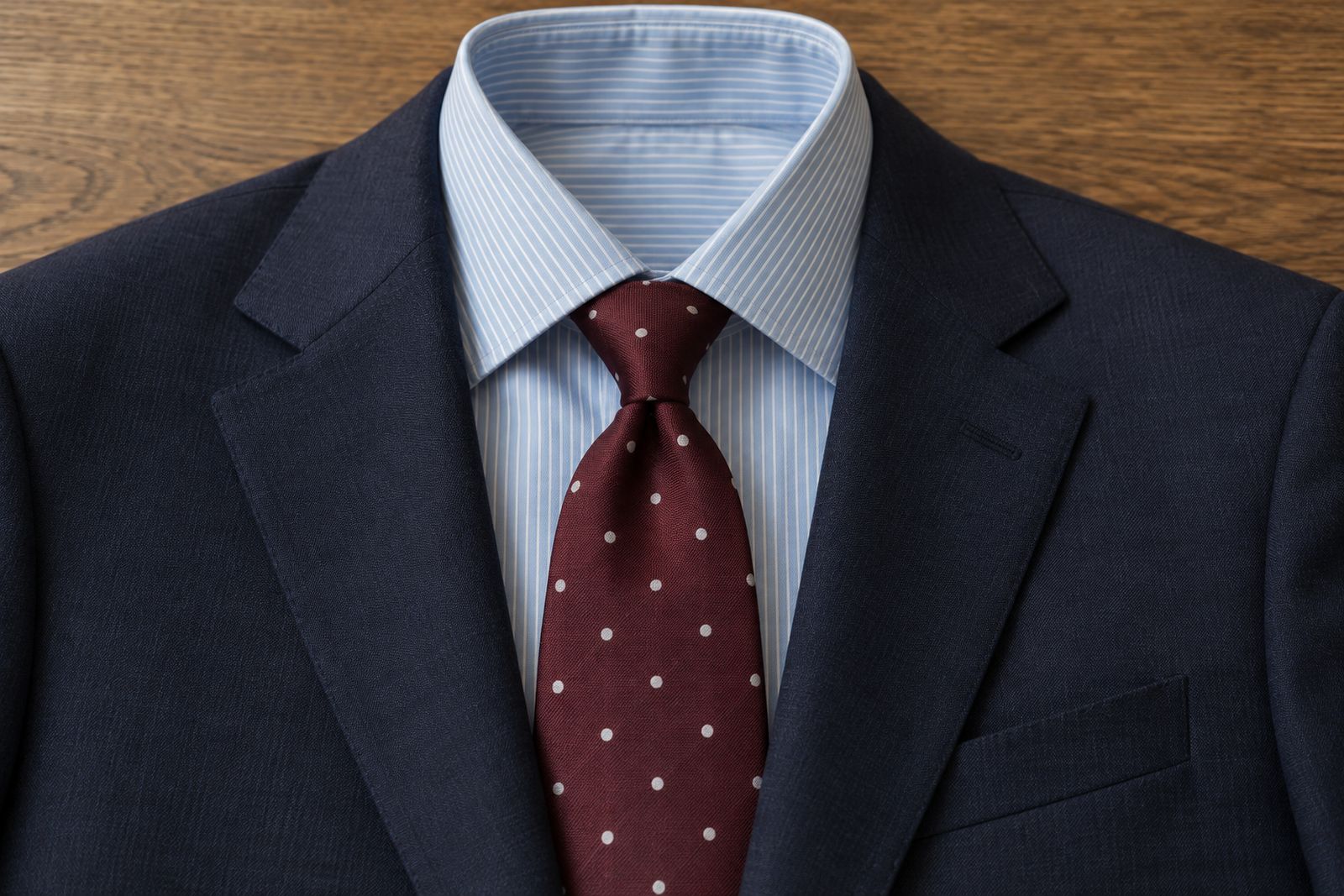
The short answer
To match a tie with a shirt, make the tie darker than the shirt and different in color from the suit, and if you can, repeat a color from the shirt or suit in the tie. With patterns, vary the scale: a fine-striped shirt takes a solid tie or a larger pattern. A white or light blue shirt goes with almost any tie.
- The tie should be darker than the shirt and clearly different from the suit.
- White and light blue shirts go with almost every tie; start your wardrobe there.
- With two patterns, vary the scale and the type: fine stripes with dots, small checks with bold stripes.
- Navy and gray suits take burgundy, silver, green, brown and navy ties with ease.
- Never match the pocket square exactly to the tie.
- Darker colors and smaller patterns read as more formal.
In this guide
- The three rules: contrast, color and pattern scale
- Five combinations that always work
- What color tie goes with a navy suit?
- What tie goes with a charcoal or gray suit?
- What tie goes with a brown, tan or blue suit?
- What tie goes with a white shirt?
- Should your tie be darker than your shirt?
- Can you wear a patterned tie with a patterned shirt?
- Combinations to avoid
- Matching by formality and season
- Building a tie wardrobe: the first five ties
- Where the pocket square fits
- The tailor's view
- Questions people ask
Learning how to match a tie with a shirt and suit comes down to three rules: contrast, color and pattern scale. Get those right and the combinations follow. Most men need only two suit colors, navy and gray, two shirt colors, white and light blue, and a handful of ties to dress correctly for almost any occasion.
The rules at a glance
- Contrast
- Tie darker than the shirt, different from the suit
- Color
- Repeat one color from the shirt or suit in the tie
- Pattern
- Vary the scale and type of every pattern you wear
- Safest shirts
- White and light blue
- Safest suits
- Navy and charcoal
- Formality
- Darker, smaller and smoother reads more formal
The three rules: contrast, color and pattern scale
1. Contrast: darker than the shirt, different from the suit
The tie sits between the shirt and the suit, and it should separate from both. In practice that means a tie darker than the shirt, so it reads as a clear stripe down the front, and a tie that differs from the suit in color, shade or texture. A light blue tie on a light blue shirt disappears; a charcoal tie on a charcoal suit looks like part of the jacket.
2. Color: borrow from what is already there
The easiest way to make a tie look chosen is to repeat a color already in the outfit. A navy tie picks up a navy stripe in a shirt; a tie with a small blue dot ties back to a light blue shirt. When there is nothing to borrow, choose colors that sit well with the suit: burgundy, navy, green, brown and silver work with both navy and gray.
3. Pattern: vary the scale
Two patterns of the same size fight each other. Two of different sizes coexist. A shirt with a fine stripe needs a tie that is solid or carries a clearly larger pattern; a shirt with a bold stripe needs a solid or a small, quiet pattern. Changing the type of pattern helps too: stripes with dots, checks with stripes.
Five combinations that always work
These five cover interviews, offices, weddings and most evenings. If you own nothing else, own these.
Classic
Navy, white, burgundy
The most versatile combination there is.
Navy
Suit
White
Shirt
Burgundy
Tie
Dark brown
Shoes
Classic
Charcoal, white, silver
Formal and quiet; right for weddings and ceremonies.
Charcoal
Suit
White
Shirt
Silver-gray
Tie
Black
Shoes
Classic
Navy, light blue, navy grenadine
Tonal, so the tie needs texture, such as grenadine or knit, to separate from the suit.
Navy
Suit
Light blue
Shirt
Dark navy
Tie
Black
Shoes
Classic
Mid-gray, light blue, navy
Relaxed but correct for any office.
Mid-gray
Suit
Light blue
Shirt
Navy
Tie
Dark brown
Shoes
Classic
Charcoal, light blue, burgundy
Strong contrast, ideal for interviews.
Charcoal
Suit
Light blue
Shirt
Burgundy
Tie
Black
Shoes
What color tie goes with a navy suit?
Almost any color except navy in the exact shade of the suit. Burgundy, red, silver-gray, bottle green, brown, rust and gold all work, as does a darker navy in a textured silk. Navy suits are the most forgiving background for ties, which is one reason navy is the usual advice for a first suit. Our guide to navy suit combinations goes further.
| Shirt | Ties that work | Use with care |
|---|---|---|
| White | Burgundy, silver-gray, navy, green, red, black for funerals | Very pale ties, which wash out |
| Light blue | Navy, burgundy, brown, green, rust, gold | Light blue in the same shade as the shirt |
| Pink | Navy, burgundy, gray, green | Bright red, which can fight the pink |
| Lavender | Purple, navy, silver-gray | Brown, which looks muddy against it |
| Fine blue stripe | Solid navy or burgundy, larger dots, paisley | Fine stripes of the same width |
What tie goes with a charcoal or gray suit?
Charcoal is the more formal gray and suits darker, richer ties: burgundy, navy, silver, deep green and purple. Mid and light gray suits are more relaxed and take a wider range, including brown, rust and lighter blues, as long as the tie stays darker than the shirt. Black ties with charcoal suits are best kept for funerals. See our guide to gray suit combinations for more.
Works
Navy, light blue, bottle green
A fresh alternative to burgundy; good with brown shoes.
Navy
Suit
Light blue
Shirt
Bottle green
Tie
Dark brown
Shoes
Works
Navy, pink, navy
The navy tie anchors the pink shirt.
Navy
Suit
Pink
Shirt
Navy
Tie
Black
Shoes
Works
Charcoal, lavender, purple
Tonal and formal enough for evenings.
Charcoal
Suit
Lavender
Shirt
Deep purple
Tie
Black
Shoes
Works
Light gray, white, bottle green
A daytime and summer combination.
Light gray
Suit
White
Shirt
Bottle green
Tie
Tan
Shoes
Bold
Navy, white, rust
Warm and lively; better at a wedding than a board meeting.
Navy
Suit
White
Shirt
Rust
Tie
Dark brown
Shoes
Bold
Mid-gray, light blue, gold
Bright; keep everything else quiet.
Mid-gray
Suit
Light blue
Shirt
Gold
Tie
Dark brown
Shoes
What tie goes with a brown, tan or blue suit?
Warmer suits want warmer ties. A brown suit sits well with bottle green, rust, burgundy and navy ties, and with knitted or wool textures in autumn and winter. A tan or stone suit, usually a summer suit in cotton or linen, suits navy, brown, green and burgundy ties and looks best with white or light blue shirts. A brighter mid-blue suit behaves like navy but reads less formal, so it takes the same ties with a little more color. In each case the three rules still hold: darker than the shirt, distinct from the suit, patterns at different scales.
What tie goes with a white shirt?
Nearly any tie. A white shirt is the most versatile background there is, because every tie is darker than it and nothing clashes. For formal occasions, choose dark, quiet ties: navy, burgundy, silver-gray for weddings and black for funerals. For everyday wear, anything from green to rust works. Pale ties are the only ones that struggle, because they lack contrast against white.
Should your tie be darker than your shirt?
Yes, in almost every case. A tie darker than the shirt reads as a clean line down the front and looks deliberate. A tie lighter than the shirt, such as a white tie on a black shirt, reverses the usual contrast and reads as a costume or a fashion statement rather than tailoring. The exception is casual: a mid-blue chambray or denim shirt can take a slightly lighter knitted or wool tie, but never in a business setting.
Can you wear a patterned tie with a patterned shirt?
Yes, if the patterns differ in scale and ideally in type. A fine pencil stripe shirt goes well with a tie in a larger dot, a paisley or a bold stripe. A bold Bengal stripe shirt wants a solid tie or a small, quiet pattern. Avoid stripes of the same width on shirt and tie; at a distance they blur together. With three patterns, suit, shirt and tie, make them small, medium and large, or keep one of them plain.
| Shirt | Ties that work | Avoid |
|---|---|---|
| Solid white or light blue | Any pattern or solid | Nothing in particular |
| Fine stripe (pencil or hairline) | Solids, larger dots, paisley, bold stripes | Fine stripes of the same width |
| Bold stripe (Bengal) | Solids, textured solids, small dots | Bold stripes |
| Small check or gingham | Solids, knits, broader stripes | Small checks |
| Large check (tattersall) | Solid wool or knitted ties | Busy prints |
Combinations to avoid
Avoid
Black on black on black
No contrast at all; reads as a uniform or a nightclub, not tailoring.
Black
Suit
Black
Shirt
Black
Tie
Avoid
Tie the same shade as the shirt
The tie disappears into the shirt.
Light gray
Suit
Light blue
Shirt
Light blue
Tie
Avoid
Light tie on a dark shirt
Reverses the contrast and looks like a costume.
Navy
Suit
Black
Shirt
White
Tie
Avoid
Tie and square in the same color
A matching set looks bought together; let the square pick up a secondary color instead.
Navy
Suit
White
Shirt
Burgundy
Tie
Burgundy
Pocket square
Matching by formality and season
Color and pattern also set the formality. Darker colors, smaller patterns and smooth silk read as more formal; lighter colors, larger patterns and textured fabrics such as wool, cashmere and knit read as more relaxed. For an interview or funeral, choose a dark solid or small pattern. For a summer wedding, lighter colors and linen or cotton ties fit the season. In winter, wool and cashmere ties suit flannel and tweed suits.
| Setting | Tie colors | Tie fabrics and patterns |
|---|---|---|
| Interview or court | Navy, burgundy, dark green | Smooth silk, solids or small neat patterns |
| Office | Most colors | Silk, grenadine, knit on relaxed days |
| Wedding guest | Silver, blue, green, warm colors in daytime | Silk; linen or cotton in summer |
| Funeral | Black, navy or charcoal | Plain silk, no bright pattern |
| Autumn and winter | Browns, greens, burgundy, rust | Wool, cashmere, knit |
Building a tie wardrobe: the first five ties
Five ties, chosen with the rules above, cover nearly every combination of navy or gray suit with white or light blue shirt. Buy them in standard widths that suit your lapels, and add color and pattern only once these are in place.
- 1.Navy grenadine or textured silk. Works with every suit and shirt here and is formal enough for anything short of black tie.
- 2.Burgundy silk, solid or with a small pattern. The most dependable color for interviews and offices.
- 3.Silver-gray silk. For weddings, ceremonies and formal daytime events.
- 4.Navy with a small white or light blue dot. A quiet pattern that pairs with striped and checked shirts.
- 5.Green or brown knit or wool. The relaxed option for odd jackets, flannel suits and days without meetings.
Where the pocket square fits
A pocket square should complement the tie, not copy it. A plain white linen square goes with everything and is the safe default. A patterned or colored square should pick up a secondary color from the tie or shirt, never repeat the tie's main color in the same fabric. Our guide to folding a pocket square shows the folds.
The tailor's view
A good tailor treats the suit as the background and the shirt and tie as the parts that change. That is why the usual advice is a first suit in navy or charcoal: both take almost any tie. When you choose a fabric from a swatch book, bring the shirts and ties you wear most and hold them against the swatch, ideally by a window. Shop lighting changes colors, and a tie that matched under spotlights can look wrong in daylight.
For more on building the wardrobe behind these combinations, see our guide to suit, shirt and tie color combinations. And once the tie is chosen, tie it properly with our hub on how to tie a tie.
Questions people ask
What color tie goes with a navy suit?
Burgundy, silver-gray, bottle green, brown, rust, gold and darker navy in a textured silk all work with a navy suit. Avoid a tie in exactly the suit's shade and texture, which merges into the jacket. With a white or light blue shirt, burgundy is the most dependable choice.
Can you wear a patterned tie with a patterned shirt?
Yes, if the patterns differ in scale and ideally in type. Pair a fine-striped shirt with a larger dot or paisley tie, or a bold stripe shirt with a solid or small-patterned tie. Avoid stripes of the same width on both.
What tie goes with a white shirt?
Almost any tie, because every tie is darker than white. For formal occasions choose navy, burgundy or silver-gray, and black for funerals. Very pale ties are the only ones that struggle, because they lack contrast.
Should your tie be darker than your shirt?
Yes, in almost every case. A tie darker than the shirt reads as a clean line and looks deliberate. A lighter tie on a darker shirt reverses the contrast and looks like a costume, outside a few casual combinations.
Should your tie match your suit?
It should coordinate, not match. The tie needs to differ from the suit in color, shade or texture so it does not blend into the jacket. A navy tie with a navy suit works only if it is clearly darker or textured.
Should your tie match your pocket square?
No. A pocket square in the same color and fabric as the tie looks like a set bought together. Choose a white linen square, or one that picks up a secondary color from the tie or shirt.
What is the safest tie color?
Navy and burgundy are the safest, because they work with navy, gray and charcoal suits and with white, light blue and pink shirts. A navy or burgundy tie in plain silk or a small pattern suits interviews, offices and weddings alike.
TailorGuide is independent. Our guides are written and checked by our team and carry no paid endorsements. How we work.