The short answer
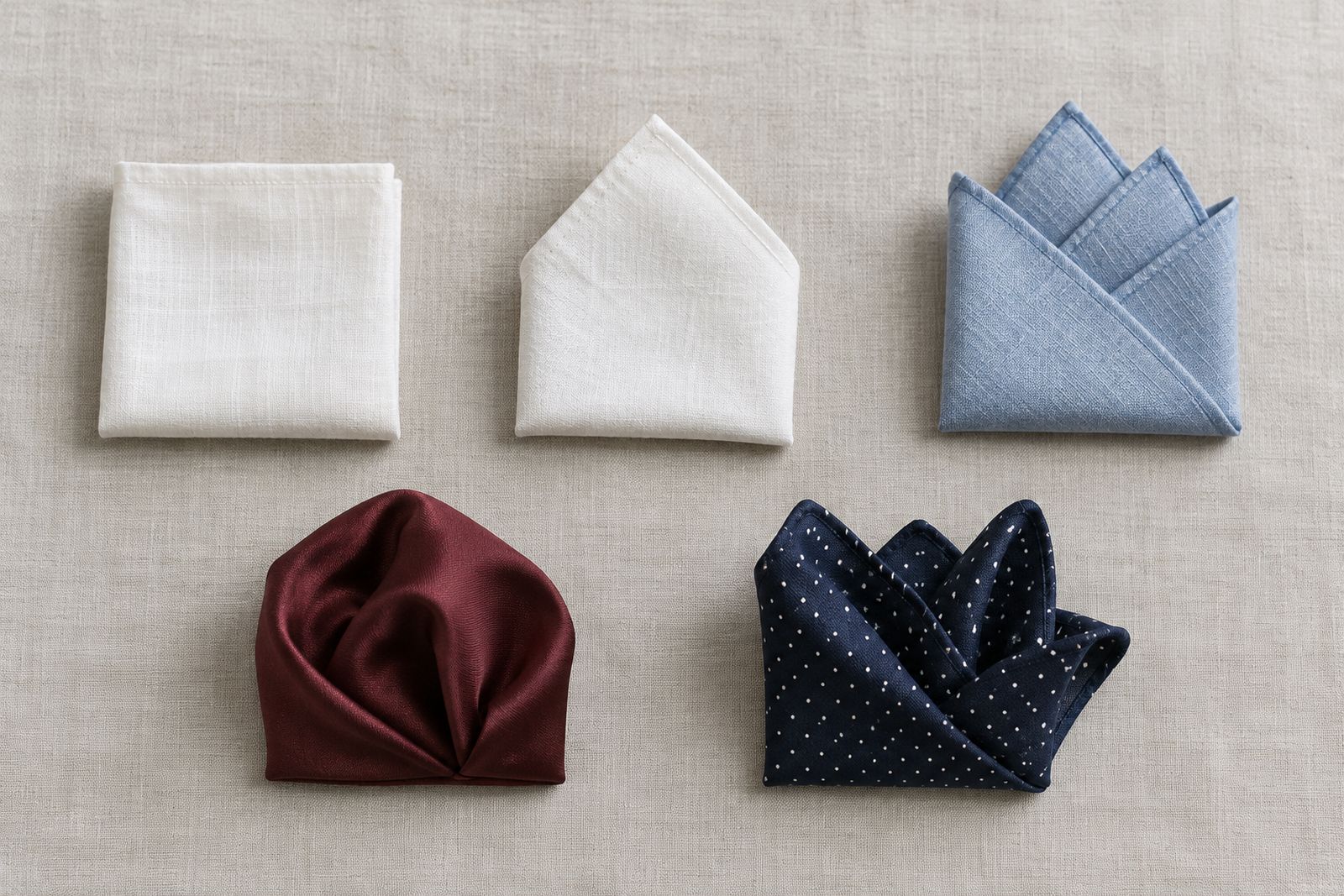
The easiest way to fold a pocket square is the presidential (flat) fold: fold the square in half, fold the sides in to the width of your pocket, and slide it in so a straight edge shows about ¼ to ½ inch (6 to 13 mm). For more flair, use a one-point, two-point or three-point fold in linen, or a puff fold in silk.
- Presidential fold: the easiest and most formal; a straight edge ¼ to ½ inch (6 to 13 mm) above the pocket.
- Linen and cotton hold crisp folds; silk suits puffs.
- Fold every square slightly narrower than your pocket opening so it sits flat.
- Complement the tie with the square; never match it exactly.
- A white linen square in a presidential fold works with every suit.
In this guide
- Before you fold: press, size and check the pocket
- How to do the presidential (TV) fold
- How to do a one-point fold
- How to do a two-point fold
- How to do a three-point fold
- How to do a puff fold
- How to do a reverse puff fold
- Which fold suits which fabric?
- Which fold should you wear for each occasion?
- Should a pocket square match your tie?
- Common pocket square mistakes
- The tailor's view: look after the breast pocket
- Questions people ask
Learning how to fold a pocket square takes a few minutes, and the right fold finishes a suit for almost no effort. The trick is to match the fold to the fabric and the occasion: crisp linen for flat and pointed folds, soft silk for puffs. Below are exact steps for six folds, from the simplest to the most decorative, followed by how to choose a fabric and how to pair a square with your tie.
Pocket squares at a glance
- Easiest fold
- Presidential (also called the TV or flat fold)
- Most formal
- Presidential fold in white linen
- Most relaxed
- Puff fold in silk
- Most useful fabric
- White linen
- How much shows
- ¼ to ½ inch (6 to 13 mm) for a flat fold; about 1 to 1½ inches (2.5 to 4 cm) for points and puffs
- Typical size
- About 12 to 17 inches (30 to 43 cm) square
Before you fold: press, size and check the pocket
Press linen and cotton squares before folding, because creases show on a flat fold. Silk needs no pressing for a puff. Check your breast pocket too: many new jackets have a loose basting thread holding the pocket closed, which you can snip and pull out. Finally, note the width of your pocket opening, because every fold below ends by making the square slightly narrower than that.
Most pocket squares measure between about 12 and 17 inches (30 and 43 cm) square. A larger square gives a fuller puff and stays anchored in the pocket; a smaller one suits flat folds in a shallow pocket. If a square is too large for a crisp fold, fold the bottom up an extra time.
How to do the presidential (TV) fold
The presidential fold, also called the TV fold or square fold, shows a single straight edge above the pocket. It is the easiest and most formal fold, right for business, interviews, funerals and black tie, and it works best in crisp white linen or cotton.
Presidential fold
- 1
Lay it flat
Lay the square face down on a flat surface and smooth it out.
- 2
Fold in half
Fold the bottom edge up to meet the top edge. You now have a wide rectangle with the folded edge at the bottom.
- 3
Fold to pocket width
Fold the left and right sides in toward the center, overlapping, until the rectangle is slightly narrower than your pocket opening.
- 4
Turn the folded edge to the top
Turn the square upside down so the clean folded edge is at the top and the overlapping layers face your chest.
- 5
Insert and adjust
Slide it into the breast pocket. If too much shows, take it out and fold the bottom up. Aim for a straight edge about ¼ to ½ inch (6 to 13 mm) above the pocket, parallel to the pocket's top.
Tip: A crooked edge spoils this fold more than any other. Check it in a mirror and straighten it with a fingertip.
How to do a one-point fold
The one-point fold, sometimes called the triangle fold, shows a single upright point. It is a little dressier than the presidential and suits business, weddings and evening events. It needs a crisp fabric: linen or cotton.
One-point fold
- 1
Lay it as a diamond
Lay the square face down with one corner pointing away from you, like a diamond.
- 2
Fold into a triangle
Fold the bottom corner up to meet the top corner exactly, forming a triangle with its point at the top.
- 3
Fold the left side in
Fold the left corner across toward the center.
- 4
Fold the right side in
Fold the right corner across over it, so the width is slightly narrower than your pocket opening.
- 5
Set the height and insert
Fold the bottom up so that, inside the pocket, about 1 to 1½ inches (2.5 to 4 cm) of point shows. Insert it point up, upright or tilted slightly toward your shoulder.
Tip: If the point flops, the fabric is too soft for this fold. Switch to linen or press the edges.
How to do a two-point fold
The two-point fold shows two peaks side by side. It is slightly more decorative than the one-point and suits weddings, social events and relaxed business wear. Use linen or cotton.
Two-point fold
- 1
Lay it as a diamond
Lay the square face down with one corner pointing away from you.
- 2
Offset the first fold
Fold the bottom corner up, but place its tip about ½ inch (1.3 cm) to the right of the top corner. You now have two points side by side.
Tip: Too small an offset and the two points merge into one; too large and the square looks lopsided.
- 3
Fold the sides behind
Fold the left and right corners behind the square until it is slightly narrower than your pocket opening.
- 4
Set the height and insert
Fold the bottom up so both points show above the pocket, then insert with the points angled slightly toward your shoulder.
How to do a three-point fold
The three-point fold shows three stepped peaks. It is the most decorative of the pointed folds and suits weddings, parties and social occasions rather than business. It needs a crisp linen or cotton square.
Three-point fold
- 1
Lay it as a diamond
Lay the square face down with one corner pointing away from you.
- 2
Make the first two points
Fold the bottom corner up to just right of the top corner, leaving about ½ inch (1.3 cm) between the two tips.
- 3
Make the third point
Fold the left corner up and across to the right, so its tip lands about ½ inch (1.3 cm) to the right of the second point.
Tip: Keep the spacing between all three tips even; uneven gaps make the fold look accidental.
- 4
Fold the right side behind
Fold the right corner behind the square toward the left, and fold back any fabric that still sticks out on the left, until the width is slightly narrower than your pocket opening.
- 5
Set the height and insert
Fold the bottom up so all three points show above the pocket, then insert with the points fanning toward your shoulder.
How to do a puff fold
The puff fold shows a soft, rounded dome of fabric. It is relaxed yet elegant, suits evening events, weddings and smart casual outfits, and works best in silk, which drapes and holds a soft shape. Wool and cashmere squares also puff well in winter.
Puff fold
- 1
Lay it flat
Lay the square face down on a flat surface.
- 2
Pinch the center
Pinch the center of the square between your thumb and forefinger and lift it, letting the four corners hang down.
- 3
Gather into a dome
With your other hand, loosely close a fist around the hanging fabric just below the pinch, so a rounded dome forms above your fingers.
- 4
Fold the tails up
Fold the loose corners up behind the dome, or tuck them under, to set the height so only the dome will show.
- 5
Insert and shape
Insert it dome up, with about 1 inch (2.5 cm) showing. Shape it with your fingers so it looks soft and slightly irregular rather than perfectly round.
Tip: If the puff sinks into the pocket, the square is too small or the tails are too short. Fold the tails up less, or use a larger square.
How to do a reverse puff fold
The reverse puff turns the puff upside down, so the corners show as loose, irregular points above a soft body. It is the most casual of the six folds and looks best in a patterned silk.
Reverse puff fold
- 1
Make a puff
Follow the first three steps of the puff fold: pinch the center, lift, and gather the fabric into a dome.
- 2
Turn it over
Turn the gathered square upside down, so the pinched center points down and the four corners point up.
- 3
Insert corners up
Slide it into the pocket with the corners up, then arrange two or three corners so they fall naturally at different heights.
Which fold suits which fabric?
Linen and cotton hold crisp folds, so they suit the presidential and pointed folds. Silk is soft and slippery, so it suits puffs and does not hold points well. Wool and cashmere are bulky and warm, best puffed in autumn and winter.
| Presidential | One-point | Two- and three-point | Puff | Reverse puff | |
|---|---|---|---|---|---|
| Linen | |||||
| Cotton | |||||
| Silk | |||||
| Wool or cashmere |
Which fold should you wear for each occasion?
The more formal or serious the occasion, the simpler and whiter the square. The more social and relaxed, the more color and the softer the fold.
| Occasion | Fold | Fabric and color |
|---|---|---|
| Business and interviews | Presidential | White linen or cotton |
| Funeral | Presidential, or none | White linen |
| Black tie | Presidential or puff | White linen, or white silk puffed |
| Wedding guest | One-point, two-point or puff | Linen or silk in a color drawn from the tie or shirt |
| Evening event | Puff | Silk in a rich color or pattern |
| Smart casual, no tie | Puff, reverse puff or points | Patterned silk; wool or cashmere in winter |
For the full dress codes behind these choices, see our guides to black tie and wedding guest attire.
Should a pocket square match your tie?
No, a pocket square should complement your tie, not match it. Choose a square that picks up a secondary color from the tie, the shirt or the suit, or one in a different pattern and texture from the tie. A plain white linen square goes with any tie. A tie and square cut from the same fabric look bought as a set, which is the effect you want to avoid.
Classic
White linen with anything
The safest pairing
Navy
Suit
White
Shirt
Burgundy
Tie
White linen
Pocket square
Works
Burgundy square, navy tie
The square adds the color the tie leaves out
Navy
Suit
Light blue
Shirt
Navy
Tie
Burgundy paisley
Pocket square
Bold
Rust square, green tie
Warm accent on a cool suit
Mid gray
Suit
White
Shirt
Bottle green
Tie
Rust
Pocket square
Avoid
Matching tie and square
Looks bought as a set
Navy
Suit
White
Shirt
Burgundy
Tie
Burgundy
Pocket square
For the colors behind these pairings, see our guide to suit, shirt and tie color combinations, and for ties specifically, how to match a tie to your shirt and suit.
Common pocket square mistakes
- A tie and square from the same matched set.
- Points in silk, which droop within the hour.
- An unpressed linen square in a flat fold, which shows every crease.
- A crooked presidential edge.
- A puff so large it bulges the pocket and distorts the chest of the jacket.
- Using the square as a handkerchief. Carry a separate one in your trouser pocket.
The tailor's view: look after the breast pocket
On a tailored jacket, the breast pocket is usually a shallow welt pocket sewn into the chest, where the jacket's shape is built. It is made to hold a folded square, not a phone, glasses or a pen. Overfilling it stretches the opening and can distort the line of the chest, which is difficult to put right.
If you only buy one square, buy white linen and learn the presidential fold. Then add a silk square in a color your ties lack, and you have the two that cover almost every occasion. For the rest of the outfit, see how to wear a suit and our guide to tying a tie.
Questions people ask
What is the easiest pocket square fold?
The presidential fold is the easiest. Fold the square in half, fold the sides in to the width of your pocket, and slide it in with the folded edge showing about ¼ to ½ inch (6 to 13 mm). It takes under a minute and suits every occasion.
How do you do a puff fold?
Pinch the center of the square and lift it so the corners hang down, then gather the fabric loosely into a dome with your other hand. Fold the loose corners up behind it and slide it into the pocket corners first, dome up, so about 1 inch (2.5 cm) shows. Silk works best for this fold.
What is a TV fold?
A TV fold is another name for the presidential fold: a flat, folded pocket square that shows a single straight edge above the breast pocket. It is the simplest and most formal fold, best in white linen or cotton. It suits business, funerals and black tie.
Should a pocket square match your tie?
No, a pocket square should complement your tie rather than match it. Pick up a secondary color from the tie or shirt, or choose a different pattern and texture. A white linen square works with any tie.
Which fabric is best for a pocket square?
Linen is the most useful fabric, because it holds crisp flat and pointed folds and looks right on every suit. Silk is best for puffs and adds color and sheen. Wool and cashmere suit puffs in autumn and winter.
Can you wear a pocket square without a tie?
Yes, a pocket square works well without a tie and adds interest to an open collar. A soft puff or reverse puff in patterned silk suits the relaxed look. Keep the color related to the shirt or the suit.
What size should a pocket square be?
Most pocket squares measure about 12 to 17 inches (30 to 43 cm) square. Larger squares make fuller puffs and stay anchored in the pocket, while smaller squares suit crisp flat folds. Fold any square to the width of your pocket so it sits flat.
TailorGuide is independent. Our guides are written and checked by our team and carry no paid endorsements. How we work.