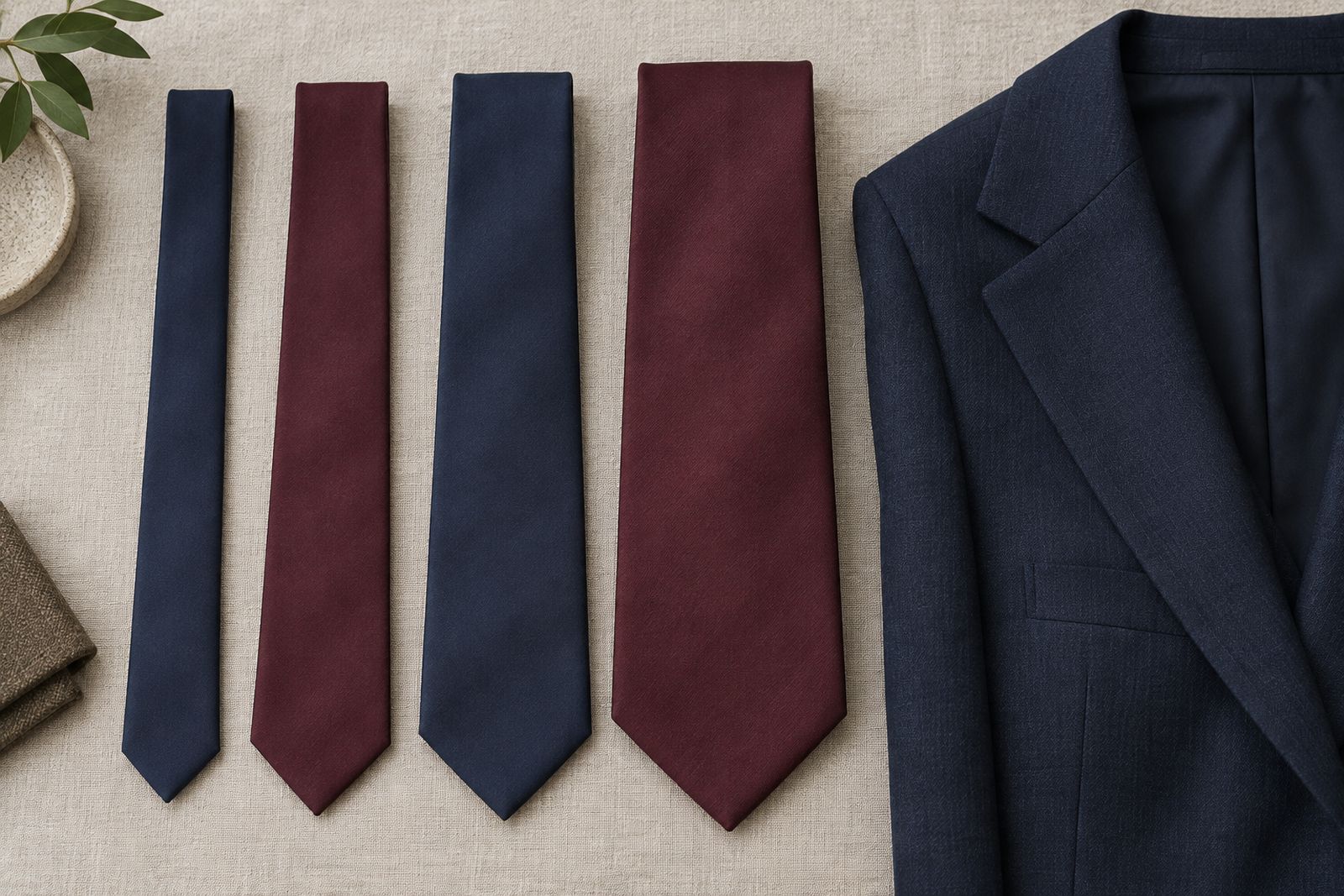
The short answer
Most ties are 2¾ to 3½ inches (7 to 9 cm) wide at their widest point, and about 3 to 3¼ inches (7.5 to 8.3 cm) suits most men. The best tie width matches your jacket's lapels at their widest point: slim lapels take a slim tie, broad lapels a broader one. Go slightly wider for a large frame and slightly narrower for a slight one.
- Most ties measure 2¾ to 3½ inches (7 to 9 cm) at the widest point; 3 to 3¼ inches (7.5 to 8.3 cm) is the classic middle.
- Match tie width to lapel width at the widest point of each.
- Large frames suit the wider end of the range; slight frames the narrower end.
- Skinny ties under about 2¼ inches (6 cm) are a fashion look that suits only slim lapels.
- Measure a tie flat, straight across its widest point, just above where the blade narrows to its tip.
In this guide
- What is the standard tie width?
- Should tie width match lapel width?
- Tie width and your build
- Tie width and the knot
- Tie width and the shirt collar
- Are skinny ties out of style?
- Knitted ties, wool ties and bow ties
- Why two ties of the same width can look different
- Tie width with double-breasted, three-piece and casual jackets
- How to measure tie width
- The tailor's view
- Questions people ask
Tie width is measured straight across the blade at its widest point. A tie that is much narrower than your lapels looks thin and dated; one that is much wider looks heavy. The fix is simple and has nothing to do with trends: match the tie to the jacket you wear it with, then adjust slightly for your build.
Tie width at a glance
- Most ties
- 2¾ to 3½ in (7 to 9 cm) at the widest point
- Classic middle
- About 3 to 3¼ in (7.5 to 8.3 cm)
- The rule
- Tie width close to lapel width, both at their widest
- Large frame
- Toward 3¼ to 3½ in (8.3 to 9 cm)
- Slight frame
- Toward 2¾ to 3 in (7 to 7.5 cm)
- Skinny ties
- Under about 2¼ in (6 cm); only with slim lapels
What is the standard tie width?
There is no single official standard, but most ties sold today measure 2¾ to 3½ inches (7 to 9 cm) at the widest point, and about 3 to 3¼ inches (7.5 to 8.3 cm) is the width that suits the widest range of men and jackets. Ties narrower than that are usually sold as slim or skinny; wider ones are less common and suit broad lapels and large frames.
Scale from 1.5 in to 4.5 in, with cm below. Skinny: 1.5 to 2.25 in. Slim: 2.25 to 2.75 in. Standard: 2.75 to 3.5 in. Wide: 3.5 to 4.5 in. Classic middle: at 3.125 in.
| Category | Width at widest point | Wear it with |
|---|---|---|
| Skinny | Under about 2¼ in (6 cm) | Very slim lapels and small collars; a fashion look |
| Slim | About 2¼ to 2¾ in (6 to 7 cm) | Slim lapels, slim builds, knitted ties |
| Standard | About 2¾ to 3½ in (7 to 9 cm) | Most suits and jackets |
| Wide | Over about 3½ in (9 cm) | Broad lapels, large frames, some double-breasted jackets |
Should tie width match lapel width?
Yes, roughly. The widest part of the tie should be close to the widest part of your jacket's lapel, measured from the lapel's outer edge straight across to the seam where it meets the jacket's front. The two do not need to match to the millimeter; within about ¼ inch (6 mm) looks deliberate. A big mismatch is what catches the eye: a skinny tie under broad peak lapels, or a wide tie under narrow notches.
| Lapel width at widest point | Lapel style | Tie width |
|---|---|---|
| About 2 to 2¾ in (5 to 7 cm) | Slim notch | Slim: 2¼ to 2¾ in (6 to 7 cm) |
| About 3 to 3½ in (7.5 to 9 cm) | Classic notch or peak | Standard: 3 to 3½ in (7.5 to 9 cm) |
| About 3¾ in (9.5 cm) and wider | Broad peak, often double-breasted | Upper standard to wide: 3½ in (9 cm) or more |
If you are not sure what kind of lapel you have, our guide to suit lapels explains the notch, peak and shawl, and our guide to peak vs notch lapels covers proportions.
Tie width and your build
Proportion runs through the whole outfit, and the tie should sit in scale with your chest and shoulders. A broad-chested or heavily built man looks best toward the wider end of the standard range, about 3¼ to 3½ inches (8.3 to 9 cm); a narrow tie on a large chest looks like a string. A slight, narrow-shouldered man looks best at about 2¾ to 3 inches (7 to 7.5 cm); a wide tie overwhelms him. A well-cut jacket will already have lapels in proportion with your build, which is one more reason to let the lapel guide the tie.
Tie width and the knot
Wider ties put more fabric into the knot, so the same knot comes out bigger in a wide tie than in a slim one. A slim or skinny tie looks best with a small knot such as a four-in-hand; a broad Windsor on a narrow blade looks top-heavy. A wide tie can look clumsy in a large knot and usually suits a four-in-hand or half Windsor. Our guide to which tie knot to wear matches knots to ties and collars.
Tie width and the shirt collar
The collar frames the knot, so it should be in proportion with the tie too. Small, short-pointed collars suit slim ties; longer points and wider spreads suit standard and wide ties. A skinny tie in a broad cutaway collar leaves a tiny knot surrounded by bare collar. Our guide to shirt collar types describes each collar's proportions.
Are skinny ties out of style?
Very skinny ties, under about 2¼ inches (6 cm), are a fashion look rather than a classic width. They suit very slim lapels and small collars and look underpowered against standard lapels. Tie widths swing with fashion, and the extremes, very wide and very skinny, are the first to look dated. If you like a narrow tie, a slim width of about 2½ inches (6.4 cm) worn with slim lapels is the safer choice.
Knitted ties, wool ties and bow ties
Knitted ties are usually narrower than woven silk ties, often around 2½ inches (6.4 cm), and many have a square end. Their texture and bulk give them presence, so they look right at slimmer widths. Wool and cashmere ties tend to be standard width but thick, so they make larger knots. Bow ties follow a different rule, sized to your face rather than your lapels; our guide to tying a bow tie explains it.
Why two ties of the same width can look different
The width printed on a label describes the blade, but the knot is tied from the narrower part of the tie higher up. Ties taper at different rates and are built with different interlinings, so two ties that both measure 3¼ inches (8.3 cm) at the blade can make noticeably different knots and hang differently. A tie with a thick interlining or a heavy woven silk looks broader and more substantial than its measurement suggests; a thin, lightly lined printed silk looks narrower. When you compare ties against a lapel, look at them tied, not just flat.
Tie width with double-breasted, three-piece and casual jackets
- Double-breasted jackets. Most have peak lapels that run wider than a single-breasted notch, so a tie at the upper end of the standard range, about 3¼ to 3½ inches (8.3 to 9 cm), usually balances them best.
- Three-piece suits. The waistcoat hides most of the blade, so width matters less below the chest, but the visible part between the waistcoat and the knot should still match the lapels.
- Sport coats and blazers. Softer jackets with patch pockets suit textured ties, and a knitted or wool tie at a slimmer width looks natural with them.
- No jacket. Without lapels to match, scale the tie to your build and collar instead; a standard width is the safe default.
Proportion check in the mirror
- The tie's blade looks about as wide as the lapel beside it
- The knot fills the collar without forcing the points apart
- The tie looks in scale with your chest, neither stringy nor heavy
- The collar points are in proportion with the tie's width
- Nothing in the outfit is at an extreme the rest does not match
How to measure tie width
- 1
Lay the tie flat
Untie it and lay it on a table, front side up, with no twists.
- 2
Find the widest point
Run your eye up from the tip. The widest point is just above where the blade starts to narrow into its point.
- 3
Measure straight across
Measure edge to edge, straight across the blade at that point, not along the diagonal of the tip.
- 4
Measure your lapel
With the jacket on a hanger, measure the lapel at its widest point, from the outer edge straight across to the seam where the lapel meets the jacket front.
- 5
Compare
If the two are within about ¼ inch (6 mm), the proportions work. If not, choose a different tie for that jacket.
The tailor's view
Lapels are part of the jacket's structure: narrowing them is a difficult, expensive job and widening them is impossible, so a tailor will almost always tell you to match the tie to the jacket, not the other way round. When you commission a suit, the cutter will set the lapel width in proportion with your chest and shoulders; once the suit is made, buy ties to suit that lapel. Some tie specialists can narrow a wide tie by re-cutting the blade, but patterns can be cut through and the results vary, so it is worth it only for a tie you value.
Get the width right, then the length: our guide to tie length shows where the tip should land, and our guide to matching a tie to your shirt and suit takes care of color and pattern.
Questions people ask
What is the standard tie width?
Most ties are 2¾ to 3½ inches (7 to 9 cm) wide at their widest point. About 3 to 3¼ inches (7.5 to 8.3 cm) suits the widest range of men and jackets. There is no official standard, so check the measurement when you buy.
Should tie width match lapel width?
Roughly, yes. The widest part of the tie should be close to the widest part of the lapel, ideally within about ¼ inch (6 mm). A skinny tie with broad lapels, or a wide tie with slim ones, looks out of proportion.
Are skinny ties out of style?
Very skinny ties under about 2¼ inches (6 cm) are a fashion look that only suits very slim lapels and small collars, and they date quickly. A slim tie of about 2½ inches (6.4 cm) with slim lapels is a safer choice if you prefer a narrow tie.
What tie width suits a big man?
A broad-chested or heavily built man looks best toward the wider end of the standard range, about 3¼ to 3½ inches (8.3 to 9 cm). A narrow tie looks too small on a large frame. Pair it with lapels of similar width and a spread collar.
How do you measure the width of a tie?
Lay the tie flat and measure straight across the blade at its widest point, just above where it narrows into the tip. Measure edge to edge, not along the angled tip. Compare that number with your lapel's width at its widest point.
What tie width is best for a wedding or the office?
A standard width of about 3 to 3¼ inches (7.5 to 8.3 cm) suits almost every suit, office and wedding. Go slightly slimmer if your suit has slim lapels and slightly wider if it has broad peak lapels. The occasion matters less than the jacket.
Does tie width affect the knot?
Yes. A wider tie puts more fabric into the knot and makes it bigger, while a slim tie makes a smaller knot. Slim and skinny ties look best with a four-in-hand; wide ties can look clumsy in a large knot like the full Windsor.
TailorGuide is independent. Our guides are written and checked by our team and carry no paid endorsements. How we work.