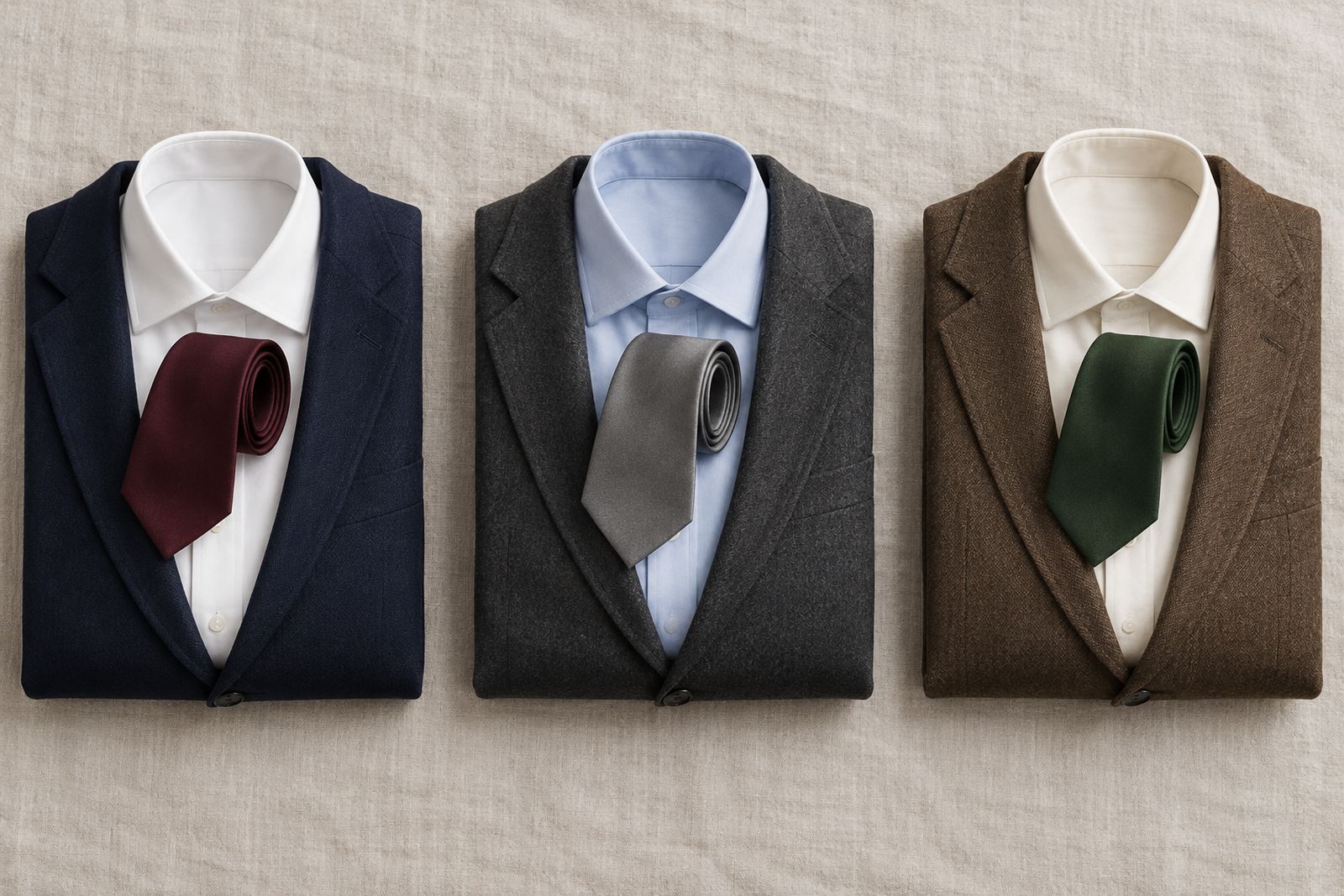
The short answer
The simplest suit, shirt and tie color combinations follow three rules: keep the shirt lighter than the suit, keep the tie darker than the shirt, and add only one or two colors beyond neutrals. A navy or charcoal suit with a white or light blue shirt and a burgundy, navy or green tie always works. Add pattern to one piece at a time.
- Shirt lighter than the suit, tie darker than the shirt.
- White and light blue shirts work with every suit color.
- Burgundy and navy ties work with almost every suit.
- Mix patterns only at different scales: a wide stripe with a small dot, never two of the same size.
- A tie can be darker than the suit; it should rarely be lighter than the shirt.
In this guide
- What colors go together in a suit outfit?
- Color wheel basics for suits and ties
- The combination grid: suit, shirt and tie by suit color
- Which shirt colors work with a suit?
- Common combination questions, answered
- How to mix patterns: stripes, checks and dots
- Which suit, shirt and tie combinations should you avoid?
- How to choose combinations for your coloring
- Seasonal combinations: spring and summer, autumn and winter
- Which combinations suit each occasion?
- The tailor's view: how to judge a combination
- Questions people ask
Most suit, shirt and tie color combinations go wrong for one of two reasons: too little contrast between the pieces, or too many colors competing at once. Fix those two things and the rest is taste. The rules below are the ones a good shirtmaker or tailor applies by eye, followed by a grid of combinations for every common suit color.
The rules in one place
- Shirt
- Lighter than the suit
- Tie
- Darker than the shirt
- Colors
- One or two beyond the neutrals (navy, gray, brown, white)
- Patterns
- One bold pattern at most; vary the scale of the others
- Safest combination
- Navy suit, white shirt, burgundy tie, dark brown or black shoes
What colors go together in a suit outfit?
Colors go together in a suit outfit when the lightness steps down from shirt to tie to suit, or from shirt to suit to tie, and when the colors you add either sit close together or sit opposite each other on the color wheel. Lightness matters more than hue. A navy suit, white shirt and dark red tie works because each piece is clearly lighter or darker than the one next to it.
Treat the suit, the shirt and the shoes as the neutral base. Navy, gray, charcoal, brown, white and light blue barely count as colors in menswear. The tie and the pocket square are where color goes, and one strong color is usually enough.
Build any outfit in four steps
- 1
Start with the suit
The suit is the largest area of color, so it sets the mood. Navy and charcoal are formal and easy; mid gray and brown are softer and more relaxed.
- 2
Choose a lighter shirt
Pick a shirt clearly lighter than the suit. White is the most formal, light blue the most versatile, and pale pink or lavender add warmth.
Tip: If the shirt and suit are close in lightness, such as a mid gray shirt with a mid gray suit, the outfit looks flat. Go lighter.
- 3
Choose a tie darker than the shirt
Pick a tie darker than the shirt, in a color that either repeats something in the outfit or contrasts with the suit. Burgundy, navy and green are the safest; rust, gold and purple are livelier.
- 4
Finish with shoes and a pocket square
Match the shoes to the formality (black most formal, then dark brown), match the belt to the shoes, and choose a pocket square that complements the tie without copying it. White linen goes with everything.
Color wheel basics for suits and ties
Three color relationships account for nearly every good tie and shirt pairing. You do not need to name them to use them, but knowing them makes it easier to see why a combination works or fails.
Tonal
Shades of one color
- Navy suit, light blue shirt, navy tie
- Charcoal suit, light gray shirt, black knit tie
- Calm, modern and very hard to get wrong
- Needs a clear step in lightness between pieces
Analogous
Neighbors on the color wheel
- Navy suit, light blue shirt, green tie
- Brown suit, cream shirt, rust or gold tie
- Harmonious and quietly interesting
- Works with any suit color
Complementary
Opposites on the color wheel
- Navy suit, white shirt, rust or orange tie
- Gray suit, lavender shirt, gold tie
- Lively and confident
- Choose muted versions: rust rather than bright orange
Blue sits opposite orange, which is why navy suits look so good with rust, copper and burnt orange ties. Purple sits opposite yellow, and red opposite green, so a lavender shirt takes a gold tie well and a burgundy pocket square lifts a green tie. Keep complementary colors muted in business settings; full-strength opposites are for parties.
The combination grid: suit, shirt and tie by suit color
Find your suit in the left column. Any shirt in the second column works with any tie in the third, as long as the tie is darker than the shirt. The shoes column runs from most to least formal.
| Suit | Shirts | Ties | Shoes |
|---|---|---|---|
| Navy | White, light blue, pink, lavender | Burgundy, navy, green, brown, gold, rust | Black, dark brown, oxblood, tan (daytime, casual) |
| Charcoal | White, light blue, pink, lavender | Burgundy, navy, silver, purple, green | Black, oxblood, dark brown |
| Mid gray | White, light blue, pink | Navy, burgundy, green, orange, yellow | Black, dark brown, mid brown |
| Light gray | White, light blue, pink, lavender | Navy, light blue, pastels, brown knit | Mid brown, tan, brown suede |
| Brown | Cream or ecru, white, light blue | Green, navy, rust, burgundy, gold | Dark brown, oxblood, brown suede |
| Black | White | Black, silver, dark gray, burgundy | Black only |
| Tan or beige | White, light blue, pink | Navy, brown, green, burgundy | Mid brown, tan, brown suede |
| Mid blue | White, light blue, pink | Navy, burgundy, brown, orange | Dark brown, mid brown, tan |
Black shoes are the most formal choice with navy, charcoal and gray; brown shoes suit daytime and less formal settings.
Classic
Navy, white, burgundy
The safest outfit in menswear
Navy
Suit
White
Shirt
Burgundy
Tie
Dark brown
Shoes
Classic
Charcoal, light blue, navy
Formal business
Charcoal
Suit
Light blue
Shirt
Navy
Tie
Black
Shoes
Classic
Navy, light blue, navy
Tonal and calm
Navy
Suit
Light blue
Shirt
Dark navy
Tie
Black
Shoes
Works
Mid gray, white, green
Daytime, relaxed business
Mid gray
Suit
White
Shirt
Bottle green
Tie
Mid brown
Shoes
Works
Charcoal, pink, burgundy
Analogous warmth on a formal base
Charcoal
Suit
Pale pink
Shirt
Burgundy
Tie
Oxblood
Shoes
Works
Brown, ecru, green
Autumn and country
Chocolate brown
Suit
Ecru
Shirt
Olive green
Tie
Dark brown
Shoes
Bold
Navy, white, rust
Complementary colors, muted
Navy
Suit
White
Shirt
Rust
Tie
Mid brown
Shoes
Bold
Mid gray, lavender, gold
Purple and yellow are opposites
Mid gray
Suit
Lavender
Shirt
Mustard gold
Tie
Dark brown
Shoes
Which shirt colors work with a suit?
White and light blue shirts work with every suit and every tie, which is why most men should own several of each before buying anything else. Pale pink, lavender and ecru add warmth and suit most occasions short of the most formal. Fine stripes and small checks in those same pale colors count as solids for pairing purposes when seen from a few feet away.
| Shirt | Formality | Best with | Ties that work |
|---|---|---|---|
| White | Highest | Every suit color | Any tie darker than white |
| Light blue | High | Navy, charcoal, gray, brown | Navy, burgundy, green, brown, gold |
| Fine blue stripe or check | Medium to high | Solid navy, charcoal and gray suits | Solid or large-scale patterned ties |
| Pale pink | Medium | Navy, charcoal, gray | Navy, burgundy, gray, purple |
| Lavender | Medium | Charcoal, gray, navy | Purple, navy, gold, silver |
| Ecru or cream | Medium | Brown, tan, olive | Green, brown, rust, navy |
| Dark or bright colors | Low | Evening and fashion settings only | Usually no tie |
Common combination questions, answered
What color tie goes with a navy suit?
Burgundy is the best tie color for a navy suit, followed by navy, green, brown and gold. Navy is a dark, slightly cool blue, so warm ties (burgundy, rust, gold) create contrast and cool ties (navy, green, purple) create harmony. Almost the only tie that struggles with navy is a bright royal blue that sits too close to the suit without being clearly darker or lighter. Our guide to navy suit combinations covers shirts, ties and shoes in more detail.
What color shirt goes with a gray suit?
White and light blue shirts go with every gray suit, and pink and lavender work with charcoal and mid gray. The darker the gray, the more contrast the shirt can carry: charcoal with a crisp white shirt looks sharp, while a light gray suit looks better with a soft light blue or pink than with stark white. See gray suit combinations for each shade separately.
What tie goes with a white shirt and a navy suit?
Almost any tie goes with a white shirt and a navy suit, because the white shirt is neutral and the navy is dark. Burgundy, navy, bottle green, brown, silver and gold all work; a navy grenadine or a burgundy repp stripe is the safest business choice. The combination is so forgiving that it is the best outfit for testing a bolder tie, such as a rust or a pattern with several colors.
Can your tie be darker than your suit?
Yes, your tie can be darker than your suit, and often should be with mid gray, light gray, tan and mid blue suits. A navy tie on a mid gray suit or a dark brown knit tie on a tan suit is a classic pairing. The rule that matters is the one between tie and shirt: the tie should almost always be darker than the shirt, because a pale tie on a darker shirt looks like a costume.
How to mix patterns: stripes, checks and dots
Mix patterns by changing their scale. Two patterns of the same size, such as a fine striped shirt and a fine striped tie, appear to shimmer and fight, especially on camera. A narrow-striped shirt with a wide-striped tie, or a small check with a large paisley, gives each pattern room. Keep it to three patterns at most, and let only one of them be bold.
| Suit | Shirt | Tie | Verdict |
|---|---|---|---|
| Solid | Solid | Patterned (stripe, dot, paisley) | Easiest: the tie carries all the interest |
| Solid | Fine stripe or check | Solid, or a pattern of a clearly different scale | Works |
| Pinstripe or chalk stripe | Solid | Solid, small dot or neat pattern | Works |
| Pinstripe | Fine stripe | Large-scale pattern or solid | Works with care |
| Check | Solid | Solid knit, grenadine or small pattern | Works |
| Any | Stripe | Stripe of the same width | Avoid: the patterns clash |
| Check | Check of the same size | Anything | Avoid: too busy |
Texture counts as a quiet pattern. A wool knit tie, a grenadine or a flannel suit adds depth without adding another color, which is useful when you want interest but no risk.
Which suit, shirt and tie combinations should you avoid?
Avoid combinations that remove contrast, add too many colors or look like a uniform. The examples below are common, and each one has an easy fix.
Avoid
Black, black, black
Reads as a nightclub or a uniform; use a white shirt
Black
Suit
Black
Shirt
Black
Tie
Black
Shoes
Avoid
Light blue tie on light blue shirt
No contrast; choose a navy tie
Navy
Suit
Light blue
Shirt
Light blue
Tie
Black
Shoes
Avoid
Pale tie on a dark shirt
Reverses the contrast; swap the shirt for white
Charcoal
Suit
Navy
Shirt
Silver
Tie
Black
Shoes
Avoid
Black shoes with a brown suit
Heavy and abrupt; choose dark brown
Chocolate brown
Suit
Light blue
Shirt
Navy
Tie
Black
Shoes
- Too many colors. A pink shirt, a green tie and an orange square on a blue suit is four colors; drop one.
- Novelty and very bright ties in business settings. Save them for parties.
- Shiny satin ties with matte wool suits. The sheen looks cheap in daylight. Choose a matte silk, grenadine or knit.
- A white long tie with a white shirt. It reads as costume; the only white tie in formalwear is the white bow tie of white tie dress.
- Shirt and suit too close in tone, such as a light gray shirt with a light gray suit.
How to choose combinations for your coloring
Match the contrast of your outfit to the contrast in your own coloring. Look at your hair, skin and eyes in daylight. If there is a strong difference between them, such as dark hair with fair skin, you can carry high-contrast combinations like a charcoal suit, a white shirt and a near-black tie. If your hair and skin are close in depth, whether both light or both deep, softer steps usually look more natural: a mid gray or navy suit with a light blue shirt and a mid-tone tie.
The color of the shirt sits next to your face, so it matters most. If a stark white shirt makes you look tired or washed out, try an off-white, a soft light blue or a pale pink. If pastels look weak on you, go back to crisp white and stronger tie colors. Your suit color matters less than the shirt and tie for this, which is another reason navy and charcoal suit almost everyone.
Seasonal combinations: spring and summer, autumn and winter
Lighter, softer colors look natural in strong daylight, and deeper, warmer colors look natural in winter. In spring and summer, try light gray or mid blue suits, pale pink and light blue shirts, and ties in light blue, pale yellow or linen and cotton textures. In autumn and winter, try charcoal, brown and navy flannels with ties in burgundy, bottle green, rust and brown, often in wool or knitted silk.
Texture follows the season too. A shiny or crisp tie looks right with a smooth summer worsted, while a wool challis, a knitted tie or a grenadine sits better on flannel and tweed. Matching texture to fabric is a quiet way to make an ordinary combination look considered.
Which combinations suit each occasion?
Formal and serious occasions call for more contrast and fewer colors; social and daytime occasions allow softer contrast and more color. The table below gives one reliable combination for each.
| Occasion | Suit | Shirt | Tie | Shoes |
|---|---|---|---|---|
| Job interview | Navy or charcoal | White or light blue | Burgundy or navy, solid or small pattern | Black oxfords |
| Conservative office | Charcoal | White | Navy or burgundy | Black oxfords |
| Relaxed office | Mid gray | Light blue | Green or brown knit | Dark brown derbies |
| Daytime wedding (guest) | Light gray or navy | Pale pink or light blue | Navy, pastel or floral | Mid brown |
| Evening event | Charcoal or navy | White | Burgundy, silver or purple | Black |
| Funeral | Charcoal or black | White | Black or dark navy | Black |
For specific dress codes, see our guides to what to wear to a job interview and wedding guest attire.
The tailor's view: how to judge a combination
Tailors and shirtmakers judge combinations in daylight, at a distance and with the pieces touching. A tie that looks right in your hand can disappear against a shirt or clash with a suit fabric that has a hidden colored thread. When you order shirting or a suit, bring the ties you wear most and hold them against the fabric.
Before you leave the house
- Is the shirt clearly lighter than the suit?
- Is the tie clearly darker than the shirt?
- Have you used no more than one or two colors beyond navy, gray, brown and white?
- If you are wearing two patterns, are they different sizes?
- Do the belt and shoes match in color?
- Does the pocket square complement the tie without copying it?
For tie patterns and textures, see how to match a tie to your shirt and suit, and read the best suit colors if you are still deciding which suit to buy.
Questions people ask
What color tie goes with a navy suit?
Burgundy is the best tie color for a navy suit, followed by navy, bottle green, brown and gold. Warm colors such as burgundy and rust contrast with navy, while cool colors such as navy and green harmonize with it. Avoid a bright blue tie that sits too close to the suit in tone.
What color shirt goes with a gray suit?
White and light blue shirts go with every shade of gray suit. Pink and lavender work well with charcoal and mid gray, and soft light blue or pink usually looks better than stark white with light gray. Keep the shirt clearly lighter than the suit.
What tie goes with a white shirt and a navy suit?
Almost any tie goes with a white shirt and a navy suit. Burgundy, navy, green, brown, silver and gold are all reliable, and a navy grenadine or burgundy repp stripe is the safest business choice. The combination is forgiving enough to carry a bold or multicolored tie.
Can your tie be darker than your suit?
Yes, a tie can be darker than the suit, and it often looks best that way with mid gray, light gray, tan or mid blue suits. A navy tie on a mid gray suit is a classic example. What matters more is that the tie is darker than the shirt.
Should your tie be darker than your shirt?
Yes, in almost every case the tie should be darker than the shirt. The step from a light shirt to a darker tie is what makes an outfit look composed. A pale tie on a dark shirt reverses that contrast and looks theatrical.
Can you wear a black shirt with a suit?
A black shirt with a suit is for evening and fashion settings, not business. It removes the contrast that frames the face and can make the outfit look like a uniform or a nightclub look. For any serious occasion, wear a white or light blue shirt.
How many colors should a suit outfit have?
A suit outfit looks best with one or two colors beyond the neutrals. Navy, gray, charcoal, brown, white and light blue act as a neutral base, so a navy suit, white shirt and burgundy tie counts as one color. Add a second accent color in the pocket square or shirt only if it relates to the first.
TailorGuide is independent. Our guides are written and checked by our team and carry no paid endorsements. How we work.