The short answer
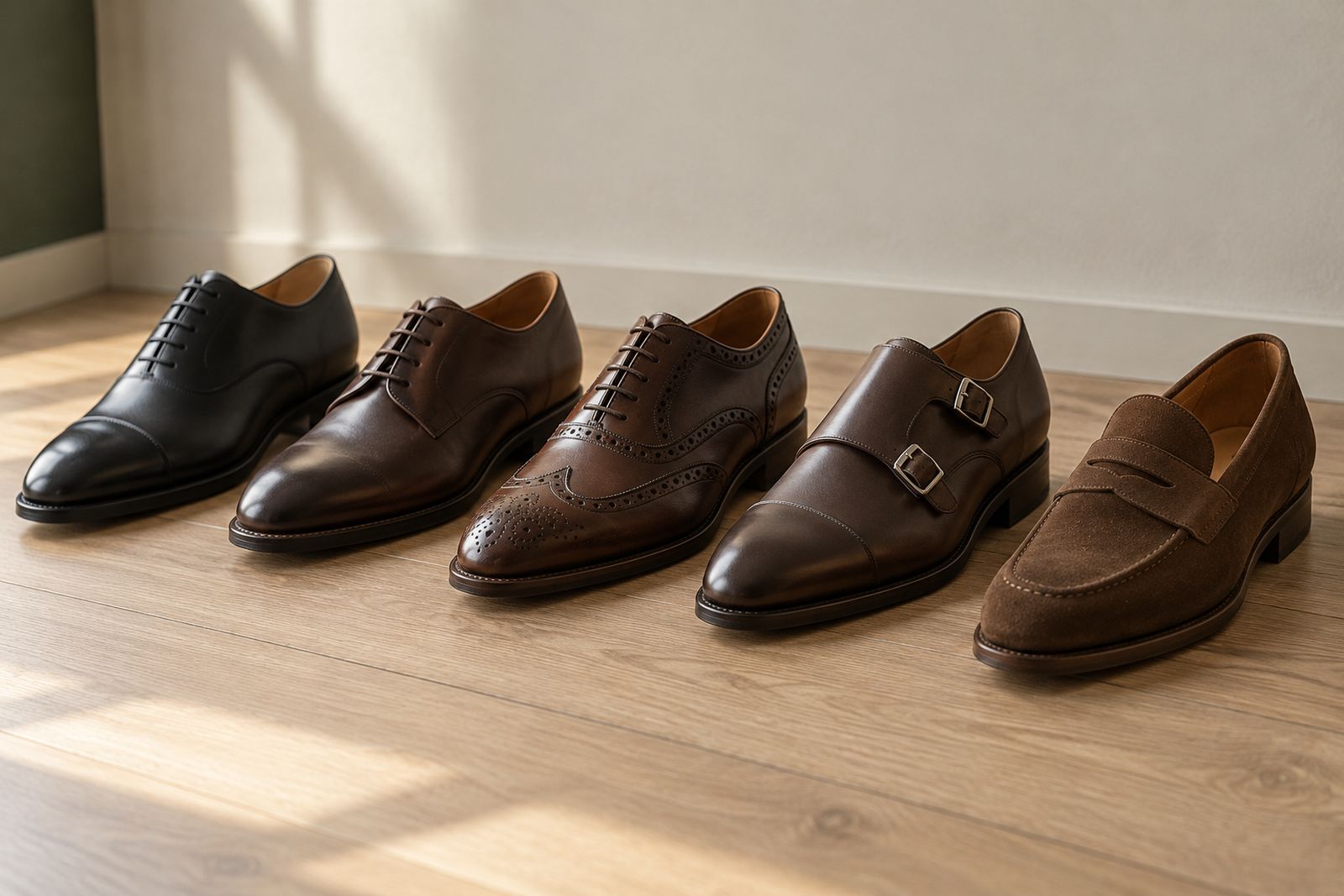
The best shoes to wear with a suit are leather lace-ups. A black cap-toe oxford is the most formal and suits any business suit; then come plain oxfords, derbies, brogues, monk straps and loafers, in falling order of formality. Wear black for formal business and evening, brown with navy or gray by day, match your belt to your shoes, and match your socks to your trousers.
- Most formal: the black cap-toe oxford. Least formal with a suit: loafers.
- Oxfords have closed lacing and are sleeker; derbies have open lacing and are more relaxed.
- Black shoes for the most formal and business settings; brown for daytime and less formal ones.
- Match the belt to the shoes in color and finish.
- Socks match the trousers and are long enough to hide your shin when you sit.
- Sneakers belong only with a casual suit in cotton, linen or a textured wool.
In this guide
- What is the most formal shoe to wear with a suit?
- Oxford vs derby: what is the difference?
- Brogues with a suit: quarter, semi and full
- Can you wear loafers or monk straps with a suit?
- Can you wear boots or sneakers with a suit?
- What color shoes go with each suit color?
- Should your belt match your shoes?
- What socks should you wear with a suit?
- Which shoes for which occasion?
- How many pairs of dress shoes do you need?
- Shoe mistakes to avoid with a suit
- The tailor's view: fit the trousers to the shoes
- Questions people ask
The right shoes to wear with a suit depend on three things: how formal the suit and the occasion are, what color the suit is, and the season. A black cap-toe oxford works with every business suit, which is why it is the first dress shoe most men should buy. Every other style steps down from there. Below is the full formality ladder, what each style suits, and straight answers on loafers, boots and sneakers.
Shoes with a suit at a glance
- First pair to buy
- Black cap-toe oxfords
- Second pair
- Dark brown oxfords or derbies
- Most formal
- Black cap-toe oxford
- Most relaxed with a suit
- Suede loafers
- Belt
- Matches the shoes in color and finish
- Socks
- Match the trousers, long enough to hide the shin
What is the most formal shoe to wear with a suit?
The black cap-toe oxford is the most formal shoe to wear with a suit. It has closed lacing, a straight line of stitching across the toe and a smooth, polished upper, and it suits business suits, interviews, funerals and evening events. Every other shoe on the ladder below is a step less formal, usually because of more open lacing, more decoration or no laces at all.
Most formal
Black cap-toe oxford
Business, interviews, funerals, evening
Plain-toe or wholecut oxford
Sleek and nearly as formal
Derby
Open lacing; business to smart casual
Brogues
Perforated detail; quarter brogue is dressiest, full brogue most relaxed
Monk strap
Buckle closure; business to smart casual
Loafers
Slip-ons; relaxed offices and casual suits
Least formal
Black tie is a separate case. With a dinner suit, wear black patent leather or very highly polished black plain-toe oxfords, or traditional evening pumps; see our guide to black tie.
Oxford vs derby: what is the difference?
The difference between an oxford and a derby is the lacing. On an oxford, the eyelet panels are stitched underneath the front of the shoe, so they close neatly together: this is called closed lacing. On a derby, the eyelet panels are stitched on top of the front, so they can open wide: this is called open lacing. Closed lacing looks sleeker and more formal; open lacing looks sturdier and more relaxed.
Oxford (closed lacing)
An oxford is a lace-up shoe whose eyelet panels (quarters) are stitched under the vamp, the front section of the upper. In the US it is sometimes called a balmoral.
Derby (open lacing)
A derby is a lace-up shoe whose eyelet panels are stitched on top of the vamp, so they open outward. In the US it is often called a blucher.
Derbies are a better fit for men with high insteps or wide feet, because the open lacing adjusts more. A sleek black derby is formal enough for most offices; a chunky derby with a thick sole belongs with tweed, flannel and casual suits. Note that in the US, "oxford" is sometimes used loosely for any lace-up; check the lacing, not the label.
Brogues with a suit: quarter, semi and full
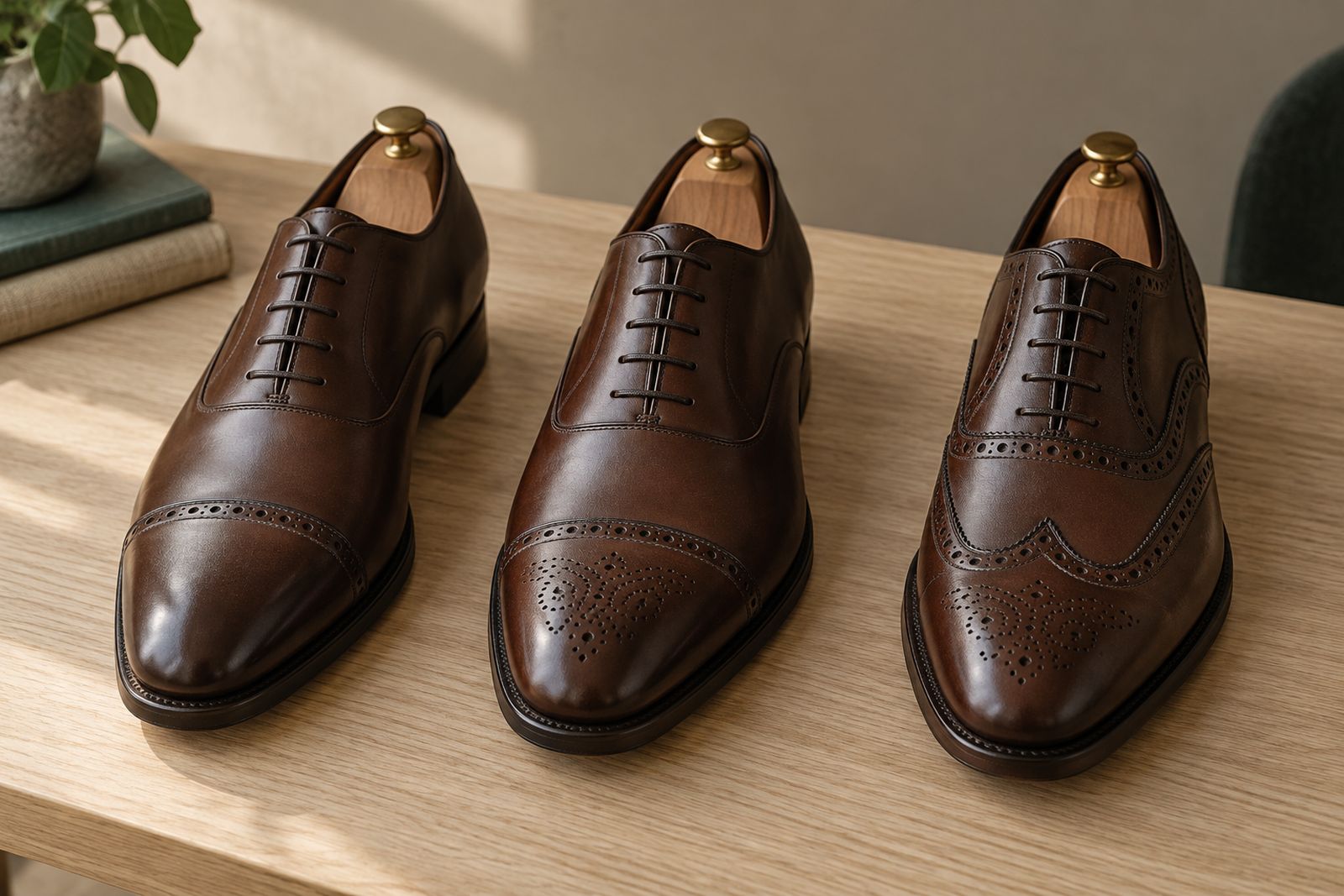
A brogue is any shoe decorated with perforations and serrated edges along its seams, and the more broguing a shoe has, the less formal it is. Brogues began as country shoes, and a full brogue still looks most at home with brown, flannel, tweed and relaxed suits. A black quarter brogue oxford, by contrast, is formal enough for business.
| Style | What it looks like | Wear it with |
|---|---|---|
| Quarter brogue | Perforations along the toe-cap seam only | Business suits; nearly as formal as a plain cap-toe |
| Semi-brogue | A quarter brogue plus a decorative medallion on the toe | Business and relaxed suits |
| Full brogue (wingtip) | A W-shaped wingtip cap with perforations along its edges and a medallion | Flannel, tweed, brown and casual suits |
| Longwing | Wingtip lines running all the way around to the heel | Casual suits, sport coats, weekend wear |
Can you wear loafers or monk straps with a suit?
Yes, you can wear loafers with a suit, as long as the setting is not the most formal. A sleek black or dark brown leather loafer suits a business suit in a relaxed office, a tassel or horsebit loafer is slightly dressier than a plain penny loafer, and suede loafers suit cotton, linen and casual wool suits. For interviews in conservative fields, funerals and formal evening events, choose lace-ups.
Monk straps close with a buckle and strap instead of laces, and they sit between the derby and the loafer in formality. Single and double monks both work with business suits in dark, smooth leather and with casual suits in suede. Keep the buckles simple and the leather polished.
Can you wear boots or sneakers with a suit?
Can you wear boots with a suit?
Yes, you can wear boots with a suit if they are slim, leather and dressy. Sleek Chelsea boots, jodhpur boots, plain leather chukkas and lace-up dress boots in black or dark brown work with business and casual suits in autumn and winter. The trouser should cover the boot shaft completely when you stand, so the boot reads as a shoe.
Avoid chunky work boots, hiking boots and thick lug soles with fine worsted suits; their bulk fights the clean line of the trouser. Suede chukkas and desert boots suit only casual suits in cotton, flannel or tweed.
Can you wear sneakers with a suit?
You can wear sneakers with a casual suit, but not with a business suit or at a formal event. Minimal, low-profile leather sneakers in white, cream, navy or brown work with suits in cotton, linen or textured wool, worn with a T-shirt, a knitted polo or an open-collared shirt. A smooth worsted business suit with sneakers looks like a mistake rather than a choice. Keep them spotless: scuffed sneakers undo the outfit.
What color shoes go with each suit color?
Wear black shoes for the most formal and business settings and brown shoes for daytime and less formal ones. Black works with navy, charcoal, gray and black suits; brown works with navy, gray, brown, tan and blue suits. Black shoes look abrupt with brown and tan suits, and brown shoes look disconnected from a black suit.
| Suit | Most formal | Daytime and less formal | Avoid |
|---|---|---|---|
| Navy | Black | Dark brown, mid brown, oxblood, tan, brown suede | Nothing in particular |
| Charcoal | Black | Oxblood, dark brown | Tan and light brown |
| Mid gray | Black | Any brown, oxblood, brown suede | Nothing in particular |
| Light gray | Black (evening only) | Mid brown, tan, brown suede | Black in daylight |
| Brown | Dark brown | Oxblood, mid brown, brown suede | Black |
| Black | Black | Black loafers | Any brown |
| Tan, beige or khaki | Dark brown | Mid brown, tan, suede | Black |
| Mid blue | Dark brown | Mid brown, tan, suede | Black in daylight |
Oxblood, a deep reddish brown, is the most versatile shoe color after black and dark brown: it works with navy, charcoal, gray and brown suits and is formal enough for most offices. For pairings by suit, see our guides to navy suit combinations and gray suit combinations.
Should your belt match your shoes?
Yes, your belt should match your shoes in color and roughly in finish: black with black, dark brown with dark brown, polished leather with polished leather and suede with suede or a matte leather. The match does not need to be exact, but the shades should be close. Keep dress belts slim, about 1 to 1¼ inches (2.5 to 3.2 cm) wide, with a plain buckle; if you wear a watch with a metal case, a buckle in the same metal looks tidy.
If your trousers have side adjusters or you wear braces (suspenders), skip the belt entirely. Never wear a belt and braces together.
What socks should you wear with a suit?
Wear socks long enough to hide your shin when you sit and cross your legs, in a color matched to your trousers. Over-the-calf socks are the surest way to stay covered; tall mid-calf socks with good elastic work for most men. Match the sock to the trousers, or go a shade darker, so the leg runs unbroken into the shoe. Subtle patterns are fine in business; bright novelty socks belong to relaxed settings.
Classic
Navy suit, brown shoes
Navy socks, dark brown belt
Navy
Suit
Dark brown
Belt
Dark brown
Shoes
Navy
Socks
Classic
Charcoal suit, black shoes
Charcoal socks, black belt
Charcoal
Suit
Black
Belt
Black
Shoes
Charcoal
Socks
Works
Mid gray suit, mid brown shoes
Gray socks, mid brown belt
Mid gray
Suit
Mid brown
Belt
Mid brown
Shoes
Gray
Socks
Avoid
Mismatched belt, white socks
Brown belt with black shoes; athletic socks
Navy
Suit
Mid brown
Belt
Black
Shoes
White
Socks
Which shoes for which occasion?
Formal and serious occasions call for black lace-ups; relaxed and daytime occasions open the door to brown, brogues, monks and loafers.
| Occasion | Best | Also works | Avoid |
|---|---|---|---|
| Job interview | Black cap-toe oxford | Dark brown oxford | Loafers, sneakers, boots |
| Conservative office | Black or dark brown oxford | Quarter brogue, sleek monk strap | Suede, sneakers |
| Relaxed office | Dark brown derby or brogue | Monk straps, leather loafers | Sneakers with a worsted suit |
| Daytime wedding | Dark or mid brown oxford | Monk straps, brogues | Chunky boots, sneakers |
| Evening event | Black oxford | Black loafer | Light brown, suede |
| Funeral | Black oxford | Black derby | Brown, suede, loafers |
| Smart casual | Suede loafers, brogues | Chukkas, leather sneakers | Formal black oxfords, which look stiff |
How many pairs of dress shoes do you need?
Two pairs cover almost every suit and occasion: black cap-toe oxfords and dark brown oxfords or derbies. Owning two also lets you rotate, which matters, because leather needs a day or more to dry out after wear. Add further pairs in the order your life requires.
| Pair | Style | What it adds |
|---|---|---|
| 1 | Black cap-toe oxford | Interviews, formal business, funerals, evening |
| 2 | Dark brown oxford or derby | Daily business with navy and gray, weddings, daytime |
| 3 | Brown suede loafer or brogue | Relaxed offices, casual suits, weekends |
| 4 | Oxblood or dark brown monk strap | Variety for business and social wear |
| 5 | Dark brown or black dress boot | Autumn and winter, wet weather |
Shoes by season
In summer, lighter browns, suede and loafers suit lighter suits and stronger daylight, and unlined or lightly lined shoes stay cooler. In autumn and winter, darker leathers, derbies, brogues and dress boots come forward, and a shoe with a slim rubber sole or a rubber-inlaid leather sole grips better on wet pavements. Suede copes with rain better than most men expect if it has been treated with a protective spray, but it should be brushed and dried naturally after a soaking.
Shoe mistakes to avoid with a suit
- Brown shoes at a funeral or the most formal business meeting.
- Unpolished or worn-down shoes. Scuffed toes and collapsed heels undo a good suit.
- A belt that does not match the shoes.
- Short or white athletic socks that show the shin.
- Sneakers with a business suit.
- Light tan shoes with a charcoal or black suit, a jump in tone that pulls the eye down.
The tailor's view: fit the trousers to the shoes
Shoes and trousers are fitted together. Heel height, sole thickness and the shape of the shoe change where the trouser hem falls and how much break it has, so a good tailor will ask you to bring the shoes you plan to wear to every fitting. A slim trouser hem looks wrong over a heavy shoe, and a wide hem swamps a sleek one; the tailor sets the hem width with both in view.
Look at how shoes are made, too. Goodyear-welted and Blake-stitched shoes can be resoled, which makes a good pair last many years; cheaply cemented shoes usually cannot be resoled economically. Rotate your shoes, use cedar shoe trees and polish them regularly, and a pair of black oxfords will outlast several suits.
Before you buy shoes for a suit
- Is the toe rounded and moderately slim, not square or very pointed?
- Is the sole in proportion to the trousers you will wear with it?
- Is it resoleable (Goodyear-welted or Blake-stitched)?
- Does it fit well at the heel and the widest part of the foot, with room for the toes?
- Do you own a matching belt?
- Will you bring these shoes to your next trouser fitting?
Start with black cap-toe oxfords, add dark brown, then choose a third pair for your life: brogues, monk straps or loafers. For the rest of the outfit, see how to wear a suit, and for your next fitting, our ranking of the best tailors in London.
Questions people ask
Can you wear loafers with a suit?
Yes, loafers work with a suit in relaxed offices, at daytime events and with casual suits. Sleek black or dark brown leather loafers suit business suits; suede loafers suit cotton, linen and casual wool. Choose lace-ups instead for interviews in conservative fields, funerals and formal evening events.
Can you wear boots with a suit?
Yes, if they are slim and dressy. Leather Chelsea boots, jodhpur boots, plain chukkas and lace-up dress boots in black or dark brown work with suits in autumn and winter, with the trouser covering the boot shaft. Avoid chunky work boots and hiking boots.
Can you wear sneakers with a suit?
Only with a casual suit in cotton, linen or a textured wool. Choose minimal, clean leather sneakers and wear them with a T-shirt, polo or open-collared shirt. Sneakers do not suit a worsted business suit, interviews or formal events.
What shoes go with a navy suit?
Black and dark brown shoes go best with a navy suit. Black oxfords are the most formal choice for business, evening and funerals, while dark brown is the most versatile for offices, weddings and social events. Mid brown, tan, oxblood and brown suede suit daytime and relaxed settings.
What shoes go with a gray suit?
Black and brown shoes both go with gray. Black suits charcoal and formal settings best; any brown suits mid gray; and mid brown, tan or suede suits light gray in daylight. Oxblood works with every shade.
Should your belt match your shoes?
Yes, your belt should match your shoes in color and roughly in finish, such as black with black or dark brown with dark brown. The shades need to be close, not identical. If you wear braces or trousers with side adjusters, skip the belt.
What socks should you wear with a suit?
Wear socks that match your trousers, or are a shade darker, and are long enough to hide your shin when you sit. Over-the-calf socks are the most reliable. Avoid white athletic socks and short socks with a suit.
TailorGuide is independent. Our guides are written and checked by our team and carry no paid endorsements. How we work.