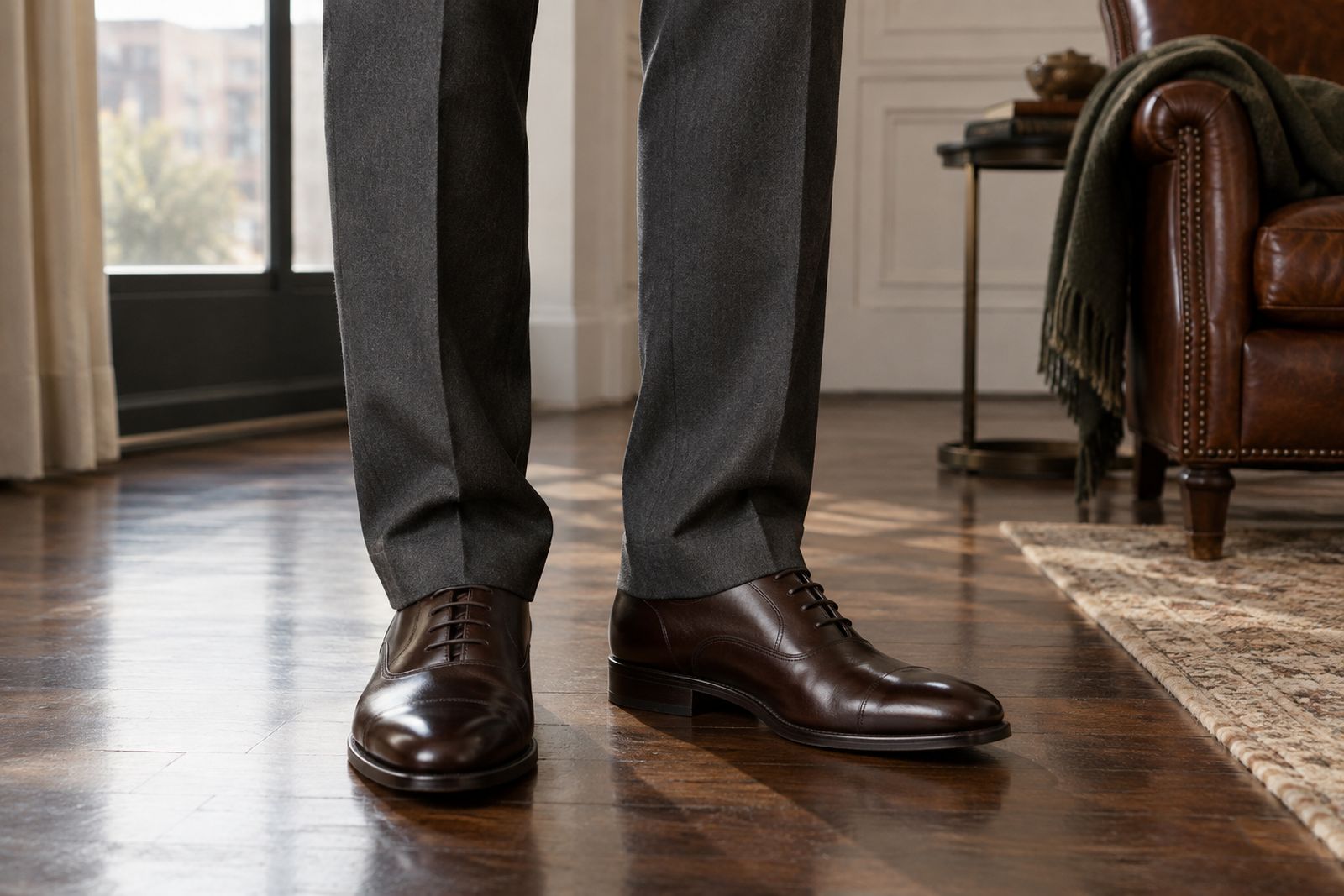
The short answer
A pants break is the fold that forms where the trouser hem meets your shoe. No break just touches or clears the shoe, a quarter break rests lightly on it, a half break makes one clear fold, and a full break makes one deep fold. Slim legs suit little or no break; wider legs can carry more. Most business suits wear a quarter or half break.
- No break clears or just touches the shoe; full break folds deeply over it
- The narrower the leg opening, the less break it can carry without bunching
- A quarter or half break suits most business suits
- Shorter men usually look best with a quarter or no break
- Pin the length standing straight, in the shoes you will wear, looking ahead
In this guide
- What is a pants break?
- No break, quarter, half and full break: the four options
- Which pants break should you choose?
- Should suit pants touch your shoes?
- How to pin suit trousers to the right length
- Common trouser length mistakes
- The tailor's view: length is easy to change, width is not
- Questions people ask
Trouser length is usually the last thing a tailor sets, and it shows every time you walk or sit. A pants break is the fold or dent that forms at the front of the trouser where the hem rests on your shoe. How much break you choose changes the line of your leg, how formal the suit looks and how much sock shows when you move. There are four standard options, and the right one depends mainly on how wide your trouser legs are.
What is a pants break?
Trouser break
A trouser break (pants break) is the horizontal fold that forms at the front of the leg when the hem meets the top of the shoe. The longer the trouser, the deeper the fold.
Tailors describe length by the break rather than by an inseam figure, because the same inseam gives a different break on different shoes. There are four names, from shortest to longest: no break, quarter break (or slight break), half break (or medium break) and full break.
| Break | Where the hem sits | Look | Best leg opening (flat across the hem) |
|---|---|---|---|
| No break | Just touches or clears the top of the shoe; no fold | Clean, modern, deliberate | About 7½ inches (19 cm) or narrower |
| Quarter break | Rests lightly on the shoe, making a slight dent | Neat and current; easy to wear | About 7 to 8 inches (18 to 20 cm) |
| Half break | Makes one clear fold at the front | Classic business | About 7½ to 8½ inches (19 to 21.5 cm) |
| Full break | Makes one deep fold and covers more of the shoe | Traditional, relaxed | About 8½ inches (21.5 cm) or wider |
Leg opening is measured flat across the hem. These ranges are a rough guide: heavier fabrics carry a break more cleanly than light ones.
No break, quarter, half and full break: the four options
No break
The hem just touches the top of the shoe or stops fractionally above it, so the leg falls in an unbroken line. It needs a slim, tapered leg; on a wide leg it looks like trousers that have shrunk. Expect your socks to show when you walk and when you sit, so they become part of the outfit. No break reads as modern and deliberate, and it suits slimmer suits and men who want a sharper line.
Quarter break
The hem rests lightly on the shoe, making a small dent at the front. It keeps the clean line of a no-break hem but covers the sock when you stand, which makes it the easiest choice for a modern business suit. If you are unsure, a quarter break is rarely wrong.
Half break
The hem makes one clear fold at the front and covers a little more of the shoe than a quarter break. It is the classic business length and works on medium legs. On very slim trousers a half break starts to bunch, because the narrow opening cannot fall cleanly over the shoe.
Full break
The hem makes one deep fold and covers more of the shoe. It belongs with wider, straighter legs and traditional cuts, where the extra length gives the trousers a relaxed, generous fall. On a slim leg a full break turns into a stack of creases. It also hides the shoe more, and some men find it makes the leg look shorter.
Which pants break should you choose?
Choose by your leg opening first, then by your height and the formality you want. The matrix shows where each break works best.
| Slim leg | Medium leg | Wide leg | Shorter men | Taller men | |
|---|---|---|---|---|---|
| No break | |||||
| Quarter break | |||||
| Half break | |||||
| Full break |
What break should short men wear?
Shorter men usually look best with a quarter break or no break. A long, unbroken leg line makes the legs look longer, while a deep fold at the ankle interrupts it. Pair the shorter hem with a slimmer leg so the trousers do not look truncated.
And tall men?
Taller men can carry any of the four. A half or full break with a slightly wider leg suits a long frame well, and no-break trousers on a very tall man can look as if he has outgrown them unless the leg is clearly slim and tapered.
Formality, fabric and shoes
- Formality: full and half breaks read as traditional; quarter and no break read as modern. For conservative business settings, a quarter or half break is the safe middle.
- Fabric: heavier fabrics such as flannel hang straight and settle into a break cleanly. Very light fabrics move more and can ripple, so they look tidier with less break.
- Shoes: sleek oxfords and loafers suit shorter hems. If you wear loafers with no-break trousers, your socks and ankles will be on show. More in which shoes to wear with a suit.
Should suit pants touch your shoes?
Usually, yes, lightly. A quarter or half break rests on the shoe, and even a no-break hem often just touches it. What should not touch anything is the back of the hem: it should come down over the back of the shoe but never reach the ground or catch under the heel, where it would scuff and fray.
Some tailors cut the hem on a slight angle, longer at the back than the front. That lets the front rest lightly on the shoe without a deep fold while the back still covers more of the heel. It works well with no-break and quarter-break lengths on slim legs. Turn-ups (cuffs) need a straight hem, so they cannot be angled in this way.
How to pin suit trousers to the right length
The length is set while you stand, so the way you stand during pinning decides how the trousers will look for years. A tailor normally does the pinning, but you control the conditions.
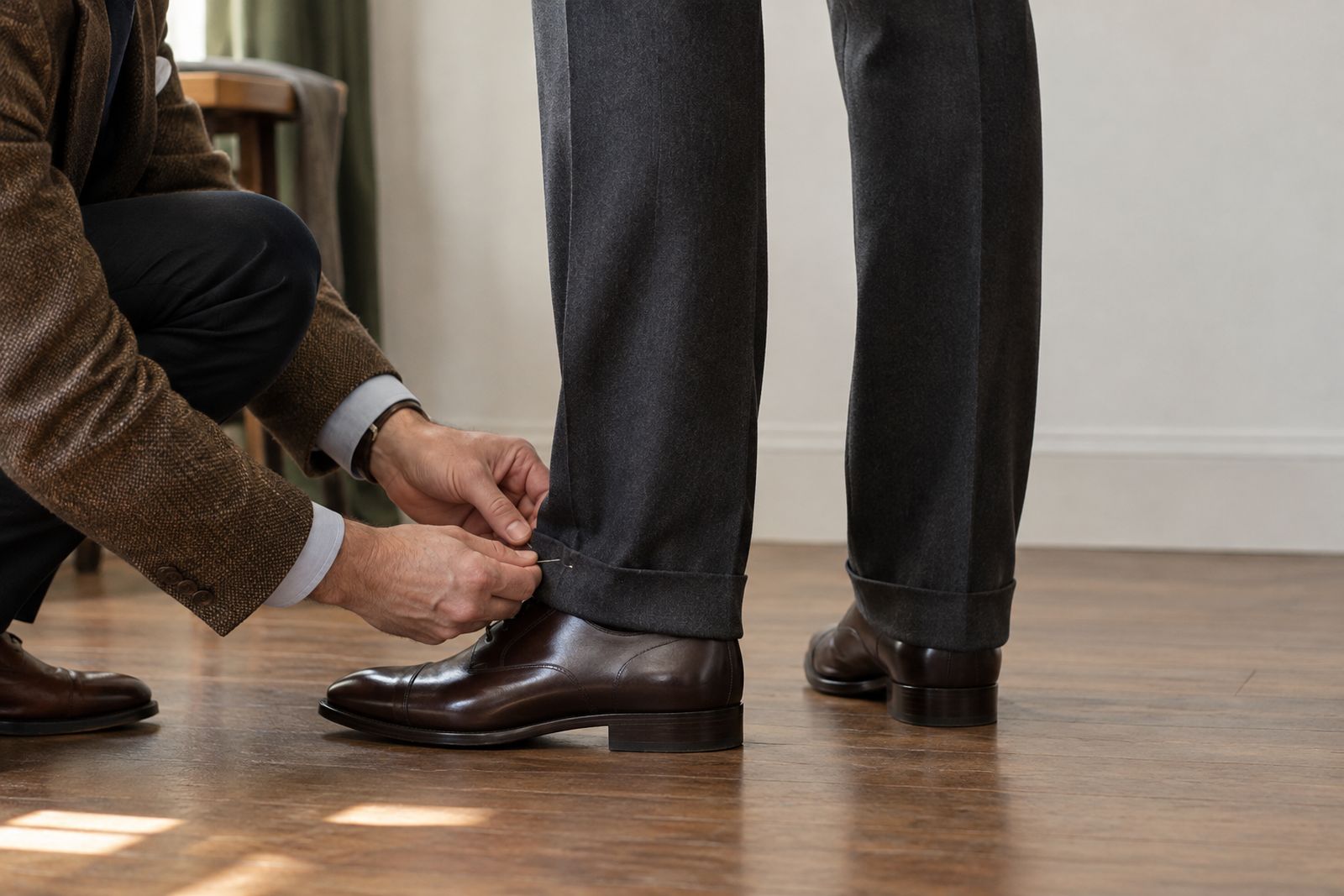
Pinning the trouser length
- 1
Fix the waist first
If the waist needs taking in or letting out, have it done or pinned first. Changing the waist changes where the trousers sit, and so how long they are.
- 2
Wear the right shoes
Put on the shoes you will wear most with the suit. A different heel height or shoe shape changes the break.
- 3
Wear the trousers where you wear them
Fasten the trousers at the height you will actually wear them, with your belt or braces (suspenders) on. Trousers worn lower than when they were pinned will end up too long.
Tip: Empty your pockets; a phone or wallet drags the trousers down.
- 4
Stand straight and look ahead
Stand with your weight even on both feet and look straight into a mirror. Looking down at your feet bends your body and pulls the hem up.
- 5
Pin the front, check the back
The tailor folds the hem under to the break you want and pins it. Check from the side that the back of the hem covers part of the shoe's heel without touching the floor.
- 6
Check both legs
Legs often differ slightly in length. Have each leg pinned on its own rather than copied from the other.
- 7
Walk and sit
Walk a few steps and sit down. The hem will rise when you sit; decide whether the sock that shows is acceptable.
For pinning at home and briefing a tailor in more detail, see hemming suit trousers.
Common trouser length mistakes
| Mistake | What it looks like | The fix |
|---|---|---|
| Full break on a slim leg | Several stacked folds above the shoe | Shorten to a quarter or no break |
| No break on a wide leg | Trousers that look shrunk | Let down to a half break, or taper the leg |
| Hem dragging at the heel | Frayed, dirty back hem | Shorten the back, or ask for an angled hem |
| Pinned in socks or the wrong shoes | Wrong break in everyday shoes | Re-pin in the shoes you will wear |
| Pinned with trousers sitting low | Too long once worn at the normal height | Re-pin at your real waist height |
| Legs pinned identically | One leg breaks more than the other | Pin each leg separately |
The tailor's view: length is easy to change, width is not
Hemming is one of the simplest alterations, and many suit trousers are sold unhemmed or with generous spare length. Letting a hem down is possible only as far as the fabric turned up inside allows, and an old crease line can show on smooth fabrics. The width of the leg is a different matter: a tailor can taper a leg to make it narrower, but cannot add width that is not there. If you want a full break, buy trousers with a wide enough leg; if you want no break, taper the leg first, then set the length.
Trouser length is one fit point among several. The waist, seat, thigh and rise are covered in how suit trousers should fit, and the whole suit, from collar to hem, in how a suit should fit. Decide on your break before you go to the tailor, and take the right shoes.
Questions people ask
What is the most popular pants break?
For business suits, a quarter or half break is the usual choice. A quarter break gives a clean modern line while still covering the sock when you stand; a half break is the classic business length. No break is common on slim fashion suits, and full breaks on wider, traditional cuts.
Should suit pants touch your shoes?
Usually, yes, lightly. A quarter or half break rests on the shoe, and even a no-break hem often just touches it. The back of the hem should cover part of the heel but never touch the ground.
What break should short men wear?
Shorter men usually look best with a quarter break or no break, paired with a slimmer leg. An unbroken leg line makes the legs look longer. A full break interrupts the line at the ankle and can make the legs look shorter.
How long should dress pants be?
Dress pants should be long enough to give the break you want, usually a quarter or half break, with the back of the hem reaching over the back of the shoe without touching the floor. Set the length while standing straight in the shoes you will wear. The right length also depends on leg width: slimmer legs should be shorter.
Can you wear no break with wide trousers?
It rarely works. A wide leg with no break tends to look as if the trousers have shrunk, because the open hem hangs above the shoe. Either taper the leg first or choose a half or full break.
Should the back of the trousers be longer than the front?
It can be. Some tailors cut an angled hem, longer at the back, so the front rests lightly on the shoe while the back covers more of the heel. It suits no-break and quarter-break lengths on slim legs, but cannot be used with turn-ups (cuffs), which need a straight hem.
Do turn-ups change the break?
Turn-ups (cuffs) add weight that helps the trousers hang straight, and they look best with little or no break. A deep full break crumples the turn-up. They also need a straight hem, so plan the length with the turn-up depth in mind.
TailorGuide is independent. Our guides are written and checked by our team and carry no paid endorsements. How we work.