The short answer
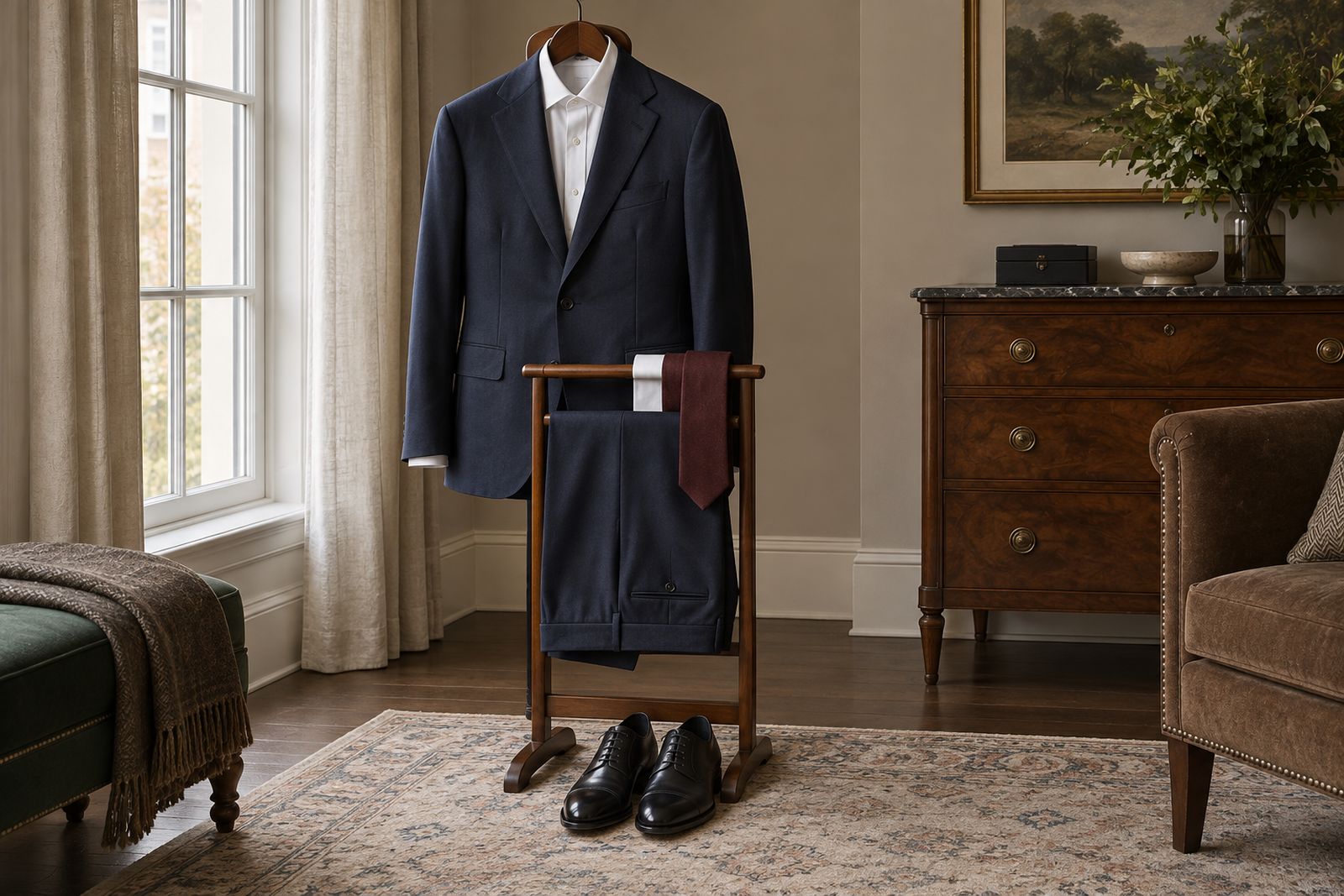
To wear a suit well, start with fit: shoulders that end at yours, a jacket that covers your seat, and sleeves that show ¼ to ½ inch (6 to 13 mm) of shirt cuff. Fasten the top button of a two-button jacket, never the bottom. Keep the shirt lighter than the suit, the tie darker than the shirt, the belt matched to your shoes and socks matched to your trousers.
- Fit first: no styling rescues a suit that does not fit.
- Two-button jacket: fasten the top button when standing, never the bottom; unfasten when you sit.
- Show ¼ to ½ inch (6 to 13 mm) of shirt cuff at the wrist and of shirt collar at the back of the neck.
- The tie tip should reach the top of your waistband or belt buckle.
- Belt matches shoes; socks match trousers and cover the shin.
- Remove the sleeve label and cut the vent tacking before the first wear.
In this guide
- How should a suit fit?
- Which suit buttons should you fasten?
- Lengths that matter: cuff, collar, trousers and tie
- Should your tie be darker than your shirt?
- Shoes, belt and socks: the finishing rules
- Details: pocket square, pockets, labels and stitches
- How to wear a suit without a tie
- How to dress a suit up or down
- How to look after a suit so it keeps looking right
- Common suit mistakes
- What a good tailor checks, and what can be altered
- Questions people ask
Knowing how to wear a suit is mostly a matter of proportion and a few conventions. Fit decides whether the suit looks like yours; buttons, lengths and colors decide whether it looks considered; shoes, belt and socks decide whether it looks finished. Here are the twelve rules that matter, each with a short explanation and a link to the detailed guide.
| # | Rule | In practice |
|---|---|---|
| 1 | Get the fit right | Shoulders end at yours; jacket covers your seat; trousers sit at the waist without a belt |
| 2 | Fasten the right buttons | Two-button: top only. Three-button: middle, sometimes top. Never the bottom |
| 3 | Show some shirt cuff | ¼ to ½ inch (6 to 13 mm) beyond the jacket sleeve |
| 4 | Show some shirt collar | ¼ to ½ inch (6 to 13 mm) above the jacket collar at the back |
| 5 | Hem the trousers to suit the cut | No break to a slight break on slim trousers; a fuller break on wider ones |
| 6 | Tie the right length | Tip at the top of the waistband or belt buckle |
| 7 | Keep the contrast | Shirt lighter than the suit, tie darker than the shirt |
| 8 | Match shoes to formality | Black for formal and business, brown for daytime and less formal |
| 9 | Match belt and socks | Belt matches shoes; socks match trousers and cover the shin |
| 10 | Complement, don't match | Pocket square relates to the tie without copying it |
| 11 | Keep it clean and flat | Empty pockets, labels removed, vent tacking cut |
| 12 | Look after it | Shaped hanger, a day's rest between wears, brush and steam |
How should a suit fit?
A suit should fit closely enough to follow your shape and loosely enough to move in. The shoulders are the most important point because they are the hardest to alter: the jacket's shoulder should end where yours does, with no overhang and no dent below the shoulder. Everything else, from sleeve length to waist, can usually be adjusted by a good tailor.
- Collar: the jacket collar lies against your shirt collar at the back, with no gap.
- Shoulders: the seam ends at your shoulder bone; the sleeve hangs straight from it.
- Chest: the lapels lie flat against your chest without bowing out.
- Button: fastened, the front closes without an X of creases pulling from the button.
- Waist: the jacket follows your waist with gentle shaping, not a tight pinch.
- Length: the jacket covers the seat of your trousers.
- Sleeve: the sleeve ends at the wrist bone, leaving room for the shirt cuff to show.
Trousers should sit at your natural waist or just below without needing a belt to hold them up, with a clean seat that neither sags nor pulls. Our guide to how a suit should fit covers every point in detail.
Which suit buttons should you fasten?
On a two-button jacket, fasten the top button and never the bottom. On a three-button jacket, fasten the middle button always, the top one if you like, and the bottom one never. Fasten your jacket when you stand and unfasten it when you sit, so the front does not pull and crease. A double-breasted jacket stays fastened when you stand.
A three-roll-two jacket has three buttons, but the lapel rolls over the top one, so you fasten only the middle. A one-button jacket is fastened when you stand. Our guide to which buttons to fasten covers double-breasted jackets and waistcoats in full.
Lengths that matter: cuff, collar, trousers and tie
Four lengths decide whether a suit looks right at a glance: how much shirt cuff and shirt collar show, where the trousers break and where the tie ends. Each one is a small measurement, and each is easy to get wrong.
How much shirt cuff should show?
About ¼ to ½ inch (6 to 13 mm) of shirt cuff should show beyond the jacket sleeve when your arms hang at your sides. That small band of white or blue frames the hand and shows the shirt fits. If no cuff shows, the jacket sleeves are too long or the shirt sleeves too short; if more than about ¾ inch (2 cm) shows, the reverse. See our guide to suit sleeve length.
How much shirt collar should show?
At the back of the neck, the shirt collar should show about ¼ to ½ inch (6 to 13 mm) above the jacket collar. It protects the jacket collar from wear and frames the neck. If no shirt collar shows, the shirt collar is too low for the jacket or the jacket collar sits too high.
How long should suit trousers be?
Suit trousers should end at the top of the shoe, with a length set by the width of the leg. Slim trousers look best with no break or a slight break, where the hem just touches the shoe. Wider, more traditional trousers look best with a half or full break, where the fabric folds once over the shoe. See trouser break.
| Break | What it looks like | Best with |
|---|---|---|
| No break | The hem just touches the shoe; no fold | Slim, modern trousers; loafers |
| Quarter (slight) break | A small dimple at the front | Most modern suits; the safest choice |
| Half break | One clear fold at the front | Traditional business suits |
| Full break | A deep fold resting on the shoe | Wide, classic trousers with turn-ups (cuffs) |
How long should a tie be?
The tip of the tie should touch the top of your belt buckle, or the top of the waistband if you wear braces; anywhere down to the middle of the buckle looks right. Shorter looks cramped; longer hangs below the belt and looks careless. Most ties are about 2¾ to 3½ inches (7 to 9 cm) wide at their widest point; match the width roughly to the width of your lapels. See how long a tie should be.
Should your tie be darker than your shirt?
Yes, your tie should almost always be darker than your shirt, and your shirt lighter than your suit. That step in lightness, from shirt to tie to suit, is what makes an outfit look composed. Keep to one or two colors beyond the neutrals (navy, gray, brown and white), and if you mix patterns, use different scales: a fine stripe with a large pattern, never two patterns of the same size.
The safest combination of all is a navy suit, a white or light blue shirt and a burgundy or navy tie. Our guide to suit, shirt and tie color combinations sets out a full grid by suit color.
Shoes, belt and socks: the finishing rules
Wear leather lace-ups with a business suit. A black cap-toe oxford is the most formal choice and right for interviews, conservative offices, funerals and evening; dark brown oxfords or derbies suit navy and gray suits in daytime and less formal settings. Loafers and monk straps suit relaxed offices; sneakers belong only with a casual suit. Our guide to shoes to wear with a suit ranks every style.
Should your belt match your shoes?
Yes, your belt should match your shoes in color and roughly in finish: black with black, brown with a close shade of brown. Keep the belt slim, about 1 to 1¼ inches (2.5 to 3.2 cm) wide, with a plain buckle. If your trousers have side adjusters or you wear braces (suspenders), wear no belt.
What socks to wear with a suit
Wear socks long enough to hide your shin when you sit and cross your legs, in a color that matches your trousers or is a shade darker. Over-the-calf socks are the most reliable. Bare shin between sock and trouser hem is a common finishing mistake, and the easiest to avoid.
Details: pocket square, pockets, labels and stitches
Pocket square
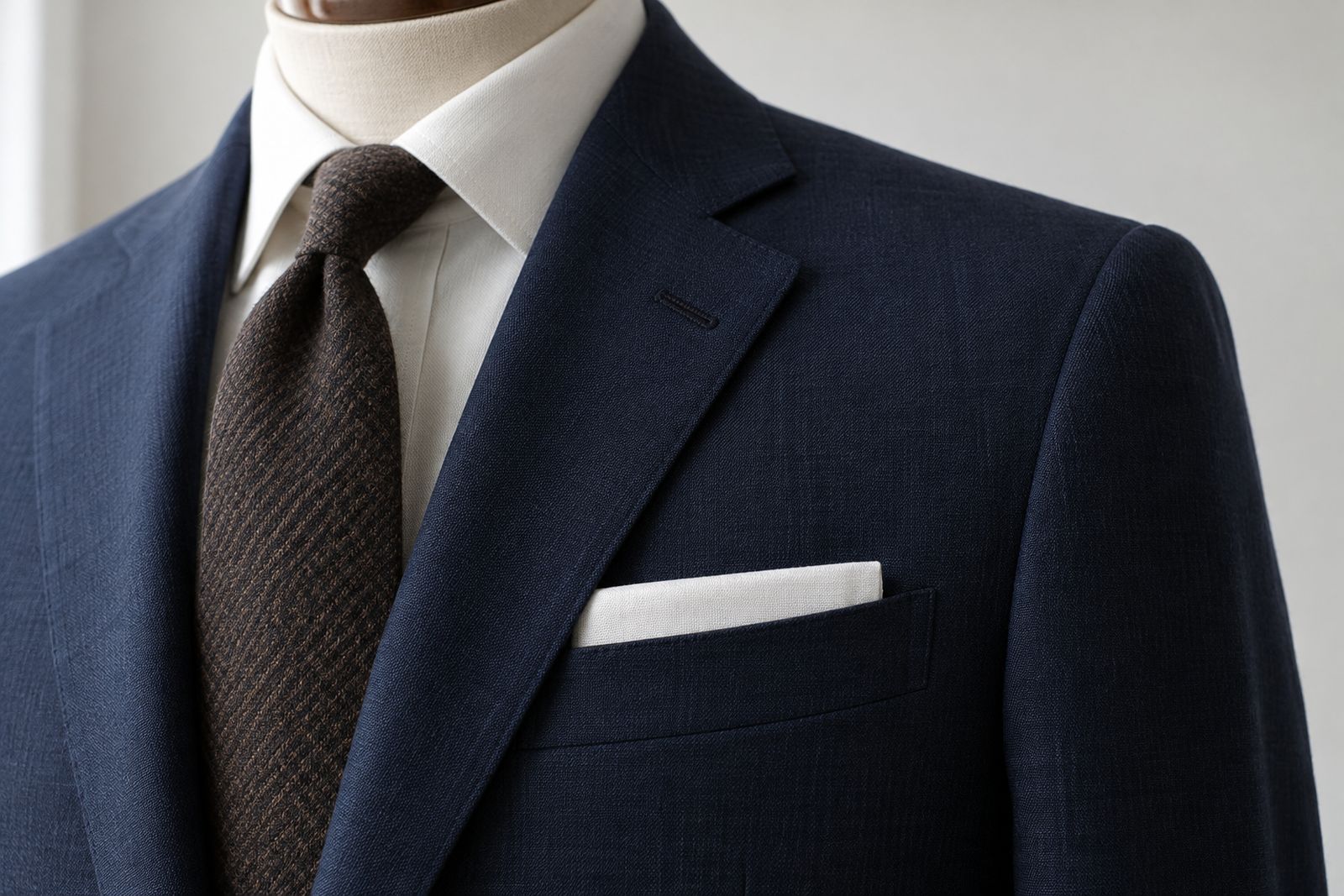
A pocket square is optional but finishes a suit. A white linen square in a flat presidential fold suits every suit and every occasion. If you choose a colored or patterned square, pick up a color from the tie or shirt rather than matching the tie exactly. Our guide to folding a pocket square shows six folds step by step.
Keep the pockets flat
Suit pockets are cut for a slim wallet, a card holder or a pen, not a phone, keys and a full wallet at once. Heavy pockets pull the jacket out of shape and, over time, stretch the openings. Carry the minimum in the jacket, ideally in the inside pocket, and keep the outer pockets nearly empty. Flap pockets can be worn with the flaps out or tucked in, as long as both sides match.
Remove the label and cut the tacking before you wear it
Many ready-to-wear suits come with a brand label stitched to the outside of the left sleeve cuff and with loose X-shaped stitches holding the vents closed. Both are there for the shop, not for you. Snip the label's stitches carefully with small scissors, without cutting the fabric, and remove the vent tacking. Outer pockets are often lightly stitched shut to keep their shape; you can open them, though many men leave the lower pockets closed for a cleaner line.
How to wear a suit without a tie
A suit without a tie needs a shirt collar that holds its shape and a few other adjustments, or it looks as if something is missing. Choose a semi-spread collar with stays or a button-down, which stand up under the lapels; a soft cutaway tends to collapse. Undo only the top button, and make sure no undershirt shows at the neck: wear a V-neck undershirt or none.
Tie-free suits look best in fabrics with some texture, such as flannel, hopsack, linen or cotton, and in navy, gray, brown or lighter colors rather than formal charcoal or black. Swap black oxfords for brown derbies, monk straps or suede loafers, and add a pocket square to put back some of the color the tie would have carried.
How to dress a suit up or down
The same suit can move from a formal meeting to a weekend lunch by changing what goes with it. Formality comes from contrast, smoothness and black leather; ease comes from softer colors, texture and brown or suede.
| Level | Shirt | Tie | Shoes | Pocket square |
|---|---|---|---|---|
| Most formal | White, spread collar, French or barrel cuffs | Dark silk, solid or small pattern | Black cap-toe oxfords | White linen, presidential fold |
| Business | White or light blue | Silk in burgundy, navy or green | Black or dark brown oxfords | White linen or none |
| Relaxed office | Light blue, pink or fine stripe | Knit, wool or grenadine | Brown derbies or monk straps | Patterned silk, puff fold |
| Smart casual | Oxford button-down or knitted polo | None | Suede loafers or leather sneakers (casual suits only) | Patterned silk or none |
How to look after a suit so it keeps looking right
Hang the jacket on a wide, shaped wooden hanger that supports the shoulders, and hang the trousers by the hem or folded over a bar. Give a suit at least a day's rest between wears so the fabric can recover and dry. Brush it after wearing, steam out creases rather than ironing directly on the fabric, and dry clean it only when it is stained or smells, because frequent cleaning wears wool faster. Our guide to caring for a suit covers the daily, weekly and seasonal routine.
Common suit mistakes
Most suit mistakes come from fit or from small details left unchecked. Here are the ones a tailor notices first, roughly in the order they spoil an outfit.
- Shoulders too wide, so the sleeve hangs from a ridge past your shoulder.
- Sleeves too long, hiding the shirt cuff entirely.
- Fastening the bottom button of a single-breasted jacket.
- Trousers pooling over the shoes, or riding high above them.
- A tie that stops above the waistband or hangs below the belt.
- A belt that does not match the shoes, or short socks that show the shin.
- Overloaded pockets that pull the jacket out of shape.
- The sleeve label and vent tacking still in place.
What a good tailor checks, and what can be altered
A good tailor checks the suit in the order of difficulty: shoulders first, because they are the hardest to change, then chest and collar, then lengths. Bring the shirt and shoes you will wear with the suit to every fitting, because the shirt sets the cuff and the shoes set the trouser length.
| Alteration | Difficulty | Notes |
|---|---|---|
| Trouser length | Easy | Bring your shoes so the break is set correctly |
| Trouser waist | Usually easy | Limited to the seam allowance, often about an inch (2.5 cm) either way |
| Jacket waist | Usually easy | Taking in or letting out at the side and back seams |
| Sleeve length | Easy to moderate | Harder if the cuffs have working buttonholes, which must be adjusted from the shoulder |
| Collar gap at the back | Moderate | A skilled tailor can lower or reshape the collar |
| Jacket length | Hard | Can be shortened a little; cannot be lengthened |
| Shoulders | Hard | Costly and rarely worth it; buy for the shoulders |
For the full picture, see our guide to what a tailor can and can't alter.
Before you leave the house
- Jacket fastened: top button of two, middle of three, never the bottom.
- ¼ to ½ inch (6 to 13 mm) of shirt cuff showing at each wrist.
- Shirt collar visible above the jacket collar at the back.
- Tie tip at the top of the waistband or belt buckle, with a neat knot.
- Shirt lighter than the suit, tie darker than the shirt.
- Belt matches shoes; shoes polished.
- Socks match trousers and cover the shin when you sit.
- Pockets nearly empty; no sleeve label, no vent tacking.
- Pocket square complements the tie rather than matching it.
Follow these rules and almost any well-fitting suit will look right. Start with fit, because it is the foundation the other eleven rules rest on, and work outward to the details.
Questions people ask
Which suit buttons should you fasten?
On a two-button jacket, fasten the top button and never the bottom. On a three-button jacket, fasten the middle, optionally the top, and never the bottom. Unfasten a single-breasted jacket when you sit and fasten it again when you stand.
Should your tie be darker than your shirt?
Yes, in almost every case. A tie darker than the shirt creates the contrast that makes an outfit look composed, while a pale tie on a darker shirt looks theatrical. The shirt, in turn, should be lighter than the suit.
Should your belt match your shoes?
Yes, match your belt to your shoes in color and roughly in finish, such as black with black or dark brown with dark brown. The shades should be close, not necessarily identical. If you wear braces or trousers with side adjusters, skip the belt.
How much shirt cuff should show?
About ¼ to ½ inch (6 to 13 mm) of shirt cuff should show beyond the jacket sleeve with your arms at your sides. If none shows, the jacket sleeves are too long; if much more shows, they are too short or the shirt sleeves too long. A tailor can usually adjust jacket sleeve length.
How long should a tie be with a suit?
The tip of the tie should touch the top of your belt buckle, or the top of the waistband if you wear braces. Adjust the starting length before tying, or choose a knot that uses more or less of the tie. A tie that ends far above or below the waistband looks careless.
Should you unbutton your suit jacket when sitting?
Yes, unbutton a single-breasted jacket when you sit, so the front does not pull, crease or strain the button. Fasten it again when you stand. A double-breasted jacket is traditionally kept fastened, though many men open it when seated for comfort.
Do you have to wear a tie with a suit?
No, many suits look good without a tie, especially in relaxed offices and at social events. Wear a shirt with a collar that stands up under the lapels, such as a semi-spread with stays or a button-down, and choose loafers or brown shoes. For interviews, funerals and formal business, wear a tie.
TailorGuide is independent. Our guides are written and checked by our team and carry no paid endorsements. How we work.