The short answer
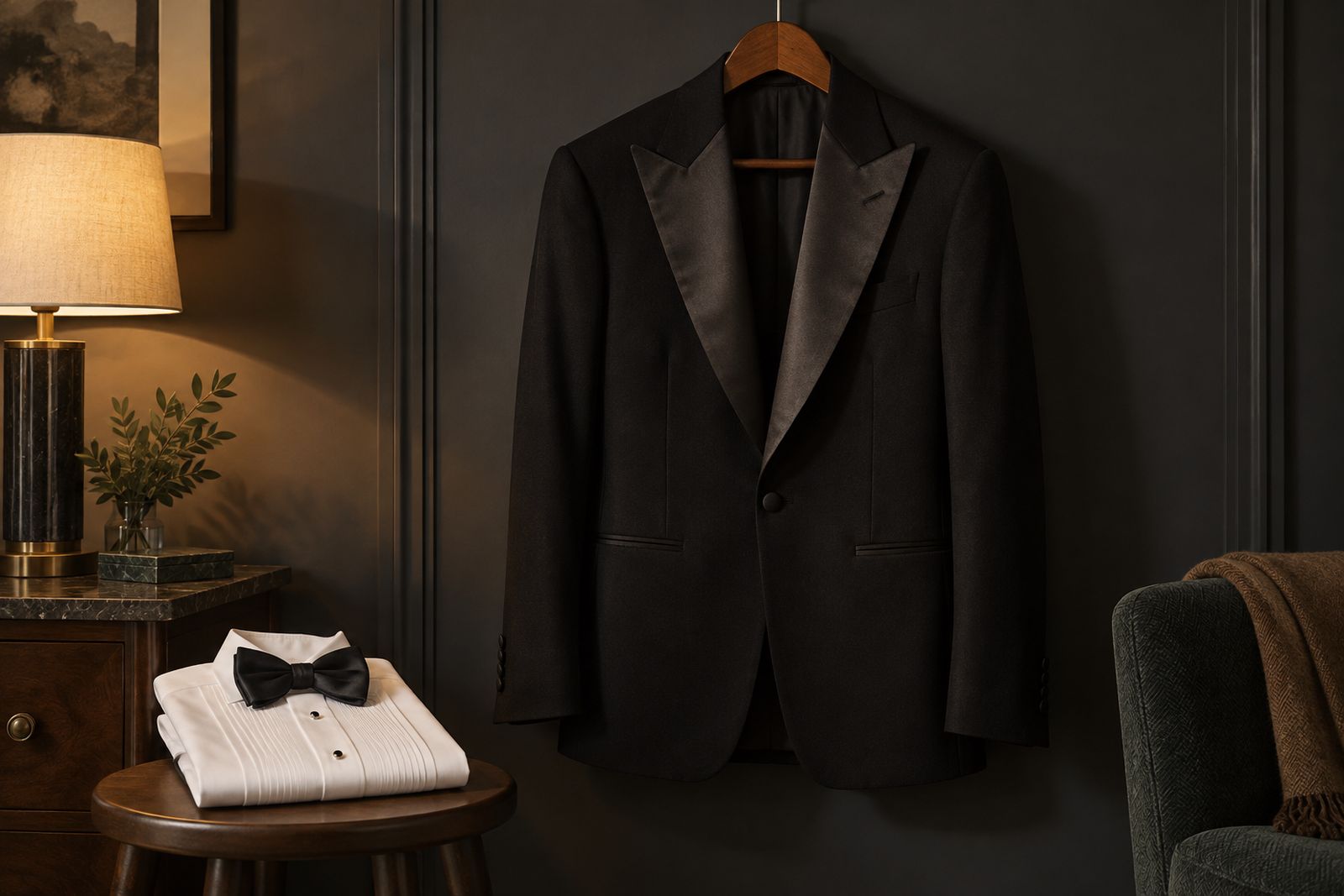
The black tie dress code for men means a black or midnight blue dinner jacket (tuxedo) with satin or grosgrain lapels, matching trousers with a single side braid, a white dress shirt with studs and French cuffs, a black self-tie bow tie, a cummerbund or low-cut waistcoat, and black patent or highly polished plain oxfords. It is worn only in the evening.
- Dinner jacket in black or midnight blue, with peak or shawl lapels faced in satin or grosgrain.
- Trousers match the jacket, with one braid per side, no belt loops and no turn-ups (cuffs).
- White dress shirt with a turndown collar, studs and French cuffs, and a black self-tie bow tie.
- Cover the waist with a cummerbund or a low-cut waistcoat, unless the jacket is double-breasted.
- Black patent or highly polished plain oxfords, or opera pumps, with black over-the-calf socks.
- In warm climates an ivory dinner jacket with black trousers is correct.
In this guide
- What does black tie mean?
- The black tie outfit, head to toe
- The dinner jacket: color, lapels and details
- Dinner suit trousers: braid, no belt loops, no turn-ups
- The shirt: collar, bib, studs and cuffs
- Do you have to wear a bow tie for black tie?
- Cummerbund or waistcoat?
- Black tie shoes and socks
- Accessories: pocket square, cufflinks, watch and coat
- What color tuxedo for black tie?
- The white dinner jacket: black tie in hot weather
- Can you wear a suit to a black tie event?
- Common black tie mistakes
- Buy, hire or have one made? The tailor's view
- Questions people ask
The black tie dress code is the evening standard for galas, formal dinners, evening weddings and award ceremonies, and it is the most exact code most men will ever wear. Unlike business dress, where taste fills the gaps, black tie specifies every item: the jacket, the lapel facing, the trouser braid, the shirt front, the tie and the shoes. That precision is a gift. Once you know the rules, there is nothing left to guess.
Black tie at a glance
- Jacket
- Dinner jacket (tuxedo), black or midnight blue; peak or shawl lapels faced in satin or grosgrain
- Trousers
- Matching; single braid down each outside seam; no belt loops; no turn-ups
- Shirt
- White; turndown collar; pleated or piqué bib; studs; French cuffs
- Neckwear
- Black self-tie bow tie
- Waist
- Cummerbund or low-cut waistcoat
- Shoes and socks
- Black patent or highly polished plain oxfords, or opera pumps; black over-the-calf socks
- Optional
- White pocket square; ivory dinner jacket in warm climates
- When
- Evening only, traditionally from about 6 pm
What does black tie mean?
Black tie means formal evening dress built around a dinner jacket, the garment Americans call a tuxedo, worn with matching trousers, a white dress shirt and a black bow tie. It sits one rung below white tie and one rung above black tie optional on the ladder of men's dress codes. It is evening wear only. A daytime formal event calls for morning dress or a lounge suit, never a dinner jacket.
The name comes from the bow tie, which separates it from white tie, where the bow tie, waistcoat and shirt front are white. "Dinner jacket", "DJ" and "tuxedo" on an invitation all mean the same thing.
The black tie outfit, head to toe
Each item has a correct form and a set of common substitutes that give the game away. This table lists both.
| Item | Correct | Avoid |
|---|---|---|
| Jacket | Black or midnight blue dinner jacket; peak or shawl lapels faced in satin or grosgrain; covered buttons; jetted pockets | A black business suit; flap pockets; plain lapels; colored jackets outside creative black tie |
| Trousers | Matching; one braid down each outside seam; braces or side adjusters; no turn-ups | Belt loops and a belt; turn-ups (cuffs); a long, puddling break |
| Shirt | White; turndown collar; pleated or piqué bib; studs or a covered placket; French cuffs | Button-down collars; colored or patterned shirts; barrel cuffs |
| Neckwear | Black self-tie bow tie, in satin, grosgrain or barathea | A long necktie; a novelty or clip-on bow tie in a bright color |
| Waist | Black cummerbund, pleats facing up, or a black low-cut waistcoat | A business waistcoat with a high opening; leaving the shirt and waistband showing |
| Shoes | Black patent or highly polished plain oxfords; opera pumps | Brogues; brown shoes; loafers with suede or tassels; sneakers |
| Socks | Black silk or fine wool, over the calf | Ankle socks that show skin; patterned or colored socks |
| Pocket square | White linen or silk, simply folded (optional) | A square matched to the bow tie in a printed set |
| Watch | A slim dress watch on a leather strap, or none | A large sports or diving watch |
The dinner jacket: color, lapels and details
A dinner jacket is cut like a single-breasted suit jacket but finished as eveningwear. The lapels are faced in silk, the buttons are covered in the same silk or in the jacket fabric, the pockets are jetted with no flaps, and the cut is clean, usually with one button. Traditionally it has no vents; double vents are a common modern compromise.
Color: black or midnight blue
The jacket is black or midnight blue. Midnight blue is a very dark navy that, under artificial light, reads as a rich near-black, which is why it has long been worn as an alternative to black. Either is correct, and nobody at a black tie event will think a midnight blue jacket is the wrong color.
Lapels: peak, shawl or notch
Peak and shawl lapels are the traditional choices. A peak lapel is sharper and more formal; a shawl collar is a continuous rounded curve with no notch, softer and slightly more relaxed. Notch lapels are acceptable but less traditional, because they borrow the lapel of a business suit. The facing on the lapels is satin, which is smooth and shiny, or grosgrain, which is ribbed and matte. Grosgrain shows less wear and looks quieter; satin catches more light. See peak vs notch lapels for the full comparison.
Single or double-breasted?
Single-breasted with one button is the standard. A double-breasted dinner jacket, usually with peak lapels, is equally correct. It stays buttoned all evening, so it needs no cummerbund or waistcoat. See single vs double-breasted for how the two cuts differ.
Fabric
Dinner suits are made in fine worsted wool, including barathea (a fine, pebbly twill) and grain de poudre (a dense weave with a matte, grainy surface), or in wool blended with mohair, which adds a subtle sheen and resists creasing. A weight of about 9 to 11 oz (280 to 340 g) wears well year-round in a heated room. For hot climates, 7 to 9 oz (220 to 280 g) in a wool-mohair blend keeps the line crisp without the heat.
Dinner suit trousers: braid, no belt loops, no turn-ups
Dinner suit trousers are cut from the same fabric as the jacket, with a single braid of silk running down each outside seam, matching the lapel facing. They have no belt loops, because a belt would show under the jacket and spoil the line. They are held up by braces (suspenders) or by side adjusters, small buckled tabs at the waistband. They never have turn-ups (cuffs).
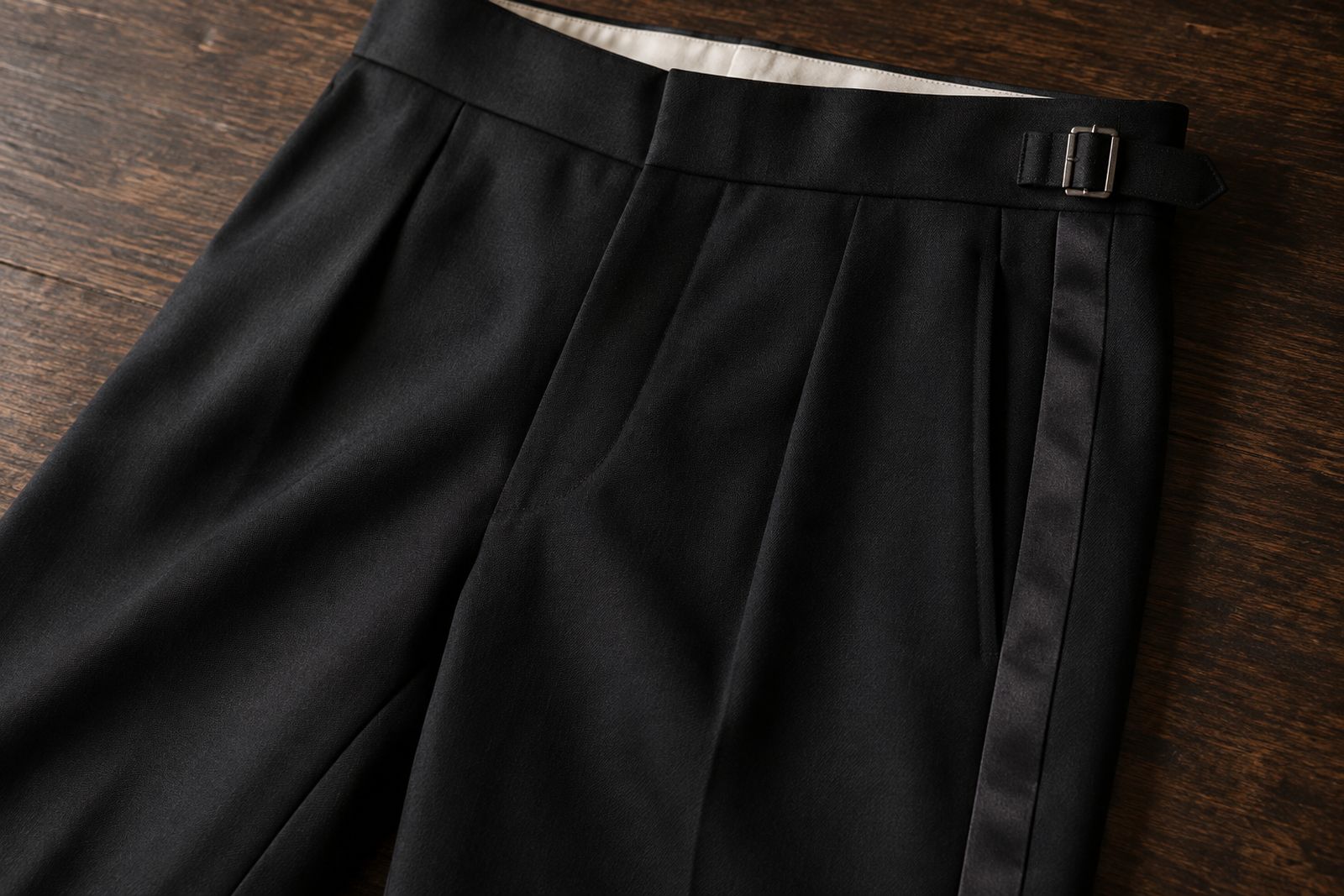
The rise should be high enough that the waistband sits at or near your natural waist, so the cummerbund or waistcoat covers it fully. Length should give a slight break or none: dinner trousers look sharpest with a clean line over the shoe. Our trouser break guide shows the options.
The shirt: collar, bib, studs and cuffs
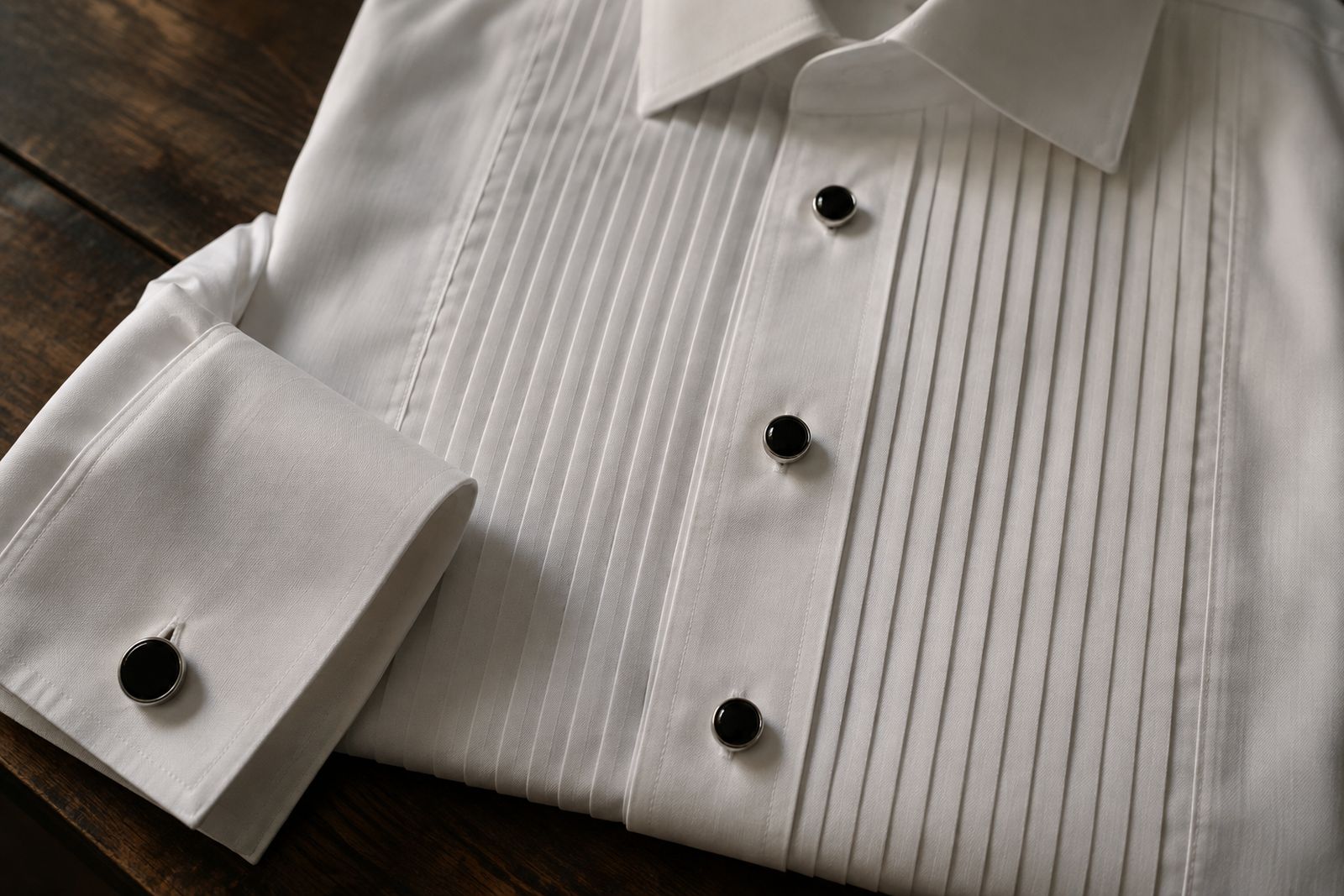
A black tie shirt is white, with a turndown collar, a decorative front (the bib), studs and French cuffs. The bib is either pleated, with narrow vertical pleats, or piqué, a stiff textured cotton. Studs replace the top front buttons, usually three or four, in black onyx, mother-of-pearl, gold or silver; a covered placket that hides the buttons is an acceptable alternative. Cufflinks should match the studs.
A wing collar, with its small points standing up under the bow tie, belongs to white tie. Some men wear it with black tie and it is not a serious error, but the turndown collar is the classic choice and sits better under a modern bow tie. The collar should be a spread or point collar with enough height to hold the bow tie band out of sight.
Do you have to wear a bow tie for black tie?
Yes. Black tie means a black bow tie, and the correct version is self-tied, in silk satin, grosgrain or barathea, usually matching the lapel facing. A long necktie is not black tie, even a black silk one. A pre-tied bow is not a disaster, but it looks too symmetrical and anyone who knows will see it. Learning to tie one takes ten minutes of practice: see how to tie a bow tie.
The common shapes are the butterfly, which is fuller, and the batwing, which is narrower and straighter. A rule of thumb for size: the bow should not extend beyond the outer corners of your eyes. Self-tie bow ties come in fixed collar sizes or with an adjustable slider.
Cummerbund or waistcoat?
Black tie covers the waist with either a cummerbund or a low-cut waistcoat, so that no white shirt shows between the jacket button and the trousers. Both are correct. The choice comes down to build, temperature and taste.
Cummerbund
A pleated silk sash
- Wraps the waist and fastens at the back
- Pleats face up
- Cooler, the better choice in warm weather
- Should match the lapel facing: satin with satin, grosgrain with grosgrain
Evening waistcoat
A low-cut vest
- Black, cut in a low U or V so the shirt bib shows
- Often backless, with a strap at the back
- Warmer and more formal-looking
- Must cover the waistband; a business waistcoat is cut too high
Black tie shoes and socks
Black tie shoes are black patent leather oxfords, highly polished plain-toe oxfords in black calf, or opera pumps, the low-cut slip-on with a grosgrain bow that is the most traditional of the three. Oxfords have closed lacing and no broguing. Socks are black silk or fine wool, over the calf, so no skin shows when you sit. Brown shoes, brogues and loafers do not belong at black tie.
Accessories: pocket square, cufflinks, watch and coat
- Pocket square: optional. White linen or silk, in a straight fold or a soft puff. Avoid matched printed sets.
- Studs and cufflinks: matching, and simple. Onyx, mother-of-pearl or plain metal.
- Watch: a slim dress watch on a black leather strap, or none. The traditional view is that a guest at a formal dinner should not be watching the clock.
- Coat: a dark overcoat, such as a navy or black Chesterfield, with a white silk scarf. See overcoat styles.
- Boutonnière: optional, small and single, worn in the lapel buttonhole.
What color tuxedo for black tie?
For black tie, the dinner jacket is black or midnight blue, and the trousers match. The one standard exception is the ivory or white dinner jacket, worn with black trousers in warm climates. Velvet jackets in bottle green, burgundy or navy are traditional for hosting at home and suit "creative black tie" invitations, but at a strict black tie event they announce that you have chosen not to follow the code. Gray, light blue and patterned tuxedos are not black tie.
Classic
Black dinner suit
Black
Jacket
Black, single braid
Trousers
White
Shirt
Black bow tie
Tie
Black patent
Shoes
Classic
Midnight blue dinner suit
Midnight blue
Jacket
Midnight blue
Trousers
White
Shirt
Black bow tie
Tie
Black patent
Shoes
Works
Ivory dinner jacket, warm climates
Ivory
Jacket
Black, single braid
Trousers
White
Shirt
Black bow tie
Tie
Black patent
Shoes
Bold
Velvet jacket, creative black tie
Bottle green velvet
Jacket
Black
Trousers
White
Shirt
Black bow tie
Tie
Black velvet or patent
Shoes
Avoid
Black business suit, long tie
Plain lapels, flap pockets and a long tie: this is not black tie.
Black
Suit
White
Shirt
Black long tie
Tie
Black
Shoes
The white dinner jacket: black tie in hot weather
In warm climates, black tie allows an ivory or white dinner jacket worn with the standard black dinner trousers, white shirt, black bow tie and black shoes. It is the right choice for evening events in tropical or desert heat and for summer black tie outdoors. It is out of place at a winter event in a cold city, where it looks like a costume.
The jacket is usually ivory or off-white rather than brilliant white, single-breasted, with peak or shawl lapels. Its lapels are usually faced in the same fabric as the body rather than in silk, which keeps the jacket quiet; the buttons are covered or in a matching material. Lightweight wool, or wool blended with mohair or silk, holds its shape best. Our guide to staying cool in a suit covers the fabric and lining choices that make eveningwear bearable in heat.
Can you wear a suit to a black tie event?
Strictly, no. A business suit is the dress code below black tie, and a host who writes "black tie" without "optional" is asking for a dinner jacket. If you have none, hire one; formalwear hire is widely available and a well-fitted hired dinner suit is better than a business suit. If that is impossible, wear your darkest navy or charcoal suit, a white shirt, a dark silk tie and black oxfords, and accept that you are underdressed.
Can you wear a black suit to a black tie event?
A black business suit is not a dinner suit, and among dinner jackets it reads as an imitation of one. Adding a bow tie makes the imitation more obvious, not less. If a black suit is all you own and hiring is impossible, wear it as a suit, with a white shirt and a dark silk tie; a navy or charcoal suit worn the same way looks more deliberate still. For a strict black tie event, hiring is the better answer. Our tuxedo vs suit guide explains each difference, and black tie optional covers when a suit is welcome.
Common black tie mistakes
- Wearing a long necktie instead of a bow tie.
- Wearing a belt, or trousers with belt loops.
- Leaving a strip of white shirt visible between the jacket button and the trousers.
- A business waistcoat cut too high, or a cummerbund with the pleats facing down.
- Brown shoes, brogues or loafers.
- A jacket too long or too short: it should cover the seat, as a suit jacket does.
- A black tie outfit at a daytime event: black tie is evening wear only.
- Ankle socks that show bare skin when you sit.
Buy, hire or have one made? The tailor's view
Hire if you wear black tie once every few years. Buy or commission if you wear it once a year or more: hire rarely fits well, hired shirts and bow ties are often poor, and a good dinner suit barely dates. Because the style changes so little, a dinner suit is one of the best garments to have made, and a bespoke or made-to-measure one will serve for decades with only minor alteration. Our ranking of London's best tailors includes the houses we would trust with one.
What a good tailor checks on a dinner suit
- The jacket covers the seat and the single button sits at or just above the natural waist.
- The sleeve shows ¼ to ½ inch (6 to 13 mm) of shirt cuff, so the cufflinks are seen.
- The lapel facing runs cleanly to the edge, with no bubbling or puckering.
- Buttons are covered in the facing silk or the jacket fabric, not horn or plastic.
- Pockets are jetted, with no flaps.
- Trousers sit at the natural waist, with side adjusters or brace buttons and no belt loops.
- One braid down each outside seam, matching the lapel facing.
- The trouser hem has a slight break or none, and no turn-up.
What to tell your tailor: single-breasted, one button, peak or shawl lapels faced in grosgrain or satin, covered buttons, jetted pockets, no vents or double vents, trousers with side adjusters and a single braid. Then get the shirt right, learn to tie the bow tie, and polish the shoes. None of these details is difficult, and together they are what make a dinner suit look right.
Questions people ask
Can you wear a suit to a black tie event?
Strictly, no: black tie means a dinner jacket, and a business suit is one rung below. Hire a dinner suit if you can. If you cannot, wear your darkest navy or charcoal suit with a white shirt and dark silk tie, and accept that you are underdressed.
Can you wear a black suit to a black tie event?
A black business suit is not a dinner suit. It has plain lapels, flap pockets and ordinary buttons, and among real dinner jackets it reads as an imitation. A dark navy or charcoal suit with a long tie looks more deliberate, and hiring a dinner suit is better still.
Do you have to wear a bow tie for black tie?
Yes. The dress code is named after the black bow tie, and a long necktie, even a black one, is not black tie. The correct version is self-tied in silk satin, grosgrain or barathea, ideally matching the lapel facing.
What color tuxedo for black tie?
Black or midnight blue, with matching trousers. An ivory or white dinner jacket worn with black trousers is correct in warm climates. Velvet jackets suit creative black tie, while gray, light blue and patterned tuxedos are not black tie.
Is a tuxedo the same as a dinner jacket?
Yes. Tuxedo is the American term and dinner jacket the British one for the same garment: an evening jacket with silk-faced lapels, covered buttons and jetted pockets. Dinner suit or tuxedo refers to the jacket and matching trousers together.
Can you wear a belt with a tuxedo?
No. Dinner suit trousers have no belt loops and are held up by braces or side adjusters. A belt would also show below the jacket button and break the line the cummerbund or waistcoat is there to keep.
What time does black tie start?
Black tie is evening wear, traditionally worn from about 6 pm onward. For a wedding that starts in the afternoon and runs into the evening, follow the invitation: if it says black tie, the host expects it from the ceremony. For a daytime formal event, morning dress or a lounge suit is correct instead.
Do you need a cummerbund with a tuxedo?
You need either a cummerbund or a low-cut evening waistcoat with a single-breasted dinner jacket, so the waistband and shirt do not show. A double-breasted dinner jacket stays buttoned, so it needs neither. Wear cummerbund pleats facing up.
TailorGuide is independent. Our guides are written and checked by our team and carry no paid endorsements. How we work.