The short answer
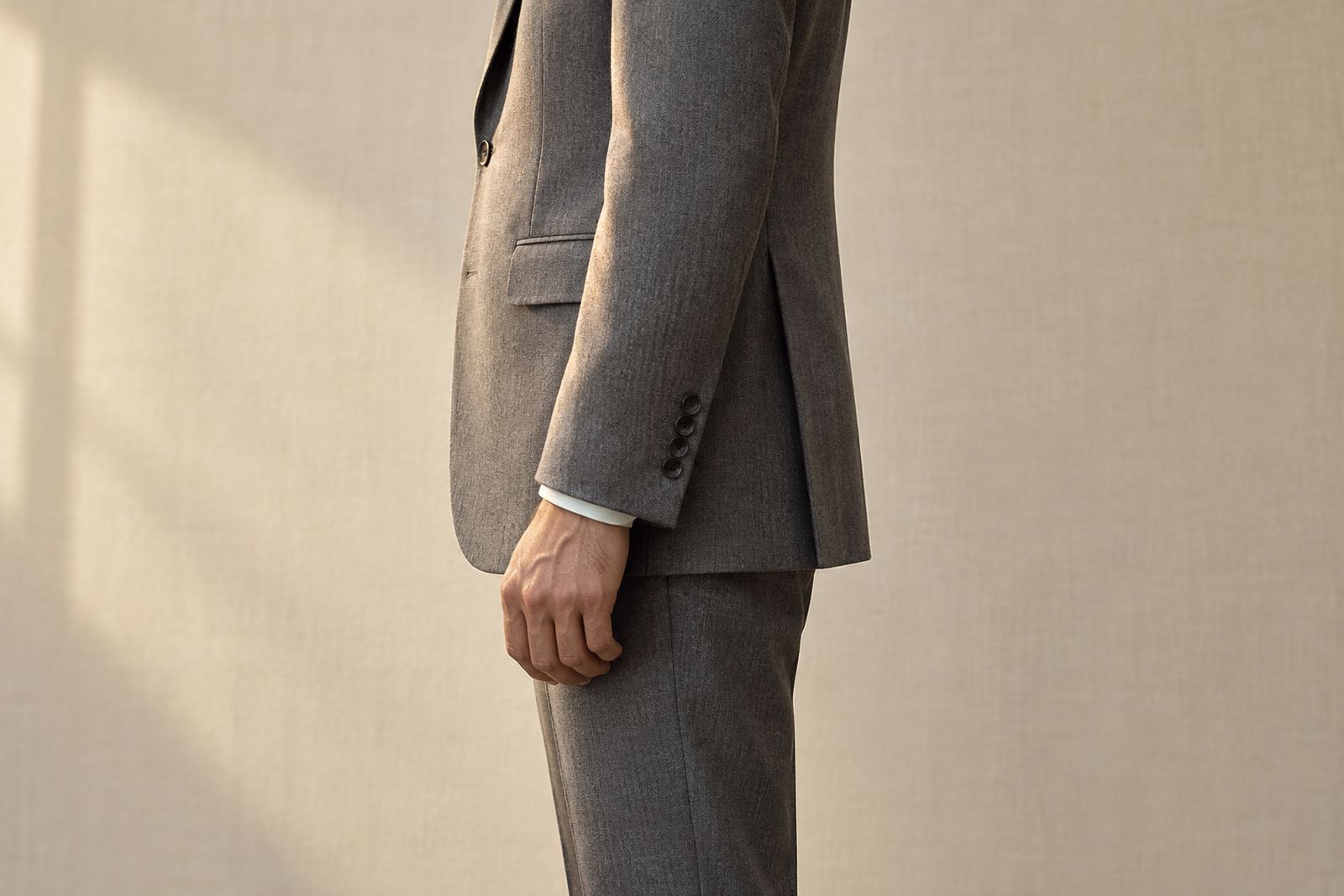
A suit jacket should be long enough to cover your seat. With your arms relaxed, the hem usually falls around your knuckles or the middle of your thumb, and many tailors cut the back length to roughly half the distance from the base of the collar to the floor. Treat these as guides: cover the seat first, then adjust for your proportions.
- Cover the seat: it is the most reliable length rule for a classic suit jacket
- The knuckle or mid-thumb check is a guide, not a law; long or short arms throw it off
- Proportion rule: back length is roughly half the distance from the collar seam to the floor
- A tailor can shorten a jacket by about 1 inch (2.5 cm); lengthening is rarely possible
- Short men should not go so short that the seat shows; tall men usually need long sizes
In this guide
- How long should a suit jacket be? The short answer
- Rule 1: Should a suit jacket cover your seat?
- Rule 2: The knuckle or thumb check
- Rule 3: Half the distance from collar to floor
- Is my suit jacket too short or too long?
- How long should a jacket be for short men?
- Can a suit jacket be shortened or lengthened?
- How a tailor decides on jacket length
- Questions people ask
Jacket length is an easy fit point to get wrong without noticing. A jacket a little too short makes a grown man look as if he has outgrown his suit; one a little too long makes his legs disappear. So how long should a suit jacket be? Long enough to cover your seat, and in proportion to your body. The popular finger rules help, but none of them works for everyone.
How long should a suit jacket be? The short answer
A classic suit jacket should cover your seat completely. From there, two checks fine-tune the length: the hem should fall around your knuckles or the middle of your thumb with your arms relaxed, and the back length should be roughly half the distance from the base of the collar to the floor. When the checks disagree, the seat rule wins.
Suit jacket length at a glance
- First rule
- Cover the seat
- Hand check
- Hem around the knuckles or mid-thumb, arms relaxed
- Proportion check
- Back length about half of collar-to-floor
- Typical back length
- About 29 to 32 inches (74 to 81 cm) for most men, by height
- Shortening limit
- About 1 inch (2.5 cm)
- Lengthening
- Rarely possible
| Rule | How to check it | Strength | Weakness |
|---|---|---|---|
| Cover the seat | Side view in a mirror, standing naturally | Works for almost every build | Says nothing about how much longer than the seat |
| Knuckles or mid-thumb | Arms relaxed at your sides, look where the hem lands on your hand | Quick, needs no tape | Depends on arm length; misleads long- and short-armed men |
| Half of collar to floor | Measure from the collar seam at the back of the neck to the floor, then halve it | Ties length to your height | Ignores whether your legs or torso are long |
Rule 1: Should a suit jacket cover your seat?
Yes. A classic suit jacket should cover your seat, and this is the most dependable of the three rules. It works because it is tied to your own body rather than to your arms or a formula. A jacket that covers the seat closes the line between the jacket and trousers neatly, keeps the vents hanging straight and gives the suit its traditional balance.
Check it side-on in a mirror, standing naturally with your weight on both feet. The hem should sit just below the curve of your seat, not on the curve itself. A jacket that ends exactly at the fullest point of the seat looks short when you move, because the hem rides up over it.
Rule 2: The knuckle or thumb check
With your arms relaxed at your sides, the hem of a well-proportioned jacket usually falls around your knuckles or the middle of your thumb. A variant says you should be able to curl your fingers under the hem. It is the most quoted jacket length rule because it needs no tape measure.
It is a guide, not a law. Arm length varies a great deal from man to man, so the rule measures your arms as much as your jacket. A man with long arms who follows it will choose a jacket that is too short at the back; a man with short arms will end up in one that is too long. Use it as a quick check, then confirm with the seat rule.
Rule 3: Half the distance from collar to floor
Many tailors set jacket length by proportion: the back length, measured from the seam where the collar joins the jacket at the back of the neck down to the hem, is roughly half the distance from that point to the floor. The rule ties length to your height, which is why it is the basis of most tailors' first estimate.
To check it, have someone measure from the base of your collar (the prominent bone at the back of your neck) to the floor while you stand in shoes, then halve the figure. Compare it with the back length of a jacket you own, measured down the center back seam from the collar seam to the hem.
| Your height | Approximate back length | Usual size length |
|---|---|---|
| 5 ft 5 in (165 cm) | About 28 inches (71 cm) | Short |
| 5 ft 8 in (173 cm) | About 29 inches (74 cm) | Short or regular |
| 5 ft 11 in (180 cm) | About 30½ inches (77 cm) | Regular |
| 6 ft 2 in (188 cm) | About 32 inches (81 cm) | Long |
| 6 ft 5 in (196 cm) | About 33 inches (84 cm) | Extra long |
Estimates only. A long torso or long legs can move the right length by an inch (2.5 cm) either way, and brands cut their short, regular and long sizes differently.
The weakness of the rule is that it treats everyone as having average proportions. A man with a long torso and shorter legs may need a slightly shorter jacket than the rule suggests, to leave more leg showing. A man with long legs and a short torso can carry a little more length. This is where the seat rule acts as the floor: whatever the proportions, the seat stays covered.
Is my suit jacket too short or too long?
Your jacket is too short if any part of your seat shows from the side, if the vents splay open over your seat, or if your trouser waistband and a triangle of shirt show below the fastened button. It is too long if the hem falls well past the seat toward mid-thigh, if your legs look short in a full-length mirror, or if the jacket starts to read as a coat.
Too short
- Seat partly visible from the side
- Vents splay open over the seat
- Shirt and waistband show below the button
- Torso looks cropped, legs overlong
- Hem rides up when you sit or reach
Too long
- Hem falls well toward mid-thigh
- Legs look short in a full mirror
- Hip pockets sit low on the body
- Jacket reads as a short overcoat
- Hem bunches when you sit
Length also has to be level. Seen from the side, the hem should run parallel to the floor. A hem that kicks up at the back usually means the jacket is short in the back for your posture; one that dips at the back means the opposite. A tailor calls this the jacket's balance, and it is checked alongside length at every fitting.
How long should a jacket be for short men?
A short man's jacket should cover the seat and no more. That keeps as much leg in view as possible, which makes you look taller, while keeping the jacket in proportion. Short sizes (marked S) exist for exactly this reason: they cut the body and the sleeves shorter than a regular of the same chest size.
Resist going shorter than the seat. A cropped jacket on a short man makes the torso look small and the suit look outgrown. Pair a seat-length jacket with trousers that sit at or near the natural waist and with a quarter or no break at the hem, so the leg line runs unbroken; the options are set out in trouser break explained.
And for tall men?
Tall men most often have the opposite problem: regular sizes are too short in both the body and the sleeves. Long (L) and extra long (XL) sizes add length to both. If you are between regular and long, choose by whether the jacket covers your seat and whether the sleeves reach your wrists, not by your height alone. The suit size chart gives the usual height ranges for each length.
Details that change how long a jacket looks
- Button position: a fastened button set below the navel lengthens the torso and shortens the legs, which makes a long jacket look longer still.
- Front quarters: fronts that curve away sharply below the button show more trouser and make the jacket read shorter; straighter, closed fronts make it read longer.
- Trouser rise: trousers that sit low on the hips leave a gap below the button, which makes even a correct jacket look short. Higher-rise trousers close it.
- Contrast: a jacket and trousers in different colors make the jacket hem a visible line, so its length shows more than on a matching suit.
Can a suit jacket be shortened or lengthened?
A suit jacket can be shortened a little, usually by about 1 inch (2.5 cm), but it can rarely be lengthened. Shortening is harder than it sounds: the tailor has to take off the lining at the hem, recut and press the hem, shorten the vents and rebalance the front. Go further than about an inch and the hip pockets end up too close to the hem, the vents look stubby and the button looks low on the jacket.
Lengthening depends on spare fabric turned up inside the hem, and ready-to-wear jackets have little or none. Even where there is some, the old hem crease can leave a visible line. If a jacket is too short, try the long version of the same size or a different brand. Which other alterations are realistic is covered in what a tailor can and can't alter.
How a tailor decides on jacket length
A bespoke tailor does not pick a length from a chart. They start from the proportion rule, then adjust for your build: the length of your torso against your legs, the curve of your seat, your posture and the style of the house. The length is then checked on your body at the first fitting, when the jacket is still loosely tacked together and the hem can be moved freely.
What to check before you agree on a length
- The seat is fully covered from the side, standing naturally
- The hem is level, neither kicking up at the back nor dipping
- The hip pockets sit comfortably above the hem
- The fastened button still sits at or just above the navel
- Sitting down, the hem does not bunch hard against the chair
- In a full-length mirror, your legs look their natural length
Length is one of seven fit checks on a jacket. The others, from collar to sleeve, are in how a suit jacket should fit, and the whole suit is covered in how a suit should fit. If you are buying ready-to-wear, start with the right length label, then let a tailor handle the details.
Questions people ask
Should a suit jacket cover your butt?
Yes. A classic suit jacket should cover your seat completely, with the hem sitting just below its curve. This is the most reliable length rule because it is tied to your body rather than your arm length. Jackets cut shorter than this are a fashion choice, not a fit standard.
Is my suit jacket too short?
Your jacket is too short if any part of your seat shows from the side, the vents splay open, or a triangle of shirt and waistband shows below the fastened button. Another sign is a hem that rides well up when you reach or sit. Check side-on in a mirror while standing naturally.
Can a suit jacket be shortened?
Yes, by about 1 inch (2.5 cm) at most. Beyond that, the hip pockets sit too close to the hem, the vents look stubby and the button looks too low. It is a more involved job than hemming trousers, because the lining, vents and front all have to be reworked.
Can a suit jacket be lengthened?
Rarely. Lengthening needs spare fabric folded inside the hem, and most ready-to-wear jackets have little or none. Even when there is some, the old hem crease may show. Try a long size or another brand instead.
How long should a jacket be for short men?
A short man's jacket should just cover the seat and go no further. That shows as much leg as possible without looking cropped. Short (S) sizes are cut for this, and a quarter or no trouser break helps keep the leg line long.
How do I measure the length of a suit jacket?
Measure the back length, from the seam where the collar joins the jacket at the center back down to the hem. Lay the jacket flat or measure it on the body, keeping the tape straight down the center back seam. Most men's back lengths fall between about 29 and 32 inches (74 and 81 cm), depending on height.
Does the knuckle rule work for everyone?
No. The rule that the hem should fall around the knuckles or mid-thumb depends on arm length, so it misleads men with long or short arms. Use it as a quick first check, then confirm that the jacket covers your seat and looks in proportion in a full-length mirror.
TailorGuide is independent. Our guides are written and checked by our team and carry no paid endorsements. How we work.