The short answer
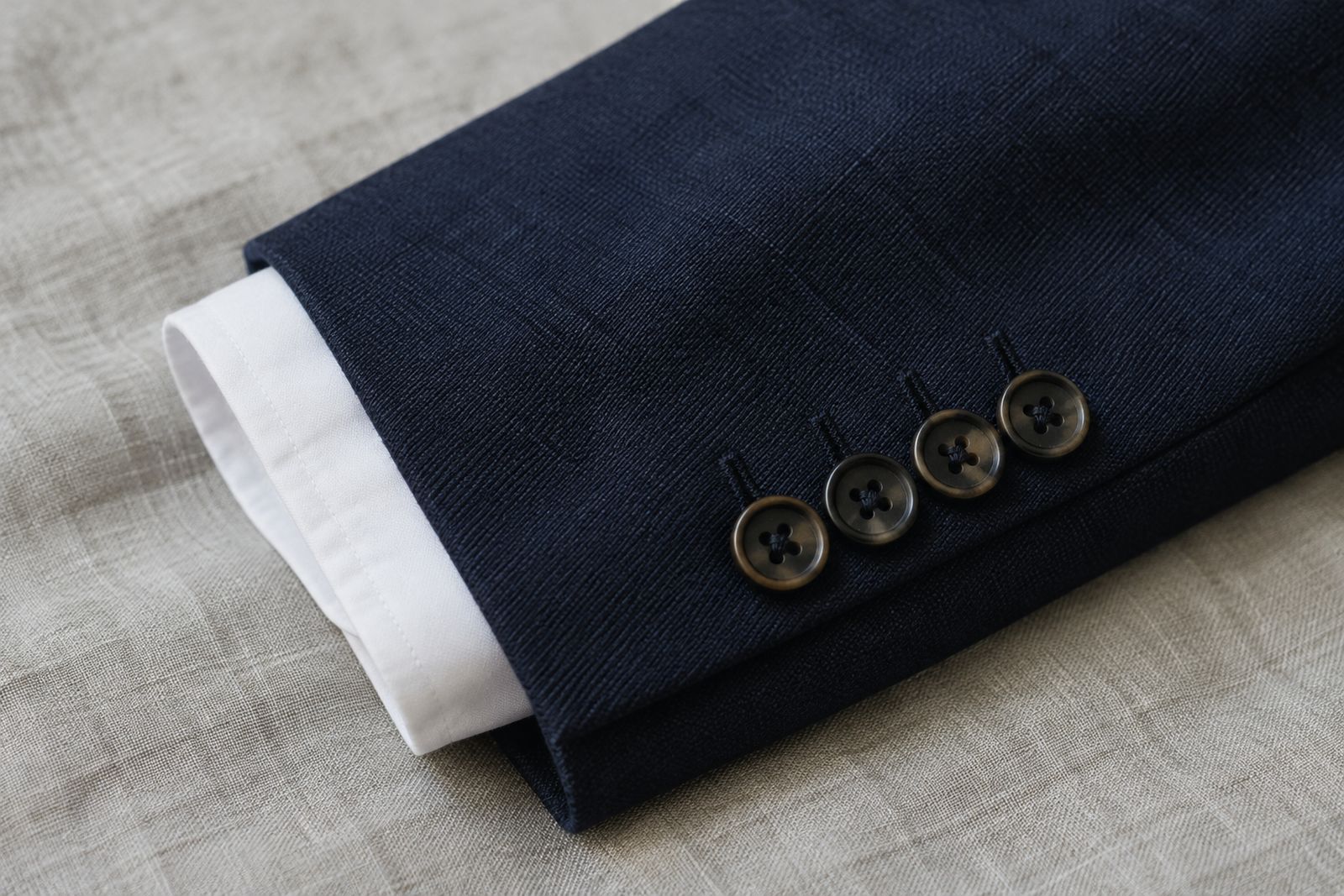
Suit jacket sleeves should end around the point where your wrist meets your hand, so that about ¼ to ½ inch (6 to 13 mm) of shirt cuff shows below them with your arms relaxed. The shirt cuff itself should reach about the base of your thumb. More cuff shows when you bend your arms or reach forward, which is normal.
- Show ¼ to ½ inch (6 to 13 mm) of shirt cuff with your arms relaxed
- The jacket sleeve ends around where your wrist meets your hand
- The shirt cuff reaches about the base of your thumb and stays at the wrist when you reach
- Check with your head level and arms hanging naturally, never while looking down
- Sleeves are easy to alter unless the cuff buttonholes are working
In this guide
- How long should suit jacket sleeves be?
- How much shirt cuff should show under a suit jacket?
- How long should dress shirt sleeves be?
- Arms down vs arms bent: what to expect
- How to measure suit sleeve length
- Common sleeve length mistakes
- Can suit sleeves be shortened or lengthened?
- What to tell your tailor
- Questions people ask
Suit jacket sleeve length is the easiest fit point to see and one of the easiest to fix. Too long, and the jacket looks borrowed. Too short, and it looks outgrown. The target is simple: a small, even band of shirt cuff below each sleeve. Getting there means looking at the jacket sleeve and the shirt sleeve together, because the right jacket sleeve on the wrong shirt still shows the wrong amount of cuff.
How long should suit jacket sleeves be?
With your arms hanging relaxed at your sides, a suit jacket sleeve should end around the point where your wrist meets your hand, roughly at the wrist bone. That leaves about ¼ to ½ inch (6 to 13 mm) of shirt cuff showing below it. The sleeve should also hang straight down your arm without diagonal twists.
Sleeve length at a glance
- Jacket sleeve ends
- Around where the wrist meets the hand
- Shirt cuff showing
- ¼ to ½ inch (6 to 13 mm), arms relaxed
- Shirt cuff ends
- About the base of the thumb
- When you reach
- More cuff shows; the shirt cuff should stay at the wrist
- Easy to alter?
- Yes, unless the cuff buttonholes are working
How much shirt cuff should show under a suit jacket?
About ¼ to ½ inch (6 to 13 mm) of shirt cuff should show below a suit jacket sleeve when your arms hang relaxed. Within that range it is a matter of taste: ¼ inch looks quiet and traditional, ½ inch a little more deliberate. Some men show slightly more, but beyond about an inch (2.5 cm) the jacket starts to look too small.
The band of cuff does three jobs. It breaks the dark line of the sleeve and frames the hand. It balances the shirt collar that shows above the jacket collar at the neck. And it protects the jacket: the shirt cuff takes the wear and dirt from desks and tables, and a shirt is much easier to wash than a jacket sleeve is to repair.
How long should dress shirt sleeves be?
A dress shirt sleeve should be long enough that the cuff reaches about the base of your thumb with your arms relaxed, covering the wrist bone. When you stretch your arms straight out in front of you, the cuff should still reach your wrist rather than sliding up your forearm. A sleeve that passes both tests is long enough to show below any correctly fitted jacket.
The cuff has to fit as well as the sleeve. Buttoned, it should be snug enough that it does not slide down over your hand, which is what keeps it in place at the wrist. Leave a little extra room on the cuff that goes over your watch. If your shirts are too short or the cuffs too loose, no jacket alteration will fix it; the shirt itself needs to change. Collar, body and cuff fit are covered in how a dress shirt should fit, and sizing in how to measure your shirt size.
French cuffs (double cuffs) are folded back on themselves, so they are thicker and slightly wider than barrel cuffs. If you wear them often, try your jacket on with one, because a sleeve that sits neatly over a barrel cuff can sit differently over the bulkier French cuff and change how much of it shows.
Arms down vs arms bent: what to expect
Judge sleeve length with your arms hanging naturally at your sides. When you bend your arms or reach forward, the jacket sleeve rides up further than the shirt sleeve, so more cuff shows. That is normal, and it is why the relaxed position is the one that counts.
| Position | What you should see | What signals a problem |
|---|---|---|
| Arms relaxed at your sides | ¼ to ½ inch (6 to 13 mm) of shirt cuff | No cuff, or more than about 1 inch (2.5 cm) |
| Arms bent at the elbow | More cuff, and some of the wrist | Sleeve pulling tight around the forearm or elbow |
| Arms reaching straight forward | The jacket sleeve rides up; the shirt cuff stays at the wrist | Shirt cuff sliding up the forearm |
| Sitting at a desk | Cuff and a little wrist on show | Jacket sleeve gripping the upper arm |
How to measure suit sleeve length
You can measure sleeve length on your body or on a jacket that already fits well. Either way, you need a soft tape measure and, for the body measurement, a helper.
Measuring jacket sleeve length
- 1
Put on your usual shirt
Wear the dress shirt you plan to wear with the suit and fasten the cuffs.
- 2
Stand naturally
Stand straight with your arms relaxed at your sides and your head level. Let your arms hang with their natural slight bend.
Tip: Do not lock your arms straight. Measure them as they hang naturally, because that is how the finished sleeve will be judged.
- 3
Find the shoulder point
Your helper finds the outer edge of your shoulder bone, where the jacket's shoulder seam should end.
- 4
Measure down the outside of the arm
Run the tape from the shoulder point, over the outside of the elbow, to the point where your wrist meets your hand. That is your jacket sleeve length.
- 5
Measure both arms
Repeat on the other side. Arms often differ slightly in length, and a tailor can set each sleeve on its own.
- 6
Check against a jacket that fits
Measure a jacket you like along the top of the sleeve, from the shoulder seam to the end of the cuff, and compare. It is often the most reliable figure.
Sleeve length is one of a dozen measurements you need for a suit; the others are in how to measure yourself for a suit.
Common sleeve length mistakes
| Mistake | What it looks like | The fix |
|---|---|---|
| Jacket sleeve too long | No cuff shows; the hand looks short and the jacket too big | Shorten the jacket sleeves |
| Jacket sleeve too short | An inch (2.5 cm) or more of cuff; the jacket looks outgrown | Let down the sleeve if there is fabric inside the cuff |
| Shirt sleeve too short | No cuff shows even with a correctly fitted jacket | Buy shirts with a longer sleeve |
| Shirt cuff too loose | The cuff slides over the hand and disappears up the sleeve | Move the cuff button, or choose a closer cuff |
| Both sleeves pinned the same | Even cuff on one side, too much or too little on the other | Have each sleeve pinned separately |
| Checked while looking down | Sleeves end up too long once you stand straight | Check with your head level, arms relaxed |
| Sleeve twisting | Diagonal creases across the sleeve | Ask the tailor to re-pitch the sleeves |
Can suit sleeves be shortened or lengthened?
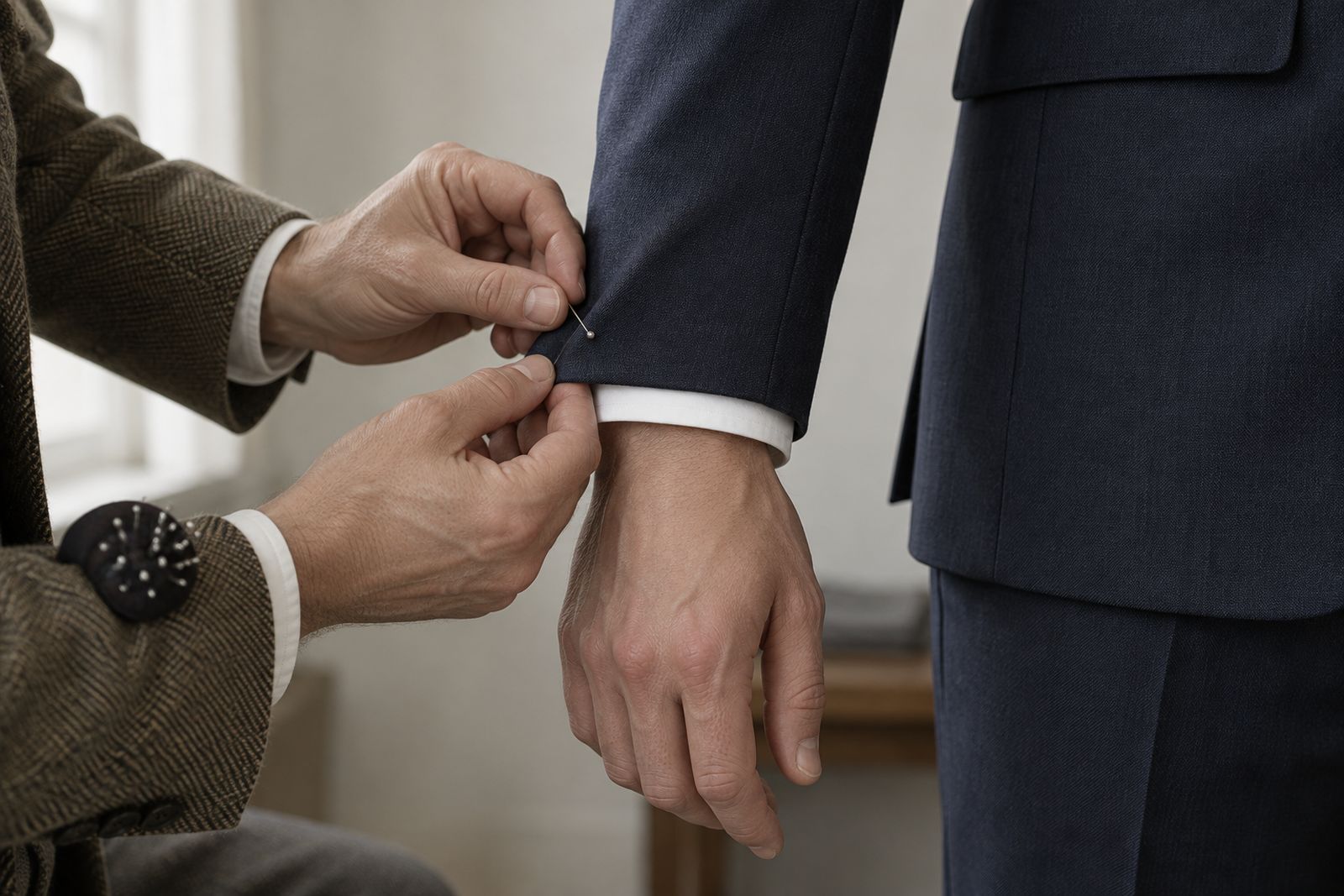
Suit sleeves can usually be shortened, and they can be lengthened if there is enough spare fabric folded inside the cuff. Both are routine jobs when the cuff buttons are decorative. The tailor opens the lining at the cuff, moves the hem up or down, presses it and re-sews the buttons in the right place.
Lengthening sleeves
Lengthening depends on the turned-up fabric inside the cuff. You can feel it through the sleeve: a double layer of fabric that runs above the buttons means there is something to let down. Cheaper jackets often have very little. On smooth worsteds, the old fold line can sometimes leave a faint mark after the sleeve is let down, which a good presser can usually reduce.
Sleeves with working buttonholes
Working (functional) cuff buttonholes are cut through the fabric, so they cannot be moved. If those sleeves are too long, the tailor has to shorten them from the shoulder end instead: remove the sleeve, take length from the top, reshape the sleevehead and set it back in. It is a skilled and more expensive job, and only a small amount can be taken this way. Lengthening sleeves with working buttonholes is usually not possible.
Typical prices for sleeve work and other jobs are in how much suit alterations cost.
What to tell your tailor
Give your tailor a target, not a feeling. Wear the shirt you will wear with the suit, stand relaxed and say how much cuff you want to see: “¼ inch” or “½ inch” is clear. A good tailor will pin each sleeve separately, check you from the front and side, and ask you to bend your arms before marking.
Before you leave the fitting
- Both sleeves show the same amount of cuff with your arms relaxed
- The amount is between ¼ and ½ inch (6 and 13 mm)
- The sleeves hang straight, with no diagonal twisting
- The shirt cuff stays at your wrist when you reach forward
- The sleeve buttons will be re-sewn at the right distance from the new edge
- If the buttonholes work, the tailor has explained the shoulder-end method and cost
Sleeve length is one of seven jacket checks; the rest are in how a suit jacket should fit, and the complete suit is covered in how a suit should fit. Sort out your shirt sleeves first, then have the jacket sleeves set to match them.
Questions people ask
How much shirt cuff should show under a suit jacket?
About ¼ to ½ inch (6 to 13 mm) of shirt cuff should show below a suit jacket sleeve with your arms relaxed. Less than that makes the jacket look too big; more than about an inch (2.5 cm) makes it look too small. When you bend your arms, more cuff will show, which is normal.
Where should suit sleeves end?
Suit jacket sleeves should end around the point where your wrist meets your hand, roughly at the wrist bone, with your arms hanging naturally. That leaves a small band of shirt cuff in view. Check with your head level, not while looking down at your hands.
How long should dress shirt sleeves be?
Dress shirt sleeves should be long enough that the cuff reaches about the base of your thumb with your arms relaxed. When you stretch your arms forward, the cuff should still reach your wrist. The cuff should be snug enough that it does not slide down over your hand.
Can suit sleeves be lengthened?
Yes, if there is spare fabric folded inside the cuff and the buttonholes are not working. You can often feel the extra fabric as a double layer above the buttons. Sleeves with working buttonholes usually cannot be lengthened.
Can suit sleeves with working buttonholes be shortened?
Yes, but only from the shoulder end, because the buttonholes are cut and cannot be moved. The tailor removes the sleeve, takes length from the top, reshapes the sleevehead and sets it back in. It costs more than a cuff alteration, and only a small amount can be taken.
Should both jacket sleeves be the same length?
They should show the same amount of cuff, which does not always mean the same length. Arms often differ slightly, so a good tailor pins and measures each sleeve on its own. Ask for this if one cuff shows more than the other.
Is it wrong if no shirt cuff shows?
It is not a disaster, but it makes the jacket look too big and the hands look short. The fix is either shorter jacket sleeves or longer shirt sleeves, depending on which is wrong. Check the shirt first: its cuff should reach about the base of your thumb.
TailorGuide is independent. Our guides are written and checked by our team and carry no paid endorsements. How we work.