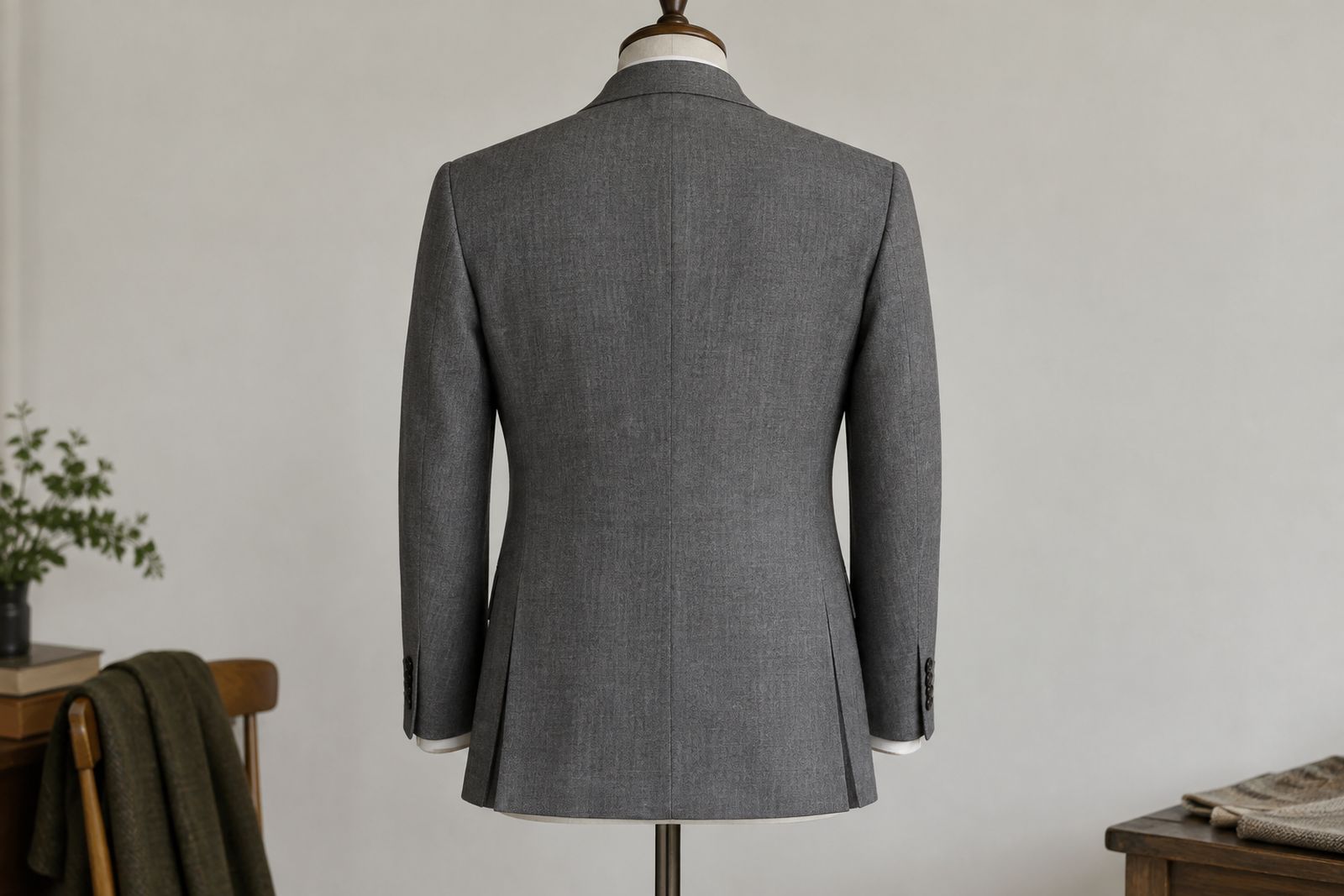
The short answer
Double vents are the best choice for most suits: they let the jacket move, keep the back neat when you sit or put your hands in your pockets, and flatter most builds. A single center vent is the traditional American choice and works well on slimmer men. No vent gives the cleanest line and suits dinner jackets, but it creases when you sit.
- Double (side) vents are the most practical and flattering choice for most suits.
- A single vent splits open when you put your hands in your pockets.
- Ventless jackets have the cleanest line and are traditional on dinner jackets.
- Vents should hang closed when you stand; if they pull open, the jacket is too tight.
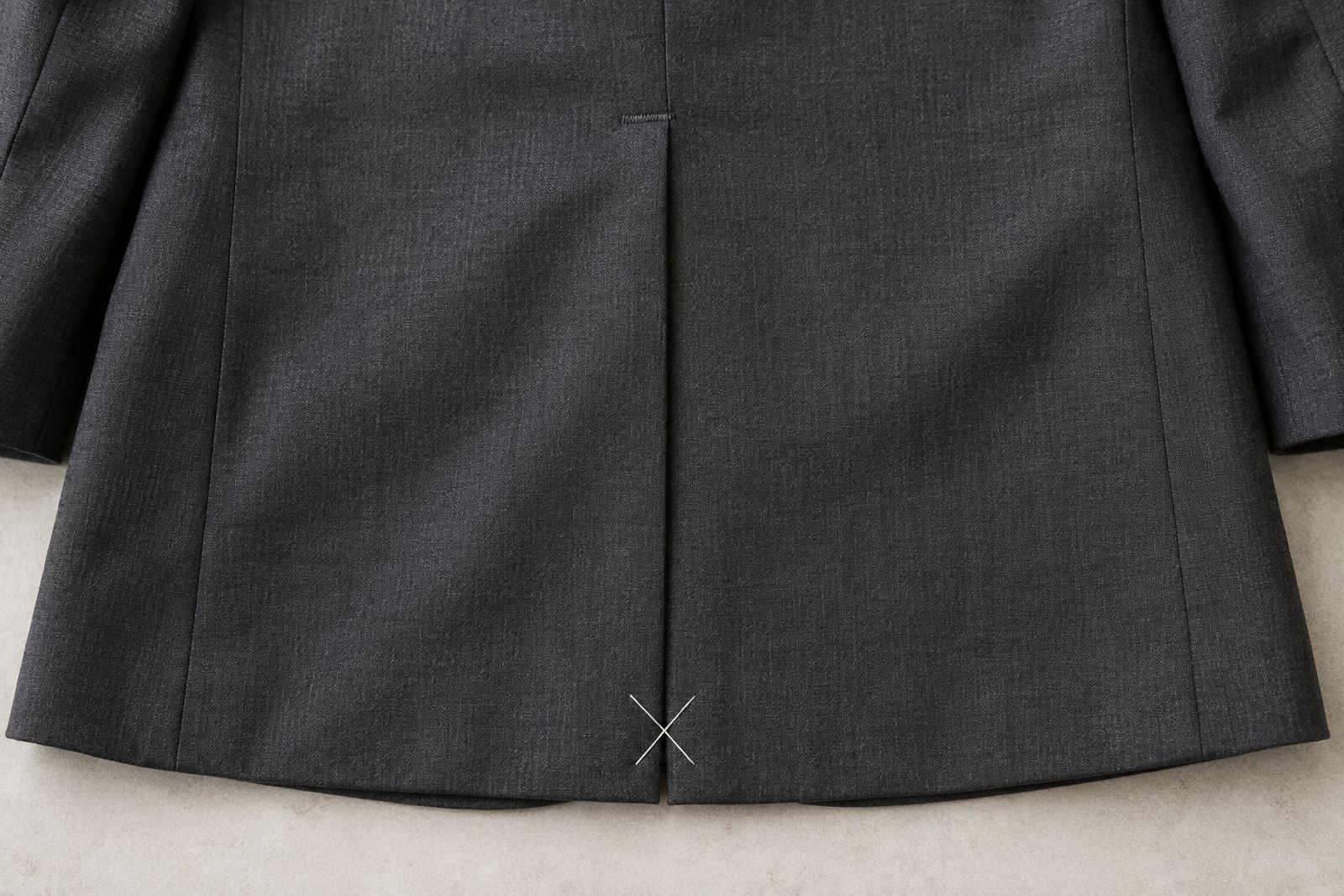
- Snip the loose X-shaped tack across a new jacket's vents before you wear it.
- A vent can be sewn shut later, but it cannot be added neatly.
In this guide
- What is a vent on a suit jacket?
- Single vs double vent vs no vent compared
- Which is better, single or double vent?
- Double vents (side vents)
- Single vent (center vent)
- No vent (ventless)
- Are ventless jackets more formal?
- Do side vents make you look slimmer?
- Which vent suits your build?
- Should you cut the stitching on suit vents?
- Why do my jacket vents pull open?
- Can a tailor change or close a vent?
- Questions people ask
The single vs double vent suit question matters more than it looks. A vent changes nothing when you stand still in front of a mirror, but it decides how the back of the jacket behaves the rest of the time: when you sit, walk, reach for your wallet or put your hands in your trouser pockets. Here is how each style behaves, which suits your build, and what to do about vents on a new jacket.
What is a vent on a suit jacket?
Vent
A vent is a slit in the back hem of a jacket, with one side overlapping the other, that lets the jacket open when you move, sit or reach into a pocket. A jacket can have no vent, a single center vent or two side vents.
Vents come from riding. A coat with a split back can fall either side of a saddle instead of bunching up behind the rider, and that practical opening survived into everyday tailoring long after most men stopped riding to work. Today a vent does the same job in a chair: it lets the back of the jacket part instead of creasing. Most vents are roughly 8 to 10 inches (20 to 25 cm) deep, with the overlap held by a small reinforcing tack at the top.
Single vs double vent vs no vent compared
Double vents handle movement best, a single vent is a traditional compromise, and no vent looks cleanest but copes worst with sitting. The table shows how each behaves.
| Double vents | Single vent | No vent | |
|---|---|---|---|
| Where | Two slits, one at each side | One slit at the center back | None |
| Hands in trouser pockets | Center panel stays down over the seat | Vent splits open and shows the seat | Jacket bunches up at the back |
| Sitting | Back panel lies flat; least creasing | Opens; some creasing | Most creasing; you sit on the jacket |
| Walking and reaching | Moves freely | Moves freely | Most restricted |
| Look from behind | Neat, with vertical lines at the sides | A clear center line | Cleanest, unbroken |
| Formality | Business and casual | Business and casual | Traditional on dinner jackets |
| Tradition | English | American | Older Italian tailoring and evening wear |
| Fit sensitivity | Flaps lift if tight at the hips | Splits open if tight at the seat | Shows every pull at the hips |
Which is better, single or double vent?
Double vents are better for most people. When you put your hands in your trouser pockets, double vents let the side flaps part while the center panel stays down over your seat; a single vent splits open in the middle and shows your seat and shirt. When you sit, double vents let the back panel lie flat behind you. They also frame the hips and seat with a clean line from behind, which flatters most builds.
A single vent is still a perfectly good choice. It is simpler to make, traditional on American jackets, and it looks neat on a slim man who rarely puts his hands in his pockets. Its weaknesses show on a fuller seat or a jacket cut a little tight, where the vent pulls open even when you are standing.
Double vents (side vents)
Double vents are the default in English tailoring and the most common choice on Savile Row. They suit business suits, sport coats and blazers alike, and together with no vent they are the usual choice on a double-breasted jacket.
Double vents
For
- +The center panel stays down over your seat when you put your hands in your pockets.
- +The back lies flat when you sit, so the jacket creases less.
- +Easy access to trouser pockets.
- +A clean line from behind that flatters most builds.
Against
- –The flaps can lift or flare if the jacket is tight across the hips.
- –More work to make well, and slightly more to go wrong.
- –Can look busy on a very short jacket.
Single vent (center vent)
A single vent is the traditional American choice. The classic American sack jacket has a single vent finished at the top with a hook-shaped line of stitching, known as a hook vent. A single vent is also common on ready-to-wear suits because it is simpler to make.
Single vent
For
- +Lets the jacket move and sit without bunching.
- +Simple and neat on a slim build.
- +Traditional on American and Ivy League jackets.
- +Less to go wrong than double vents.
Against
- –Splits open and shows your seat when you put your hands in your pockets.
- –Pulls open on a fuller seat or a jacket cut a little tight.
- –Can draw attention to the seat from behind.
No vent (ventless)
A ventless jacket has an unbroken back. It was common in older Italian tailoring and remains traditional on dinner jackets, where a clean, uninterrupted line suits evening wear and the jacket is mostly worn standing.
No vent
For
- +The cleanest, sleekest line from behind.
- +Traditional and correct on dinner jackets.
- +Nothing to flare or split open when you stand.
Against
- –Creases badly when you sit, since you sit on the back of the jacket.
- –Bunches up when you put your hands in your trouser pockets.
- –Less freedom to move.
- –Shows every pull across the hips and seat.
Are ventless jackets more formal?
Traditionally, yes, in the sense that the ventless back belongs to the dinner jacket and to evening wear. On a business suit, a ventless back is not more formal so much as more minimal. Today, double vents are also accepted on dinner jackets and are the more comfortable choice if you will sit through a long dinner. Our guide to black tie covers the dinner jacket in full.
Do side vents make you look slimmer?
Slightly, from behind, as long as they hang closed. Double vents let the center back panel fall straight over your seat and create two vertical lines at the sides, which frame the hips neatly. The effect disappears if the vents pull open, which makes the hips look wider. Fit matters far more than vent style: a jacket that is shaped correctly through the waist and seat does more for your figure than any vent.
Which vent suits your build?
| Double vents | Single vent | No vent | |
|---|---|---|---|
| Tall and slim | |||
| Average build | |||
| Shorter than average | |||
| Fuller seat or hips | |||
| Athletic, with a prominent seat | |||
| Spends the day sitting or driving |
If you have a fuller seat or hips, choose double vents and have the jacket cut with enough room there; both a single vent and a ventless back will pull. If you spend most of the day sitting, at a desk or in a car, double vents will keep the back of the jacket looking better by evening.
Should you cut the stitching on suit vents?
Yes. New jackets and coats arrive with a loose X-shaped stitch across each vent to hold it flat in the shop. It is temporary and should be removed before you wear the jacket. Leaving it in makes the vent pucker and pull when you move.
How to remove the tack stitch from a vent
- 1
Find the tack
Look near the hem of the vent for a large X or a few loose stitches, often in a contrasting thread, joining the two sides of the vent.
- 2
Cut one thread at a time
Use small, sharp scissors or a seam ripper. Slide the blade under a single thread and cut it, keeping the point away from the fabric.
Tip: Never pull the tack before cutting it. Tugging can pucker the fabric or snag the weave.
- 3
Pull out the loose ends
Draw the cut threads out with your fingers or tweezers until nothing remains.
- 4
Leave the reinforcing tack
Do not cut the small, dense bar of stitching at the very top of the vent. It is permanent and stops the vent tearing.
Tip: If you are unsure which stitch is which, the temporary tack is loose and obvious; the permanent one is short, tight and neat.
- 5
Steam if needed
If the tack has left small marks, hold a steamer a short distance from the fabric or ask your tailor to press the vent lightly.
Why do my jacket vents pull open?
Vents that pull open when you stand still almost always mean the jacket is too tight across the seat or hips. A well-fitted jacket's vents hang closed, with the overlap lying flat. A good tailor can often let the jacket out through the side seams and the center back seam if there is enough inlay; if not, the jacket is too small in the place that matters. Vents that kick out at the bottom can also come from the jacket's balance, the relationship between its front and back lengths, being wrong for your posture, which is harder to correct. Our guide to how a suit jacket should fit covers the checks.
Can a tailor change or close a vent?
A tailor can close a vent, but cannot neatly add one. Closing a vent means stitching the overlap shut; it works, though the line of the vent usually remains faintly visible. Adding a vent to a ventless jacket, or turning a single vent into double vents, needs an overlap of fabric that was never cut into the pattern, so it is rarely possible and almost never worth it. Choose the vent when you buy or commission the jacket. For other limits, see what a tailor can and can't alter.
Vents are one of the details covered in our guide to the parts of a suit jacket, alongside the lapels, pockets and buttons. If you are choosing a jacket to wear as a separate rather than a suit, read suit jacket vs blazer vs sport coat next.
Questions people ask
Which is better, a single or double vent?
Double vents are better for most people. They keep the back panel down over your seat when you put your hands in your pockets and lie flatter when you sit. A single vent is a good traditional choice on a slim build.
Should you cut the stitching on suit vents?
Yes. The loose X-shaped stitch across a new jacket's vents is temporary and should be cut and removed before you wear it. Leave the small, dense reinforcing stitch at the top of the vent, which is permanent.
Are ventless jackets more formal?
Traditionally, yes: the ventless back belongs to the dinner jacket and evening wear. On a business suit it reads as minimal rather than more formal. It creases more when you sit.
Do side vents make you look slimmer?
Slightly, from behind, if they hang closed. They frame the hips with vertical lines and let the back panel fall straight. Vents that pull open have the opposite effect.
Why do my suit jacket vents flare open?
Usually because the jacket is too tight across the seat or hips. A tailor may be able to let it out through the side and back seams if there is enough fabric. Vents on a well-fitted jacket hang closed when you stand.
Should a dinner jacket have vents?
Traditionally, a dinner jacket has no vent. Double vents are now widely accepted and are more comfortable if you will sit through a long dinner. A single vent is the least traditional choice.
How deep should suit vents be?
Most vents are roughly 8 to 10 inches (20 to 25 cm) deep, depending on the length of the jacket. Deeper vents move more freely, while very short vents can look skimpy.
Can you add vents to a ventless jacket?
Not neatly. A vent needs an overlap of fabric cut into the pattern, which a ventless jacket does not have. A tailor can close a vent but rarely adds one.
TailorGuide is independent. Our guides are written and checked by our team and carry no paid endorsements. How we work.