The short answer
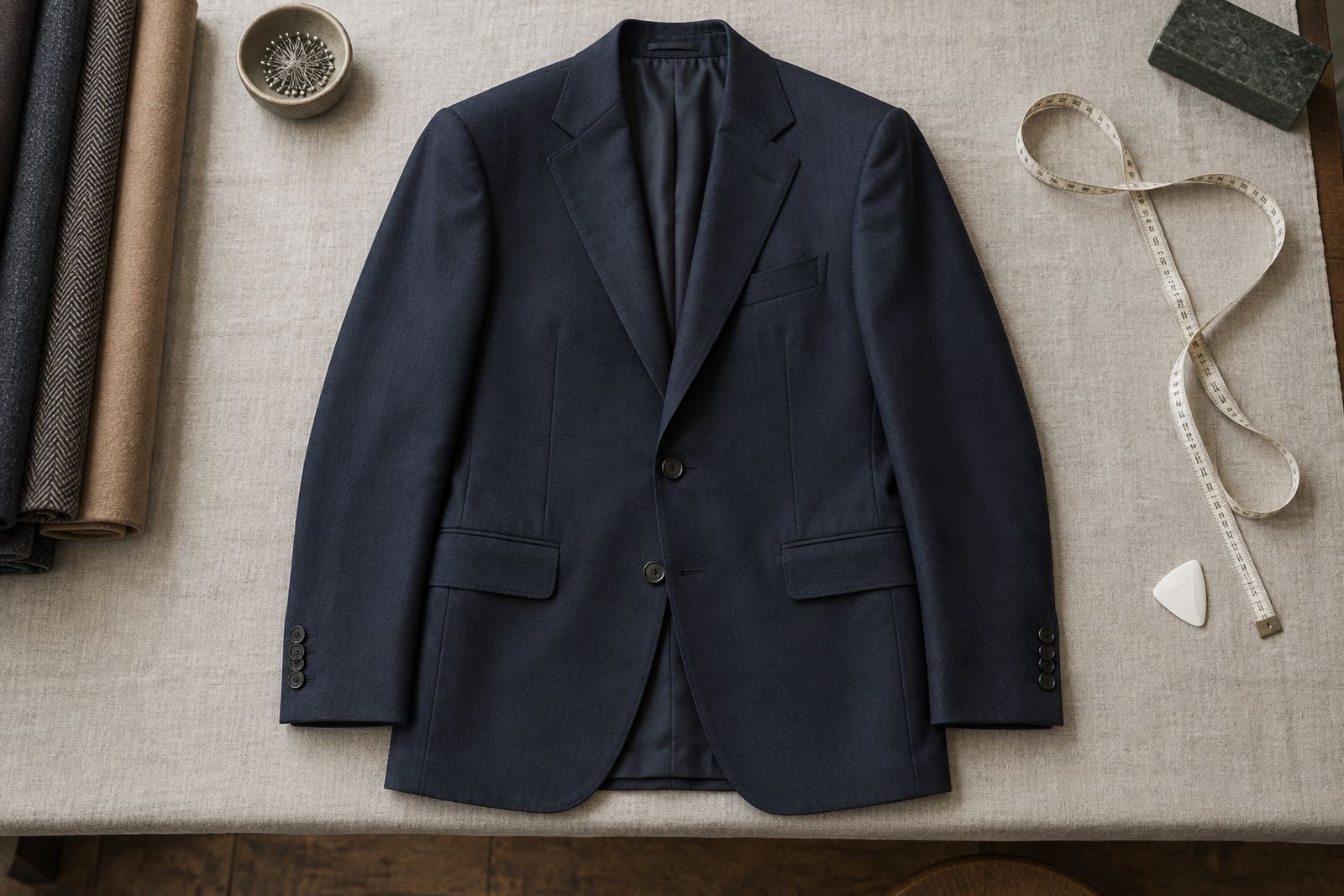
A suit jacket has about fifteen named parts. At the top are the collar, lapels, gorge and notch. The front carries the breast pocket, buttons, button stance, front darts, hip pockets, ticket pocket and quarters. The shoulders and sleeveheads set the silhouette, the sleeves end in buttons, and the back has the vents. Inside sit the canvas, lining and inside pockets.
- The gorge is the seam where collar meets lapel; its height changes how long the lapels look.
- The button stance, the height of the fastening button, sets the depth of the V.
- The quarters are the front edges below the waist button; they decide how the hem opens.
- Buy for the shoulders: they are the part a tailor can least easily alter.
- Working sleeve buttonholes make shortening the sleeves much harder, so get the length right first.
- Classic lapels measure about 3 to 3½ inches (7.5 to 9 cm) at the widest point.
In this guide
- What are the parts of a suit jacket?
- The collar, lapels and gorge
- What is the difference between a lapel and a collar?
- The front: buttons, button stance and quarters
- Pockets: breast, hip and ticket
- Shoulders, sleeveheads and sleeve buttons
- The back: vents, back seam and hem
- Inside the jacket: canvas, lining and inside pockets
- Which parts of a suit jacket can a tailor alter?
- What to check on each part in the fitting room
- How do the parts change from one jacket to another?
- Questions people ask
Every part of a suit jacket has a name, and those names are how tailors think. Once you know the parts of a suit jacket, a fitting stops being a series of vague gestures. You can say the gorge sits too low, the quarters flare or the sleevehead has a divot, and the tailor knows exactly what you mean. Each part below is named, located and explained, with a link to its detailed guide.
What are the parts of a suit jacket?
A suit jacket has about fifteen parts you can see from the outside and a few more inside. The table gives each one, where it sits, what it does and the first thing a tailor looks at. The sections below define each part properly and explain the choices you have.
| Part | Where it is | What it does | What to look for |
|---|---|---|---|
| Collar | Band around the back of the neck | Frames the shirt collar and joins the lapels | Sits against your shirt collar with no gap |
| Lapel | Folded-back front edge below the collar | Frames the chest, shirt and tie | Width in proportion to your shoulders; a soft roll |
| Gorge | Seam where the collar meets the lapel | Sets how high the lapels begin | Usually near the collarbone |
| Notch | Gap at the gorge between collar and lapel | Gives the notch lapel its name | Clean and identical on both sides |
| Lapel buttonhole | Upper left lapel | Holds a flower or pin | Cut open and hand-finished on better jackets |
| Breast pocket | Left chest | Holds a pocket square | Lies flat; level or slightly angled |
| Front dart | Seam from the chest down toward the hip pocket | Shapes the chest and waist | Smooth, with no puckering |
| Buttons | Front closure | Fasten the jacket | One, two or three on single-breasted; four or six on double-breasted |
| Button stance | Height of the fastening button | Sets the depth of the V | At or just above your navel |
| Hip pockets | Either side, below the waist | Storage; set the formality of the front | Level and flat |
| Ticket pocket | Above the right hip pocket | A small extra pocket | Matches the hip pocket style |
| Quarters | Front edges below the fastening button | Shape how the front hem opens | Hang cleanly, without flaring or overlapping |
| Shoulder | From the collar to the top of the sleeve | Sets the silhouette | Ends where your shoulder ends |
| Sleevehead | Top of the sleeve where it meets the shoulder | Shapes the top of the arm | Smooth, with no dents or divots |
| Sleeve buttons | Outside of each cuff | Decoration, or a working cuff | Usually three or four, evenly spaced |
| Vents | Slits in the back hem | Let the jacket move and sit | Hang closed when you stand |
| Hem | Bottom edge of the jacket | Sets the jacket's length | Covers your seat |
The collar, lapels and gorge
The top of the jacket sets its character more than any other part, and it is where most of the vocabulary lives. Five terms cover it: collar, lapel, gorge, notch and roll line.
Collar
The collar is the band of fabric that wraps the back of the neck and joins the lapels at the gorge. Its underside, the undercollar, is usually melton, a dense, felted wool fabric, which helps the collar hug the shirt collar without bulk.
Lapel
A lapel is the front edge of the jacket folded back on itself below the collar. There are three main shapes: the notch lapel, the peak lapel and the shawl lapel.
Gorge
The gorge is the seam where the collar is sewn to the lapel. A high gorge makes the lapels look longer and leaner; a low gorge shortens them and gives a softer, broader look.
Notch
The notch is the wedge-shaped gap at the gorge between the end of the collar and the top of the lapel. On a peak lapel there is no open notch: the lapel sweeps up into a point that nearly meets the collar.
Roll line
The roll line is the fold where the lapel turns back from the jacket front. On a canvassed jacket the lapel curves over it in a soft, three-dimensional roll; on many fused jackets the lapel is simply pressed flat.
Lapel buttonhole
The lapel buttonhole, or boutonnière, sits on the upper left lapel and is meant for a flower or a pin. On a well-made jacket it is cut open and finished by hand, with a small thread loop behind it to hold a stem.
The notch lapel is the business standard. The peak lapel is more formal and more assertive, and it is traditional on double-breasted jackets and dinner jackets. The shawl lapel belongs on dinner jackets. Width should sit roughly in proportion to your shoulders and your tie: on a classic jacket that means about 3 to 3½ inches (7.5 to 9 cm) at the widest point. Our guide to suit lapels covers width, gorge height and roll in detail, and peak vs notch lapels settles the most common choice.
What is the difference between a lapel and a collar?
The collar wraps the back of your neck; the lapels are the folded-back fronts below it. The two are cut as separate pieces on a notch or peak lapel and meet at the gorge seam, which is why you can see a join. On a shawl lapel the collar and lapel facing are cut as one continuous piece, so there is no gorge seam on the front and no notch. People often say "collar" when they mean the whole folded area, but a tailor will always separate the two, because each is fitted differently: the collar to your neck, the lapels to your chest.
The front: buttons, button stance and quarters
The front of a jacket is built around one point: the fastening button at your waist. The depth of the V, the shape of the chest and the curve of the hem all follow from where that button sits.
Single-breasted and double-breasted
A single-breasted jacket has one column of buttons and a narrow overlap at the front. A double-breasted jacket has two columns and a wide overlap that crosses the body, held in place by an inside button called the anchor or jigger button.
Button stance
The button stance is the height of the jacket's fastening button. A higher stance gives a shorter V and covers more shirt; a lower stance gives a longer V that makes the torso look longer.
Quarters
The quarters are the front edges of the jacket below the fastening button. Open quarters curve away to show more of the trousers and look lighter; closed quarters fall straighter and look more formal.
Front dart
A front dart is a narrow sewn fold that runs from below the chest down toward the hip pocket, taking in fabric to shape the chest and waist. The traditional American sack jacket has no front darts, which gives it a straighter, looser line.
A good tailor puts the button stance at or just above your navel, close to your natural waist, so the jacket draws in where you do. The number of buttons changes how long the V looks and how much shirt shows; our guide to one, two and three-button suits compares them side by side, and single vs double-breasted suits covers the bigger choice of front.
Pockets: breast, hip and ticket
A suit jacket usually has three outside pockets: one on the left chest and one on each hip. The style of the hip pockets does more than any other detail to set how formal the front looks.
Breast pocket
The breast pocket is the welt pocket on the left chest, made for a pocket square. Neapolitan tailors often curve it upward into a boat shape called a barchetta.
Flap pocket
A flap pocket is a hip pocket covered by a flap of matching fabric. It is the standard on business suits, and the flap can be tucked inside so the pocket looks jetted.
Jetted pocket
A jetted pocket, also called a besom pocket, is a slit finished with two narrow strips of fabric and no flap. It is the cleanest and most formal option and the standard on dinner jackets.
Patch pocket
A patch pocket is sewn onto the outside of the jacket like a patch. It is casual, and it suits sport coats, blazers and jackets in linen or cotton.
Ticket pocket
A ticket pocket is a small flap pocket set just above the right hip pocket. It is usually said to have begun as a place to keep a train ticket, and it remains a mostly English detail.
Hacking pockets
Hacking pockets are hip pockets set at a slant, a detail taken from riding jackets. They add a sporting note and are more at home on a tweed jacket or a country suit than on a city worsted.
Shoulders, sleeveheads and sleeve buttons
The shoulders set the silhouette of the whole jacket, and they are the hardest part to alter, so they are the first thing to check on any jacket you try on. The way the sleeve is set into the shoulder is also one of the clearest signs of a tailoring tradition.
Shoulder
The shoulder runs from the collar to the top of the sleeve. It can be natural, with little or no padding; structured, with a built-up pad; or roped, with a raised ridge where the sleeve meets the shoulder.
Sleevehead
The sleevehead is the rounded top of the sleeve, sewn into the armhole. A clean sleevehead runs smoothly into the shoulder; a dent or divot just below the shoulder seam usually means the shoulder is too wide for you or the sleeve is badly set.
Sleeve buttons
Sleeve buttons sit on the outside of each cuff, usually four on a suit jacket and sometimes three or fewer on a sport coat. They are either decorative or working, meaning the buttonholes open; working buttonholes are also called surgeon's cuffs.
Sleeve buttons can sit edge to edge, which tailors call kissing buttons, or overlap slightly, a stacked arrangement that Neapolitan tailors favor. Neither is more correct. What matters more is the sleeve length: with your arms at your sides, about ¼ to ½ inch (6 to 13 mm) of shirt cuff should show. Our guide to suit sleeve length explains how to judge it.
The back: vents, back seam and hem
Most people never look at the back of their own jacket, but everyone behind them does. Three parts matter there: the vents, the center back seam and the hem.
Vent
A vent is a slit in the back hem of a jacket that lets it open when you move, sit or reach into a trouser pocket. A jacket can have no vent, a single center vent or two side vents.
Center back seam
The center back seam runs down the spine and lets the tailor shape the back to your posture. Tailors usually leave extra fabric, called inlay, in this seam so the waist can be let out or taken in later.
Hem
The hem is the bottom edge of the jacket. On a classic suit jacket it should cover your seat; exactly how long that is depends on your height and build.
Double vents are the English default and the most practical choice for most people. A single vent is traditional on American jackets. No vent gives the cleanest line and is traditional on dinner jackets, but it creases when you sit. Our guide to suit jacket vents compares how each behaves when you sit and put your hands in your pockets.
Inside the jacket: canvas, lining and inside pockets
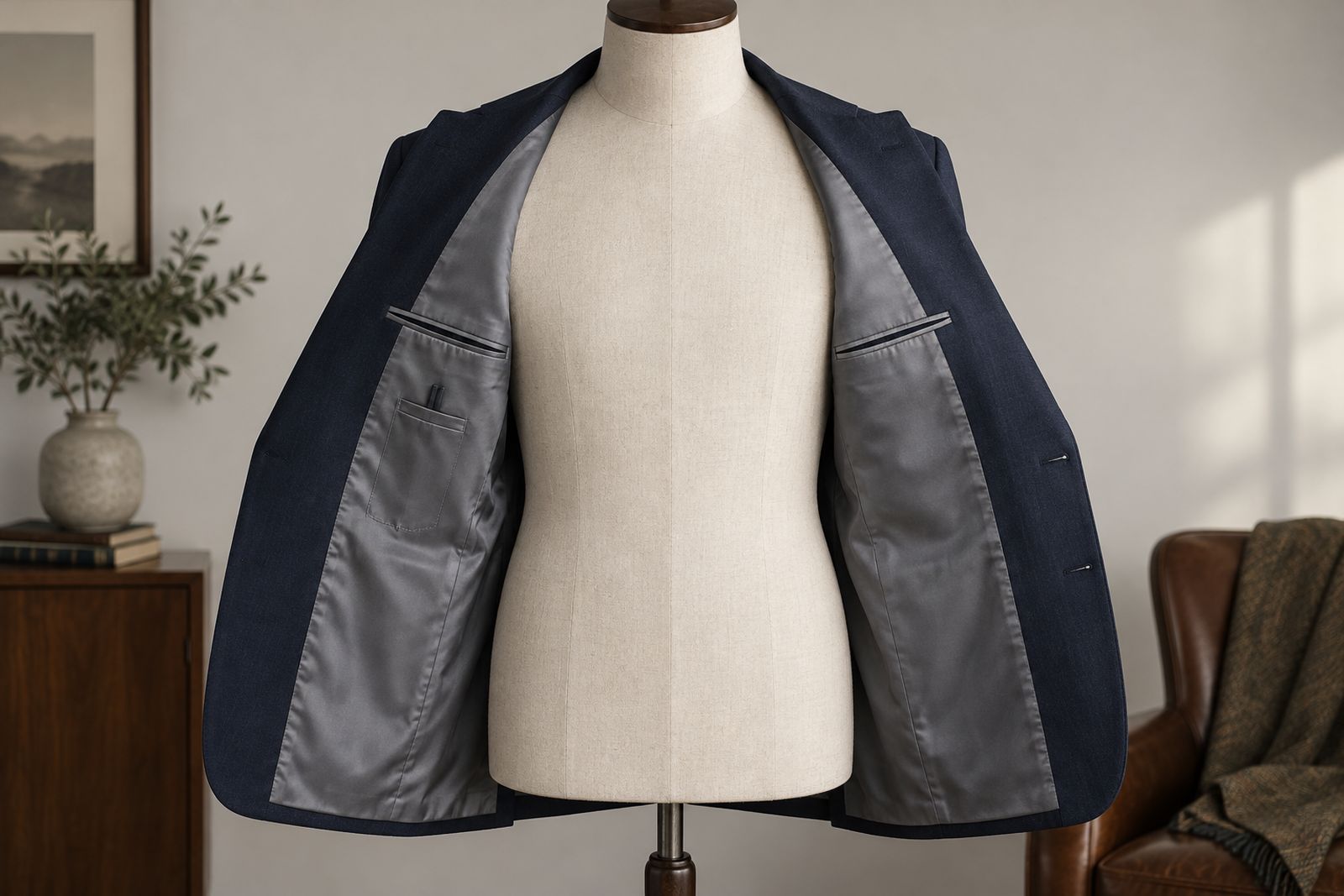
Much of a jacket's quality sits where you can't see it. The interior decides how the chest holds its shape, how the lapels roll and how the jacket ages.
Canvas
Canvas is a layer of interlining, traditionally wool and horsehair, between the outer fabric and the lining that gives the chest its shape. A full canvas runs the length of the front, a half canvas covers the chest and lapels only, and a fused jacket bonds an interlining to the fabric with glue instead.
Lining
The lining covers the inside of the jacket, helps it slide on over a shirt and hides the construction. A half-lined or quarter-lined jacket leaves part of the back unlined to keep it lighter and cooler.
Inside pockets
Most jackets have an inside breast pocket on each side, and often a smaller pen or card pocket below one of them. They are built into the lining and facings, so they should never show through the front when used lightly.
If you want to know how a jacket is built before you buy it, our guide to fused vs half canvas vs full canvas explains the three constructions and how to tell them apart by touch.
Which parts of a suit jacket can a tailor alter?
A tailor can easily change the sleeve length, the waist and the buttons, but the shoulders, the lapels and the length of the jacket are hard or impossible to change well. That is why a good tailor tells every client the same thing: buy for the shoulders and chest, and alter the rest. The table shows what is realistic.
| Part | Can it be altered? | What a good tailor will tell you |
|---|---|---|
| Sleeve length | Yes, usually | Easy with decorative buttons; much harder once working buttonholes are cut |
| Waist | Yes | Taken in or let out through the back and side seams, within the inlay available |
| Collar gap | Often | Can usually be reduced by reshaping or resetting the collar; a gap caused by posture is harder |
| Buttons | Yes | Buttons can be changed or moved slightly to ease or tighten the front; buttonholes stay put |
| Jacket length | Only slightly | Shortening more than about 1 inch (2.5 cm) leaves the pockets and buttons looking too low |
| Shoulders | Rarely worth it | Narrowing means removing the sleeves and recutting; expensive, and the result is uncertain |
| Lapel width | Rarely worth it | Possible, but costly, and it often upsets the balance of the front |
| Vents | Close only | A vent can be sewn shut; a vent cannot be added neatly |
| Lining | Yes | Can be repaired or replaced entirely |
| Canvas | No | A fused jacket cannot be converted to a canvassed one |
For the complete list, with what each job involves, see what a tailor can and can't alter.
What to check on each part in the fitting room
Use the parts you now know as a checklist. Stand naturally in front of a three-way mirror, fasten the jacket correctly and work from the top down.
Jacket parts to check before you buy or sign off a fitting
- Collar: sits against your shirt collar all the way round, with no gap at the back of the neck.
- Lapels: lie flat against your chest when the jacket is fastened and do not bow outward.
- Shoulders: the seam ends where your shoulder bone ends, and the sleevehead runs smoothly with no divot.
- Button stance: the fastening button sits at or slightly above your navel, with no X-shaped pulling around it.
- Quarters: hang cleanly below the button, without flaring apart or crossing over.
- Pockets: lie flat when empty, and the flaps sit level.
- Sleeves: show about ¼ to ½ inch (6 to 13 mm) of shirt cuff with your arms relaxed.
- Vents: hang closed when you stand still.
- Hem: covers your seat.
If two or more of these fail on a ready-to-wear jacket, and one of them is the shoulders or chest, try a different size or a different maker rather than paying for alterations. Our guide to how a suit jacket should fit goes through each check in more depth.
How do the parts change from one jacket to another?
The same parts appear on a suit jacket, a blazer and a sport coat, but the choices differ. A suit jacket usually has flap pockets and a cleaner, more structured front. A blazer often has metal buttons and sometimes patch pockets. A sport coat tends toward patch or hacking pockets, softer shoulders and textured fabrics. Our guide to suit jacket vs blazer vs sport coat sets the three side by side.
House and regional styles change the parts too. A classic English jacket tends to have a structured or roped shoulder, a suppressed waist, double vents and often a ticket pocket. A Neapolitan jacket typically has a soft spalla camicia shoulder, a barchetta breast pocket and often patch pockets. A traditional American sack jacket has a natural shoulder, no front darts and a single hooked vent. None is wrong; each is a set of choices about the same parts.
With the vocabulary in hand, the next step is choosing the details that suit you. If you are weighing a double-breasted jacket, start with how to wear a double-breasted suit, or move to the trousers with our guide to trouser cuffs. If you want every part cut for your body, our ranking of the best tailors in London is a good place to begin.
Questions people ask
What is the gorge on a suit jacket?
The gorge is the seam where the collar is sewn to the lapel, usually at about collarbone height. Its height changes the look of the whole front: a high gorge makes the lapels look longer and leaner, and a low gorge makes them shorter and broader.
What are the quarters on a jacket?
The quarters are the front edges of a jacket below the fastening button. Open quarters curve away from each other and show more of the trousers; closed quarters fall straighter and look more formal. They should hang cleanly without flaring apart or overlapping when the jacket is fastened.
What is the roll line on a jacket?
The roll line is the fold where the lapel turns back from the front of the jacket. On a canvassed jacket the lapel curves over it softly in three dimensions; on many fused jackets the lapel is pressed flat along it. A good roll runs smoothly all the way down to the fastening button.
What is the difference between a lapel and a collar?
The collar is the band that wraps the back of the neck, and the lapels are the folded-back fronts below it. On notch and peak lapels the two are separate pieces joined at the gorge seam. On a shawl lapel they are cut as one continuous piece, so there is no gorge or notch.
What is the small pocket above the jacket pocket called?
It is called a ticket pocket. It sits above the right hip pocket and is usually said to have begun as a place for a train ticket. It is a mostly English detail and is common on Savile Row suits and on many British ready-to-wear jackets.
How many buttons should be on a suit jacket sleeve?
Four is the most common number on a suit jacket sleeve, though three is also correct, and sport coats sometimes have fewer. The buttons can be decorative or working. Working buttonholes look smart but make it much harder to shorten the sleeves later.
What is the button inside a double-breasted jacket for?
The inside button, called the anchor or jigger button, holds the underneath front panel of a double-breasted jacket in place. Fastening it stops the inner panel sagging and keeps the outer front lying flat. Most wearers fasten it whenever they fasten the jacket.
What is the button stance on a suit?
The button stance is the height of the jacket's fastening button. It controls the depth of the V at the front: a higher stance shows less shirt and tie, while a lower stance shows more and makes the torso look longer. A good tailor sets it at or just above the navel.
TailorGuide is independent. Our guides are written and checked by our team and carry no paid endorsements. How we work.