The short answer
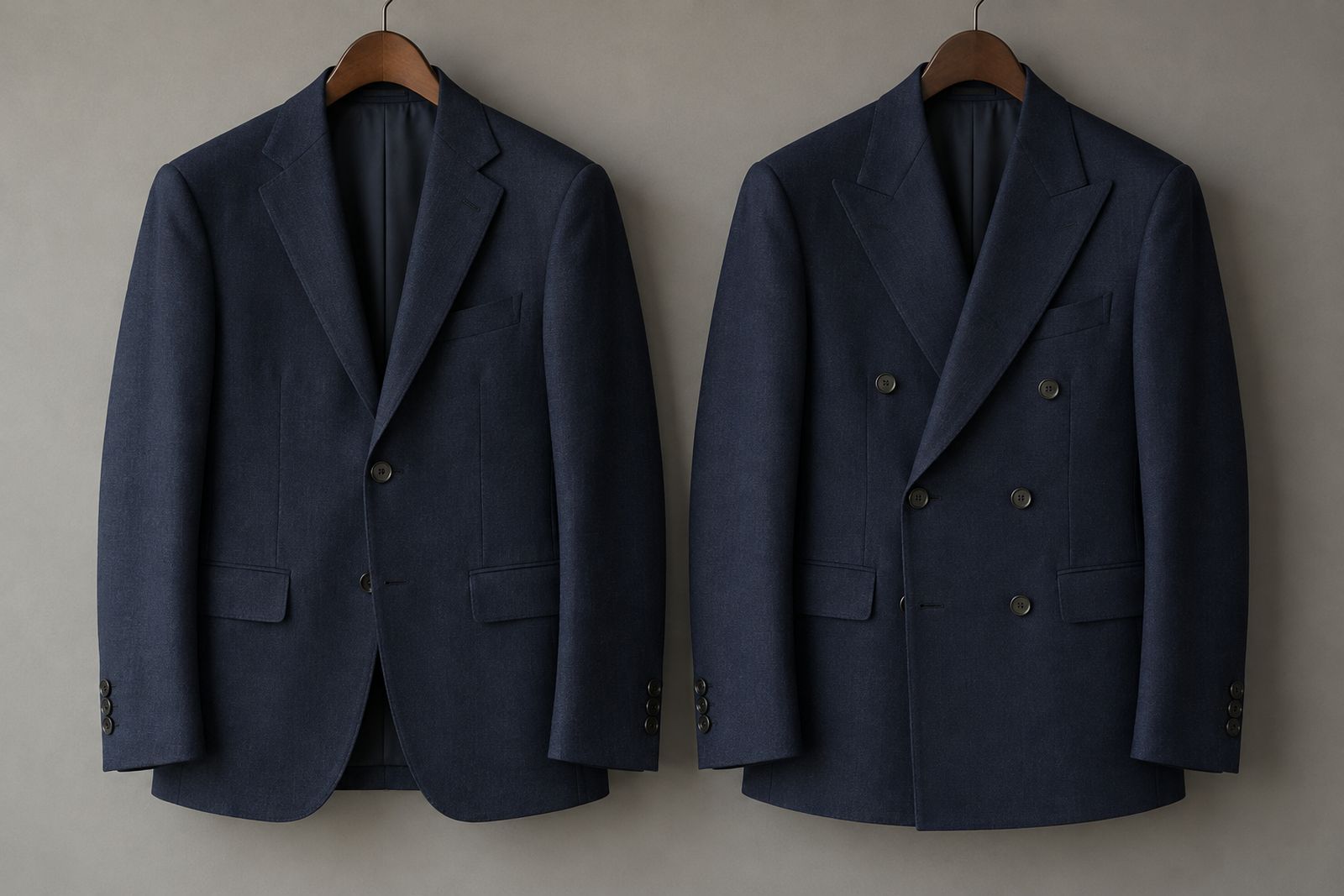
A single-breasted suit has one column of buttons and a narrow overlap; a double-breasted suit has two columns and a wide overlap that crosses the body. Single-breasted is more versatile, can be worn open and suits almost everyone, so buy it first. Double-breasted is slightly more formal, should stay fastened and needs a close fit.
- Buy a single-breasted suit first: it works everywhere and can be worn open.
- A double-breasted suit is slightly more formal and is meant to be worn fastened.
- A double-breasted jacket must fit closely; extra room shows twice across the front.
- Peak lapels are traditional on double-breasted jackets; notch lapels on single-breasted.
- Shorter men can wear double-breasted: choose a 6x2 with the fastening button at the natural waist.
- Unbutton a single-breasted jacket to sit; a double-breasted jacket usually stays fastened.
In this guide
- What is the difference between single and double-breasted suits?
- Single vs double-breasted suits compared
- Is a double-breasted suit more formal?
- Which suits your body type?
- Can short men wear double-breasted suits?
- How do you button a single or double-breasted jacket?
- Should you unbutton a double-breasted suit when sitting?
- Which lapels and fabrics suit each style?
- Are double-breasted suits in style?
- Single or double-breasted: which should you choose?
- What a good tailor checks on a double-breasted jacket
- Questions people ask
The choice between a single vs double-breasted suit comes down to how you will wear it. A single-breasted jacket can be worn open or closed, at a desk or a wedding, on almost any build. A double-breasted jacket is built to be worn closed, and it rewards a close fit and a little confidence.
Single vs double-breasted at a glance
- Front
- Single: one column of buttons, narrow overlap. Double: two columns, wide overlap.
- Formality
- Double-breasted is slightly more formal
- Versatility
- Single-breasted wins: it works open, closed and as everyday business wear
- Usual lapel
- Single: notch. Double: peak.
- Sitting down
- Single: unbutton. Double: usually stays fastened.
- Fit
- Double-breasted must fit closely; single-breasted is more forgiving
- Best first suit
- Single-breasted, two-button, in navy or charcoal
What is the difference between single and double-breasted suits?
The difference is the overlap at the front. A single-breasted jacket closes with one column of buttons, and its two front edges meet with only a small overlap. A double-breasted jacket has a wide overlap that crosses the body, with two parallel columns of buttons, of which only some fasten.
Single-breasted jacket
A single-breasted jacket is a jacket whose fronts overlap only slightly and fasten with one column of buttons, usually one, two or three. It is the standard business suit jacket and can be worn open or fastened.
Double-breasted jacket
A double-breasted jacket is a jacket whose left front crosses well over the right, with two columns of buttons, usually four or six in total. An inside anchor button, also called a jigger button, holds the underneath panel in place.
Double-breasted jackets are described by two numbers. The first is the total number of front buttons and the second is how many of them can fasten. A 6x2 has six buttons in three rows, two of which fasten. It is the most traditional configuration and the usual recommendation for a first double-breasted suit.
Single vs double-breasted suits compared
Single-breasted is more versatile and more forgiving; double-breasted is more formal and more distinctive. The table sets out the practical differences.
| Single-breasted | Double-breasted | |
|---|---|---|
| Overlap | Narrow | Wide, crossing the body |
| Button styles | One, two, three or three-roll-two | 6x2, 6x1, 4x2 or 4x1 |
| Usual lapel | Notch; peak is a dressier option | Peak; notch is unusual |
| How to fasten | Top of two, middle of three; never the bottom | The working button or buttons, plus the inside anchor button |
| Worn open | Yes | Not really; it looks untidy |
| When sitting | Unbutton | Usually stays fastened |
| Formality | Business standard | Slightly more formal |
| Fit | Forgiving; can be worn open if snug | Must fit closely; any looseness shows |
| Usual vents | Double, single or none | Double or none |
| Warmth | One layer across the front | Two layers across the front |
| Best for | Everyone; first suits; everyday wear | Second or third suits; formal events; men who like a strong line |
Is a double-breasted suit more formal?
Yes, slightly. A double-breasted suit is a little more formal than a single-breasted suit in the same fabric, because its closed front and peak lapels come from naval and formal dress. In practice the fabric matters more than the cut: a double-breasted suit in linen or a soft flannel looks more relaxed than a single-breasted navy worsted.
Both are correct for business, weddings and evening events where a suit is asked for. Where the occasion calls for restraint, such as a job interview or a conservative client meeting, the single-breasted suit is the safer choice simply because it draws less attention.
Which suits your body type?
Single-breasted suits flatter almost every build. Double-breasted suits are easiest on tall, slim and athletic men, but most men can wear one well if the proportions are chosen with care. The matrix shows where each works without effort and where it needs adjustment.
| Single-breasted | Double-breasted | |
|---|---|---|
| Tall and slim | ||
| Average height and build | ||
| Broad or athletic | ||
| Shorter than average | ||
| Heavier through the middle | ||
| Very slim, narrow shoulders |
Tall and slim men carry a double-breasted suit most naturally, because the horizontal rows of buttons and the wide overlap add a little width. Broad or athletic men look good in both; the double-breasted front emphasizes a strong chest. Heavier men can wear a double-breasted suit if it is cut to fit and kept fastened, since it gives a clean, unbroken front; the risk is that the extra overlap and widely spaced buttons add visual width across the middle, so a single-breasted two-button is the easier option. Very slim men with narrow shoulders can find a double-breasted jacket swamps them unless the lapels and button spacing are kept modest.
Can short men wear double-breasted suits?
Yes. A shorter man can wear a double-breasted suit well if the jacket keeps the eye moving up and down rather than across. The details that matter are the button configuration, the spacing of the buttons and the length of the jacket.
- Choose a 6x2 and have the fastening button set at your natural waist, so the lapels form a long V.
- Ask for the columns of buttons to be set fairly close together; wide spacing makes the front look broad.
- Keep the lapels in proportion to your shoulders; oversized peaks shorten the torso.
- Get the jacket length right: just covering the seat and no longer.
- Wear it in one dark color, such as navy or charcoal, so the suit reads as one unbroken column.
How do you button a single or double-breasted jacket?
On a single-breasted jacket you fasten the waist button and leave the bottom one open; on a double-breasted jacket you fasten the working button or buttons and, usually, the inside anchor button. The rules are fixed, and they are part of how each jacket is cut.
| Jacket | What to fasten |
|---|---|
| One-button | Fasten it when standing |
| Two-button | The top button; never the bottom one |
| Three-button | The middle always, the top sometimes, the bottom never |
| Three-roll-two | The middle button only; the top one sits on the lapel roll and stays undone |
| Double-breasted 6x2 or 4x2 | The upper working button, plus the inside anchor button; the lowest is optional |
| Double-breasted 6x1 or 4x1 | The single working button on the bottom row, plus the inside anchor button |
A double-breasted jacket is cut to close at one particular point, so fastening it anywhere else spoils the shape through the waist. Our guide to how to button a suit jacket has a diagram for each style, and how to wear a double-breasted suit covers the double-breasted configurations in detail.
Should you unbutton a double-breasted suit when sitting?
Usually not. A double-breasted jacket is designed to stay fastened, and when you open it the two wide front panels fall loose and bunch in your lap. A single-breasted jacket is different: you unbutton it as you sit so the front doesn't pull and crease.
If a double-breasted jacket feels tight when you sit, that is a fit problem rather than a reason to unbutton it. A well-cut double-breasted jacket has enough room through the waist and the skirt to sit comfortably while fastened. On a long flight or at a relaxed dinner, unbuttoning it for comfort is fine; just fasten it again when you stand.
Which lapels and fabrics suit each style?
Single-breasted suits usually have notch lapels, the business standard, while double-breasted suits traditionally have peak lapels. The points of a peak lapel balance the wide, closed front of a double-breasted jacket; a notch lapel on a double-breasted jacket is unusual and tends to look unfinished. A peak lapel on a single-breasted jacket is correct too, but it reads as dressier and more assertive. Our guide to peak vs notch lapels covers that choice in detail.
A double-breasted jacket is easiest in a fabric with some body: a worsted of about 10 to 13 oz (310 to 400 g), a flannel or a firm hopsack holds the overlap and the lapels crisply. Very light, soft fabrics can make the wide front droop, although a skilled tailor can make a summer double-breasted suit work. A single-breasted suit works in everything from summer linen to winter tweed, which is another reason it is the better first suit.
Are double-breasted suits in style?
Yes. Double-breasted suits have been part of men's tailoring for more than a century and move in and out of fashion every couple of decades; they were very popular in the 1930s and 1940s and again in the 1980s, and they have been widely worn again in recent years. The versions that never look dated are the classic ones: a 6x2 with peak lapels of moderate width, in navy, charcoal or a quiet stripe.
What dates a double-breasted suit is exaggeration: very wide lapels, a long, boxy jacket and heavy shoulder pads, or the opposite extreme of a short, tight jacket with tiny lapels. Ask your tailor for proportions that follow your body rather than the season.
Single or double-breasted: which should you choose?
Choose single-breasted for your first suit, for interviews and for anything you will wear open. Choose double-breasted once you have the basics covered and want a suit that looks deliberate. The decision table covers the common situations.
| Your situation | Choose | Why |
|---|---|---|
| Your first or only suit | Single-breasted, two-button | Works for everything, open or closed |
| Job interview | Single-breasted | Quiet and expected; nothing to distract |
| Wedding guest or formal dinner | Either | A double-breasted suit stands out in the right way |
| Hot weather or long days sitting | Single-breasted | Can be worn open; one layer across the front |
| You like to wear your jacket open | Single-breasted | A double-breasted jacket looks untidy open |
| You already own two or three suits | Double-breasted | Adds variety without a loud color or pattern |
| You want a strong, formal look | Double-breasted 6x2 with peak lapels | The most commanding classic suit |
| Cold climate | Double-breasted works well | The double layer of fabric adds warmth |
What a good tailor checks on a double-breasted jacket
A double-breasted jacket shows every fitting error twice, because the overlap doubles the fabric across the front. A good tailor checks these points at every fitting:
- The front edge lies flat across the body with no ripple or pull toward the buttons.
- The fastened buttons sit without strain: no X-shaped creases radiating from them.
- The inside anchor button holds the underneath panel flat, so it doesn't sag below the outer front.
- The lapels roll cleanly to the fastening button and lie against the chest.
- The buttons are spaced to suit your width, neither crowded nor spread toward your sides.
- The jacket sits comfortably fastened when you sit down.
- The shoulders and sleeve length pass the same checks as any jacket.
Whichever front you choose, the rest of the jacket matters as much: the lapel shape, the vent style and above all the fit. Our guide to the parts of a suit jacket names every detail you will discuss at a fitting, and our ranking of the best tailors in London includes houses known for both styles.
Questions people ask
Is a double-breasted suit more formal than a single-breasted suit?
Yes, slightly. A double-breasted suit's closed front and peak lapels come from naval and formal dress, so it reads a little more formal than a single-breasted suit in the same fabric. Fabric still matters more: a double-breasted jacket in linen is less formal than a single-breasted navy worsted.
Can short men wear double-breasted suits?
Yes. Choose a 6x2 with the fastening button at your natural waist, buttons set fairly close together, lapels in proportion to your shoulders and a jacket that just covers your seat. A single dark color helps the suit read as one long line.
Should you unbutton a double-breasted suit when sitting?
Usually not. A double-breasted jacket is cut to stay fastened, and the wide front panels bunch when it is open. If it feels tight when you sit, the jacket needs letting out rather than unbuttoning.
Are double-breasted suits in style?
Yes. They have been part of tailoring for more than a century and have been widely worn again in recent years. A 6x2 with moderate peak lapels in navy or charcoal is the classic version that doesn't date.
Can you wear a double-breasted suit to a job interview?
You can, but a single-breasted suit is the safer choice. A double-breasted suit is slightly more formal and more noticeable, which suits some industries and not others. If you do wear one, keep it fastened and keep the shirt and tie quiet.
Can you wear a double-breasted jacket open?
Only briefly. A double-breasted jacket is designed to be fastened, and worn open its wide front panels hang loosely and look untidy. If you want a jacket you can wear open, choose single-breasted.
Is a double-breasted suit warmer?
Yes, a little. The wide overlap puts two layers of fabric across your torso, so a double-breasted jacket is warmer than a single-breasted one in the same fabric. That makes it a good choice for flannel and other winter suits, and a less obvious one for hot weather.
TailorGuide is independent. Our guides are written and checked by our team and carry no paid endorsements. How we work.