The short answer
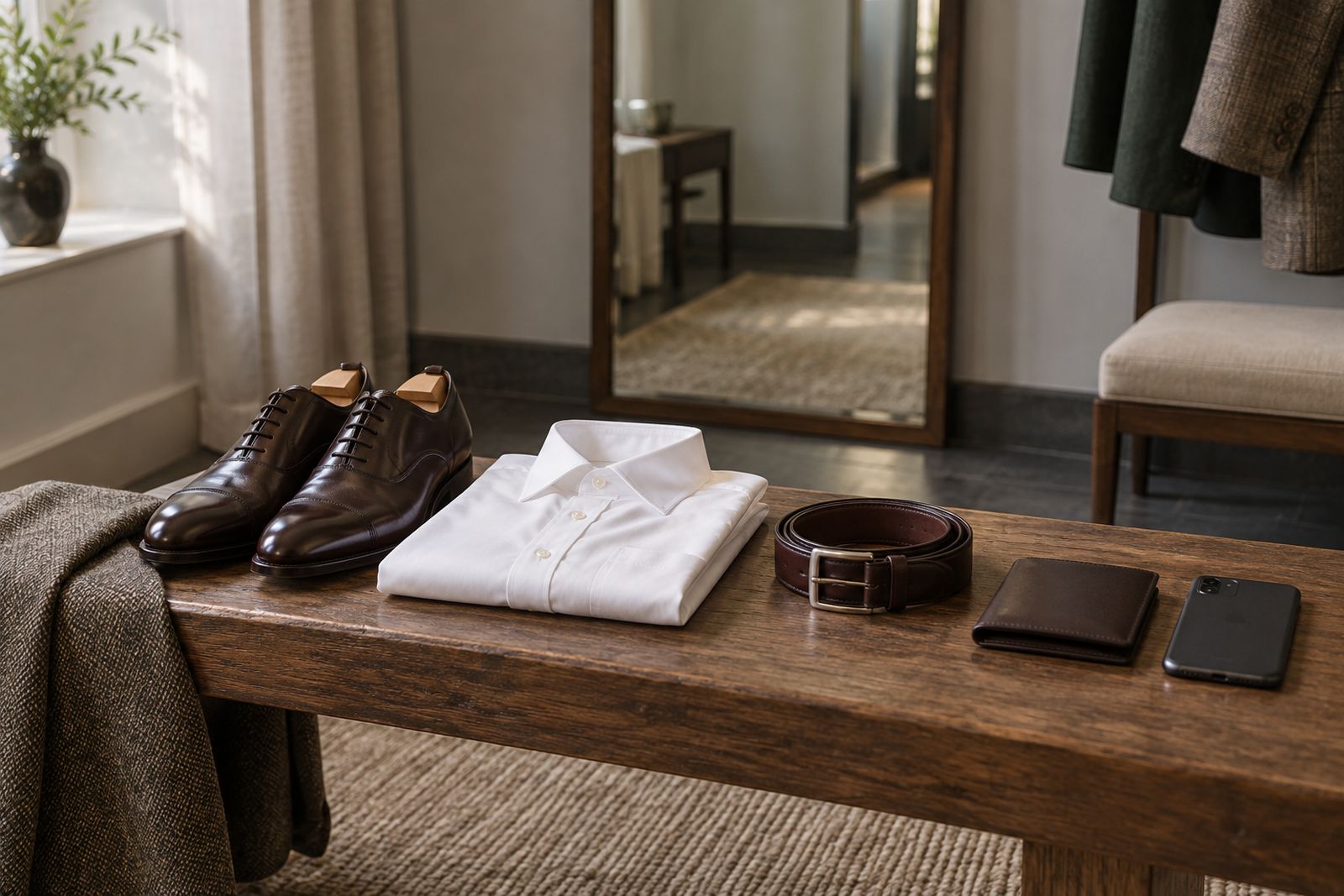
Wear the shoes and the kind of shirt you plan to wear with the suit, because heel height sets the trouser length and the shirt cuff sets the sleeve length. Bring your usual wallet and phone, a belt or braces, reference photos and a suit that fits well. Stand naturally, describe how it feels, and confirm the changes before you leave.
- Wear the shoes you will wear with the suit; heel height changes the trouser length.
- Wear a shirt that fits: the jacket sleeve is set to show ¼ to ½ inch (6 to 13 mm) of cuff.
- Carry your usual wallet, phone and keys in the pockets you will really use.
- Stand as you normally do; holding your breath or standing to attention skews the fit.
- Describe what you feel, not what you think the fix is, and confirm the changes before you leave.
In this guide
- What should you wear to a suit fitting?
- What should you bring to a suit fitting?
- What happens at a suit fitting?
- How long does a suit fitting take?
- What to look for at a fitting
- What should you say at a suit fitting?
- Questions to ask before you leave
- Common mistakes at a first fitting
- The tailor's view: what a good tailor is checking
- Questions people ask
What to wear to a suit fitting matters more than most people expect. The tailor sets the trouser length against your shoes, the sleeve length against your shirt cuff, and the jacket's ease against what you carry in your pockets. Arrive in sneakers and a T-shirt and the tailor is guessing. The advice below applies to a first bespoke or made-to-measure fitting and to an alterations fitting alike.
At a glance
- Wear
- The shoes and the kind of shirt you will wear with the suit; your usual belt or braces
- Bring
- Wallet, phone and keys; reference photos; a suit or jacket that fits you well
- Allow
- About 15 to 30 minutes for alterations; 30 to 60 minutes for a bespoke baste fitting; longer for a first consultation
- Do
- Stand naturally, move, sit, and say how it feels
- Before you leave
- Confirm the changes, the next fitting and the collection date
What should you wear to a suit fitting?
Wear the shoes and the kind of shirt you plan to wear with the suit, plus your usual belt or braces (suspenders). Each one changes a measurement the tailor will set at the fitting. If you cannot wear them, bring them and change in the fitting room.
| Wear | Why it matters |
|---|---|
| The shoes you will wear with the suit | Heel height and shape change where the trouser hem falls and how much break it has. Dress shoes, not sneakers. |
| A dress shirt that fits you | The jacket sleeve is set to show about ¼ to ½ inch (6 to 13 mm) of shirt cuff, and the collar is checked against the shirt collar. |
| Your usual belt, or braces | Trousers worn with braces are often cut with a higher rise and no belt loops; tell the tailor which you will use. |
| Your usual watch | A watch can catch a tight shirt cuff and change how the sleeve sits on that wrist. |
| Your usual undershirt, or none | A thick undershirt adds bulk at the chest and waist. |
What should you bring to a suit fitting?
Bring the things that change how the suit hangs, the things that help the tailor understand what you want, and your diary. This checklist covers a first fitting for a new suit; for an alterations fitting, you need only the first four items.
Fitting checklist
- The shoes you will wear with the suit, if you are not wearing them.
- A dress shirt that fits, if you are not wearing one.
- Your belt or braces.
- Your usual wallet, phone, keys and glasses case, to carry where you will carry them in the suit.
- Two or three photos of jackets or suits you like.
- A jacket or suit that fits you well, if you own one.
- A note of what bothers you about the suits you own.
- The event date, if the suit is for a wedding or other occasion.
- Your diary, to book the next fitting before you leave.
What happens at a suit fitting?
At a suit fitting, the tailor puts you in the garment, studies how it sits while you stand and move, and marks changes with pins or chalk. At a first bespoke fitting the garment is a baste: loosely tacked together with white thread, with no pockets cut and unfinished lapels. At a made-to-measure fitting you may wear a try-on garment in a standard size. At an alterations fitting you wear your own suit.
Stage 1: Change and settle
Shoes, shirt and pocket contents as you will wear them
Stage 2: Stand naturally
The tailor checks collar, shoulders, chest and balance from front, side and back
Stage 3: Move
Reach forward, raise your arms, sit down, turn
Stage 4: Check the trousers
Waist, seat, rise and length against your shoes
Stage 5: Agree the changes
Pins and chalk marks, explained and confirmed
Stage 6: Book the next step
Next fitting or collection date
Your fitting, step by step
- 1
Change and fill your pockets
Put on the shoes and shirt, then put your phone, wallet and keys where you will really carry them. A phone in the inside breast pocket changes how the front hangs.
Tip: Tell the tailor which pockets you use. Many people carry a phone in the inside left pocket, and a good tailor can allow for it.
- 2
Stand as you normally do
Stand relaxed, weight on both feet, arms by your sides, looking straight ahead. Do not hold your breath, pull your stomach in or stand to attention.
Tip: If you are not sure whether you are standing naturally, walk a few steps and stop. That is your stance.
- 3
Let the tailor look before you look
The tailor will check the collar, shoulders, chest, button point, waist, length and sleeves from the front, side and back. Keep still and face forward rather than turning to the mirror.
- 4
Move
Reach forward as if driving, raise your arms, fold your arms, sit down and stand up. Say where it pulls or restricts.
- 5
Check the trousers
The tailor checks the waist, seat, rise and leg, then pins the length against your shoes. Sit down to check the waist and seat while seated.
- 6
Agree the changes
Ask the tailor to explain each pin or chalk mark. Add anything you have noticed, such as a preference for a shorter jacket or less break.
- 7
Book the next step
Confirm the next fitting or the collection date, what will have changed by then, and what you will owe.
How long does a suit fitting take?
A suit fitting usually takes between 15 minutes and an hour, depending on the stage. A first consultation takes longest, mostly because choosing fabric takes time. Allow extra so you are not rushed; a hurried fitting is a worse fitting.
| Appointment | Typical length |
|---|---|
| Alterations fitting (pinning hems, sleeves, waist) | About 15 to 30 minutes |
| Made-to-measure consultation and try-on | About 45 to 90 minutes, including fabric choice |
| Bespoke consultation and measuring | About an hour, more if fabric choice is slow |
| Bespoke baste or forward fitting | About 30 to 60 minutes |
| Final fitting or collection | About 15 to 30 minutes |
Times vary by tailor and by how many changes are needed.
What to look for at a fitting
Look at the fit points that are hardest to change later: the collar, the shoulders and the balance. Leave the details until they are right. At a basted fitting, ignore the finish entirely: loose threads, raw edges and missing pockets are the point of a baste.
In the mirror
- The jacket collar rests against your shirt collar all the way around, with about ½ inch (1.3 cm) of shirt collar showing at the back.
- The shoulder ends where your shoulder ends, with no dent below it and no overhang.
- The lapels lie flat on your chest; the fastened button does not pull the front into an X.
- The back is clean: no horizontal roll below the collar, no diagonal drag lines.
- The hem is level all the way round, and the fronts neither gape open nor overlap below the button.
- The sleeve hangs without twisting and shows about ¼ to ½ inch (6 to 13 mm) of shirt cuff.
- The trousers sit where you want them at the waist, with no pulling across the front pockets or seat.
For each point in detail, see how a suit should fit, and for the hem, trouser break explained.
What should you say at a suit fitting?
Say what you feel and what you see, in plain words, and let the tailor decide the fix. You know how the suit feels from the inside; the tailor knows what causes it. Diagnosing the problem yourself can send the tailor after the wrong one.
| Say this | Rather than this |
|---|---|
| "It feels tight across the back when I reach forward." | "Let the back out." |
| "The collar feels as if it stands away when I turn my head." | "Take the collar in." |
| "I'd like the jacket a little shorter than this." | Saying nothing, then disliking it later. |
| "I carry my phone in the inside left pocket." | Leaving your phone in your bag at the fitting. |
| "I'll wear these mostly sitting at a desk." | "Make them slim." |
| "I prefer a little more room than this." | Accepting a fit that feels tight to be polite. |
Questions to ask before you leave
Before you leave, make sure you know what will change, what happens next and when. Five questions cover it.
- What are you changing, and why?
- When is the next fitting, and what will the suit look like by then?
- When will it be ready, and does anything still threaten that date?
- Should I wear or bring anything different next time?
- What do I owe now, and what at collection?
For questions to ask before ordering, see questions to ask a tailor. For what changes from one bespoke fitting to the next, see bespoke fittings explained.
Common mistakes at a first fitting
One more: bringing a crowd. One trusted person whose taste you value can help. Several opinions at once make it hard for you and the tailor to hear each other, and the suit is being cut for you.
The tailor's view: what a good tailor is checking
At a first fitting, a good tailor works from the big things to the small: balance and shoulders first, then the chest and waist, then lengths. They look at you from behind and from the side as much as from the front, and they watch how the garment behaves when you move. They may not fix every small point at the first fitting, because changing the balance or the shoulders moves everything below them.
They are also checking you: how you stand, which shoulder sits lower, how you carry your arms. That is why standing naturally matters so much. If the tailor fits the posture you put on for the mirror, the suit will be wrong for the posture you live in. For more on choosing a tailor who fits this way, see how to choose a tailor and our ranking of the best tailors in London.
Questions people ask
What happens at a suit fitting?
The tailor puts you in the garment, checks how it sits while you stand and move, and marks changes with pins or chalk. At a first bespoke fitting the garment is loosely basted together; at made-to-measure it may be a try-on garment. You then agree the changes and book the next step.
Should I bring my own shoes to a suit fitting?
Yes. Wear or bring the shoes you will wear with the suit, because heel height and shape change where the trousers should end and how much break they have. Without them, the tailor has to guess the length.
How long does a suit fitting take?
An alterations fitting usually takes 15 to 30 minutes, and a bespoke baste or forward fitting 30 to 60 minutes. A first consultation for a made-to-measure or bespoke suit can take an hour or more, mostly because of fabric choice. Allow extra time so you are not rushed.
What should I ask at a suit fitting?
Ask what the tailor is changing and why, when the next fitting is, when the suit will be ready, whether you should wear anything different next time and what you owe. Also say anything that feels wrong, in plain words.
What should I wear under a suit at a fitting?
Wear a dress shirt that fits you, ideally the kind you will wear with the suit, and your usual undershirt or none. The tailor sets the sleeve length against your shirt cuff and checks the collar against your shirt collar. A thick undershirt or sweater skews the fit.
Can I bring someone with me to a fitting?
Yes, one trusted person can help, especially for a wedding suit. More than one tends to get in the way. Make sure the final word on how it feels is yours.
Should I wait until I lose weight to get fitted?
If you expect your weight to change significantly, wait until it settles, or tell the tailor so they can plan for it. A suit fitted at one weight will not fit well at a very different one. Small changes can usually be handled by later alterations.
TailorGuide is independent. Our guides are written and checked by our team and carry no paid endorsements. How we work.