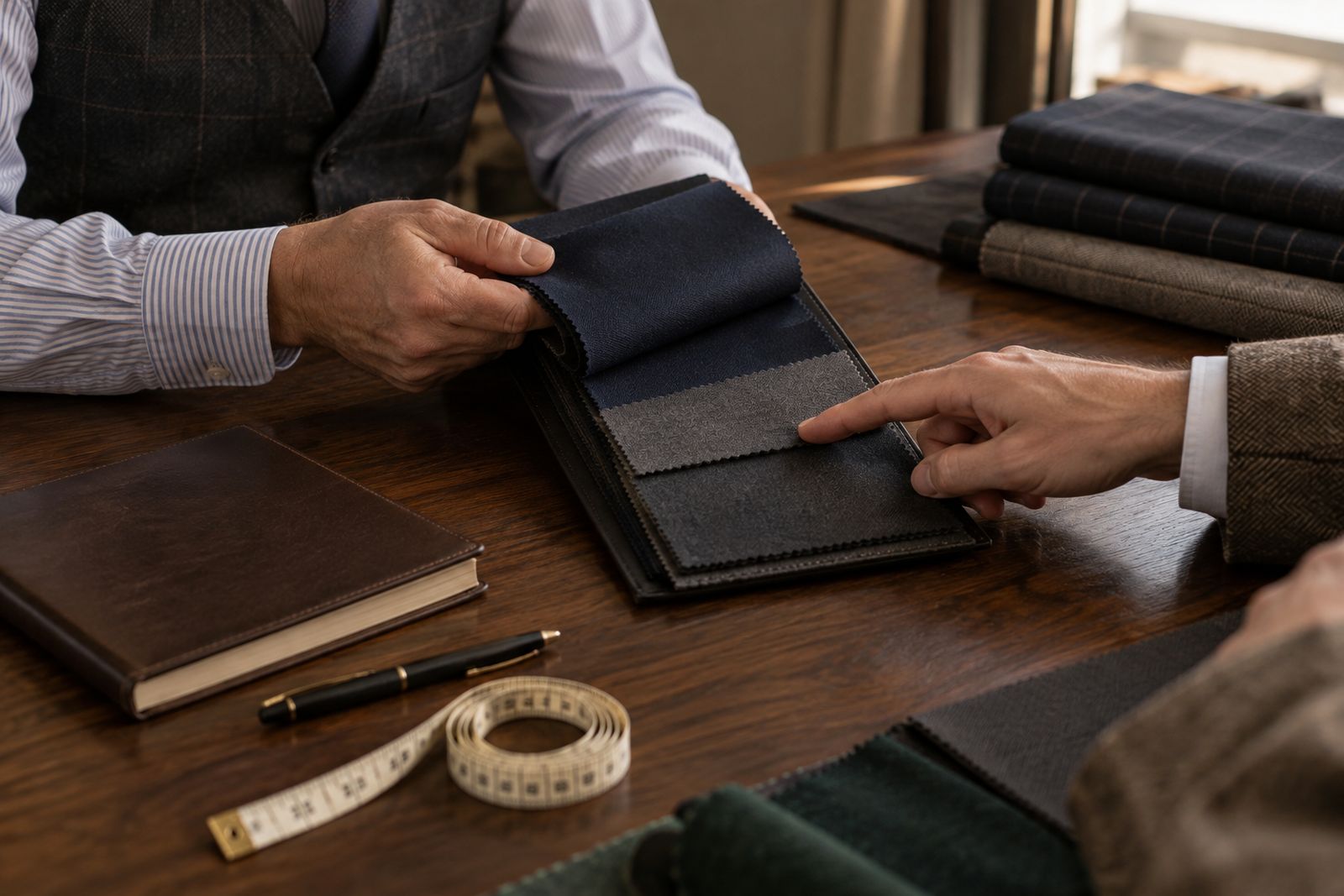
The short answer
Before ordering a suit, ask a tailor how the pattern is made, how many fittings you get, who cuts and sews the suit and where, which fabric weight suits your use, how long it will take, what the price includes, what deposit is due, and what alterations cost afterward. A good tailor answers each one plainly; vague answers are the warning sign.
- Ask whether a pattern is drafted for you or a standard block is adjusted.
- For bespoke, expect three or more fittings, starting with a basted fitting.
- Ask who makes the suit and where; any honest answer beats an evasive one.
- Get the price, deposit, timeline and aftercare terms in writing.
- A tailor who says no to a bad idea is worth more than one who agrees to everything.
In this guide
- What questions should you ask a tailor?
- Questions about the process
- Questions about who makes the suit
- Questions about fabric
- Questions about timing
- Questions about price and deposit
- Questions about aftercare
- Questions to ask an alterations tailor
- How do I explain what I want to my tailor?
- How to judge the answers
- The tailor's view: questions good tailors will ask you
- Questions people ask
The questions to ask a tailor before you order a suit are simple. The skill is in listening to the answers. A good tailor explains the process, the maker, the fabric, the timeline and the price without hesitation, and will tell you when something you want is a bad idea. A poor one answers in adjectives. Below, each question is paired with what a good and a worrying answer sound like.
The six areas to cover
- Process
- Bespoke or made-to-measure; how many fittings
- Maker
- Who measures, cuts, fits and sews; and where
- Fabric
- Which fabric and weight for your use
- Timing
- When the fittings are and when it will be ready
- Price
- What is included, the deposit, tax and cancellation
- Aftercare
- Alterations after collection, repairs, letting out later
What questions should you ask a tailor?
Ask enough to know what you are buying, who is making it, when you will get it and what it will cost in total. This short list covers the main points; take it to every consultation.
The short list
- Is this bespoke or made-to-measure? Do you draft a new pattern for me?
- How many fittings will I have, and is the first one basted?
- Who will measure and fit me, and will it be the same person each time?
- Who makes the jacket and trousers, and where?
- Is the jacket full canvas, and which parts are sewn by hand?
- Which fabric and weight do you recommend for how I will wear it?
- When will the fittings be, and when will the suit be ready?
- What does the price include, and is tax included?
- What deposit do you take, and when is the balance due?
- What do alterations cost after collection, and do you keep my pattern?
Questions about the process
Process questions tell you which tier you are buying. The word on the window does not; the answers do. Our guide to bespoke vs made-to-measure explains what each answer means.
| Ask | A good answer sounds like | A worrying answer sounds like |
|---|---|---|
| Is this bespoke or made-to-measure? | "Made-to-measure: we adjust our block to your measurements," or "Bespoke: our cutter drafts a pattern for you." | "It's fully custom," with no detail about the pattern. |
| Do you draft a new pattern for me? | "Yes, on paper, and we keep it for your next order." | "We take your measurements and send them off." (That is made-to-measure, whatever it is called.) |
| How many fittings will I have? | "Usually three for a first suit: baste, forward and finish, and more if we need them." | "We get it right first time," or a single fitting on delivery for a 'bespoke' suit. |
| What if it isn't right at the final fitting? | "We keep working on it until it is, and recut a piece if we have to." | "Alterations after delivery are charged separately." |
| Do you keep my pattern or measurements? | "Yes; your next suit starts from what we learn on this one." | "You'd need to be measured again." |
If the answers point to made-to-measure, that is fine, as long as the price does too. What you are checking is that the description matches the process.
Questions about who makes the suit
Ask who will measure you, who will fit you, and who makes the suit and where. In bespoke, the cutter who drafts your pattern should fit you. In made-to-measure, a fitter records adjustments for a factory. Either is honest. Evasion is the problem.
| Ask | A good answer sounds like | A worrying answer sounds like |
|---|---|---|
| Who will measure and fit me? | A named cutter or fitter, the same person at every fitting. | "Whoever is in that day." |
| Who makes the jacket and trousers, and where? | "Our coat maker upstairs," "outworkers nearby," or "our factory in Italy": specific and plain. | "Our team makes it," with no location. |
| Is the jacket full canvas? | "Full canvas, hand-padded," or "half canvas on this program," with the reason. | "It's all handmade," at a price that cannot cover it. |
| Which parts are sewn by hand? | A specific list: canvas, sleeves, buttonholes, linings, collar. | "Everything that matters." |
If the construction answers confuse you, our guide to fused vs canvas explains what each one means for how the jacket wears.
Questions about fabric
Ask which fabric suits the way you will wear the suit, not which is the finest. A good tailor asks about your climate and how often you will wear it, then recommends a weight and a weave. For a first suit worn year-round in most climates, expect a recommendation of a worsted around 9 to 11 oz (280 to 340 g).
| Ask | A good answer sounds like | A worrying answer sounds like |
|---|---|---|
| Which fabric and weight for how I'll wear it? | Questions about your climate and use, then a specific weight and weave. | Straight to the highest Super number in the book. |
| Who is the mill or merchant? | The name, the book and the reference number. | "It's Italian," and nothing more. |
| How will this fabric wear? | Honest about creasing, shine or durability, especially for very fine fabrics. | "It's the best there is." |
| Is there enough for a second pair of trousers? | "Yes; we'll reserve the length now," with a price. | No answer until the suit is finished. |
Questions about timing
Ask when the fittings will be and when the suit will be ready, and listen for a realistic answer. A first bespoke suit on Savile Row usually takes around 8 to 12 weeks, often longer; made-to-measure about 3 to 8 weeks. See how long a bespoke suit takes for what drives the timeline.
| Ask | A good answer sounds like | A worrying answer sounds like |
|---|---|---|
| When will my fittings be? | Approximate dates for each fitting, with gaps of a few weeks for bespoke. | "We'll call you." |
| When will it be ready? | A realistic range, with the caveat that fittings can add time. | "Two weeks" for a suit described as bespoke. |
| I need it by this date. Is that realistic? | An honest yes or no, and what would have to happen for yes. | An instant yes, whatever the date. |
Questions about price and deposit
Ask what the price includes, what deposit is due and what happens if plans change. Get it in writing. Many bespoke tailors take a deposit when the order is placed, often around half, with the balance at the final fitting or collection.
| Ask | A good answer sounds like | A worrying answer sounds like |
|---|---|---|
| What does the price include? | The fabric range, trimmings, buttons, fittings and any alterations, itemized. | "Everything," with no list. |
| What deposit do you take? | A stated amount or percentage, the balance due at a stated point, in writing. | Full payment today for a discount that expires. |
| Is tax included? | A clear yes or no. UK retail prices normally include 20% VAT; US prices usually exclude sales tax. | "We'll sort that out later." |
| What if I change a detail after cutting? | Which changes are free at fittings, and which cost extra. | No answer, or "no problem" to anything. |
| What happens to my deposit if I cancel? | A clear policy, usually tied to how far the work has gone. | Evasion. |
Questions about aftercare
Ask what happens after you collect the suit. Bodies change and suits need pressing and repair, and a good tailor plans for both. Members of the Savile Row Bespoke Association, for example, must provide aftercare including sponging, pressing, repairs and button matching.
- Are alterations after collection included, and for how long? A good answer gives a period and what it covers.
- Can the suit be let out later? In bespoke, look for an answer about inlays, the extra seam allowance left for exactly this.
- Do you offer pressing and repairs? Most good tailors do, for suits they made.
- Will you keep my pattern? For bespoke, yes; for made-to-measure, your measurements and fitting notes.
Questions to ask an alterations tailor
If you are having a suit altered rather than made, the questions are narrower but just as useful. They tell you whether the job can be done well, and what it will do to the rest of the garment.
| Ask | Why it matters |
|---|---|
| Is there enough seam allowance to let this out? | Ready-to-wear suits often have little spare fabric in the waist and seat; the answer decides whether the job is possible. |
| Will you shorten the sleeves from the cuff or the shoulder? | Sleeves with working buttonholes usually cannot be shortened much from the cuff; working from the shoulder is a bigger, more expensive job. |
| Will this change anything else? | Taking in a jacket waist a lot at the side seams can leave the pockets crowding the seam; shortening a jacket can unbalance the pockets and buttons. |
| Can I try it on before I pay the balance? | A good alterations tailor wants you to check the work while you are in the shop. |
| Do you do the work here, or send it out? | You want to know who is responsible if it goes wrong. |
For what can and cannot be fixed, and roughly what it costs, see our guide to what a tailor can and can't alter.
How do I explain what I want to my tailor?
Explain what you want by showing and describing rather than by using technical terms you are unsure of. Bring two or three photos of jackets you like and say what you like about each. Describe how you will wear the suit and what annoys you about the suits you own: a jacket that rides up when you reach forward, trousers that slip below your waist, a collar that stands away from your neck. Then let the tailor translate.
| If you say | The tailor hears |
|---|---|
| "I want it shaped at the waist" | More waist suppression |
| "I want it to feel easy across the back" | More drape, or fullness across the shoulder blades |
| "I don't like padded shoulders" | A natural or soft shoulder with little or no padding |
| "The sleeves twist on my current jackets" | Check the sleeve pitch, the angle at which the sleeve is set |
| "The jacket swings open at the front" | Check the balance, the relation between front and back length |
| "I want the trousers to sit at my natural waist" | A higher rise, often with side adjusters or braces (suspenders) |
| "I want little or no break" | A shorter trouser length; see trouser break |
How to judge the answers
You are not testing the tailor's vocabulary. You are testing whether they explain plainly, whether they ask about you, and whether they are willing to disagree with you.
Answers that reassure
Specific and honest
- Names the cutter, the maker and the place
- Gives a number of fittings and a realistic timeline
- Recommends a fabric for your use, not the most expensive one
- Puts the price, deposit and aftercare in writing
- Tells you when something will not work
Answers that should worry you
Vague or too good to be true
- "Fully custom" or "all handmade" with no detail
- "We get it right first time"
- Bespoke delivered in two weeks
- Full payment today for a vanishing discount
- Yes to every request
The tailor's view: questions good tailors will ask you
A consultation should be a conversation, and a good tailor will question you as closely as you question them. Have answers ready.
Be ready to answer
- What is the suit for, and how often will you wear it?
- Where will you wear it: climate, office, travel, evenings?
- What do you like and dislike about the suits you own?
- Will you wear it with a belt or braces (suspenders)?
- Which shoes will you wear with it?
- What is your budget, including any extra trousers?
- Is there a date you need it by?
Then ask the question good tailors wish more customers asked: "What would you change about my brief?" The answer will tell you whether this is the right tailor. For the fittings that follow, see your first fitting and bespoke fittings explained. To build a shortlist, start with our guide to choosing a tailor and our ranking of the best tailors in London.
Questions people ask
What should I ask at a suit consultation?
Ask whether the suit is bespoke or made-to-measure, how many fittings you will have, who makes it and where, which fabric and weight suit your use, when it will be ready, what the price includes, what deposit is due and what aftercare is offered. Get the price, deposit and timeline in writing.
How do I explain what I want to my tailor?
Bring photos of jackets you like and say what you like about each. Describe how you will wear the suit and what bothers you about your current suits, in plain words. A good tailor will translate that into cutting decisions.
How do I know if a tailor is good?
A good tailor answers questions specifically, asks about how you will wear the suit, studies your posture and will tell you when something will not work. Their finished jackets have collars that sit against the neck and clean backs. Their price, deposit and timeline are in writing.
How can I tell if a suit is made in-house?
Ask directly who makes the jacket and trousers and where. A tailor who makes in-house or uses local outworkers will usually say so readily and may show you the workroom. If the answer is vague, assume it is made elsewhere.
Should I pay a deposit for a custom suit?
Yes, a deposit is normal for made-to-measure and bespoke suits, because the fabric is cut for you. Many bespoke tailors ask for around half at the order and the balance at collection. Make sure the amount, the balance and the cancellation terms are in writing.
What questions will a tailor ask me?
A good tailor will ask what the suit is for, how often and where you will wear it, what you like and dislike about your current suits, which shoes you will wear and what your budget is. They may also ask whether you wear a belt or braces. Have answers ready to save time.
Is it OK to bring photos to a tailor?
Yes, and good tailors welcome it. Two or three photos of jackets you like, with a note of what you like about each, save a great deal of explanation. Expect the tailor to adapt the idea to your build and their house style.
TailorGuide is independent. Our guides are written and checked by our team and carry no paid endorsements. How we work.