The short answer
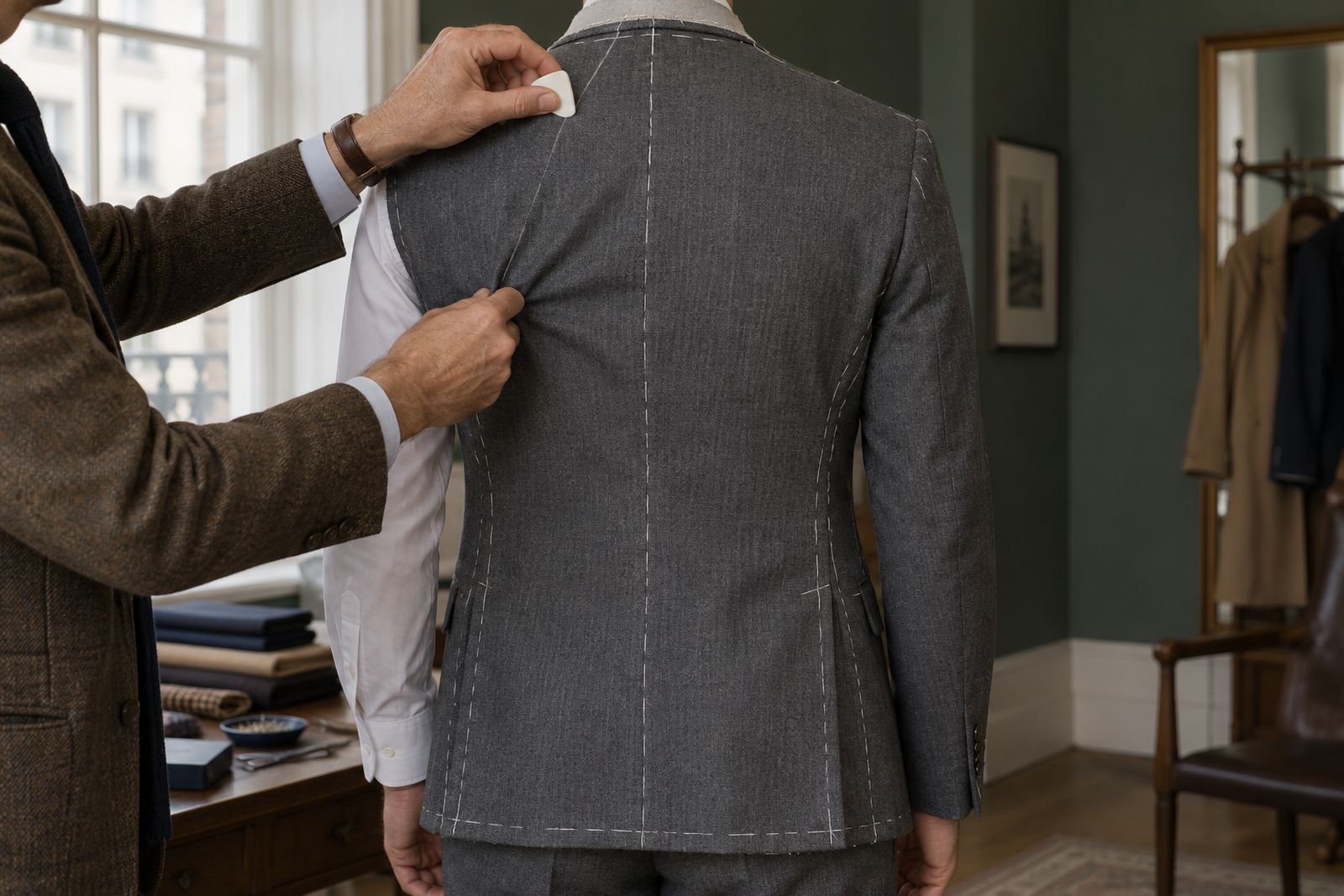
A bespoke suit usually takes three fittings: a baste fitting on a loosely tacked garment, where the balance, shoulders and proportions are set; a forward fitting on a partly finished suit, where the collar, sleeves and details are refined; and a finish fitting on the completed suit. Difficult figures or first orders may need more, and repeat customers sometimes fewer.
- Expect three fittings for a first bespoke suit: baste, forward and finish, sometimes more.
- The baste is where the big things change: balance, shoulders, length and proportions.
- At the forward, buttonholes are not yet cut, so button position and sleeve length can still move.
- By the finish fitting, only small adjustments remain: lengths, a little at the waist, pressing.
- Speak up early: the earlier the fitting, the more can change.
In this guide
- How many fittings does a bespoke suit need?
- What is a basted fitting?
- What is a forward fitting?
- What happens at the finish fitting?
- What can still change at each fitting?
- How long is there between fittings?
- How many fittings for a made-to-measure suit?
- How to get the most from every fitting
- The tailor's view: why fittings matter more than measurements
- Questions people ask
How many fittings for a bespoke suit? Usually three, and each one does a different job. A bespoke suit is fitted while it is still being made, so the cutter can correct the pattern as well as the garment. The first fitting sets the big proportions, the second refines them, and the third checks the finished suit. Knowing what each stage is for tells you what to look at, and when it is too late to change something.
At a glance
- Typical number
- Three for a first bespoke suit; more for difficult figures, sometimes fewer for repeat orders
- Baste fitting
- Loosely tacked garment; balance, shoulders, length and proportions set
- Forward fitting
- Partly finished; collar, sleeves, pockets and buttons refined
- Finish fitting
- Completed suit; small adjustments and pressing
- Total time
- About 8 to 12 weeks on Savile Row, often longer
How many fittings does a bespoke suit need?
A first bespoke suit usually needs three fittings: baste, forward and finish. A difficult figure, an unusual fabric or a first order at a new house can add a fourth, often a second baste. A repeat customer whose pattern is already proven may need fewer, because the cutter is refining rather than discovering. Made-to-measure, by contrast, usually has one fitting before the order and one at delivery.
| Type | Typical fittings | Notes |
|---|---|---|
| Bespoke, first suit | 3 or more: baste, forward, finish | Extra fittings for difficult figures or big changes |
| Bespoke, repeat order | Often fewer than the first | The pattern is proven; depends on the fabric and any changes |
| Visiting bespoke tailor | 3 or more | Spaced around the tailor's visits, so a first suit can take months |
| Made-to-measure | 1 at order, 1 at delivery | Some higher-end programs add a basted fitting |
| Online made-to-measure | None before delivery | Alterations by a local tailor afterward |
| Ready-to-wear | 1 alterations fitting | Lengths and the waist only |
Stage 1: Measure and cut
Week 0 to 2
Pattern drafted, fabric cut with inlays
Stage 2: Baste fitting
Around weeks 3 to 5
Loosely tacked garment; balance, shoulders, length and proportions set
Stage 3: Recut
Suit unpicked, pattern corrected, pieces recut
Stage 4: Forward fitting
Around weeks 6 to 9
Partly finished; collar, sleeves, pockets and buttons refined
Stage 5: Finish fitting
Around weeks 8 to 12, often later
Completed suit; small adjustments and final press
What is a basted fitting?
Basted fitting (the baste)
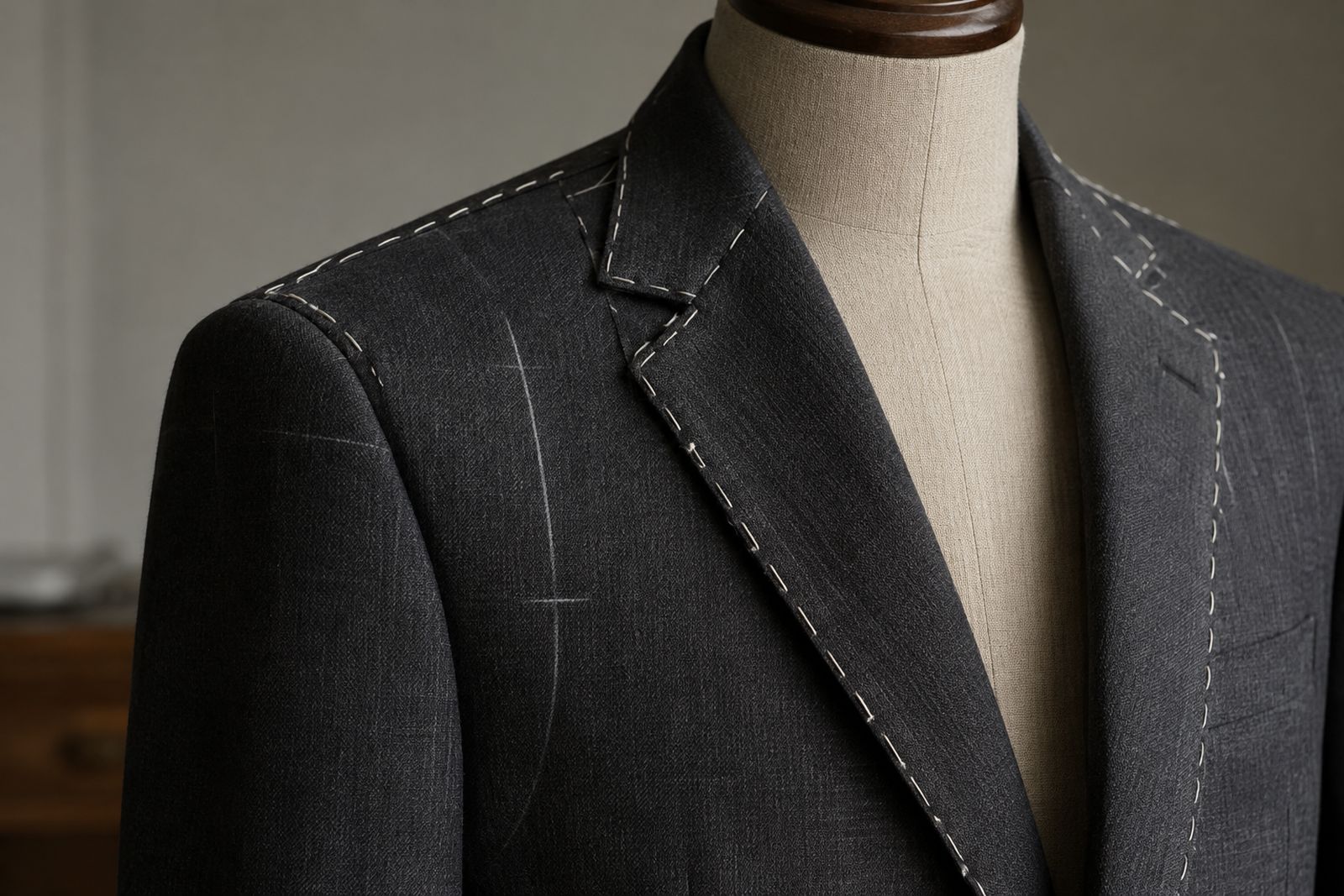
A basted fitting is the first fitting of a bespoke garment, made from fabric cut to the customer's own pattern and held together with long, loose white tacking stitches, so that it can easily be taken apart and recut.
A basted jacket looks unfinished, and that is deliberate. The seams are tacked in white thread, the canvas is basted inside, the pockets are marked in chalk rather than cut, the lapels have raw edges and the collar is roughly attached. Sleeves are tacked in loosely, and some cutters fit only one sleeve at this stage. The trousers are basted too, with the waistband in place and the hems unfinished. Some tailors call this a skeleton baste, because it is the bare frame of the suit.
What the cutter checks at the baste
At the baste, the cutter checks the things that are hardest to change later, working from the top down. These are the decisions that shape the whole pattern.
- Balance: whether the front and back lengths suit how you stand, so the hem is level and the fronts neither gape open nor overlap.
- Shoulders: width, slope and whether one side needs to sit lower than the other.
- Collar: whether it sits against your neck all the way round when you stand naturally.
- Back: no roll of fabric below the collar and no drag lines across the shoulder blades.
- Chest and waist: clean lapels, the right amount of shape at the waist, no pull at the button.
- Proportions: jacket length, button position and the line of the lapels.
- Sleeves: the pitch, or angle at which the sleeve hangs, and a first estimate of length.
- Trousers: the rise, the seat, the line of the leg and the length against your shoes.
Balance
Balance is the relationship between the front and back lengths of a jacket. When it is right, the hem hangs level and the fronts fall straight; when the front is too long, the fronts overlap and the hem drops at the front; when it is too short, the fronts swing open.
What you should say at the baste
Say anything that feels or looks wrong, because this is when it is easiest to fix. Describe what you feel rather than the fix: "it pulls across my back when I reach forward" is more useful than "let the back out". If you want the jacket shorter, the lapel slimmer or the trousers higher in the rise, say so now. Ignore the finish entirely: loose threads and raw edges are the point of a baste.
After the baste, the suit is unpicked, the cutter re-marks the pieces in chalk and corrects the pattern, and the parts are recut and rebuilt. If the changes were large, the next fitting may be a second baste rather than a forward. Our guide to how a bespoke suit is made shows what happens at the bench between fittings.
What is a forward fitting?
Forward fitting
A forward fitting is the stage after the baste, on a suit that is partly finished: pockets cut, collar and lapels shaped, sleeves set and the lining partly in, but with the buttonholes not yet made and the sleeve ends left open.
The forward is where the corrections from the baste are tested and the details are refined. Because the buttonholes are not yet cut, the button position can still move. Because the sleeve ends are still open, the sleeve length can still change; this matters most with working sleeve buttonholes, which fix the length once they are cut. The jacket now looks like a jacket, which makes it easier for you to judge the overall effect.
What the cutter checks at the forward
- Whether the corrections from the baste worked: balance, shoulders, collar and back.
- How the lapel rolls and how the collar sits now that both are shaped.
- Sleeve pitch and the final sleeve length, showing about ¼ to ½ inch (6 to 13 mm) of shirt cuff.
- The position of the buttons and pockets relative to your waist and hips.
- The final jacket length.
- Trouser length and break against your shoes, and the waist and seat after the baste changes.
What you should say at the forward
Say whether it feels right when you move, sit and reach, and whether the proportions look the way you pictured. Style decisions such as lapel width, pocket style and the number of buttons are largely fixed by now, because the parts have been cut and shaped. Fit can still change; the design, mostly, cannot. If something still bothers you, this is the last fitting where a substantial change is straightforward.
What happens at the finish fitting?
Finish fitting
The finish fitting, also called the final fitting, is the fitting on the completed or nearly completed suit, with linings finished and the garment pressed, to make any last small adjustments before collection. Some houses leave the sleeve buttonholes until this fitting has confirmed the sleeve length.
At the finish fitting the suit is complete, and the changes left are small: a sleeve or trouser length, a slight adjustment at the waist or seat, a better press. Larger changes are still possible, but they mean unpicking finished work, so a good cutter aims to have the big decisions settled at the baste and forward. Wear the suit around the shop, sit, reach and check it in daylight if you can. Our guide to how a suit jacket should fit explains each fit point in detail.
What to check at the finish fitting
- The collar sits against your shirt collar all the way round, with no gap at the back.
- The back is clean when you stand naturally, with no roll below the collar.
- The jacket buttons without pulling, and the fronts fall straight.
- The sleeves show about ¼ to ½ inch (6 to 13 mm) of shirt cuff and hang without twisting.
- The trousers sit at the height you want and end with the break you chose.
- Pockets are where you want them and take your phone and wallet without distorting.
- Nothing restricts you when you reach forward, raise your arms or sit.
After collection, wear the suit for a few weeks and report anything that bothers you. Many tailors adjust their own work after collection, and a suit sometimes settles a little with wear. For what any tailor can change later, see what a tailor can and can't alter.
What can still change at each fitting?
What can change narrows at every stage, because each fitting turns more of the suit into finished work. This matrix shows what can be changed easily, with some difficulty, or hardly at all, at each fitting.
| Baste | Forward | Finish | |
|---|---|---|---|
| Balance (front and back length) | |||
| Shoulder width and slope | |||
| Collar fit | |||
| Chest and waist | |||
| Jacket length | |||
| Button position | |||
| Pocket position | |||
| Lapel width and shape | |||
| Sleeve pitch | |||
| Sleeve length | |||
| Trouser waist and seat | |||
| Trouser length |
How long is there between fittings?
Fittings for a bespoke suit are usually a few weeks apart, set by how long the coat maker needs to rebuild the suit and by your availability. With three fittings, that adds up to the 8 to 12 weeks, often longer, that a first Savile Row suit typically takes. With a tailor who visits your city a few times a year, the gaps follow the visits, and a first suit can take several months. Our guide to how long a bespoke suit takes explains what drives the timeline.
How many fittings for a made-to-measure suit?
A made-to-measure suit usually has one fitting before the order, in a try-on garment of a standard size, and one when the finished suit arrives, when final alterations are pinned. Some higher-end programs add a basted fitting, which brings them closer to bespoke. Because the pattern is a standard block, the first fitting records adjustments rather than correcting a pattern drafted for you. Our bespoke vs made-to-measure guide compares the two processes.
How to get the most from every fitting
You get the most from each fitting by giving the cutter the same, honest information every time. Our guide to your first fitting covers what to wear and bring in detail; these are the points that matter across all three.
At every fitting
- Wear the same shoes and the same kind of shirt each time.
- Carry your phone, wallet and keys where you will carry them in the finished suit.
- Stand as you normally do; don't hold your stomach in or stand to attention.
- Move: reach forward, raise your arms, sit down.
- Describe what you feel in plain words, and say it early.
- Settle style decisions before cutting; change fit, not design, at the fittings.
- Keep your weight steady between fittings, and warn the tailor if it changes.
- Book the next fitting before you leave.
The tailor's view: why fittings matter more than measurements
Measurements are numbers; a fitting shows how fabric actually hangs on a body. Two people with the same chest and waist measurements can need very different patterns, because one stands upright and the other leans forward, or one has a lower right shoulder. The baste is where a cutter sees those things in fabric and corrects the pattern to suit. That is why bespoke suits are fitted unfinished, and why a first suit takes the most fittings.
It is also why the second suit is usually better than the first. The corrections made at your fittings stay in your pattern, so the next suit starts from a shape that already fits. If you are choosing a house to begin that process, our guide to questions to ask a tailor and our ranking of the best tailors in London are good places to start.
Questions people ask
How many fittings for a bespoke suit?
A first bespoke suit usually needs three fittings: baste, forward and finish. Difficult figures or big changes can add a fourth, often a second baste. Repeat orders from a proven pattern sometimes need fewer.
What is a forward fitting?
A forward fitting is the stage after the baste, on a partly finished suit with pockets cut, collar and lapels shaped and sleeves set, but buttonholes not yet made and sleeve ends left open. It tests the corrections from the baste and refines the details. Button position and sleeve length can still change.
What is a basted fitting?
A basted fitting is the first fitting of a bespoke garment, cut from your own pattern and loosely tacked together with white thread so it can be taken apart and recut. Pockets are only marked and the lapels are unfinished. It is where the balance, shoulders and proportions are set.
Why is my suit held together with white stitches at the fitting?
The white stitches are basting, long temporary stitches that hold the suit together loosely so the cutter can unpick it, correct the pattern and recut the pieces after the fitting. They are a sign of a genuine bespoke process. They are removed as the suit is made up.
How many fittings for a made-to-measure suit?
A made-to-measure suit usually has one fitting at the order, in a try-on garment, and one at delivery for final alterations. Some higher-end programs add a basted fitting. Online made-to-measure often has no fitting before delivery.
What should I look for at a suit fitting?
Look first at the collar, shoulders and balance: the collar should sit against your neck, the shoulders should end where yours do, and the hem should hang level. Then check the chest, waist, button position, sleeve and trouser lengths. Move and sit to check comfort.
Can I skip a fitting?
You can, but it is rarely wise with a first bespoke suit, because each fitting corrects the pattern as well as the garment. With a proven pattern, your tailor may suggest fewer fittings. Let the cutter decide.
What if the suit still doesn't fit at the final fitting?
Say so clearly. A good bespoke tailor will keep working until the suit is right, which can mean another fitting or recutting a piece. Small issues that appear after a few weeks of wear are usually adjusted too.
TailorGuide is independent. Our guides are written and checked by our team and carry no paid endorsements. How we work.