The short answer
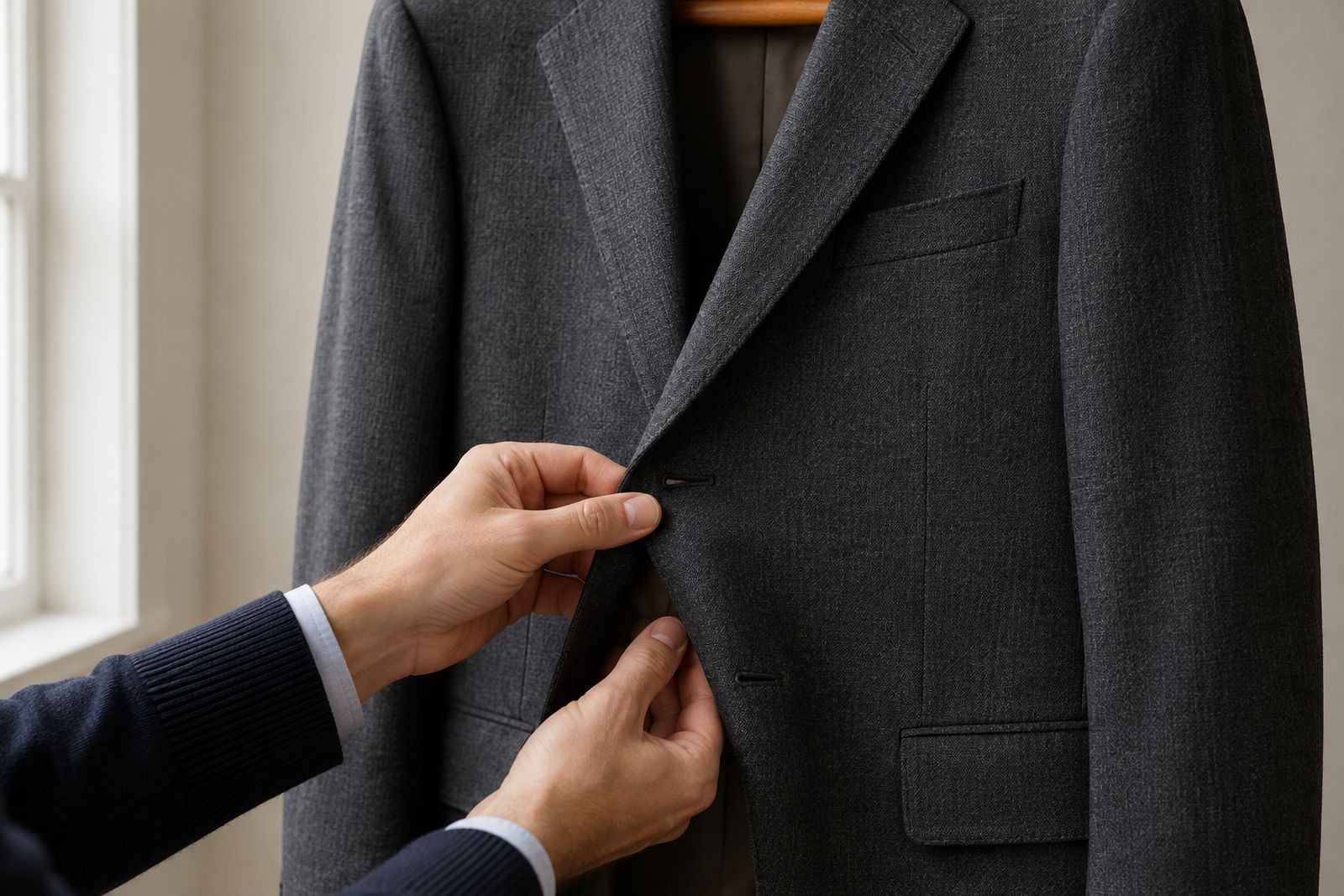
To tell if a suit is canvassed, pinch the jacket front just below the lowest buttonhole and gently separate the layers. If you feel a third, loose layer floating between the outer fabric and the inside, the jacket is full canvas. If that loose layer appears only in the chest and lapel, it is half canvas. If the front feels like one stiff layer everywhere, it is fused.
- Pinch below the lowest buttonhole: a third, loose layer there means full canvas.
- A loose layer in the chest and lapel only means half canvas.
- One stiff, papery layer and no free layer in the lapel means fused.
- A soft lapel roll supports canvas; ripples or blisters on the front mean failing fusing.
- Fused jackets often have a loose chest piece, so never judge from the chest alone.
In this guide
- How do you do the pinch test on a suit?
- What the pinch test tells you
- How to tell if a suit is fused
- Can a half canvas suit be identified from outside?
- Check the lapel roll
- Other clues: bubbling, the under collar, labels and price
- The limits of the pinch test
- The tailor's view: what to ask
- Questions people ask
Most suits do not tell you how they are built, and many sales descriptions are vague. Yet whether a jacket is fused, half canvas or full canvas predicts how it will drape, how the lapels will roll and how long it will last. You can tell if a suit is canvassed in a minute, in any shop, with the pinch test and three quick visual checks. Below is how to do each one, and where the test can fool you.
Quick reference
- Full canvas
- Loose third layer below the lowest buttonhole, in the chest and in the lapel
- Half canvas
- Loose layer in the chest and lapel; none below the lowest buttonhole
- Fused
- No loose layer in the lapel or lower front; stiff, papery feel
- Lapel
- Soft roll suggests canvas; flat or sharply creased suggests fusing
- Bubbling
- Ripples or blisters on the front almost always mean fused
How do you do the pinch test on a suit?
The pinch test works by feeling for a floating layer between the outer fabric and the inside of the jacket. A canvas is stitched in loosely, so it moves on its own; fused interlining is glued to the fabric, so it does not. Do the test at three points on the jacket front, starting below the lowest buttonhole.
The pinch test, step by step
- 1
Find the lowest buttonhole
Unbutton the jacket and let the front hang naturally. Find the lowest buttonhole on the front edge. You will test a point about 1 to 2 inches (2.5 to 5 cm) below it and about 2 inches (5 cm) in from the edge.
Tip: On a one-button jacket, the single buttonhole is the lowest one.
- 2
Take hold of all the layers
Put your thumb on the outside of the jacket and your forefinger and middle finger on the inside, directly opposite. You are now holding every layer of the front: the outer fabric, whatever sits behind it, and the inside layer (the facing or the lining).
- 3
Separate the outside from the inside
Keep a light grip on the outer fabric with your thumb and on the inside layer with your fingers, and gently ease them apart, as if peeling two pages away from each other. Then rub the layers slowly between your fingers.
Tip: Be gentle. You are feeling for movement, not pulling seams. Ask before handling stock in a small shop.
- 4
Feel for a third, loose layer
In a canvassed front you will feel a third layer, slightly coarse and springy, that slides independently between the outer fabric and the inside. In a fused front you will feel only two layers, and the outer one feels stiff and slightly papery because the interlining is glued to it.
- 5
Repeat in the chest and lapel
Do the same just below the breast pocket, then on the lapel a little above the top button. A loose layer in both places but not below the lowest buttonhole means half canvas. A loose layer everywhere means full canvas.
- 6
Compare with a jacket you know
If you are unsure, try the same test on a jacket whose construction you know, ideally one fused and one canvassed. After a few tries the difference becomes obvious.
What the pinch test tells you
The pattern of results across the three test points tells you the construction. The lapel matters most when you are separating half canvas from fused, because many fused jackets have a loose chest piece but very few have a floating layer running into the lapel.
| Test point | Full canvas | Half canvas | Fused |
|---|---|---|---|
| Below the lowest buttonhole | Loose third layer | No loose layer; stiff | No loose layer; stiff |
| Chest, below the breast pocket | Loose third layer | Loose third layer | Often a loose chest piece, sometimes nothing |
| Lapel, above the top button | Loose layer, lapel rolls | Loose layer, lapel rolls | No loose layer; lapel feels stiff and flat |
How to tell if a suit is fused
A fused suit gives itself away through stiffness, flatness and, over time, bubbling. No single sign is proof, but two or three together are close to it.
- No loose layer below the lowest buttonhole or in the lapel when you do the pinch test.
- A stiff, papery hand. Bend the lower front between your fingers. Fused fabric resists in an even, slightly crisp way, like a card rather than a cushion.
- A flat lapel. The lapel lies flat against the chest or shows a hard pressed crease where it folds.
- Ripples or blisters. Small bubbles on the chest, lapels or lower front are adhesive letting go.
- Silence in the description. Brands that canvas their jackets almost always say so. Vague phrases such as 'structured front' or 'tailored construction' usually mean fused.
Fused is not a verdict of poor quality on its own. Modern fusing is much better than it was, and a well-made fused suit is a reasonable buy at the right price. Our full comparison of fused vs canvas construction explains the trade-offs and when each makes sense.
Can a half canvas suit be identified from outside?
Partly. From the outside, a soft lapel roll and a shaped chest suggest that a jacket has canvas in the chest, but you cannot reliably tell half canvas from full canvas by eye. The difference lies in the lower front, and only the pinch test below the lowest buttonhole will tell you for certain. An experienced eye may notice that a full canvas front hangs and curves a little more freely over the hips, but that is a hint, not a test.
Check the lapel roll
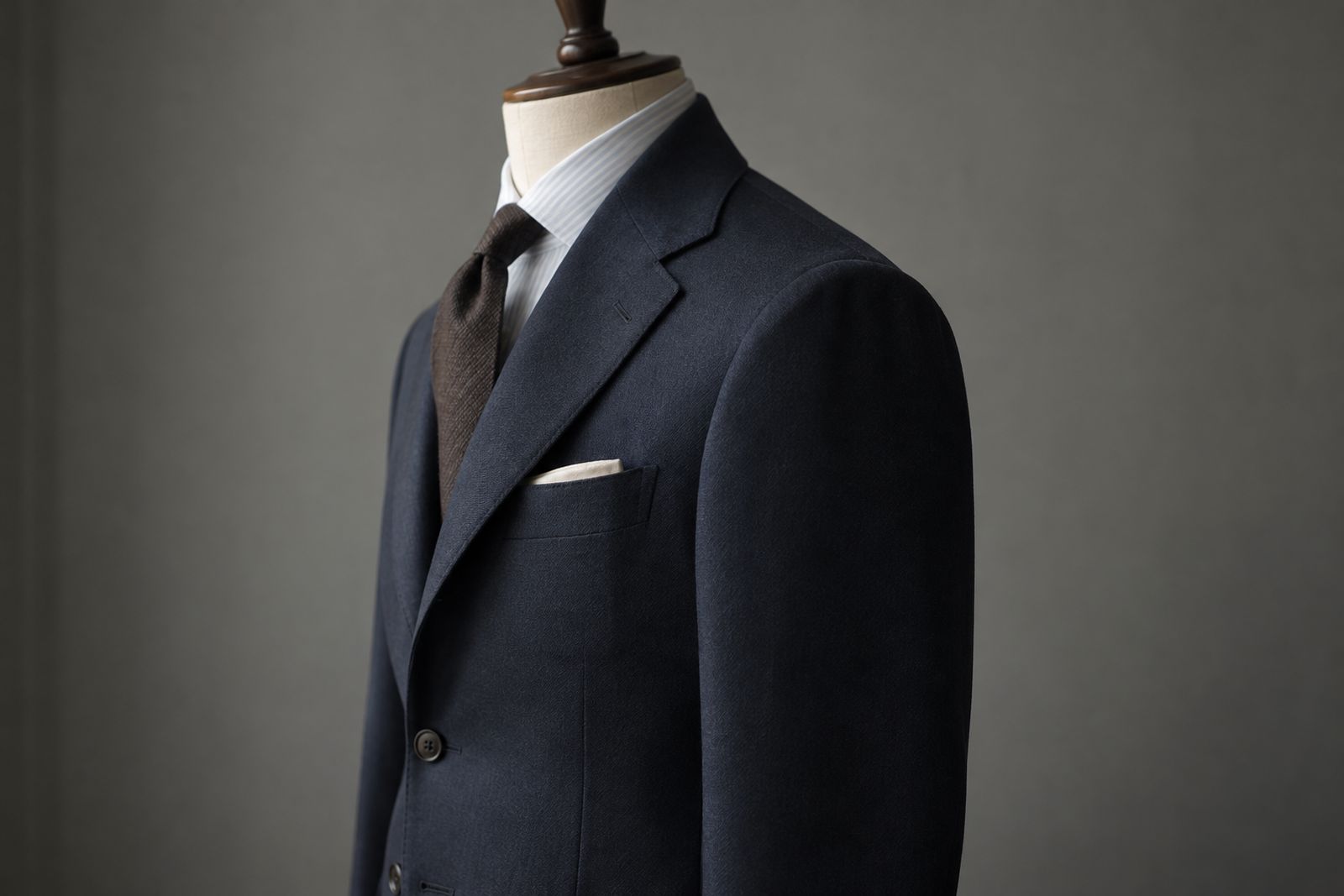
The lapel roll is the easiest sign of canvas to see. Button the jacket and stand side-on to a mirror. A canvassed lapel lifts slightly off the chest and turns back in a soft curve from the top button to the collar, without a sharp fold line. A fused lapel tends to lie flat, like a page in a closed book, or shows a hard crease along the fold. Our guide to suit lapels covers lapel shapes and widths.
Other clues: bubbling, the under collar, labels and price
Bubbling
Hold the jacket front up to the light and look across it at a low angle. Puckers, waves or small blisters on the chest, lapels or lower front are a sign of fused interlining starting to separate. Look hardest at second-hand and older jackets, and at any jacket that has been dry cleaned many times.
The under collar
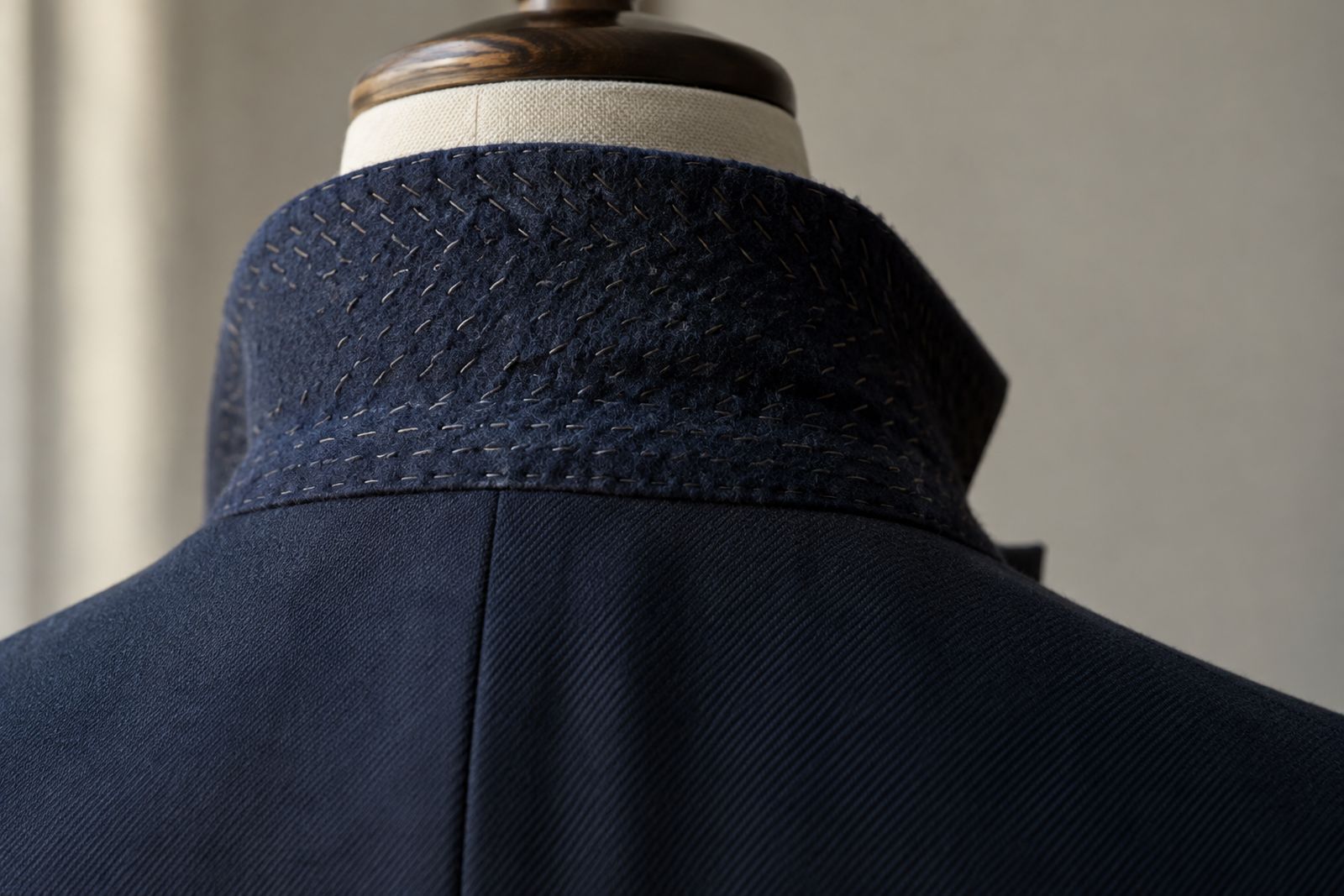
Turn the collar up and look underneath. Good jackets use a felted wool called melton for the under collar. On a hand-made jacket you may see rows of small, slightly irregular pad stitches in the felt; on factory jackets you will see regular machine stitching or no visible stitching at all. This tells you more about how the collar was made than about the front, but hand work here usually goes with a canvassed front.
Labels and descriptions
Read the product description and any swing tag. Full canvas and half canvas are selling points, and brands that use them say so. Be careful with half-claims: 'floating chest piece' or 'canvas chest piece' can describe a fused jacket with a sewn-in chest piece, which is not the same as half canvas. If the description is unclear, ask directly and then check with your fingers.
Price signals
Price is a rough signal. As of 2026, a new two-piece suit under about $500 is very likely fused, half canvas usually sits between about $500 and $1,500, and full canvas ready-made usually starts from about $1,200. There are exceptions both ways: some expensive designer suits are fused, and some direct-to-consumer brands sell half canvas for well under $1,000.
The limits of the pinch test
The pinch test is reliable for one question, whether there is a floating layer at the point you pinch, and less reliable for everything else. Know where it can mislead you.
Construction is one sign of quality among several. Fabric, fit, pattern matching, buttonholes and inside finishing matter as much. Our checklist of 10 signs of a high-quality suit covers the rest.
The tailor's view: what to ask
A good tailor or salesperson can answer construction questions plainly. If the answers are vague, that tells you something too. In made to measure and bespoke, the construction is a choice you make, so ask before you choose the fabric.
Questions that get straight answers
- Is this jacket fused, half canvas or full canvas?
- Does the canvas run into the lapels?
- Are the lapels pad-stitched by hand or by machine?
- In made to measure: what is the base construction, and what does full canvas cost as an upgrade?
- In bespoke: how soft or structured is your canvas and chest piece?
- How should this jacket be pressed and cleaned?
Once you can feel the difference, you will find yourself pinching every jacket you pick up. For the full picture of how canvas is built and why it matters, read how a bespoke suit is made.
Questions people ask
How do you do the pinch test on a suit?
Pinch the jacket front about 1 to 2 inches (2.5 to 5 cm) below the lowest buttonhole, with your thumb outside and fingers inside, and gently separate the layers. A third, loose layer sliding between the outer fabric and the inside means floating canvas. Repeat in the chest and lapel to tell half canvas from full.
How can you tell if a suit is fused?
A fused suit has no loose layer in the lapel or lower front when you pinch it, feels stiff and slightly papery, and usually has a lapel that lies flat or shows a hard crease. Ripples or small bubbles on the front are a strong sign of fused interlining starting to fail.
Can a half canvas suit be identified from outside?
Only partly. A soft lapel roll and a shaped chest suggest canvas in the chest, but you cannot tell half canvas from full canvas by eye. Pinch below the lowest buttonhole: a loose layer there means full canvas.
Is the pinch test reliable?
It reliably tells you whether there is a floating layer where you pinch. It can mislead if you test only the chest, because many fused jackets have a loose chest piece, and it says nothing about the quality of the canvas or how the jacket is cut. Test three points and use the other checks too.
Can a fused suit be converted to canvas?
No, not in any practical way. The fused interlining is bonded to the outer fabric, so converting it would mean remaking the jacket front from new fabric. Buy canvassed construction from the start if it matters to you.
Are all expensive suits canvassed?
No. Some designer suits costing four figures are fused, and some direct-to-consumer brands sell half canvas for well under $1,000. Check the construction yourself rather than trusting the price or the label.
TailorGuide is independent. Our guides are written and checked by our team and carry no paid endorsements. How we work.