The short answer
To tell a quality suit, check ten things: a canvassed front, a natural-fiber fabric that springs back when crushed, stripes or checks that match at the seams, a collar that hugs your shirt, clean shoulders and sleeves, neat buttonholes, horn or corozo buttons, a breathable lining, tidy inside finishing with generous seam allowances, and hand work where it affects the fit.
- Pinch below the lowest buttonhole and on the lapel: a loose third layer means canvas.
- Crush a handful of the fabric for five seconds; good wool springs back.
- Stripes and checks should line up at the pocket flaps, the back seam and the collar.
- Look inside: a cupro lining, neat seams and wide seam allowances show care.
- Hand-sewn buttonholes and pick stitching can be imitated by machine, so they are not proof alone.
- No construction detail makes up for shoulders that do not fit.
In this guide
- How can you tell a quality suit? The 10 signs
- Sign 1: Is the jacket canvassed?
- Sign 2: Is the fabric good?
- Signs 3 to 5: Pattern matching, collar, shoulders and sleeves
- Signs 6 and 7: Buttonholes and buttons
- Signs 8 to 10: Inside the jacket
- What about the trousers?
- How can you tell if a suit is cheap?
- Extra checks for a second-hand or vintage suit
- What makes a suit expensive?
- The tailor's view: what to look for when buying a suit
- Questions people ask
A suit's price tells you what the seller wants for it, not how it was made. Two jackets at the same price can differ enormously in construction, fabric and finishing, and an expensive label can sit on an ordinary suit. You can tell a quality suit yourself, in a shop or a fitting room, with ten checks that need nothing more than your hands, your eyes and a mirror.
How can you tell a quality suit? The 10 signs
You can tell a quality suit by its construction, its fabric and the care taken over details that are slow to do well. The table lists the ten signs in the order you would check them, with what good and poor look like.
| # | Check | Good sign | Warning sign |
|---|---|---|---|
| 1 | Front construction | Floating canvas you can feel with the pinch test | Stiff, papery front; flat lapel; bubbles |
| 2 | Fabric | Natural fiber that springs back after crushing | Synthetic sheen; creases that stay |
| 3 | Pattern matching | Stripes and checks line up at pockets, back seam and collar | Pocket flaps and collar out of line |
| 4 | Collar | Hugs the shirt collar with no gap; felt under collar | Gap at the back of the neck; rippling |
| 5 | Shoulders and sleeves | Smooth sleeve head; sleeves hang straight | Divots, twisting, puckered seams |
| 6 | Buttonholes | Dense, clean, well-shaped stitching | Flat, loose or fraying stitching |
| 7 | Buttons | Horn or corozo, sewn on a thread shank | Light, shiny plastic sewn flat |
| 8 | Lining | Cupro or viscose with ease pleats | Polyester cut tight |
| 9 | Inside finishing | Neat seams, generous seam allowances | Raw edges, loose threads, narrow seams |
| 10 | Hand work | Hand-felled lining, hand-set collar and sleeves | Everything machine-sewn and pressed flat |
Sign 1: Is the jacket canvassed?
A quality jacket is canvassed, at least in the chest and lapels. A canvas is a springy interlining of wool and horsehair that floats between the outer fabric and the lining, held by stitches rather than glue. It gives the chest its shape and the lapel its soft roll, and it does not bubble. Cheaper jackets are fused: the interlining is glued to the fabric, which makes the front stiffer and flatter.
To check, pinch the front about 1 to 2 inches (2.5 to 5 cm) below the lowest buttonhole and gently separate the layers. A third, loose layer means full canvas. If the loose layer appears only in the chest and lapel, the jacket is half canvas, which is a sensible middle ground. Our guide to how to tell if a suit is canvassed walks through the pinch test, and fused vs canvas explains the trade-offs.
Sign 2: Is the fabric good?
Good suit fabric is a natural fiber, usually wool, that feels lively in the hand and recovers from creasing. Start with the composition label: 100% wool, or wool with a little silk, linen, mohair or cashmere, is what you want for most suits. Polyester blends cost less and resist creasing, but they breathe poorly and develop a shine over time; see polyester vs wool suits.
Then do the crush test. Take a handful of fabric from the trouser leg or the jacket's lower front, squeeze it firmly for five seconds and let go. Good worsted wool springs back with few creases, and those that remain soon drop out. Fabric that stays crumpled will look tired by lunchtime.
Signs 3 to 5: Pattern matching, collar, shoulders and sleeves
Sign 3: Do the stripes and checks match?
On a striped or checked suit, the pattern should continue across the places where the eye expects it to. Matching takes extra fabric and extra time at the cutting stage, so it is one of the first things cut from a cheap suit's budget.
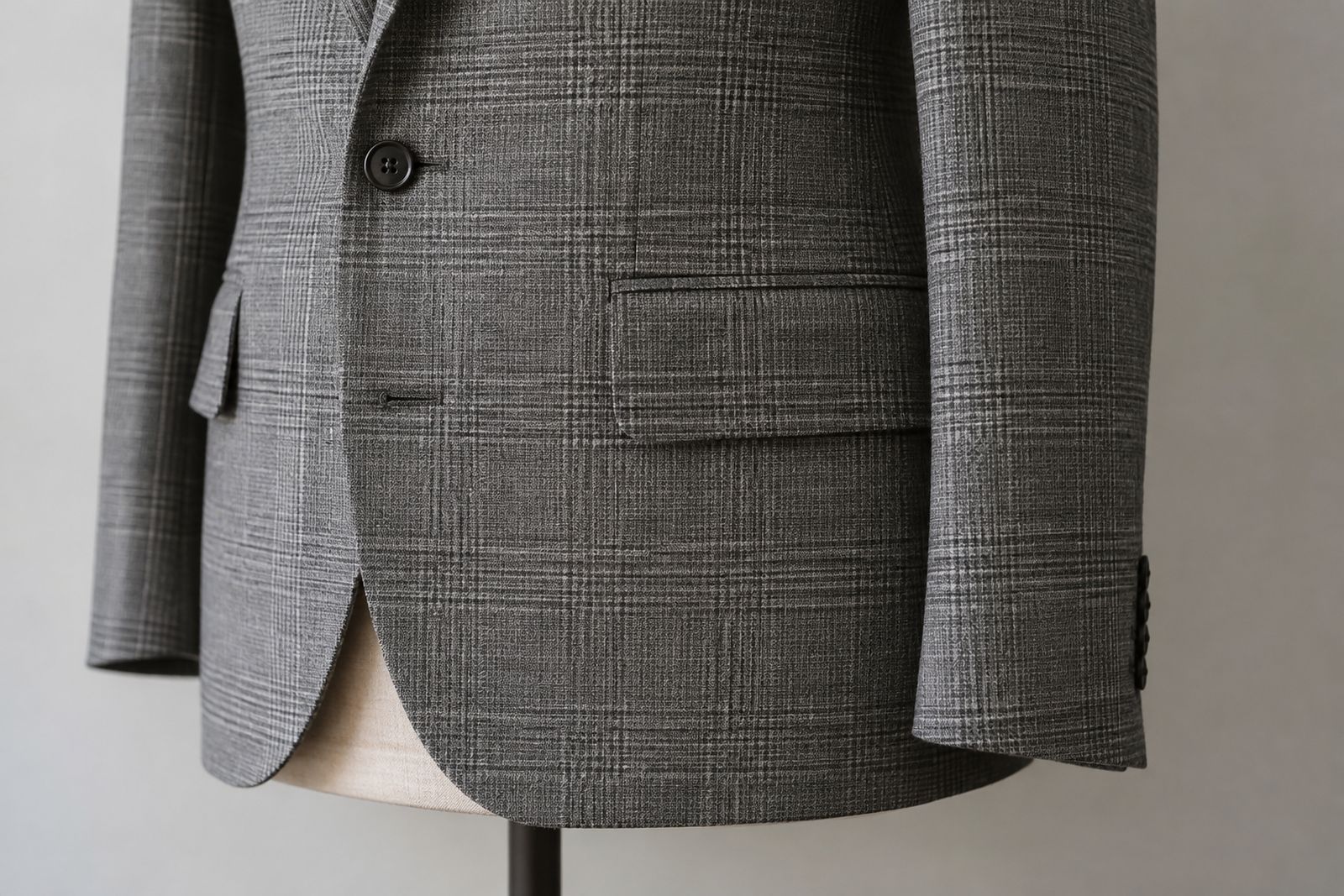
Where to look for pattern matching
- Pocket flaps: the stripes or checks on the flap should line up with the body of the jacket behind it.
- Breast pocket: the welt should match the chest around it.
- Center back seam: stripes should meet symmetrically, and checks should line up horizontally across the seam.
- Collar: the pattern at the back of the collar should continue from the back of the jacket.
- Sleeves: on a check, the horizontal lines of the sleeve should meet the body at the front of the chest.
Perfect matching everywhere is impossible because a jacket curves around the body, so even good makers prioritize the places above. A plain navy or charcoal suit hides this sign completely, which is why it is worth checking a patterned suit from the same brand if you can.
Sign 4: Does the collar sit cleanly?
The jacket collar should sit against your shirt collar all the way around, with no gap at the back of the neck and about ½ inch (1.3 cm) of shirt collar showing above it. Lift the collar and look underneath: good jackets use a dense felt called melton for the under collar, and on hand-made jackets you may see small pad stitches in it. A collar that stands away from the neck or ripples along its length is either badly made or badly fitted. Our guide to how a suit jacket should fit covers the fit checks.
Sign 5: Are the shoulders and sleeves clean?
Look at where the sleeve joins the shoulder, the sleeve head. It should be smooth and full, without dents, divots or random puckers. The sleeves should hang straight down from the shoulder and fall slightly forward with your arms relaxed, without twisting or folding at the back of the arm, which shows the sleeves are set at the right angle. Seams along the sleeve and body should lie flat, with no puckering along the stitching.
Signs 6 and 7: Buttonholes and buttons
Sign 6: How are the buttonholes made?
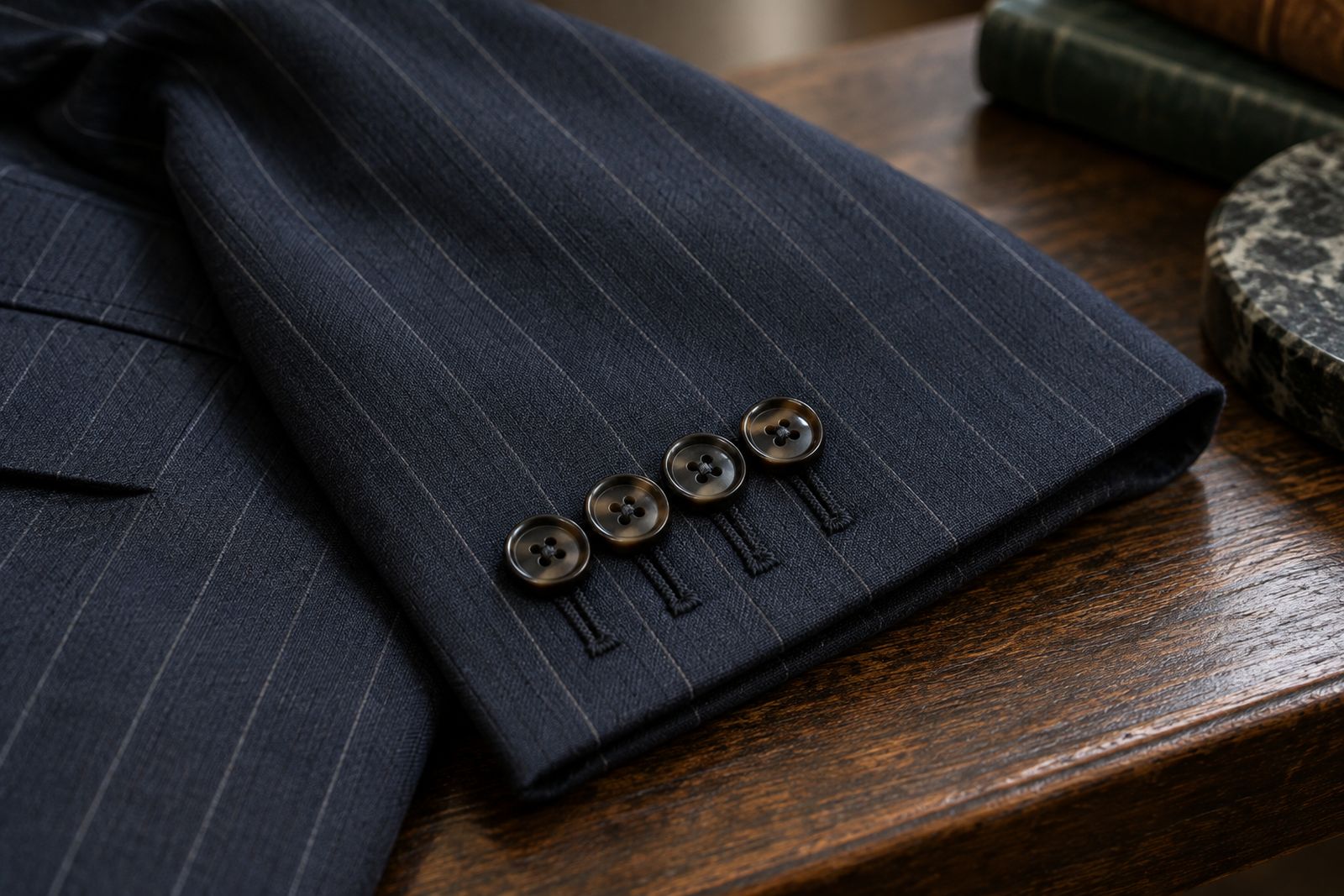
A good buttonhole has dense, even stitching over a firm edge, a clean keyhole shape and no loose threads. Hand-sewn buttonholes, worked in silk twist over a cord, have a slightly raised, rounded edge and small irregularities that show a person made them. Turn the front over: a hand-sewn buttonhole is usually less tidy on the back than on the front, while a machine buttonhole often looks much the same on both sides. Good machine buttonholes are perfectly acceptable; flat, sparse or fraying ones are a warning sign.
Working sleeve buttonholes, sometimes called surgeon's cuffs, were once a reliable sign of a good suit. Today many mid-priced suits have them, and they make it much harder to shorten the sleeves. On a ready-made suit, non-working sleeve buttons are often the more practical choice; see what a tailor can alter.
Sign 7: What are the buttons made of?
Quality suits use horn or corozo buttons. Horn feels cool and heavy for its size and shows natural streaks, so no two buttons are quite alike. Corozo, made from the tagua nut, takes dye well and has a fine, matte surface. Plastic buttons are light, warm to the touch, identical to one another and often show a faint molding line around the edge. Good buttons are sewn on with a thread shank, a short wrapped stem that lifts the button so it sits neatly over the overlapping fabric when fastened.
Signs 8 to 10: Inside the jacket
Sign 8: What is the lining like?
Open the jacket and read the label. A cupro (Bemberg) or viscose lining breathes and resists static; a polyester lining is cheaper, does not breathe and often goes with other cost-cutting. The lining should have room to move: a vertical pleat down the center back and a fold of extra length at the hem, so it does not pull on the outer fabric when you reach forward. Our guide to suit linings compares the materials.
Sign 9: How is the inside finished?
The inside of a jacket shows how much time went into the parts nobody sees. Look for straight, even stitching, no loose threads, well-made inside pockets and, on a half-lined jacket, seams bound neatly in strips of lining or tape rather than left as raw overlocked edges. Check the seam allowances where you can see or feel them: generous allowances at the side and back seams, called inlays, mean the suit can be let out later. Narrow ones mean it cannot.
Sign 10: Is there hand work where it matters?
Hand work matters where it shapes the garment: pad stitching the lapels and collar, attaching the collar, setting the sleeves, felling the lining and working the buttonholes. Where the lining meets the facing inside the jacket, look for tiny, close, slightly irregular stitches, a sign of hand felling. Be careful with visible decorative stitching along the lapel edges, called pick stitching: a machine can imitate it convincingly, so on its own it proves nothing.
What about the trousers?
Trousers get less attention than jackets, but a few details separate good ones from ordinary ones quickly. Turn them inside out if the shop allows it.
Quality signs on suit trousers
- A back waistband split by a seam, with a wide seam allowance below it, so the waist and seat can be let out.
- A cotton curtain lining the inside of the waistband.
- Front lining to just below the knee, which helps the trousers hang and reduces bagging.
- A heel guard: a strip of tape inside the back of the hem that takes the wear from your shoes.
- Strong cotton pocket bags and small bar tacks at the corners of the pockets and the base of the fly.
- A smooth fly that lies flat, whether it closes with buttons or a zip.
How can you tell if a suit is cheap?
A cheap suit usually shows several of these signs at once. One on its own may be a compromise you can live with; four or five together tell you where the savings came from.
- A glassy or slightly plastic sheen on the fabric, often from polyester.
- A flat, stiff front with a lapel that lies flat or carries a hard crease.
- Bubbles or ripples on the chest or lapels.
- Puckered seams, especially down the sleeves and along the front edges.
- Stripes or checks that jump at the pocket flaps and back seam.
- Light plastic buttons sewn flat to the fabric.
- A polyester lining that clings and crackles.
- A collar that stands away from the neck.
- Narrow seam allowances that leave nothing to let out.
Extra checks for a second-hand or vintage suit
A well-made second-hand suit can be excellent value, because canvassed construction and good fabric outlast their first owner. The ten signs still apply, but wear and old alterations add a few more things to check before you pay.
Before you buy a used suit
- Shine on the seat, elbows and cuffs: polished wool cannot be restored.
- Small holes from moths, especially under the collar, in the armpits and along the trouser creases.
- Bubbling on the chest or lapels, which rules out a fused jacket.
- Linings worn through at the armholes and cuffs, which can be replaced at a cost.
- Faint lines along the seams from earlier alterations, showing how much has already been let out or taken in.
- Enough length in the sleeves and trouser hems for your size, since lengthening is limited to what is folded inside.
- Shoulders that fit you as they are, because they are the one part that cannot be changed well.
Budget for alterations when you compare prices. A used suit that needs only a hem and a waist adjustment is a bargain; one that needs the shoulders, the length and a new lining is not. Our suit alteration cost guide gives typical prices.
What makes a suit expensive?
A suit is expensive mostly because of labor, fabric and construction. Canvassing and hand work take skilled hours; good fabric from a respected mill costs more per yard, and patterns that must be matched use more of it; and a well-cut pattern with fittings costs more than a standard block. Some of the price is always brand, and at the top of the market brand can be a large share of it.
| Worth paying for | Often overpriced |
|---|---|
| Canvassed construction | A famous label on a fused suit |
| Good fabric from a known mill | Very high Super numbers for an everyday suit |
| Hand work in the collar, sleeves and lapels | Decorative pick stitching on its own |
| Generous seam allowances | Bold logo linings |
| A cut that fits your shoulders | Fashion details that will date quickly |
For how bespoke pricing breaks down, see why bespoke suits are expensive.
The tailor's view: what to look for when buying a suit
Any tailor will tell you the same thing first: buy for the shoulders. A jacket's waist, sleeves and trouser length can be altered cheaply; shoulders cannot be altered well at any price. Check the fit, then check the quality, in that order.
Your two-minute check in the shop
- Shoulders: the seam ends at your shoulder bone, with no dent below it and no overhang.
- Collar: sits against your shirt collar with no gap.
- Pinch test below the lowest buttonhole and on the lapel.
- Crush a handful of the fabric and watch it recover.
- Read the composition label for the shell and the lining.
- Look at the pocket flaps and back seam on a patterned suit.
- Feel the buttons: cool and heavy, or light and warm?
- Look inside at the seams and the seam allowances.
A suit that passes most of these checks and fits your shoulders is worth taking to a tailor for the finishing touches. If you want to go further, our ranking of the best tailors in London shows what the top of the craft looks like.
Questions people ask
How can you tell if a suit is cheap?
Look for several warning signs together: a synthetic sheen, a stiff front with a flat lapel, bubbles on the chest, puckered seams, mismatched stripes at the pockets, light plastic buttons and a polyester lining. One of these may be an acceptable compromise; several together tell you where the savings came from.
What makes a suit expensive?
Mostly labor, fabric and construction: canvassing and hand work take skilled hours, and good fabric from a respected mill costs more. Brand also adds to the price, sometimes heavily, which is why it pays to check the suit itself rather than the label.
What should you look for when buying a suit?
Fit first, especially the shoulders, because they cannot be altered well. Then check the construction with the pinch test, the fabric with the crush test, the lining label, the buttons and the inside finishing.
Are hand-sewn buttonholes a sign of quality?
They are a sign of hand work, which usually goes with good making, but they are not proof on their own. Good machine buttonholes are perfectly acceptable. What matters more is that the buttonholes are dense, clean and well shaped.
Do working sleeve buttons mean a suit is high quality?
Not anymore. Many mid-priced suits now have working sleeve buttonholes, and they make shortening the sleeves harder and more expensive. On a ready-made suit, non-working buttons are often the more practical choice.
Is a 100% wool suit always better quality?
Not always, but it is a good start. A well-made suit in a sturdy wool will outlast and outperform a polyester blend, yet a poorly constructed wool suit can still be a bad buy. Check the construction and finishing as well as the fabric label.
TailorGuide is independent. Our guides are written and checked by our team and carry no paid endorsements. How we work.