The short answer
A bespoke suit is cut from a paper pattern drafted from scratch for you and shaped over three or more fittings, mostly by hand, in about 8 to 12 weeks or longer. Made-to-measure adjusts an existing block pattern to your measurements and is factory-made in about 3 to 8 weeks. Ready-to-wear is made in standard sizes and altered after you buy it.
- Bespoke: a pattern drafted for you, 3 or more fittings, 8 to 12+ weeks, from about $6,600 on Savile Row.
- Made-to-measure: a standard block adjusted to you, 1 or 2 fittings, 3 to 8 weeks, mostly $650 to $3,300.
- Ready-to-wear: standard sizes altered after purchase; lengths and the waist alter easily, shoulders do not.
- 'Custom' and 'semi-bespoke' have no fixed meaning: ask whether a pattern is cut for you alone.
- Bespoke earns its price for hard-to-fit builds and specific styles; good MTM is the better buy for most standard builds.
In this guide
- What is the difference between bespoke, made-to-measure and ready-to-wear?
- Bespoke vs made to measure vs ready-to-wear: the side-by-side table
- How is a bespoke suit made?
- How does made-to-measure work?
- How are ready-to-wear suits sized and fitted?
- Fittings, time, hand work and canvas compared
- How much does bespoke cost compared with made-to-measure?
- What does 'custom' mean? Semi-bespoke and other blurred terms
- How can you tell if a suit is bespoke?
- Which should you choose: bespoke, made-to-measure or ready-to-wear?
- The tailor's view: what to ask before you order
- Questions people ask
Bespoke vs made to measure is usually the next question once suits off the rail stop fitting well enough. Both words are used loosely, and ready-to-wear sits beneath them. The real differences come down to four things: where the pattern comes from, how many fittings you get, how much of the suit is sewn by hand, and what you are allowed to change. Price follows from those four.
At a glance
- Bespoke
- Pattern drafted from scratch for you; 3 or more fittings; about 8 to 12 weeks or longer; from about $6,600 on Savile Row
- Made-to-measure
- Standard block pattern adjusted to your measurements; 1 or 2 fittings; about 3 to 8 weeks; mostly $650 to $3,300
- Ready-to-wear
- Standard sizes, altered after purchase; available today; mostly $200 to $2,000
- The real dividing line
- Whose pattern it is: yours alone (bespoke), a size block adjusted for you (MTM), or a size chart (ready-to-wear)
- Prices
- Approximate as of 2026; they vary by house, city and fabric
What is the difference between bespoke, made-to-measure and ready-to-wear?
The difference is the pattern. A bespoke suit is cut from a paper pattern that a cutter drafts from scratch for your body alone, then corrects over several fittings. A made-to-measure suit starts from an existing block pattern in a standard size, which is adjusted to your measurements before a factory makes it. A ready-to-wear suit is made in standard sizes for no one in particular and altered after you buy it.
Bespoke suit
A bespoke suit is a suit made from an individual pattern drafted for one customer, cut and refined through a series of fittings (usually three or more) and largely sewn by hand. In the Savile Row sense it also means a full floating canvas with a hand-padded chest and lapels.
Made-to-measure (MTM) suit
A made-to-measure suit is a suit made from a standard block pattern that is altered to the customer's measurements and fitting notes, then produced in a factory. Quality ranges from fused, machine-made suits to full canvas suits with hand finishing.
Ready-to-wear (RTW) suit
A ready-to-wear suit, also called off-the-rack or off-the-peg, is a suit made in advance in standard sizes from a graded pattern and fitted afterward by alterations.
Bespoke
A pattern drafted for you
- Paper pattern cut from scratch by a cutter
- 3 or more fittings, starting with a basted fitting
- Mostly hand-made on a full floating canvas
- About 8 to 12 weeks, often longer
- Posture, proportions and style cut into the pattern
Made-to-measure
A standard block adjusted
- House block pattern altered to your measurements
- Try-on garment at order, then a delivery fitting
- Mostly machine-made; canvas varies by program
- About 3 to 8 weeks
- Changes limited to the program's menu
Ready-to-wear
Standard sizes
- Graded size pattern, made in volume
- Fitted by alterations after purchase
- Fused to full canvas, roughly by price
- Available the same day
- Only lengths and the waist alter easily
Bespoke vs made to measure vs ready-to-wear: the side-by-side table
This table compares the three tiers point by point, from the pattern to the price. Prices are approximate as of 2026 and vary by house, city and fabric.
| Bespoke | Made-to-measure | Ready-to-wear | |
|---|---|---|---|
| Pattern | Drafted from scratch for you by a cutter, usually on paper | The maker's block pattern in your nearest size, adjusted to your measurements | One graded size pattern, the same for everyone in that size |
| Measuring | A full set of measurements plus notes on posture, shoulder slope and stance | Key measurements plus try-on garments in sample sizes | Your size label (for example 40R), then an alterations fitting |
| Fittings | 3 or more: baste, forward and finish | Usually 1 at order and 1 at delivery | 1 alterations fitting, sometimes a check at pick-up |
| Time | About 8 to 12 weeks on Savile Row, often longer | About 3 to 8 weeks | Same day, or up to about 2 weeks with alterations |
| Who makes it | A cutter, coat maker, trouser maker and finishers, usually close to the shop | A factory, often in another country, working from the fitter's order | A factory, in volume |
| Hand work | Most of the garment; Savile Row Bespoke Association members typically 50+ hours for a two-piece | Mostly machine; some hand finishing in better programs | Mostly machine; some hand details at the top end |
| Canvas | Full floating canvas, hand-padded | Fused, half or full canvas, depending on the program | Mostly fused at low prices; half or full canvas higher up |
| Fabric choice | Thousands of options from merchants' swatch books | The program's own fabric books | Whatever is on the rail |
| Style choice | Anything the cutter can make, within the house style | A menu: lapels, pockets, vents, buttons, linings | Choose a model; nothing else |
| Posture and asymmetry | Cut into the pattern: a dropped shoulder, forward neck or prominent seat | Some standard corrections, if the program offers them | Only what alterations can fix |
| Later alterations | Generous inlays; your pattern is kept on file | Moderate seam allowance; measurements usually stored | Limited seam allowance |
| Typical price, 2026 (approx.) | From about $6,600 on Savile Row; roughly $3,300 to $6,600 at many independents | Mostly $650 to $3,300; luxury-brand programs more | Mostly $200 to $2,000; designer labels more |
| Best for | Hard-to-fit builds, a specific style, frequent wearers who keep suits for years | Most people who want a better fit and a choice of fabric at a fair price | Standard builds, tight budgets, a suit needed this week |
Prices are approximate as of 2026 for a two-piece suit and vary by house, city, fabric and exchange rate.
How is a bespoke suit made?
A bespoke suit is made from nothing: no existing pattern and no standard size. At the first appointment the cutter asks what the suit is for, how you want it to look and which fabric suits that use, then takes a full set of measurements, often 20 or more. Just as important are the things a tape measure misses. A good cutter notes whether one shoulder sits lower than the other, whether you stand upright or lean forward, how your seat and stomach sit, and how you carry your head.
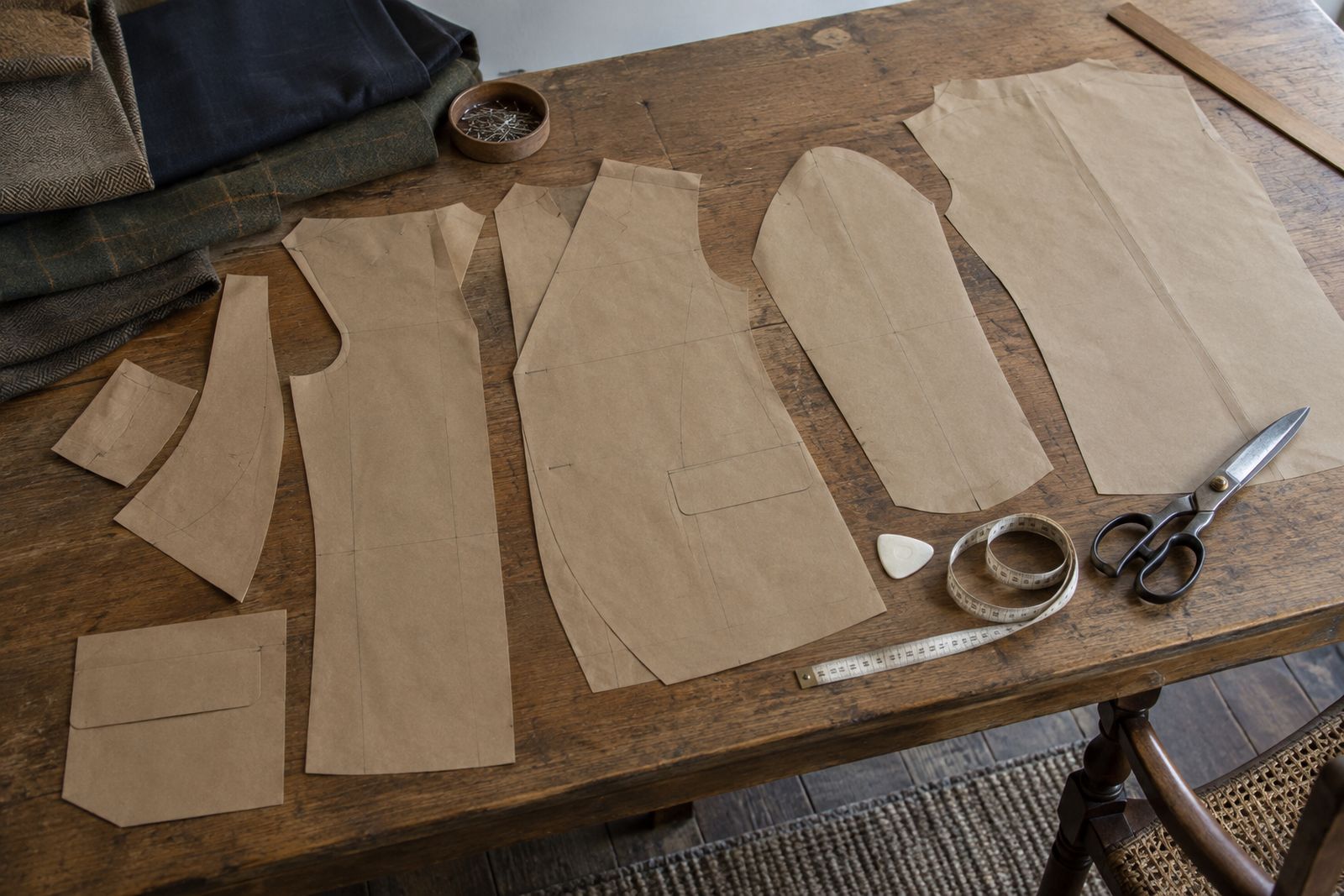
From those notes the cutter drafts your pattern by hand, usually on brown paper or card, and chalks it onto the fabric. The pieces are cut with inlays, extra fabric left in the seams so the suit can be adjusted at fittings and let out years later. A trimmer gathers the canvas, linings, pocketing and buttons, and the bundle goes to a coat maker and a trouser maker, craftsmen who usually specialize in one garment.
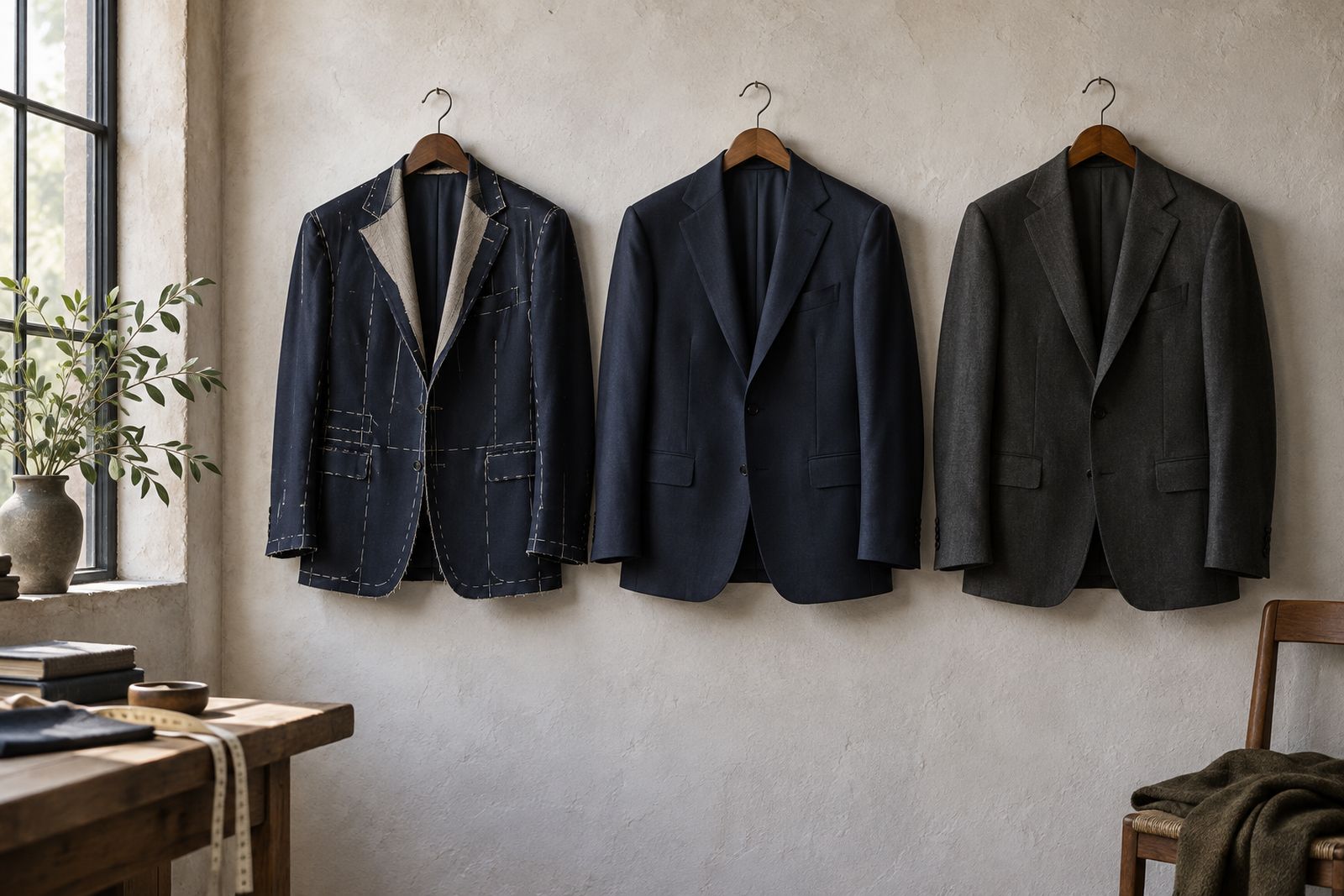
The coat maker tacks together a loose first version called the baste. You try it on, the cutter marks changes in chalk, and the suit is taken apart and recut. A more finished forward fitting follows, then a final fitting on the completed suit. Our guide to how a bespoke suit is made follows each stage at the bench.
Stage 1: Consultation and measuring
Week 0, about 1 hour
Use, style and fabric agreed; full measurements and posture notes
Stage 2: Pattern and cutting
Weeks 1 to 2
Cutter drafts your paper pattern and cuts the fabric with inlays
Stage 3: Baste fitting
Around weeks 3 to 5
Loosely tacked jacket and trousers; balance, shoulders and length set
Stage 4: Forward fitting
Around weeks 6 to 9
Recut and partly finished; collar, pockets and sleeves checked
Stage 5: Finish fitting
Around weeks 8 to 12, often later
Completed suit; small adjustments, final press and collection
How does made-to-measure work?
Made-to-measure works by adjusting a pattern that already exists. The maker has a block pattern for each size: a standard jacket and trouser shape that sets the house silhouette. The fitter puts you in a try-on garment in your nearest size, pins and measures the differences, and records them on an order form. The block is then adjusted, usually by software, cut by machine and made in a factory, often in another country.
You generally see the suit once before it is made and once when it arrives, when final alterations are pinned. That makes MTM faster and cheaper than bespoke, but it also means errors in the order appear only in the finished garment, when less can be changed. The quality range is wide. Some online programs make fused suits from body measurements alone, while the best Italian and British programs use full canvas and finish much of the jacket by hand.
What made-to-measure can and cannot change
- Can change: sleeve and jacket length, chest, waist and seat, shoulder width within a range, and trouser rise, waist, leg width and length.
- Often can change: sloping or square shoulders, a forward or very upright stance and a prominent seat, depending on the program.
- Style menu: lapel width and shape, button stance, pockets, vents, linings, buttons, trouser pleats and turn-ups (cuffs).
- Cannot change: the block's underlying cut, its balance between front and back, and any asymmetry the order form has no field for. A jacket that needs its pattern redrawn needs bespoke.
How are ready-to-wear suits sized and fitted?
Ready-to-wear suits are cut from one sample pattern that is graded up and down into a size run. Jackets are sized by chest measurement and length, such as 40R or 42L, and trousers usually come with a fixed drop: a 40R jacket typically pairs with 34-inch (86 cm) trousers, a 6-inch (15 cm) drop. If your chest, waist and arm length match the grading, a ready-to-wear suit can fit well after small alterations. Our suit size chart shows how to find your size.
Alterations fix lengths and the waist easily: trouser hems, sleeve length on most jackets, and taking in or letting out the waist within the seam allowance. They cannot fix the shoulders or the jacket's balance, and a collar that stands away from the neck is a major job. Our guide to what a tailor can and can't alter covers each job and what it costs to get right.
Fittings, time, hand work and canvas compared
Fittings
Bespoke suits are fitted three or more times: a basted fitting, a forward fitting and a finish fitting, with extra fittings for difficult figures or a first order at a new house. Made-to-measure usually gives you one fitting before production and one at delivery. Ready-to-wear gets one alterations fitting. The count matters because, in bespoke, each fitting corrects the pattern as well as the garment. Bespoke fittings explained covers what happens at each one.
Time
A first bespoke suit on Savile Row usually takes around 8 to 12 weeks, often longer, set by the gaps between fittings and the coat maker's queue. If you use a tailor who visits your city a few times a year, expect several months. Made-to-measure takes about 3 to 8 weeks. Ready-to-wear is ready the same day, or within a week or two if it needs alterations.
Hand work
In bespoke, hand work does the shaping. The canvas is pad-stitched by hand so the chest and lapels hold a curve, sleeves are eased and set by hand, linings and the undercollar are felled by hand, and buttonholes are hand-sewn with silk thread. Made-to-measure and ready-to-wear are mostly machine-made; better makers add hand-sewn buttonholes, hand-set sleeves or hand-finished linings, and will tell you which.
Canvas
Canvas is the layer inside the jacket front that gives it shape. A full canvas runs the whole length of the front and floats free of the outer fabric; a half canvas covers the chest and lapels only; a fused front uses a glued interlining instead. Traditional bespoke suits are full canvas. Made-to-measure and ready-to-wear can be any of the three, roughly in line with price. Our fused vs canvas guide explains how each one wears.
How much does bespoke cost compared with made-to-measure?
A bespoke two-piece suit from an established Savile Row house usually starts around $6,600, and some houses charge considerably more. A Savile Row price guide published by Luxury London and updated in December 2025 listed starting prices for a bespoke two-piece at the established houses of roughly $6,600 to $9,900. Independent bespoke tailors away from the prime streets often charge roughly $3,300 to $6,600. Made-to-measure mostly costs $650 to $3,300, and ready-to-wear $200 to $2,000, with designer labels far above that.
Ready-to-wear (mainstream)
Designer labels go far higher; add alterations
$200–2,000
Made-to-measure
Luxury-brand programs can reach bespoke prices
$650–3,300
Bespoke, independent tailors
Varies with city and how much is hand-made
$3,300–6,600
Bespoke, Savile Row houses
Typical starting prices; fabric and extra pieces add more
$6,600–9,900
Within each tier the price moves with the fabric (a rare fiber such as vicuña can cost more than the making), the number of pieces, extra trousers, a double-breasted cut and the city. UK prices include 20% VAT. For local figures, see how much a bespoke suit costs in London, New York, Milan and Dubai.
What does 'custom' mean? Semi-bespoke and other blurred terms
Custom has no fixed meaning. In the US, 'custom suit' covers everything from online made-to-measure to true bespoke, and 'semi-bespoke' is used for anything in between. Even 'bespoke' is not protected. In 2008 the UK's Advertising Standards Authority considered an advert by Sartoriani London that described suits cut and sewn by machine as bespoke, and ruled that the use was not likely to mislead. The Savile Row Bespoke Association disagreed, and the trade still uses the word in its stricter sense. There is more on the word itself in what does bespoke mean.
| Term | What it usually means | What to ask |
|---|---|---|
| Bespoke | In the trade sense, an individual pattern and several fittings; sometimes used loosely for MTM | Is a paper pattern cut for me alone? Is the first fitting basted? |
| Custom or custom-made | Anything made to order; in the US most often made-to-measure | Do you adjust a block pattern or draft a new one? |
| Semi-bespoke | Usually MTM with extra hand work or a basted fitting; no agreed standard | What exactly is done by hand, and how many fittings are included? |
| Made-to-order | Your standard size, with your choice of fabric or details | Is the pattern changed for my measurements at all? |
| Hand-made or hand-tailored | Some hand work; the amount varies widely | Which parts are sewn by hand? |
How can you tell if a suit is bespoke?
You can tell a suit is bespoke mainly by how it was made, not by any one detail. Working sleeve buttons, pick stitching and a smart lining appear on plenty of ready-to-wear suits. The surest evidence is the process: a pattern cut for you and kept on file, and a basted fitting. On a finished suit, these signs point the same way.
Signs a suit is genuinely bespoke
- You had a basted fitting, with white tacking thread and no finished lapels or pockets.
- The tailor keeps your paper pattern and can cut the next suit from it.
- There are generous inlays in the jacket's center back seam and the trousers' seat seam.
- Buttonholes are hand-sewn: dense, slightly irregular stitches rather than a uniform machine zigzag.
- The front is full canvas: pinch below the chest and you can feel a separate, floating layer.
- A label inside carries your name and the order date, as many bespoke houses add.
- The jacket hangs cleanly around your posture, even if one shoulder sits lower than the other.
Which should you choose: bespoke, made-to-measure or ready-to-wear?
Choose by your build, your budget, your deadline and how often you wear a suit. Use this table as a starting point.
| If you... | Choose | Why |
|---|---|---|
| Fit standard sizes well and need a suit this month | Ready-to-wear plus alterations | Fastest and cheapest; alterations fix lengths and the waist |
| Fall between sizes, or have a large drop between chest and waist | Made-to-measure | The block is adjusted to both measurements |
| Want to choose fabric and details for a first custom suit | Made-to-measure | Much of the choice of bespoke for a fraction of the price |
| Have sloping or uneven shoulders, a forward stance, or a very athletic or heavy build | Bespoke | Posture is cut into the pattern rather than pinned out afterward |
| Want a cut that no brand offers | Bespoke | The cutter drafts the shape you want within the house style |
| Wear a suit four or five days a week and keep suits for years | Bespoke or high-end MTM | Durability, inlays and a stored pattern pay off over time |
| Need a suit for one event, or your weight is changing | Ready-to-wear or MTM | Commission bespoke once your body is stable |
Bespoke: the honest trade-offs
For
- +Fits your posture and proportions, not a size
- +Any detail the cutter can make, within the house style
- +Your pattern is kept, so later suits need fewer corrections
- +Inlays let the suit be let out or recut for years
Against
- –Several times the price of good made-to-measure
- –Three or more fittings spread over two to three months or longer
- –A first commission is rarely perfect; the second usually fits better
- –The result depends heavily on the individual cutter
For cost-per-wear figures and the cases where bespoke does not pay, see is a bespoke suit worth it.
The tailor's view: what to ask before you order
Ask enough to know which tier you are actually buying, because the word on the window will not tell you. A good tailor answers these plainly, without selling.
- Do you draft a new pattern for me, or adjust a block?
- How many fittings will I have, and is the first one basted?
- Who cuts the suit, and where is it made?
- Is the jacket full canvas, and which parts are sewn by hand?
- What does the price include, and what are the deposit and alterations terms?
The full list, with what good and bad answers sound like, is in questions to ask a tailor.
If your build is standard and your budget is under about $2,000, a good made-to-measure suit or a well-altered ready-to-wear one will serve you well. If you want a suit cut for your body, start with a house whose style you like. Our ranking of the best tailors in London is a good place to begin.
Questions people ask
What is the difference between bespoke and custom?
In the tailoring trade, bespoke means a suit cut from a pattern drafted for you alone and refined over several fittings. Custom is a looser word, used in the US for anything made to order and most often for made-to-measure. Ask whether the pattern is new or an adjusted block, and how many fittings you get.
Is made-to-measure worth it?
Made-to-measure is worth it if ready-to-wear sizes do not fit you well or you want to choose your own fabric and details. A good MTM suit fits most people noticeably better than an altered off-the-rack one. It is less worth it for a standard build, where a well-altered ready-to-wear suit can look nearly as good for less.
What is semi-bespoke?
Semi-bespoke has no agreed definition. It usually means made-to-measure with something added, such as a basted fitting, more hand work or a cutter adjusting the block in-house. Ask exactly what is done by hand and how many fittings are included before paying extra for the word.
Is bespoke better than made-to-measure?
Bespoke usually fits better and is better made, because the pattern is drafted for you and corrected over three or more fittings. It is not automatically better value: a high-end MTM program can beat a mediocre bespoke tailor, and the gap is smallest for standard builds. The bigger your fit problems, the more bespoke earns its price.
How long does a bespoke suit take compared with made-to-measure?
A bespoke suit on Savile Row usually takes around 8 to 12 weeks, often longer, with three or more fittings. Made-to-measure takes about 3 to 8 weeks, and ready-to-wear with alterations a few days to two weeks. A first order from a tailor who visits your city a few times a year can take several months.
How much does a bespoke suit cost in 2026?
A bespoke two-piece from an established Savile Row house usually starts around $6,600, and many houses start between $7,900 and $9,900. Independent bespoke tailors often charge roughly $3,300 to $6,600. Prices are approximate and vary by house, city and fabric, so ask for a written quote.
Can a made-to-measure suit be altered later?
Yes, within limits. Lengths and the waist can be altered like any suit, but MTM suits usually carry less seam allowance than bespoke, so there is less room to let out. Most makers keep your measurements, so the next order can be corrected at the source.
How can you tell if a suit is bespoke?
The surest sign is the process: a pattern cut for you, kept on file, and a basted fitting. On the finished suit, look for generous seam inlays, hand-sewn buttonholes, a full floating canvas and a label with your name and order date. Working sleeve buttons alone prove nothing.
TailorGuide is independent. Our guides are written and checked by our team and carry no paid endorsements. How we work.