The short answer
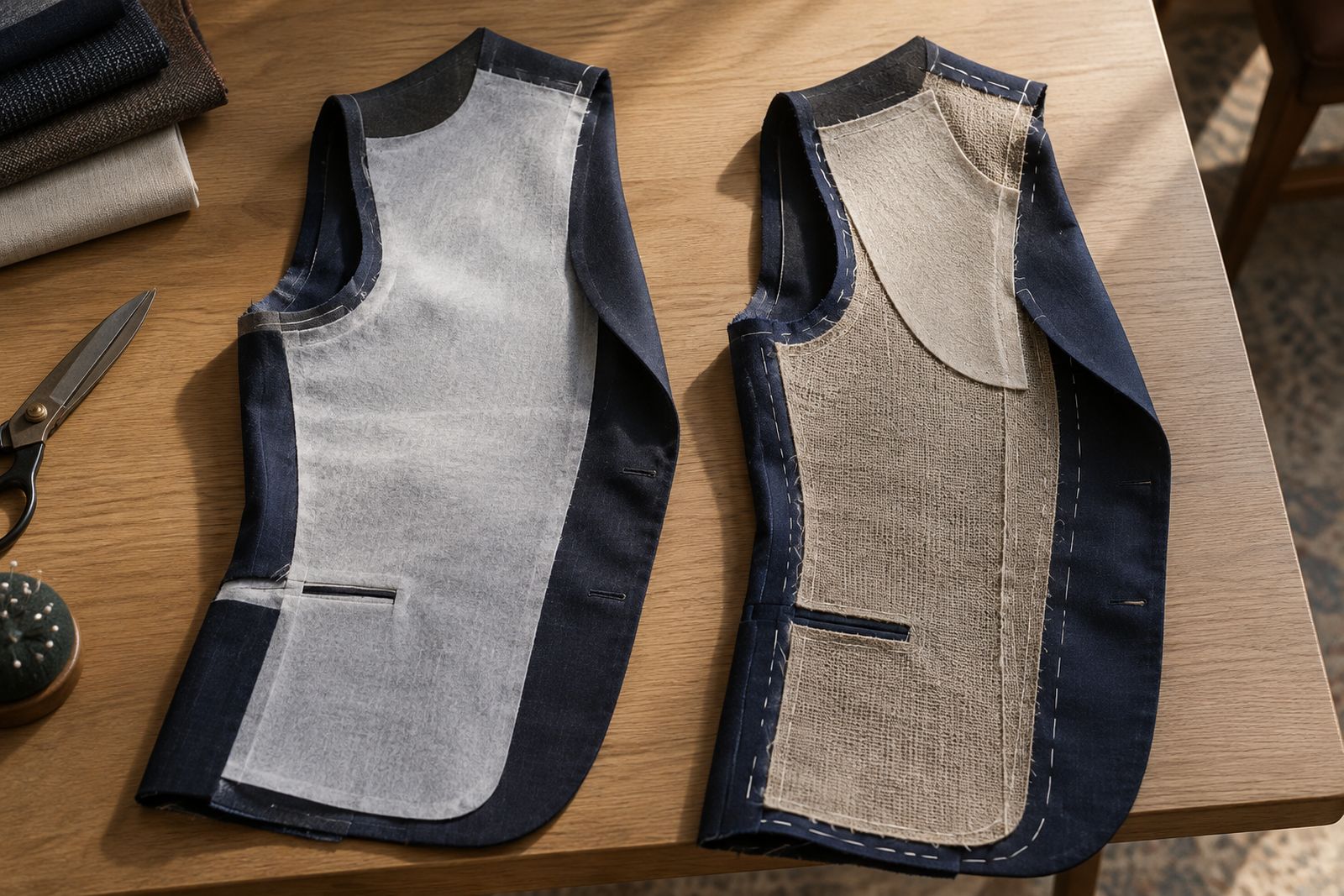
A fused jacket has its interlining glued to the outer fabric with heat-set adhesive. A canvassed jacket has a floating interlining of wool and horsehair that is stitched in, not glued. Full canvas runs from shoulder to hem; half canvas covers the chest and lapels, with the lower front fused. Canvas drapes, rolls and ages better; half canvas is the sensible middle ground.
- Fused: interlining glued to the fabric. Cheapest and stiffest, and it can bubble if the glue fails.
- Half canvas: floating canvas in the chest and lapels, fused below. Most of the benefit for much less money.
- Full canvas: floating canvas from shoulder to hem. Standard in bespoke, with the best drape and lifespan.
- A canvassed lapel rolls softly from the top button; a fused lapel tends to lie flat or look pressed.
- Modern fusing is far better than it was. A well-made fused jacket is a reasonable buy at entry level.
- Pinch below the lowest buttonhole and in the chest: a loose third layer in both means full canvas; in the chest only, half canvas.
In this guide
- What is a canvas in a suit jacket?
- What is a fused suit?
- What is a half canvas suit?
- What is a full canvas suit?
- Fused vs half canvas vs full canvas compared
- Pad stitching, the chest piece and the lapel roll
- How long does a fused suit last?
- Is a half canvas suit worth it?
- Is full canvas better than half canvas?
- What does each construction cost?
- How to check a jacket in the shop
- The tailor's view: what to ask for
- Questions people ask
Two navy suits can look identical on the hanger and behave completely differently after a year of wear. The difference is usually the interlining: the layer between the outer fabric and the lining that gives the jacket front its shape. In a fused suit that layer is glued on; in a canvassed suit it floats, held only by stitches. Fused vs canvas is the most useful construction question you can ask about a suit, because it predicts drape, lapel roll, comfort and lifespan better than the label or the Super number.
The constructions at a glance
- Fused
- Interlining glued across the whole front. Lowest cost, flattest look, risk of bubbling.
- Half canvas
- Floating canvas in the chest and lapels, fused lower front. The best value for most buyers.
- Full canvas
- Floating canvas from shoulder to hem. Bespoke standard; best drape and longevity.
- Unstructured
- Little or no interlining. Soft and cool, but the fabric alone holds the shape.
- Quick check
- Pinch below the lowest buttonhole: a third, loose layer there means full canvas; in the chest only, half canvas.
What is a canvas in a suit jacket?
Canvas
A canvas is a springy interlining, traditionally woven from wool or cotton with horsehair or goat hair, that sits between a jacket's outer fabric and its lining and gives the front its shape. In a canvassed jacket it floats, held in place by loose stitches rather than glue.
Tailors call the main material hair canvas. The hair, usually woven across the fabric, makes it springy: bend it and it pushes back, which is what lets a canvassed chest keep its curve and a lapel keep its roll. A canvassed jacket front is built in layers. The main canvas covers the front panel. Over the chest sits a chest piece, extra layers of horsehair canvas shaped to the chest and shoulder. A soft, fluffy layer called domette covers the chest piece so the hair cannot work through the fabric or scratch.
The canvas is attached to the outer fabric with loose basting stitches, and fixed more firmly only at the edges, the shoulder seam and the armhole. Because nothing is glued, the outer fabric and the canvas can move slightly against each other. That small freedom is the whole point: the fabric hangs from the canvas instead of being stuck to it, and with body heat and wear the canvas gradually takes on the shape of your chest.
What is a fused suit?
Fused jacket
A fused jacket is one whose front interlining is bonded to the back of the outer fabric with a heat-activated adhesive instead of being stitched in. The fabric and interlining become, in effect, one stiffened layer.
Fusible interlining is a light fabric coated on one side with small dots of resin. In the factory it is laid on the back of each cut front panel and run through a fusing press, where heat and pressure melt the resin and bond the two layers. The lapels, facings and collar are usually fused too. Many fused jackets also have a small sewn-in chest piece to give the upper chest some shape, which matters when you try to identify one.
Fusing exists because it is fast, consistent and needs far less skilled labor than setting and pad stitching a canvas. It also makes soft or loosely woven fabrics easier to handle in a factory. Almost every suit sold at the lower end of the market is fused, and so are many mid-priced ones.
Modern fusing has improved
The case against fusing was made in an era of heavy interlinings and adhesives that often failed. Today's fusibles are lighter and more flexible, the adhesives last much longer, and a well-made fused jacket in a good fabric can look sharp and give years of service. Bubbling is now mostly a problem of cheap garments and rough handling. Fusing still falls short in four places: the lapel tends to lie flat rather than roll, the front looks and feels flatter and stiffer, the glued layer reduces air flow a little, and the front cannot be reshaped with the iron the way a canvas can.
What is bubbling?
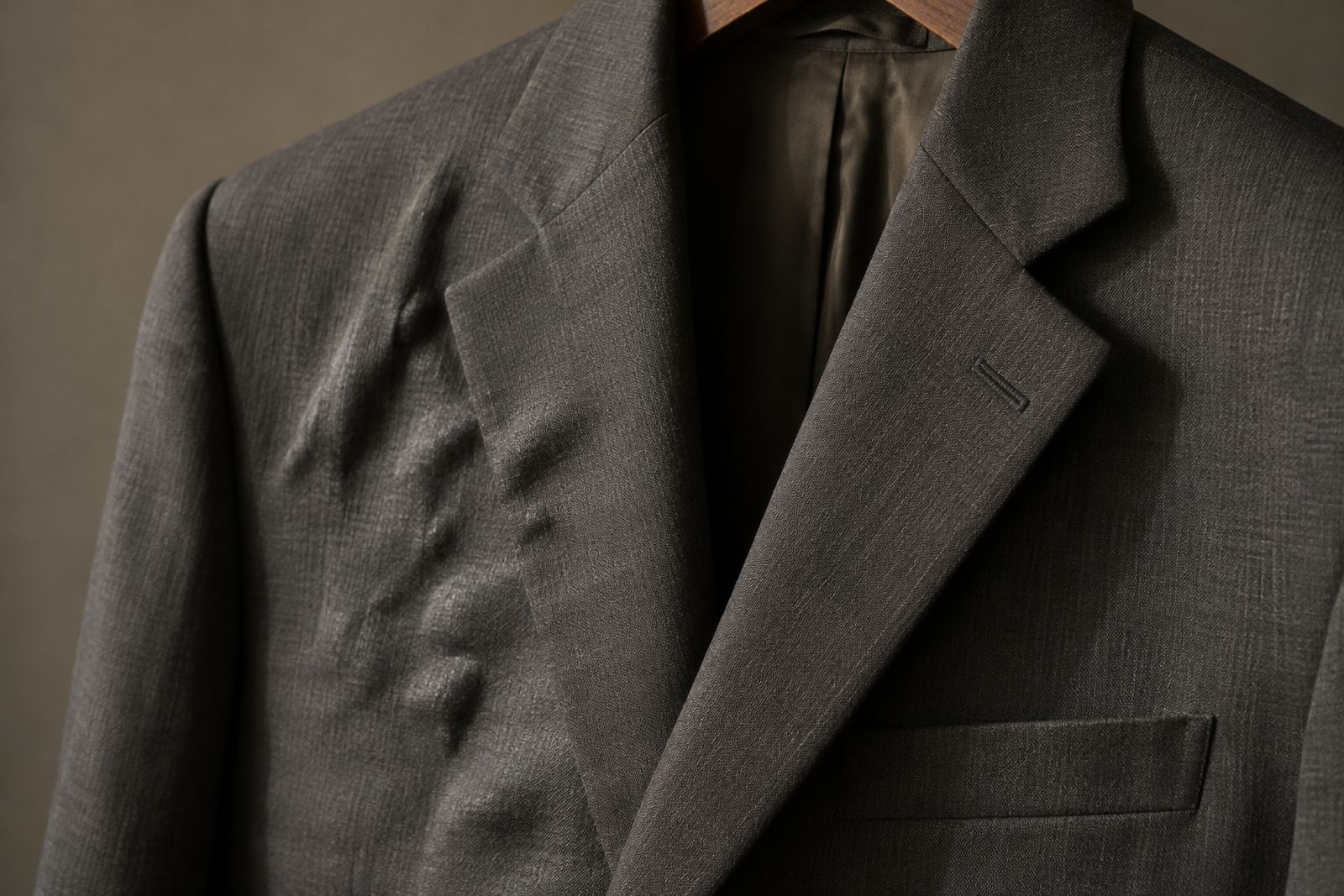
Bubbling, or delamination, is what happens when the adhesive in a fused jacket lets go in patches. The outer fabric separates from the interlining and shows as puckers, ripples or blisters across the chest, lapels or lower front. Heat, steam, dry cleaning and age are the usual triggers. A tailor can sometimes re-press a small area so it holds for a while, but bubbling cannot be repaired reliably, and on a cheap suit it usually marks the end of the jacket.
What is a half canvas suit?
Half canvas jacket
A half canvas jacket is a jacket whose chest and lapels are built on a floating canvas, while the lower front is fused.
In a half canvas jacket the floating canvas and chest piece run from the shoulder down to roughly the bottom of the chest or the waist, and up into the lapels, which are pad-stitched to it. Below that point the front is fused. The design puts canvas where it does the most work, in the chest and lapels, and uses fusing on the lower front, where the fabric is under less stress and the shape matters less.
You get the two benefits most people can see: a lapel that rolls instead of lying flat, and a chest with some three-dimensional shape. Half canvas is common in good ready-to-wear and in made-to-measure programs, and in ready-to-wear the pad stitching is usually done by machine. It is the construction to look for when you move beyond entry-level suits.
What is a full canvas suit?
Full canvas jacket
A full canvas jacket has a floating canvas running the full length of the front, from the shoulder to the hem, with no fused layer holding the front panel.
Full canvas is the standard in bespoke tailoring and in high-end ready-to-wear. Carrying the canvas through the lower front, or quarters, lets the skirt of the jacket hang and curve more naturally over the hips and stay free of any risk of bubbling. In bespoke, the lapels and under collar are pad-stitched by hand and a linen tape called a bridle is sewn along the roll line; in ready-to-wear, full canvas jackets are often pad-stitched by machine.
Full canvas does not mean no fusing anywhere. Many good jackets still use small pieces of fusible to stabilize pocket openings or facings. What matters is what holds the front panel, and in a full canvas jacket that is the floating canvas alone. For how this fits into the making of a bespoke coat, see how a bespoke suit is made.
Fused vs half canvas vs full canvas compared
The differences between fused, half canvas and full canvas show up in five places: the lapel, the chest, comfort, lifespan and price. The table sets them side by side.
| Fused | Half canvas | Full canvas | |
|---|---|---|---|
| How the front is held | Interlining glued across the whole front | Floating canvas in chest and lapels; lower front glued | Floating canvas from shoulder to hem |
| Lapel | Tends to lie flat or show a pressed crease | Soft roll from the top button | Soft roll from the top button, often hand pad-stitched |
| Chest and drape | Flatter, stiffer front | Shaped chest; lower front a little flatter | Shaped chest and a lower front that hangs and curves freely |
| Comfort and heat | Glued layer cuts air flow a little | Better in the chest | Best, other things being equal |
| Risk of bubbling | Low with good fusing; higher with cheap fusing | Possible in the lower front only | None in the front panel |
| Lifespan | Several years of regular wear for a decent one | Long; the fabric usually wears out first | Decades with care, repairs and relining |
| Reshaping by a tailor | Simple alterations fine; little reshaping with the iron | Chest and lapels can be reshaped | Whole front can be reshaped with steam |
| Typical price, two-piece (2026) | Roughly $150 to $600 | Roughly $500 to $1,500 | Usually from about $1,200 ready-made; thousands for bespoke |
Prices are rough guides to where each construction usually sits, as of 2026. There are exceptions in both directions.
Pad stitching, the chest piece and the lapel roll
Three details explain most of what you feel and see in a canvassed jacket. They are also the details that cheap construction leaves out.
Pad stitching
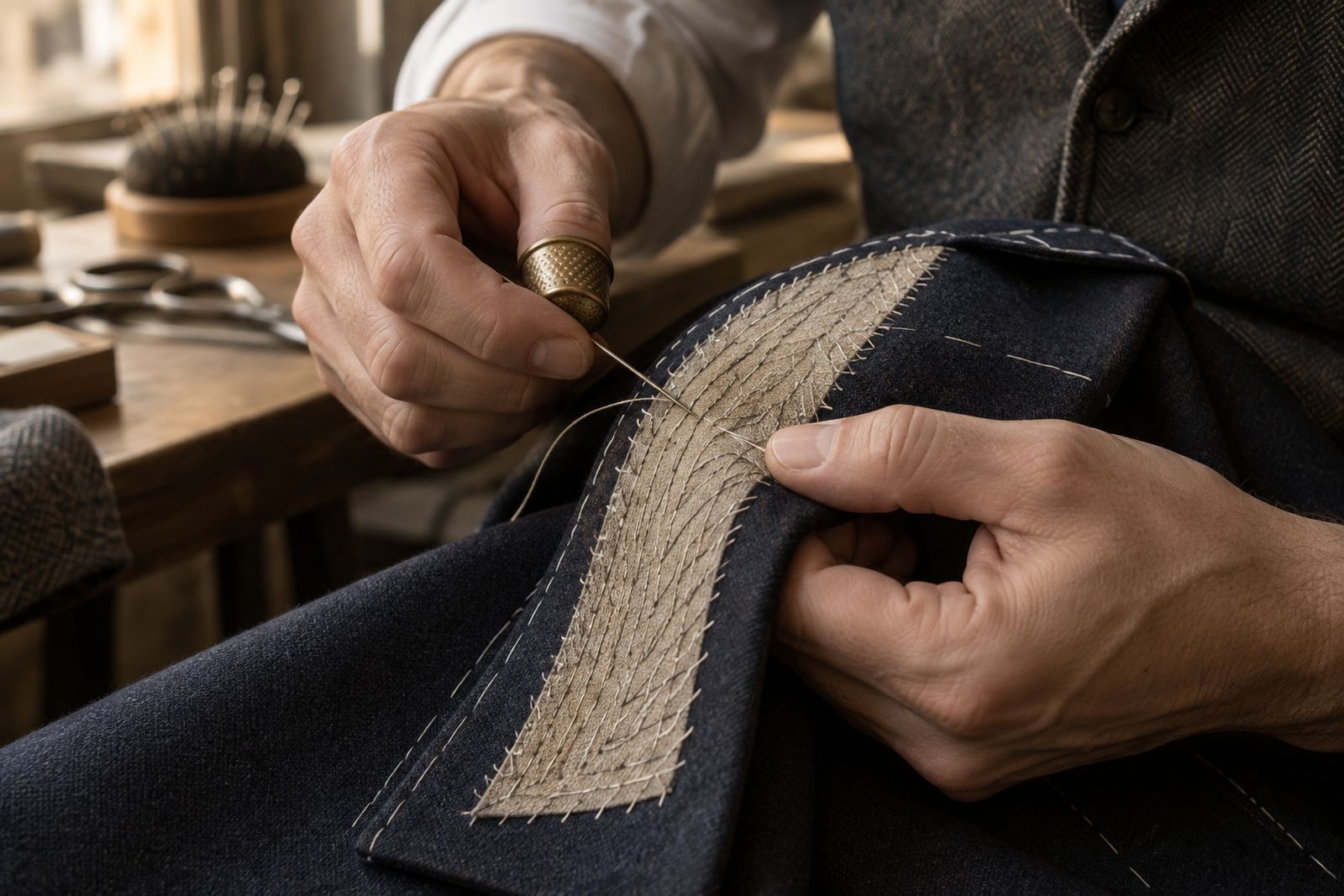
Pad stitching is a grid of small diagonal stitches that joins the lapel fabric to the canvas beneath it. A coatmaker sewing by hand holds the lapel curled over the fingers while stitching, so the layers are fixed in a curve and the lapel remembers that shape. Machine pad stitching joins the layers too, but flat and evenly, so the curve depends more on pressing. Hand pad stitching on the lapel is hidden under the facing; on the under collar you can sometimes see it on the felt when you lift the collar.
The chest piece
The chest piece is the extra layer of horsehair canvas over the chest and shoulder. It gives the jacket a clean line from the shoulder down over the chest and stops the fabric collapsing into a hollow below the collarbone. A large, firm chest piece gives the confident, built-up chest of traditional English tailoring; a small, light one gives a softer Italian look.
The lapel roll
Lapel roll
The lapel roll is the soft, three-dimensional curve with which a lapel turns back from the top button to the collar, instead of folding along a pressed line.
A good roll comes from the canvas, the pad stitching and the bridle tape along the roll line, and it is the easiest sign of canvas to see from across a room. On a fused jacket the lapel usually lies flat against the chest or shows a sharp pressed edge along the fold. Some fused jackets are pressed to fake a roll, but it rarely survives the first proper press.
How long does a fused suit last?
A decent modern fused suit worn once or twice a week typically lasts several years, and often the fabric wears at the seat, cuffs or elbows before good fusing fails. A cheaply fused suit can start to bubble after a few rounds of dry cleaning or a hot press. A canvassed suit has no glue to fail in the front panel, can be reshaped when the chest or lapel tires, and with relining and repairs can last for decades.
Lifespan depends more on care than on construction alone. Rotate suits so each rests a day or two between wears, hang them on shaped hangers, and dry clean rarely. Our guides to caring for a suit and how often to dry clean a suit cover the routine.
Is a half canvas suit worth it?
Yes, for most people a half canvas suit is worth it, and it is the construction we would point a first-time buyer of a good suit toward. The chest and lapels are where canvas does most of its visible work, and half canvas puts it exactly there for a much smaller premium than full canvas. Compared with fused, you gain a rolling lapel, a better chest, a front that can be reshaped and a much lower risk of bubbling.
Half canvas: the honest trade-offs
For
- +Lapel roll and chest shape of a canvassed jacket
- +Usually a modest step up in price from fused
- +Lower risk of bubbling, confined to the lower front
- +Widely available in good ready-to-wear and made to measure
Against
- –Lower front is still fused and can still, rarely, bubble
- –Lower front hangs a little flatter than full canvas
- –Not all half canvas is equal: the canvas may be light and the stitching machine-made
- –Fit still matters more than construction
Is full canvas better than half canvas?
Full canvas is better than half canvas, but the gap is smaller than the gap between half canvas and fused. Full canvas adds a freer, more shapely hang to the lower front and removes the last of the bubbling risk. In bespoke it is standard and there is no reason to accept less. In ready-to-wear the extra cost buys a real but subtle improvement, and a well-fitted half canvas suit will look better than a poorly fitted full canvas one.
What does each construction cost?
Construction is one of the main things that sets a suit's price, alongside fabric and labor. The ranges below are rough guides for a two-piece suit as of 2026; prices vary by country, brand and fabric.
| Construction | Typical price, two-piece | Where you find it |
|---|---|---|
| Fused | Roughly $150 to $600 | Mass-market, department store and entry-level brands |
| Half canvas | Roughly $500 to $1,500 | Good ready-to-wear and most entry made-to-measure |
| Full canvas, ready-made or made to measure | Usually from about $1,200; designer labels far more | Upper ready-to-wear and premium made to measure |
| Full canvas, bespoke | Thousands; Savile Row houses typically start at about $6,600 | Bespoke tailors |
Price is a signal, not proof. Some designer suits costing four figures are fused, and some direct-to-consumer brands sell half canvas for well under $1,000.
For full bespoke prices city by city, see how much a bespoke suit costs in London, New York, Milan and Dubai. In made to measure, the base construction is often half canvas, with full canvas offered as an upgrade; ask what the upgrade costs before you choose your fabric, because it is usually better value than a more expensive fabric.
Which should you buy?
Match the construction to how hard the suit will work. A suit worn once a month for a few years does not need the same build as one worn three days a week for a decade. The matrix shows where each construction makes sense.
| Fused | Half canvas | Full canvas | |
|---|---|---|---|
| First suit for interviews, tight budget | |||
| Office suit worn two or three days a week | |||
| Suit worn a few times a year | |||
| Suit you want to keep for a decade or more | |||
| Hot, humid climate | |||
| Bespoke commission |
How to check a jacket in the shop
You can tell fused from canvassed in about a minute, without a label. The pinch test does most of the work; the lapel, the surface of the fabric and the price fill in the rest. Our step-by-step guide to how to tell if a suit is canvassed covers each check in more detail.
The one-minute construction check
- 1
Pinch below the lowest buttonhole
Take the jacket front between thumb and forefinger just below the lowest buttonhole, about 2 inches (5 cm) in from the edge. Gently separate the layers. A third, loose layer moving between the outer fabric and the inside means floating canvas there: the jacket is full canvas.
Tip: Rub slowly. You are feeling for a layer that slides, not for thickness.
- 2
Pinch the chest and the lapel
Repeat just below the breast pocket and on the lapel a little above the top button. A loose layer here but not below the buttonhole means half canvas. A stiff, papery feel everywhere, with no loose layer in the lapel, means fused.
- 3
Look at the lapel roll
Button the jacket and look from the side. A soft roll suggests canvas; a flat lapel or a sharp crease along the fold suggests fusing.
- 4
Look for bubbling
Hold the front up to the light and look across it. Ripples or small blisters on the chest or lapels mean fused interlining that is starting to fail.
- 5
Check the label and the price
Brands that canvas their jackets usually say so. If a suit is cheap and the description says nothing about construction, assume it is fused.
The tailor's view: what to ask for
A good tailor will talk about construction without being asked, because it shapes everything else about the jacket. These are the questions worth putting to a salesperson, a made-to-measure fitter or a cutter.
Questions to ask about construction
- Is the front fused, half canvas or full canvas?
- In made to measure, what is the base construction and what does an upgrade to full canvas cost?
- Are the lapels pad-stitched by hand or by machine?
- How soft or firm is the chest piece, and how much padding is in the shoulder?
- For a hot climate: can you use a lighter canvas and minimal padding?
- How should I have the jacket pressed, and who do you recommend for cleaning?
If you are buying ready-made, start with half canvas in a fit that suits your shoulders and spend the difference on alterations. If you are going bespoke, full canvas is a given; ask instead how soft or structured the house builds its coats, and compare houses in our ranking of the best tailors in London.
Questions people ask
Is a half canvas suit worth it?
For most buyers, yes. Half canvas puts a floating canvas in the chest and lapels, where it does most of its visible work, for a modest premium over fused. You get a rolling lapel, a better chest and a much lower risk of bubbling.
Is full canvas better than half canvas?
Yes, but the difference is smaller than the step up from fused. Full canvas lets the lower front hang more naturally and removes the last of the bubbling risk. A well-fitted half canvas suit will still look better than a poorly fitted full canvas one.
What is a fused suit?
A fused suit has its front interlining glued to the outer fabric with a heat-activated adhesive instead of being stitched in. It is quicker and cheaper to make, but the front is stiffer and flatter, the lapel tends to lie flat, and the adhesive can fail and bubble.
How long does a fused suit last?
A decent modern fused suit worn once or twice a week usually lasts several years, and the fabric often wears out before good fusing fails. Cheap fusing can bubble after a few dry cleans or hot presses. Gentle care makes the biggest difference.
Can a tailor fix a bubbling suit jacket?
Not reliably. A tailor can sometimes re-press a small area so the adhesive holds again for a while, but bubbling usually returns. On an inexpensive suit it is rarely worth paying to try.
Is a canvassed suit cooler than a fused one?
Slightly, other things being equal, because a glued layer reduces air flow through the front. The fabric weight and weave and the lining matter far more for heat, so a light, open-weave fused jacket can still be cooler than a heavy canvassed one.
Do all bespoke suits have a full canvas?
Traditional bespoke jackets are full canvas, with hand pad-stitched lapels and collar. If a tailor calling a suit bespoke offers fused construction, treat that as a sign it is not bespoke in the traditional sense, and ask more questions.
TailorGuide is independent. Our guides are written and checked by our team and carry no paid endorsements. How we work.