The short answer
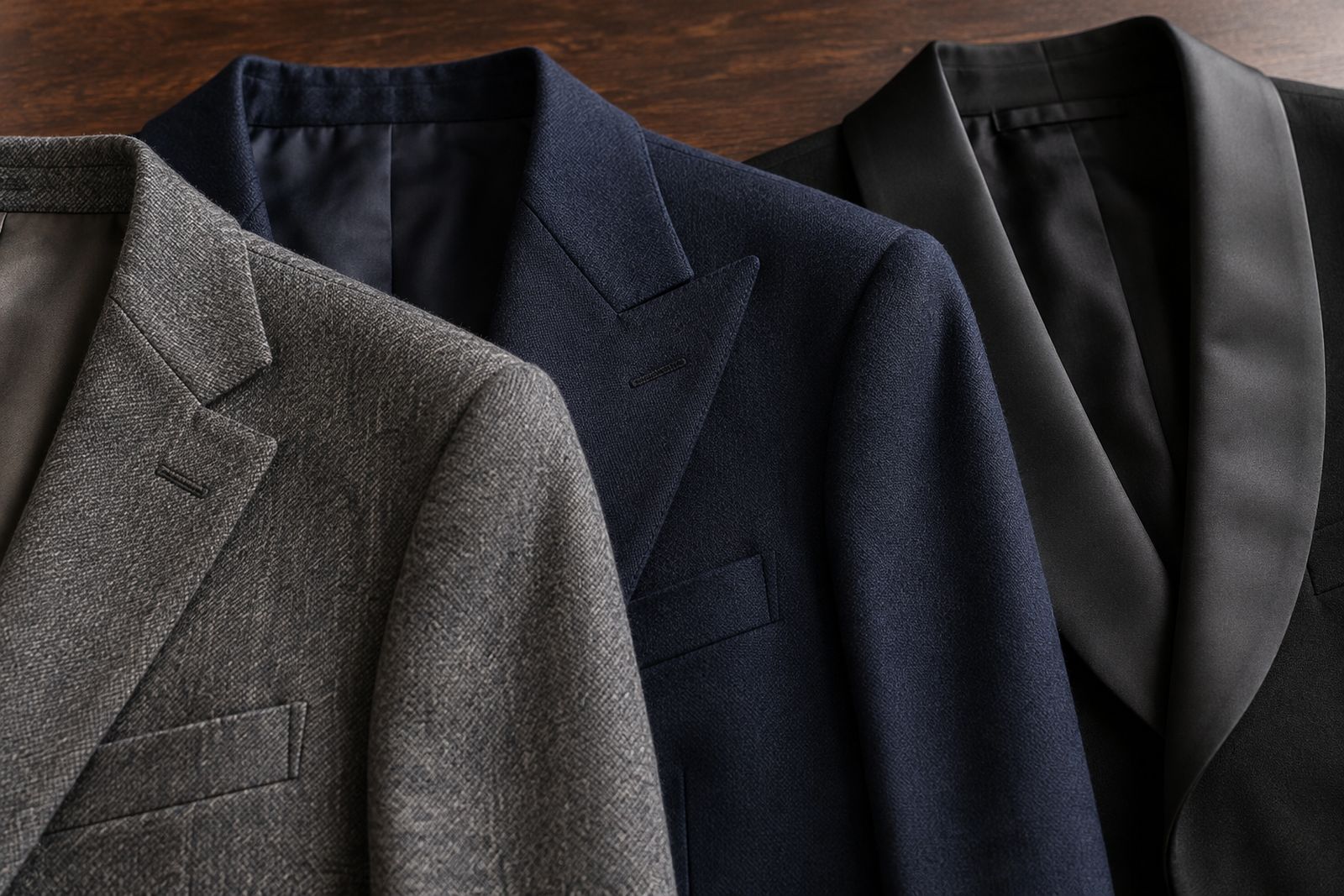
There are three suit lapel types. The notch lapel, with a wedge-shaped gap where collar meets lapel, is the business standard and the most versatile. The peak lapel points up toward the shoulder; it is more formal and traditional on double-breasted jackets and dinner jackets. The shawl lapel is one smooth curve with no notch and belongs on dinner jackets.
- Notch lapels are the business standard and the most versatile choice for a first suit.
- Peak lapels are more formal and assertive; they are traditional on double-breasted and dinner jackets.
- Shawl lapels belong on dinner jackets and smoking jackets, not business suits.
- A classic lapel measures about 3 to 3½ inches (7.5 to 9 cm) at its widest point.
- Match your tie width to your lapel width at their widest points.
- A soft lapel roll is a sign of a canvassed jacket; a pressed-flat lapel often means fused.
In this guide
- What are the three types of suit lapels?
- What is a notch lapel?
- What is a peak lapel?
- What is a shawl lapel?
- Which lapel is most formal?
- What is the most versatile lapel?
- How wide should lapels be?
- Which lapel suits your build?
- What is the gorge, and why does its height matter?
- What is a lapel roll?
- What is the belly of a lapel?
- Lapel details: buttonholes, stitching and facings
- Which lapel should you choose?
- Lapel problems a tailor can and can't fix
- What to tell your tailor about lapels
- Questions people ask
There are only three suit lapel types, but within each there are dozens of decisions: how wide, how high the gorge sits, how the lapel rolls, whether its edge curves. Those decisions are what make one notch lapel look sharp and another look tired. Learn the three types, which is most formal, how wide lapels should be and the tailor's vocabulary of gorge, roll and belly, and you can judge a lapel at a glance and ask for the one you want.
What are the three types of suit lapels?
The three types of suit lapels are the notch, the peak and the shawl. They differ in shape where the lapel meets the collar, and that shape sets the jacket's formality.
| Lapel | Shape | Formality | Traditional on | Best for |
|---|---|---|---|---|
| Notch | Wedge-shaped gap where collar meets lapel | Business standard | Single-breasted suits, sport coats, blazers | First suits, everyday business, most occasions |
| Peak | Lapel points up and out toward the shoulder | More formal and assertive | Double-breasted suits, dinner jackets, tailcoats | Double-breasted suits, weddings, a dressier single-breasted suit |
| Shawl | One smooth curve, no notch or point | Evening only | Dinner jackets, smoking jackets | Black tie |
What is a notch lapel?
Notch lapel
A notch lapel is a lapel that meets the collar at an angle, leaving a wedge-shaped gap, the notch, at the gorge seam. It is the standard lapel on single-breasted business suits.
The notch lapel is the usual lapel of the lounge suit, the informal suit of the late nineteenth century that became today's business suit, and it still carries that everyday character. It is the most versatile lapel: right for the office, interviews, weddings, funerals and dinners, and at home on sport coats and blazers too. If you own one suit, it should almost certainly have notch lapels.
Notches vary more than most people notice. The notch can sit higher or lower, open wider or narrower, and angle up or down. A small, neat notch at a moderate height looks cleanest. A very large notch, or one that sits noticeably lower on one side than the other, is a sign of careless making.
What is a peak lapel?
Peak lapel
A peak lapel is a lapel whose upper edge sweeps up into a point that rises toward the shoulder, nearly meeting the collar. It is traditional on double-breasted jackets, dinner jackets and the evening tailcoat.
Peak lapels come from formal dress. The evening tailcoat still has them, and the morning coat traditionally does too. On a suit, the upward points draw the eye up and out toward the shoulders, which makes the chest look broader and the whole jacket look more commanding. That is why the peak lapel reads as more formal and more assertive than the notch.
On a double-breasted jacket, peaks are the norm, because the points balance the wide, closed front; a notch lapel on a double-breasted jacket is unusual. On a single-breasted jacket, peaks are a dressier, more individual choice. Peak lapels are often cut slightly wider than notch lapels on the same jacket, because the point needs room to rise. Our guide to peak vs notch lapels helps you decide between the two.
What is a shawl lapel?
Shawl lapel
A shawl lapel, or shawl collar, is a lapel cut in one continuous curve from the back of the neck to the fastening button, with no gorge seam, notch or point. It is used on dinner jackets and smoking jackets.
The shawl lapel descends from the Victorian smoking jacket and is now almost entirely an evening style. On a dinner jacket it is usually faced in silk satin or grosgrain. It is equally correct with a peak lapel for black tie; the choice is one of taste, with the shawl looking softer and the peak sharper. A shawl lapel on a business suit looks out of place, though the style also appears on cardigans and casual knitwear. Our guide to black tie covers the rest of the dress code.
Which lapel is most formal?
For evening wear, the peak and shawl lapels are the most formal, faced in silk on a dinner jacket. For daywear, the peak lapel is more formal than the notch. The ladder shows how lapel and jacket combine.
Most formal
Peak or shawl, silk-faced
Dinner jackets for black tie; the tailcoat has silk-faced peaks
Peak, double-breasted suit
The most formal daytime suit lapel
Peak, single-breasted suit
Dressier business and wedding suits
Notch, suit
The business standard
Notch, sport coat or blazer
Odd jackets and casual tailoring
Least formal
What is the most versatile lapel?
The notch lapel is the most versatile. It is correct for every occasion a business suit is worn to, it suits every build, and it is the default on sport coats and blazers too. A notch lapel of about 3 to 3½ inches (7.5 to 9 cm) is the choice least likely to look out of place or out of date in ten years.
How wide should lapels be?
On a classic suit jacket, lapels should be about 3 to 3½ inches (7.5 to 9 cm) at the widest point, measured straight across from the outer edge to the seam or roll. More precisely, lapel width should sit in proportion to your shoulders and chest: a broad-shouldered man can carry a wider lapel, and a slight man looks better in one toward the narrow end of the range.
Scale from 1.5 in to 5 in, with cm below. Slim: 2 to 2.75 in. Classic: 3 to 3.5 in. Wide: 3.75 to 4.5 in. 3 in: at 3 in. 3½ in: at 3.5 in.
| Width at widest point | How it reads | Who it suits |
|---|---|---|
| About 2 to 2¾ inches (5 to 7 cm) | Slim, fashion-led; dates quickly | Very slight builds, fashion suits |
| About 3 to 3½ inches (7.5 to 9 cm) | Classic; the range that lasts | Most men, most suits |
| About 3¾ inches (9.5 cm) and wider | Wide; a deliberate, dressier look | Broad-shouldered men, double-breasted and peak lapels |
Your tie should match your lapels: the widest point of the tie should be roughly the same width as the widest point of the lapel. A wide tie between slim lapels looks heavy, and a skinny tie between wide lapels looks lost. Our guide to tie width explains how to pair the two.
Which lapel suits your build?
Every build can wear a notch or a peak lapel; what changes is the width and the gorge. The aim is a lapel that sits in proportion to your shoulders and chest, so the jacket looks like it belongs to you rather than to a trend.
| Build | Lapel type | Width at widest point | Notes |
|---|---|---|---|
| Tall and slim | Notch or peak | About 3 to 3¼ inches (7.5 to 8.5 cm) | A peak adds useful breadth across the chest |
| Shorter than average | Notch or peak | About 3 to 3¼ inches (7.5 to 8.5 cm) | A peak or a moderately high gorge draws the eye upward; avoid very wide lapels |
| Broad or athletic | Either | About 3¼ to 3½ inches (8.5 to 9 cm), or a little wider | Slim lapels make broad shoulders look even broader |
| Heavier through the middle | Either | About 3¼ to 3½ inches (8.5 to 9 cm) | Narrow lapels make a larger frame look larger; a generous lapel balances it |
| Slight, narrow shoulders | Notch | About 3 inches (7.5 cm) | Wide lapels overwhelm a small frame |
Lapel width is also the detail that dates a jacket fastest. Fashion has swung between narrow lapels, as in the early 1960s, and very wide ones, as in the 1970s, every couple of decades. A jacket with lapels in the classic range of about 3 to 3½ inches (7.5 to 9 cm) sits in the middle of that swing, which is why it still looks right years later.
What is the gorge, and why does its height matter?
Gorge
The gorge is the seam where the collar is sewn to the lapel. Its height, how far it sits below the shoulder line, changes the look of the whole front.
A high gorge makes the lapels look longer and leaner and gives the jacket a modern, Italian-influenced look; very high gorges sit almost level with the top of the shoulder. A low gorge shortens the lapels and gives a broader, softer look. Most classic jackets place the gorge somewhere around the collarbone. Neither extreme is wrong, but both date faster than a moderate gorge, and a very high gorge can make a short neck look shorter.
What is a lapel roll?
Lapel roll
The lapel roll is the soft, three-dimensional curve with which a lapel turns back from the jacket front along the roll line. On a canvassed jacket the lapel rolls over rather than folding flat.
A good roll is one of the clearest signs of quality. On a half or full canvas jacket, the canvas and the hand stitching that joins it to the lapel let the lapel curl gently, so it seems to spring away from the chest. On many fused jackets the lapel is pressed flat with a hard crease, which looks lifeless and cannot be restored. Our guide to fused vs canvassed jackets explains why.
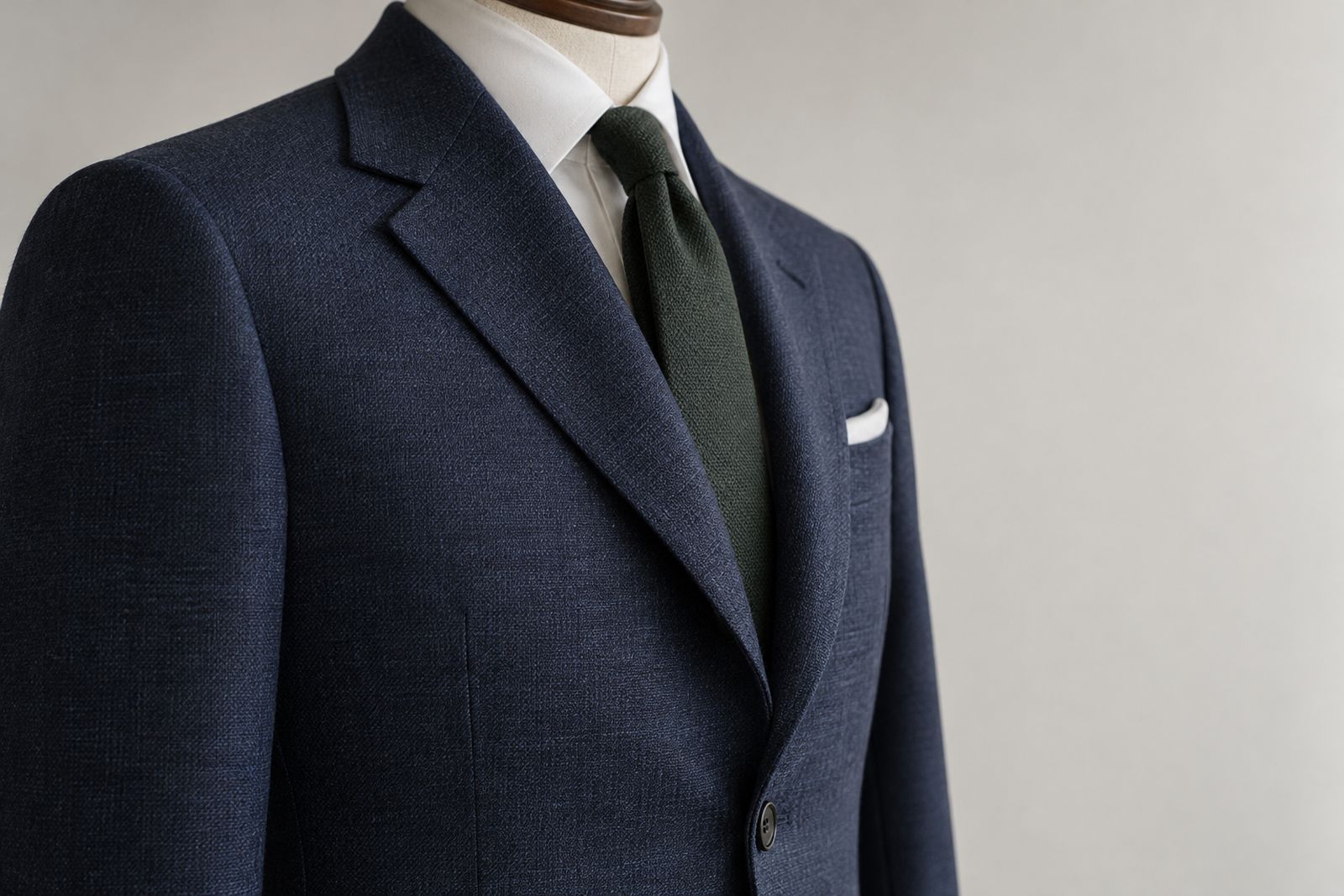
The roll also explains the three-roll-two jacket: a three-button jacket whose lapel rolls past the top button down to the middle one, so the top button sits on the turned lapel and is left undone. Our guide to one, two and three-button suits covers it in detail.
What is the belly of a lapel?
The belly is a gentle outward curve along the outer edge of a lapel, so it swells slightly between the gorge and the button before tapering. A straight lapel runs in a straight line instead. A little belly gives a lapel a fuller, more three-dimensional look and is common in classic English and bespoke tailoring. Too much belly looks exaggerated; none at all can look flat and mechanical. It is a matter of taste, and a detail you can ask for on a bespoke or made-to-measure jacket.
Lapel details: buttonholes, stitching and facings
Lapel buttonhole
The lapel buttonhole, or boutonnière, sits on the upper left lapel and holds a flower or pin. On a well-made jacket it is cut open and hand-finished, with a small loop behind it to hold the stem; some double-breasted jackets have one on each lapel.
Pick stitching
Pick stitching is a line of small stitches set just in from the lapel edge. Done by hand it is a sign of careful finishing; on many ready-to-wear jackets it is made by machine to look hand-sewn.
Lapel facing
On a dinner jacket, the lapels are faced, or covered, in silk satin or grosgrain, while the rest of the jacket is in wool. The facing is what moves a peak or shawl lapel into evening wear.
Which lapel should you choose?
Choose notch lapels for single-breasted business suits and odd jackets, peak lapels for double-breasted suits and when you want a dressier single-breasted suit, and peak or shawl lapels for a dinner jacket. The table gives the choice by jacket.
| Jacket | Best lapel | Also correct |
|---|---|---|
| First or only business suit | Notch | None needed |
| Double-breasted suit | Peak | Notch is unusual |
| Wedding suit for a groom | Notch or peak | Peak reads dressier |
| Dinner jacket | Peak or shawl | Notch is acceptable but less traditional |
| Sport coat or single-breasted blazer | Notch | Peak is rare and dressy |
| Double-breasted blazer | Peak | None |
Lapel problems a tailor can and can't fix
Most lapel problems are fit problems in the chest, and a good tailor will look there first. The lapel itself is hard to change once the jacket is made.
- Lapels that bow outward when the jacket is fastened usually mean the chest or waist is too tight. Letting out the waist can help if there is inlay; a tight chest often cannot be fixed.
- Lapels that collapse or gape away from the chest usually mean the chest is too big or the jacket is fused with little shape. Taking in the chest is difficult on a finished jacket.
- A lapel roll pressed flat can sometimes be revived on a canvassed jacket by careful steaming and pressing; on a fused jacket it cannot.
- Lapel width can be narrowed, but it is costly and often upsets the balance between collar, gorge and lapel. It is rarely worth doing.
- A lapel buttonhole can usually be added to a jacket that lacks one.
What to tell your tailor about lapels
On a made-to-measure or bespoke jacket, you can specify the lapel in detail. Ask for:
- The type: notch or peak for a suit, peak or shawl for a dinner jacket.
- The width at the widest point, in inches or centimeters, in proportion to your shoulders.
- The gorge height: moderate unless you want a deliberate high or low look.
- A soft roll, which needs a canvassed front.
- How much belly, if any.
- A working lapel buttonhole with a stem loop behind it.
- For a dinner jacket, the facing: satin or grosgrain.
Lapels are one part of a jacket with many named details; our guide to the parts of a suit jacket covers the rest. If you are choosing a double-breasted suit, read single vs double-breasted suits next. When you are ready to have lapels cut for your shoulders, our ranking of the best tailors in London is a good place to start.
Questions people ask
What is the most versatile lapel?
The notch lapel is the most versatile. It suits every build and is correct on business suits, sport coats and blazers, from the office to a wedding. A notch of about 3 to 3½ inches (7.5 to 9 cm) at its widest is the least likely to date.
Which lapel is most formal?
For evening, the peak and shawl lapels, faced in silk on a dinner jacket, are the most formal. For daywear, the peak lapel is more formal than the notch, especially on a double-breasted suit. Fabric and facing matter as much as shape.
How wide should lapels be?
About 3 to 3½ inches (7.5 to 9 cm) at the widest point on a classic jacket. Go toward the wider end if you have broad shoulders and toward the narrower end if you are slight. Match your tie to the same width.
What is a lapel roll?
The lapel roll is the soft, curved turn of the lapel along the roll line, rather than a hard pressed crease. It comes from a canvassed front and hand work, and it is one of the clearest signs of a well-made jacket.
Can a tailor change the width of my lapels?
It is possible to narrow lapels, but it is costly and often upsets the balance between the collar, gorge and lapel. It is rarely worth doing. Choose the lapel width you want when you buy or commission the jacket.
Can a dinner jacket have notch lapels?
Yes, but it is the least traditional choice. Peak and shawl lapels are the classic options for a dinner jacket, faced in satin or grosgrain. A notch-lapel dinner jacket is acceptable, but it looks closer to a business suit.
Why is there a buttonhole on a suit lapel?
The lapel buttonhole, or boutonnière, is there to hold a flower or a pin. On a good jacket it is cut open and hand-finished, with a small loop behind it to hold the stem steady.
TailorGuide is independent. Our guides are written and checked by our team and carry no paid endorsements. How we work.