The short answer
A bespoke suit is made in stages. The cutter measures you and notes your posture, drafts a paper pattern by hand, cuts the fabric with generous inlays and bundles it with canvas and linings for the coatmaker and trouser maker. You return for baste, forward and finish fittings before the buttonholes and final press. Expect 50 or more hours of hand work and 8 to 12 weeks or longer.
- A first bespoke suit usually takes 8 to 12 weeks, often longer, and three to four months is common at busy houses.
- Many houses quote 50 or more hours of hand work for a two-piece suit, most of it on the jacket.
- Expect three fittings for a first order: baste, forward and finish.
- Your paper pattern is kept on file, so a second suit is faster and needs fewer fittings.
- Wear the shirt and shoes you will wear with the suit to every appointment.
In this guide
- How is a bespoke suit made? The stages in order
- Who makes a bespoke suit?
- Stage 1: The consultation and choosing the fabric
- Stage 2: Measuring and observing your posture
- Stage 3: What is a bespoke pattern?
- Stage 4: Cutting the fabric
- Stage 5: The trimmings
- Stage 6: Making the jacket and trousers
- What is a baste fitting? The three fittings explained
- Finishing: buttonholes, pressing and the final fitting
- How long does it take to make a bespoke suit?
- The tailor's view: what to do at each stage
- Questions people ask
A bespoke suit starts as a page of numbers and notes about one body and ends, about three months later, as a jacket and trousers that follow that body closely. In between, the suit is drafted on paper, cut, loosely assembled, fitted, taken apart, recut and fitted again. Knowing how a bespoke suit is made tells you why it costs what it does, why it takes as long as it does, and what you should be checking at each fitting.
A bespoke suit at a glance
- Hand work
- 50 or more hours for a two-piece suit at many houses
- Fittings
- Usually three for a first suit: baste, forward and finish
- Overall time
- Usually 8 to 12 weeks, often longer; three to four months is common
- Who works on it
- Cutter, trimmer, coatmaker, trouser maker, finisher and presser
- Construction
- Full floating canvas, with hand pad-stitched lapels and collar
- Pattern
- Drafted by hand for you alone and kept on file for later orders
How is a bespoke suit made? The stages in order
A bespoke suit is made in eight stages, and the order is much the same on Savile Row, in Milan or in a good independent workshop in New York. The cutter is responsible for the fit, specialist makers do the sewing, and you return for fittings while the suit can still be changed. The diagram shows the sequence with typical calendar time at a house with a normal queue; busy houses take longer.
Stage 1: Consultation and fabric
Week 0
Style, fabric and details agreed; fabric ordered from the merchant
Stage 2: Measuring
Week 0
Measurements taken and posture observed
Stage 3: Pattern drafting
Week 1
Paper pattern drafted by hand by the cutter
Stage 4: Cutting and trimming
Weeks 1 to 2
Fabric cut with inlays; canvas, linings and buttons bundled
Stage 5: Baste fitting
Weeks 3 to 5
Loosely tacked jacket, no lining; balance and shape checked
Stage 6: Forward fitting
Weeks 6 to 8
Rebuilt with collar, pockets and part of the lining
Stage 7: Finish fitting
Weeks 8 to 11
Nearly complete; sleeve and trouser length confirmed
Stage 8: Finishing and collection
Weeks 9 to 12 or later
Buttonholes, final press and handover
Who makes a bespoke suit?
A bespoke suit is made by a small team, not by one person. In a traditional house the cutter measures you, drafts the pattern, cuts the fabric and runs every fitting, while separate tailors sew the jacket and the trousers. Many coatmakers and trouser makers are outworkers with their own workshops who make for more than one house.
| Role | What they do | When you see them |
|---|---|---|
| Cutter | Measures you, drafts and corrects the pattern, cuts the fabric and runs the fittings | At every appointment |
| Under-cutter | Assists the cutter while training; may cut trousers or waistcoats | Sometimes at fittings |
| Trimmer | Cuts and matches the canvas, linings, pocketing and buttons for each order | Rarely |
| Coatmaker | Sews the jacket: canvas, pad stitching, collar, sleeves and pockets | Rarely; some houses bring them to fittings |
| Trouser maker | Sews the trousers, including the waistband, fly and pockets | Rarely |
| Finisher | Fells the lining, works the buttonholes and sews on the buttons by hand | Rarely |
| Presser | Presses and shapes the garment between stages and at the end | Rarely |
Small workshops combine these roles. A single tailor may cut, make and fit the whole suit.
Stage 1: The consultation and choosing the fabric
The first appointment starts with a conversation, not a tape measure. A good cutter asks what the suit is for, how often you will wear it, what climate you live in and what you already own, then steers you toward a fabric and a cut that will do that job. You choose from swatch books supplied by mills and merchants, and the house orders a length of fabric for your suit. Our guide to suit fabrics explains the options.
The style decisions are made here too: single or double-breasted, lapel shape and width, number of buttons, vents, pockets, trouser front (flat or pleated), belt loops, side adjusters or brace buttons, and turn-ups (cuffs). A house with a strong cut, such as the soft drape of Anderson & Sheppard or the structured one-button coat of Huntsman, cuts in its own style, and you choose the details within it.
Stage 2: Measuring and observing your posture
Measuring for a bespoke suit is half tape measure and half observation. The cutter takes more than 20 measurements, but the notes on how you stand matter as much as the numbers: two men with the same chest and waist can need very different patterns.
What the tape records
Chest, waist, seat, shoulder width, back length, jacket length, sleeve length to each wrist and upper arm, and for trousers the waist, seat, thigh, knee, leg opening, inside leg and rise. Many cutters measure both arms separately, because one is often slightly longer than the other. Our guide to measuring for a suit shows where the main points fall.
What the cutter observes
Posture notes a cutter makes
- Shoulder slope: square, regular or sloping, and whether one shoulder sits lower than the other, which is very common.
- Stance: upright or leaning slightly forward, which changes how much length the jacket needs at the front against the back.
- Back: prominent shoulder blades or a rounded upper back need extra length and room across the back.
- Chest: full or flat, which affects how the canvas and lapels are shaped.
- Stomach and seat: how prominent each is, which shapes the jacket front and the trouser pattern.
- Arms: whether they hang forward or back, which sets the angle of the sleeves (the pitch).
- Neck and head: neck thickness and whether the head is carried forward, which shapes the collar.
Stage 3: What is a bespoke pattern?
Bespoke pattern
A bespoke pattern is a set of paper templates for every piece of a suit, drafted by hand for one customer from their measurements and posture notes. It is corrected after each fitting and kept on file for later orders.
The cutter drafts the pattern on stiff brown paper with chalk, a square, a tape and a set of curves, following a drafting system and adjusting it by eye for your figure. A jacket pattern includes the front (forepart), side body, back, top and under sleeves, collar and facings; trousers have a front and back for each leg plus the waistband. Not every tailor works on paper first: some, especially in Italy, chalk the pattern straight onto the fabric.
The pattern is the real asset you are paying for. Once it is right, a second suit can be cut from it with fewer fittings, and the cutter can adjust it if your weight or posture changes over the years. This is the main reason bespoke customers tend to stay with one house.
Stage 4: Cutting the fabric
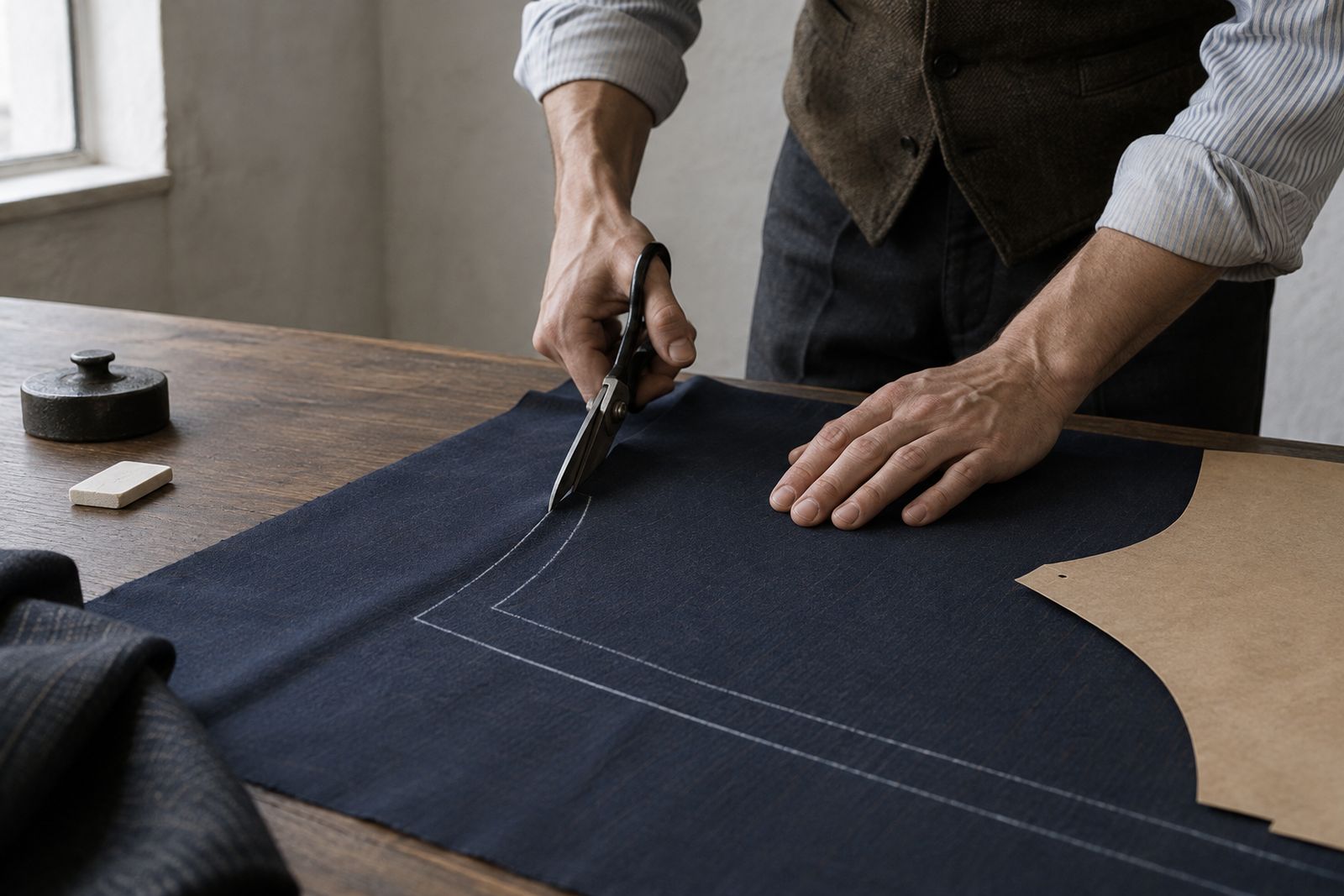
The cutter lays the pattern on the fabric, chalks around it and cuts by hand with heavy shears. Two things separate a bespoke cut from a factory cut. First, the cutter leaves generous inlays: extra seam allowance at the center back, side seams, sleeves and trouser seat, so the suit can be adjusted at fittings and let out years later. Second, stripes and checks are placed so they line up across seams, pocket flaps and the collar, which uses more fabric and more time.
Stage 5: The trimmings
The trimmings are every material in the suit other than the outer fabric, and in a good house the trimmer cuts them to suit each order. The cut fabric and its trimmings are rolled together with the cutter's notes into a bundle and sent to the makers.
| Trimming | What it is | Where it goes |
|---|---|---|
| Hair canvas | A springy interlining woven from wool or cotton with goat hair or horsehair | The whole jacket front, from shoulder to hem |
| Chest piece | Extra layers of horsehair canvas, shaped over the chest | Chest and shoulder, to give shape and spring |
| Domette | A soft, fluffy wool or cotton interlining | Over the chest piece, so the hair does not show through or scratch |
| Shoulder padding | Layers of wadding or felt, from a thin sliver to a built-up pad | The shoulder, depending on the house style |
| Bridle tape | A narrow linen tape | Along the lapel roll line, to control the roll |
| Melton | A dense, felted wool | Under the collar |
| Linings | Usually cupro (often sold as Bemberg) | Jacket body and sleeves; often the trouser fronts to the knee |
| Pocketing | Strong cotton twill, often called silesia | Pocket bags and inside the waistband |
| Buttons | Horn or corozo; metal on some blazers | Jacket front, cuffs and trousers |
| Threads | Basting cotton, sewing silk and buttonhole twist | Throughout the suit |
Linings deserve more thought than most customers give them, because they affect comfort and how long the inside of the jacket lasts. See suit linings explained for how cupro compares with viscose, polyester and silk.
Stage 6: Making the jacket and trousers
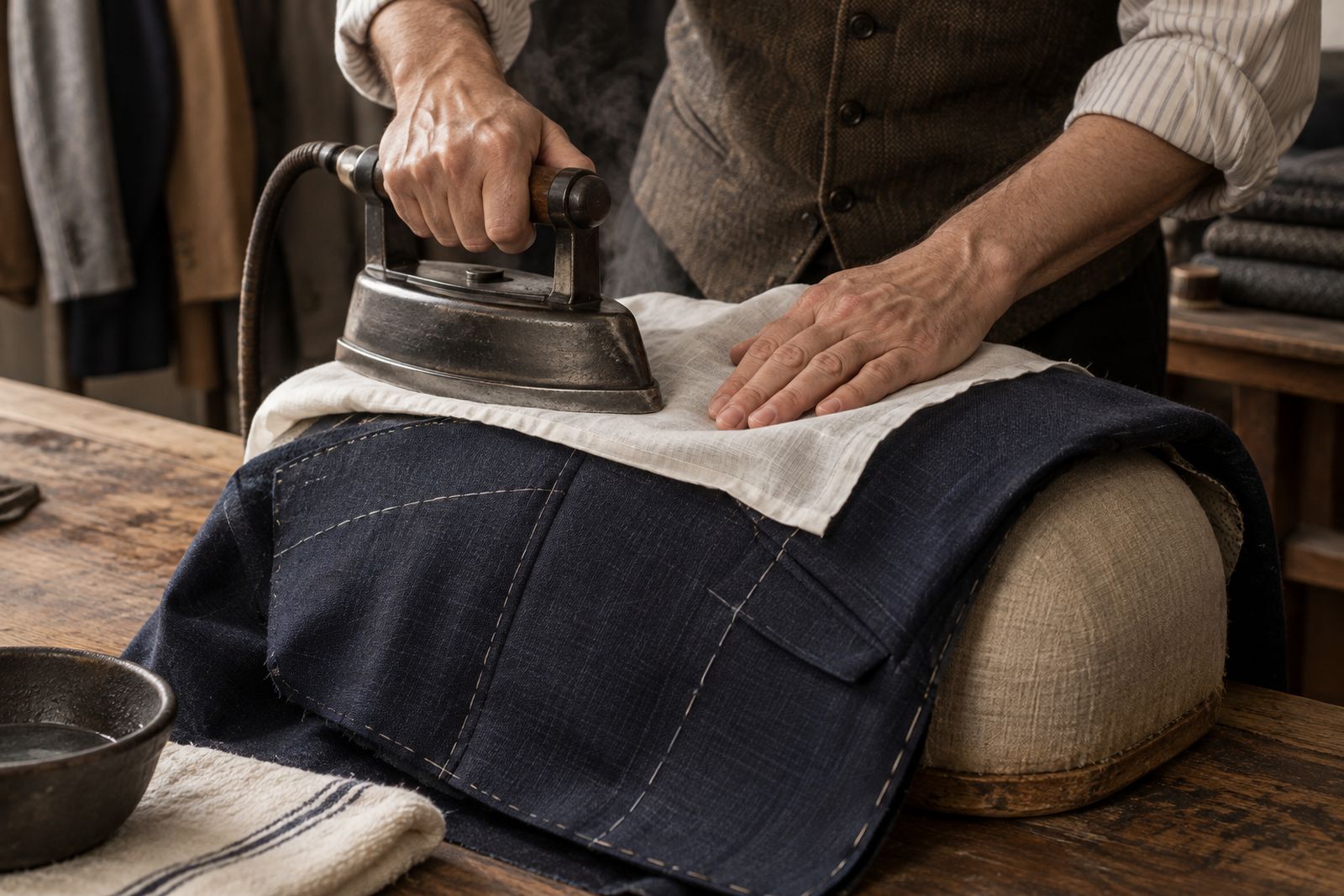
The coatmaker builds the jacket around a full floating canvas. The canvas is not glued; it is held to the fabric with loose basting stitches so it can move with you and mold to your chest over time. The coatmaker pad-stitches the lapels and under collar by hand, making hundreds of small stitches while holding the fabric curved over the fingers, so the lapel keeps a permanent roll. A linen bridle tape along the roll line stops the lapel from stretching. Our guide to fused vs canvas construction explains why this matters.
The tailor also shapes the fabric with the iron. By shrinking the wool in some places and stretching it in others with steam and pressure, a skilled maker works curves for the shoulder blades, chest and seat into flat fabric before the seams are closed. This iron work is a large part of why bespoke jackets sit so cleanly on the body.
Meanwhile the trouser maker makes up the trousers, with the waistband, seat and length left so they can be adjusted at fittings. Bespoke trousers are often finished with a back waistband split by a seam, so the waist can be altered easily, along with brace buttons or side adjusters and a cotton curtain inside the waistband.
What is a baste fitting? The three fittings explained
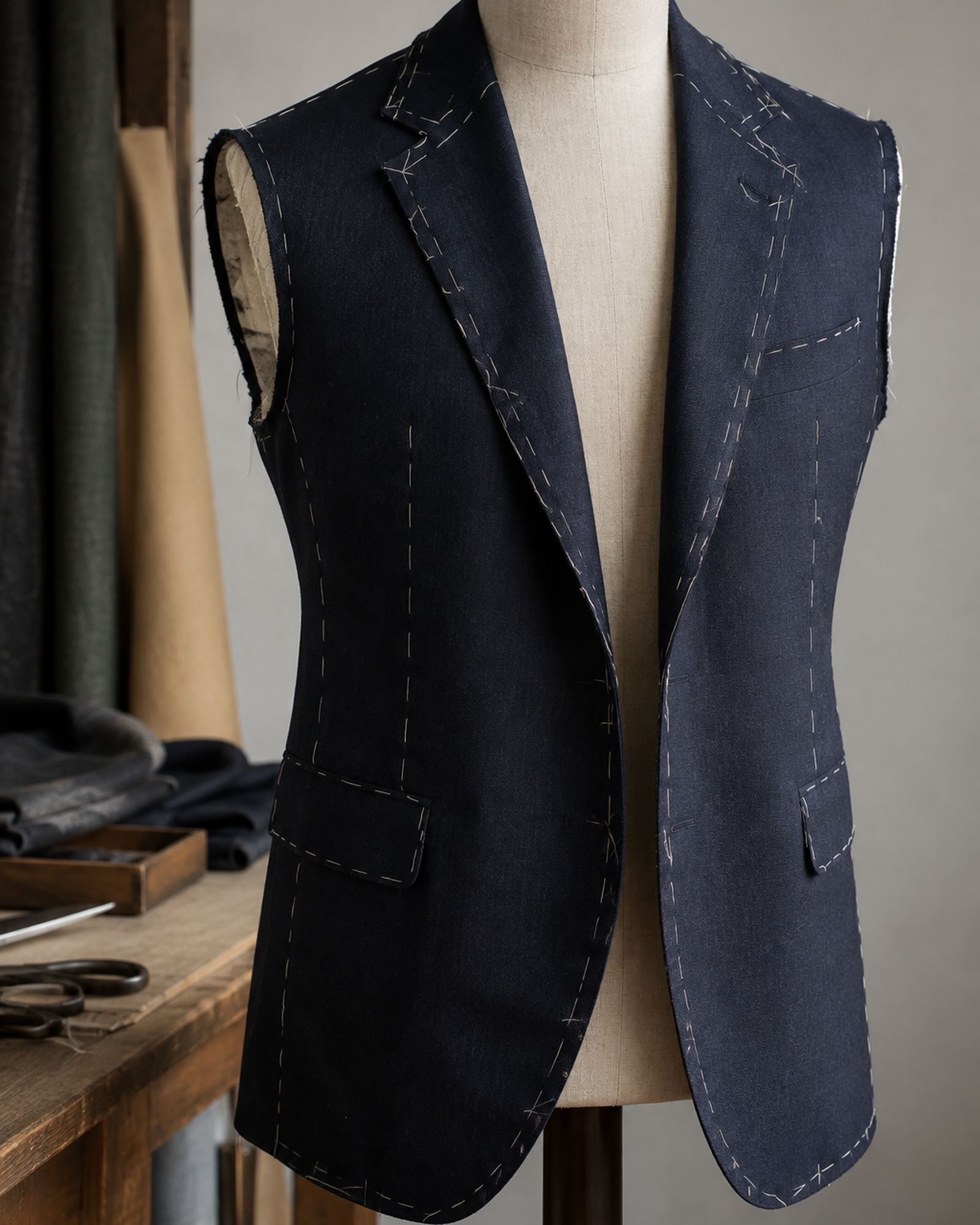
A baste fitting is the first fitting of a bespoke suit, when the jacket is only loosely tacked together in white basting thread so the cutter can check its balance and shape before anything is permanently sewn. Most first suits go through three fittings, each more finished than the last. A house may add one if something needs another look, and repeat orders on a settled pattern can need only one or two.
| Fitting | State of the suit | What the cutter checks |
|---|---|---|
| Baste | Jacket tacked in white thread, canvas in, no lining, no finished collar or pockets, sometimes one sleeve | Balance from front to back, shoulder width and slope, chest, waist, length, how the back hangs |
| Forward | Rebuilt with collar on, pockets made, part of the lining in, sleeves basted | Collar against the neck, lapel roll, sleeve pitch and length, button position, trouser seat and length |
| Finish (fin bar fin) | Nearly complete; sleeve buttonholes often left until the length is final | Final sleeve length and hem, small adjustments to waist or collar |
After the baste, the cutter rips the seams, marks the changes in chalk and corrects the paper pattern, and the coatmaker rebuilds the jacket. This is the core of bespoke: the suit is taken apart and remade, not simply pinned. Savile Row calls the near-final stage fin bar fin, usually explained as 'finished bar finishing': complete except for the last hand finishing. For more on what happens at each appointment, read bespoke fittings explained.
Finishing: buttonholes, pressing and the final fitting
Finishing turns a fitted garment into a finished one, and it is almost all hand work. The finisher fells the lining in place with small, close stitches, sews the buttons on with a wrapped thread shank so they sit above the fabric, and works the buttonholes by hand in silk twist over a corded core called a gimp. Sleeve buttonholes are usually cut last, once the sleeve length is confirmed, because a sleeve with working buttonholes is very hard to shorten afterward.
The presser then gives the suit its final press, setting the lapel roll and the shape of the chest without flattening them. At collection the cutter checks the suit on you once more. Small adjustments at this point are normal, and many houses ask you to wear a new suit for a few weeks and come back if anything needs a touch.
How long does it take to make a bespoke suit?
A first bespoke suit usually takes 8 to 12 weeks, often longer, and three to four months is common at busy houses. The Savile Row Bespoke Association expects its members to put at least 50 hours of hand work into a typical two-piece suit, and many houses elsewhere quote 50 hours or more. Most of that time goes into the jacket; the trousers are a much smaller job.
The hand work alone would fill a week or two of one tailor's time. The calendar time comes from the gaps: fabric delivery, queues at the makers' workshops, the rebuild between fittings and your own availability. If you live away from the house and fit during its visits to your city, four to six months or more is normal. Our guide to how long a bespoke suit takes has a planning table and a backward-planning example for events.
The tailor's view: what to do at each stage
Your part in the process
- At the consultation, say what the suit is for and how often you will wear it, and let that decide the fabric weight.
- At measuring, stand naturally and wear the shoes and type of shirt you will wear with the suit.
- At the baste, move: sit, reach forward and raise your arms. Say where anything pulls; the baste is the cheapest moment to change it.
- At the forward fitting, check that the collar sits against your shirt collar with no gap, and look at the lapel roll in a side mirror.
- At the finish fitting, confirm sleeve length with your arms relaxed, showing about ¼ to ½ inch (6 to 13 mm) of shirt cuff, before the sleeve buttonholes are cut.
- Bring the same shirt and shoes to every fitting, so the cutter compares like with like.
- Ask the cutter to note your style choices on your pattern card, so the next suit starts from them.
If you are ready to start, read how to choose a tailor, then see our ranking of the best tailors in London, each assessed on cut, make and the fitting process described here.
Questions people ask
How many fittings does a bespoke suit need?
A first bespoke suit usually needs three fittings: baste, forward and finish. Some houses add a fourth if something needs another look, and a second suit cut from a settled pattern may need only one or two. A suit with no fitting until it is finished is not bespoke in the traditional sense.
What is a baste fitting?
A baste fitting is the first fitting of a bespoke suit, when the jacket is loosely tacked together in white thread with the canvas in but no lining or finished pockets. The cutter uses it to check balance, shoulders, chest and length, then takes the jacket apart and corrects the pattern before it is rebuilt.
How long does it take to make a bespoke suit?
Expect about 8 to 12 weeks for a first suit, often longer, and three to four months at busy houses. Many houses quote 50 or more hours of hand work for a two-piece; the rest of the time is spent waiting for fabric, the makers and fitting appointments.
What is a bespoke pattern?
A bespoke pattern is a paper template for each piece of your suit, drafted by the cutter from your measurements and posture notes. It is corrected after every fitting and kept on file, so your next suit starts from a pattern that already fits you.
Is a bespoke suit sewn entirely by hand?
Not usually. Most bespoke makers sew some long, straight seams by machine and do the shaping work by hand: setting the canvas, pad stitching the lapels and collar, attaching the collar, setting the sleeves, felling the lining and working the buttonholes. The hand work is concentrated where it affects fit and movement.
How is bespoke different from made to measure?
A bespoke suit is cut from a pattern drafted for you and fitted in stages while it is being made. A made-to-measure suit adjusts a standard pattern to your measurements, is usually made in a factory and is normally fitted once it is finished. See bespoke vs made to measure for the full comparison.
What should I wear to a bespoke fitting?
Wear the type of shirt and the shoes you plan to wear with the suit, and bring the same ones every time. Empty your pockets and stand as you normally do, so the cutter fits the suit to your real posture.
TailorGuide is independent. Our guides are written and checked by our team and carry no paid endorsements. How we work.