The short answer
The easiest tie knot is the simple knot, also called the oriental or small knot. Start with the tie inside out and the wide end on your right. Cross the wide end behind the narrow end, bring it across the front, up through the neck loop from underneath, and down through the front band. That is four moves.
- The simple knot takes four moves: behind, across the front, up through the neck loop, down through the front band.
- Start with the tie inside out, seam facing away from your shirt, or the seam will show on the knot.
- It is the smallest common knot and uses the least tie.
- Best with thick ties (wool, knit, heavy silk), narrow collars and tall men whose ties land short.
- Learn the four-in-hand next; it is almost as easy and suits more shirts.
In this guide
The easiest tie knot is the simple knot, also called the oriental knot or small knot. It takes four moves, one fewer than the four-in-hand, and there is only one wrap to keep track of. The one catch is that it starts with the tie inside out, which feels wrong the first time and is exactly what makes it come out right.
The simple knot at a glance
- Moves
- Four
- Size
- The smallest common knot
- Shape
- Narrow and slightly asymmetric
- Start
- Inside out (seam out), wide end on your right
- Best ties
- Thick: wool, knit, cashmere, heavy silk
- Best collars
- Point and button-down
- Tie length used
- The least of any knot
How to tie the simple knot, step by step
Left and right are your own left and right, which is also how they look in a mirror. The neck loop is the loop of tie around your neck above the crossing point. The front band is the horizontal wrap you make in step 4, and the wide end finishes by passing down through it.
Tie the simple knot
- 1
Collar up, tie inside out
Fasten the top button and turn your collar up. Drape the tie around your neck inside out, so the seam and label face away from your shirt, with the wide end on your right.
- 2
Set the length
Let the wide end hang below the narrow end. Because this knot uses so little tie, start the narrow end lower than you would for any other knot, around the level of your navel for a first try.
Tip: If the tip lands above or below your belt, move the starting point by the same distance next time.
- 3
Cross behind
Take the wide end behind the narrow end, from right to left, just below your collar.
- 4
Across the front
Bring the wide end across the front of the knot, from left to right. The right side of the tie now faces out. This horizontal wrap is the front band.
Tip: Slide a finger under the front band to keep it open for step 6.
- 5
Up through the neck loop
From the right, bring the wide end up behind the knot and through the neck loop from underneath, so the tip comes out at the top.
- 6
Down through the front band
Feed the wide end down through the front band and draw it through.
- 7
Tighten
Hold the narrow end and slide the knot up firmly until it covers your collar button. Pinch a dimple below the knot if the tie will hold one, fold the collar down and tuck the narrow end into the keeper loop.
What the simple knot looks like
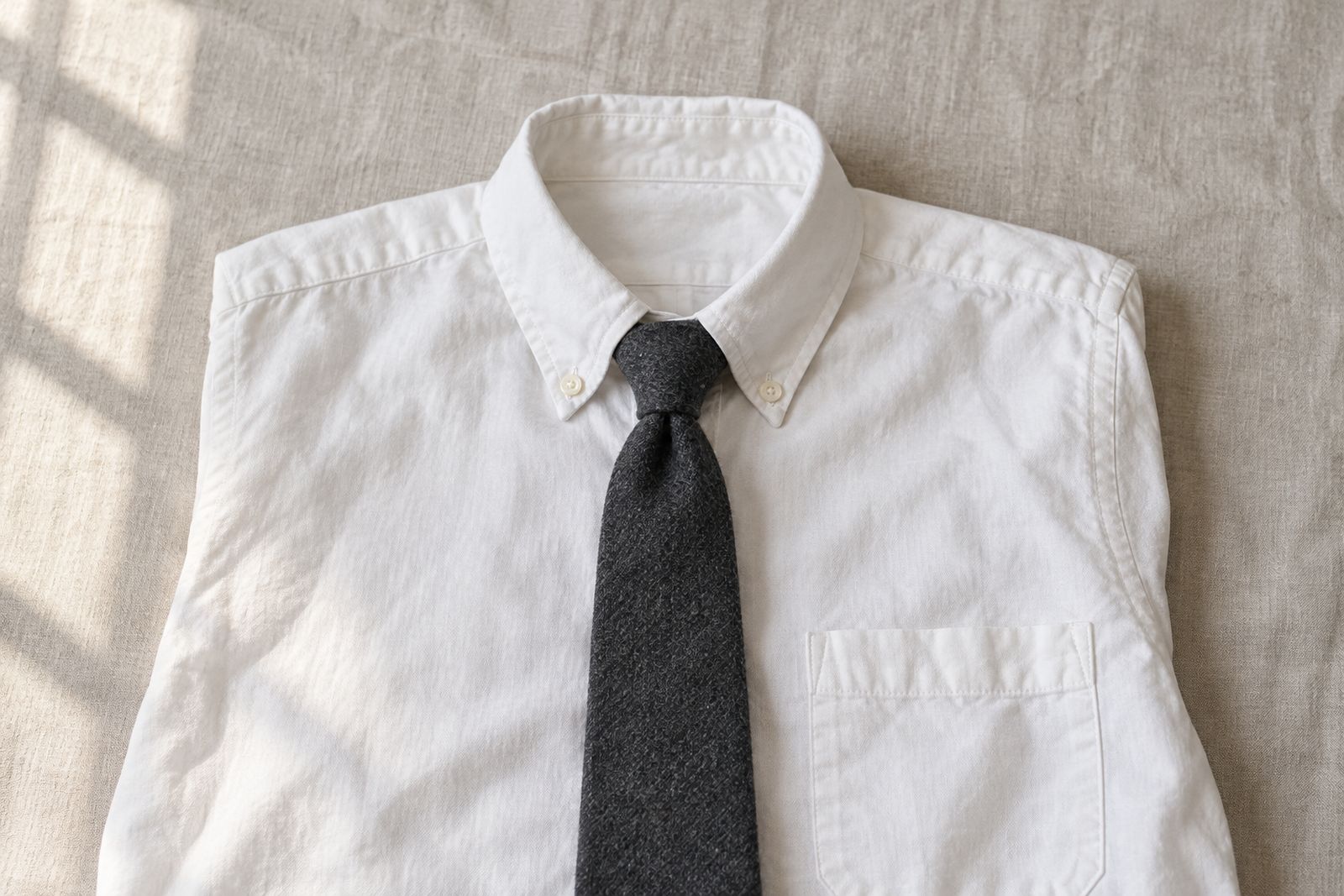
Finished, the simple knot is a small, narrow knot, a little smaller and slightly less tidy than a four-in-hand. With a thin tie it can look meager. With a thick wool, knit or heavy silk tie it looks compact and deliberate, because the tie's own bulk supplies the size the knot lacks.
Why the simple knot starts inside out
The wide end turns over each time it wraps around the narrow end. The simple knot's first move goes behind the narrow end, and that single wrap flips the tie, so it has to start inside out to finish right side out on the front band. Start it seam in by mistake and the front of the knot will show the seam. The four-in-hand avoids this by crossing over the front first, which is why it starts seam in.
Simple knot vs four-in-hand
| Feature | Simple knot | Four-in-hand |
|---|---|---|
| Moves | Four | Five |
| Starts | Seam out (inside out) | Seam in |
| First move | Wide end behind the narrow end | Wide end over the narrow end |
| Size | Smallest | Small |
| Tie length used | Least | A little more |
| Looks best with | Thick ties, narrow collars | Most ties, point to semi-spread collars |
| Formality | Casual to business | Business to formal |
In practice the four-in-hand is the better everyday knot, because it suits more ties and collars and looks a little fuller. The simple knot earns its place in the situations below. Our four-in-hand guide covers that knot in full.
When the simple knot is the better choice
- Thick ties. Wool, cashmere, knitted and heavily lined silk ties make a bulky knot from a single wrap. In a four-in-hand they can look clumsy; in a simple knot they look right.
- Narrow collars. Point, button-down and club collars leave little room, and a small knot fits neatly.
- Tall men and short ties. The simple knot uses the least tie of any knot, so it can rescue a tie whose tip stops above your belt with a four-in-hand.
- Speed. Four moves, done in seconds once learned.
- Casual outfits. A knit tie with a button-down shirt and an odd jacket suits a small, relaxed knot.
When to choose a different knot
- Spread and cutaway collars. The small knot looks lost and leaves bare collar on either side. Tie a half Windsor instead.
- Thin, lightly lined silk ties. The knot looks skimpy. Use a four-in-hand, Kelvin or half Windsor.
- Formal occasions. At a wedding or formal business event, a fuller knot reads as more considered.
- Short men with long ties. The simple knot leaves the most tie hanging, so the tip may fall below the belt. A bigger knot takes up the spare length.
Common mistakes with the simple knot
| Mistake | What you see | Fix |
|---|---|---|
| Starting seam in | The seam and label show on the front of the knot | Start again with the tie inside out |
| Crossing over the front first | You are tying a different knot, and it will not match the steps | Make the first move behind the narrow end |
| Starting the narrow end too high | The tip hangs below the belt | Start the narrow end lower by the overshoot |
| Leaving the knot loose | A gap above the knot and the collar button showing | Hold the narrow end and slide the knot up firmly |
| Using a thin silk tie | A tiny, skimpy knot | Switch to a four-in-hand or Kelvin |
What to learn next
Once the simple knot is automatic, the next knots build on it. The Kelvin is a simple knot with one extra wrap; the four-in-hand is the same idea started from the front. Learn them roughly in this order and each new knot adds only one new move.
Learn first
Simple knot
Four moves, starts inside out
Four-in-hand
Starts seam in, one extra wrap
Kelvin
The simple knot with an extra wrap
Pratt
Adds a pass over the neck loop
Half Windsor
The everyday knot for spread collars
Full Windsor
Wraps both sides of the neck loop
Learn last
Most men can stop after the four-in-hand and half Windsor. Our hub on how to tie a tie has the steps for all six knots, and our guide to which tie knot to wear shows which to use with each collar.
The tailor's view
A small, tight knot in a good thick tie, sitting snugly in a well-cut collar, looks better than a big knot forced into the wrong one. The simple knot is at its best with exactly the ties a tailor would suggest for a tweed or flannel suit: wool, cashmere and knitted silk. If your collar fits properly and your tie has body, the easiest knot can also be the right one.
Check the length once you have tied it: the tip should touch the top of your belt buckle. Our guide to tie length explains how to fix a tie that lands short or long.
Questions people ask
What is the simplest way to tie a tie?
The simple knot, also called the oriental knot, is the simplest: four moves, starting with the tie inside out. Cross the wide end behind the narrow end, bring it across the front, up through the neck loop and down through the front band. The four-in-hand, with five moves, is the next simplest.
What is the difference between the simple knot and the four-in-hand?
The simple knot starts inside out and begins by passing the wide end behind the narrow end; the four-in-hand starts seam in and begins by crossing over the front. The simple knot has one fewer move, is slightly smaller and uses less tie. The four-in-hand suits more collars and ties.
What is the oriental knot?
The oriental knot is another name for the simple or small knot: the smallest common tie knot, tied in four moves from an inside-out start. It is the same knot described step by step in this guide.
Is the simple knot professional?
It can be, with a thick tie and a point or button-down collar, tied snug against the collar button. With a thin tie or a spread collar it looks skimpy, and for interviews or formal events a four-in-hand or half Windsor is the safer choice.
Why does my simple knot show the seam?
You started with the tie seam in. Because the simple knot's first move goes behind the narrow end, the tie must start inside out, with the seam facing away from your shirt. Retie it inside out and the front will show the right side.
Can you tie a tie without a mirror?
Yes. Many people find it easier to look down at the tie for the first few attempts, and the simple knot's four moves are easy to do by feel. Use a mirror at the end to check the knot is centered and the tip reaches your belt.
Are clip-on ties acceptable?
For adults in ordinary business or formal settings, a tied tie is expected. Clip-on ties are common for children and in some uniformed jobs, where a tie that pulls away is a safety advantage. With the simple knot taking under a minute, a real tie is rarely too much trouble.
TailorGuide is independent. Our guides are written and checked by our team and carry no paid endorsements. How we work.