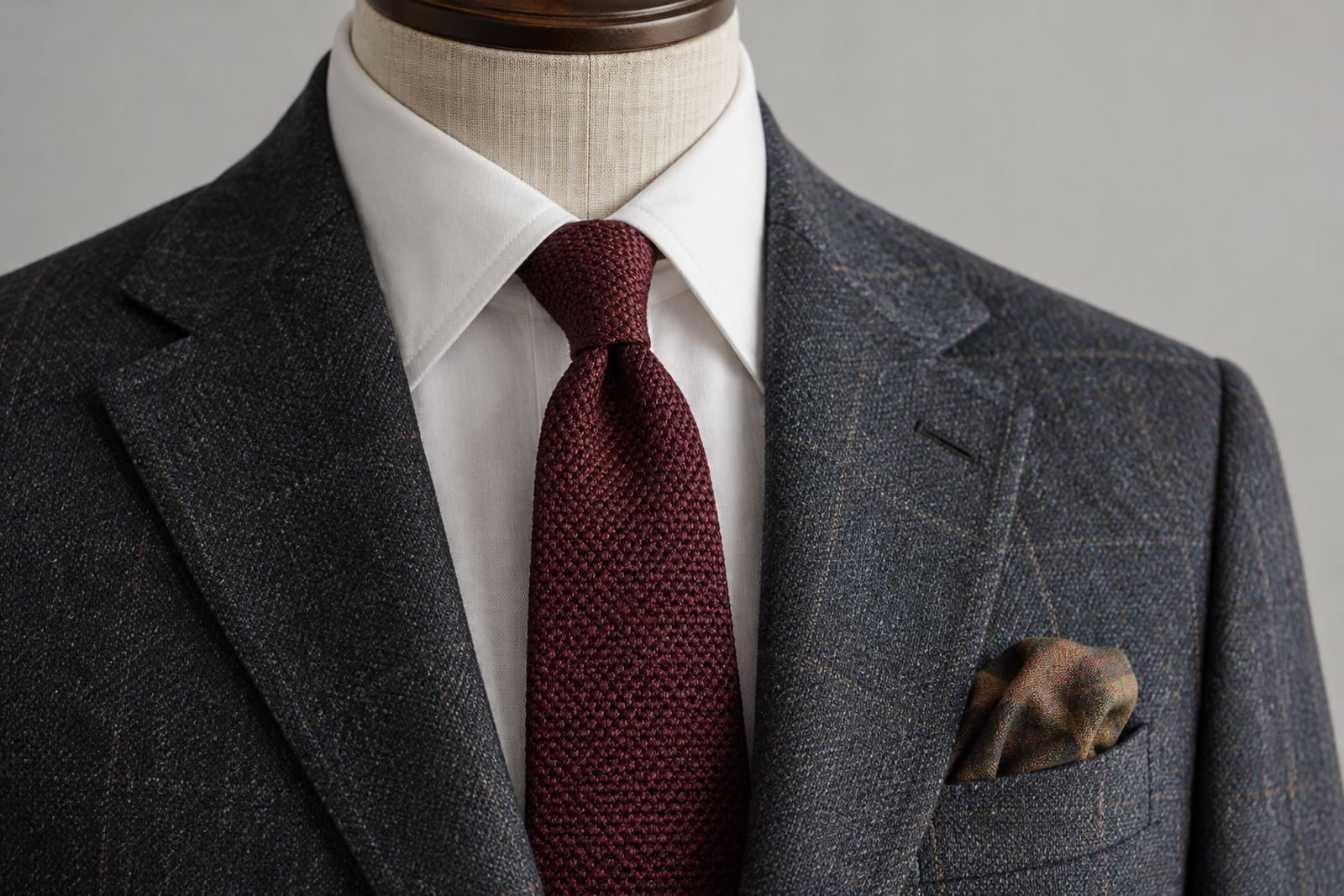
The short answer
To tie a four-in-hand knot, start seam in with the wide end on your right, hanging lower than the narrow end. Cross the wide end over the narrow end, bring it behind, cross it over the front again, bring it up through the neck loop from underneath, then tuck it down through the front band. Slide the knot up snug and pinch a dimple below it.
- Five moves: over, behind, over, up through the neck loop, down through the front band.
- Start seam in, with the wide end on your right.
- The knot leans slightly by design; pull the wide end straight down to keep it tidy.
- Best with point and button-down collars and with medium to thick ties.
- Formal enough for interviews, offices, weddings and funerals.
- It uses less tie than any standard knot except the simple knot, which makes it the tall man's knot.
In this guide
- How to tie a four-in-hand knot, step by step
- What a well-tied four-in-hand looks like
- How to put a dimple in a four-in-hand
- How to fix a crooked, loose or lopsided four-in-hand
- Which collars and ties suit a four-in-hand?
- Is the four-in-hand knot professional?
- Four-in-hand vs half Windsor, Kelvin and simple knot
- Length check for tall men
- Why is it called a four-in-hand?
- The tailor's view
- Questions people ask
The four-in-hand knot is the narrow, slightly lopsided knot you see in most offices. It takes five moves, uses little of the tie, and suits more collars and fabrics than any other knot. Tied carelessly it looks like an afterthought. Tied with a snug front band and a clean dimple, it looks quietly expert.
Four-in-hand at a glance
- Size
- Small
- Shape
- Tall and narrow, leans slightly to one side
- Difficulty
- Easy
- Start
- Seam in, wide end on your right
- Best collars
- Point, button-down, semi-spread
- Best ties
- Medium to heavy silk, wool, knit, cashmere
- Tie length used
- Little: less than any standard knot except the simple knot
How to tie a four-in-hand knot, step by step
Left and right mean your own left and right; facing a mirror, your right hand appears on the right of the reflection, so the words match what you see. The neck loop is the loop of tie around your neck above the crossing point, and the front band is the horizontal wrap you make in step 5. Our hub on how to tie a tie defines every term if you need it.
Tie the four-in-hand
- 1
Collar up, tie on
Fasten your top button and turn the collar up. Drape the tie around your neck with the seam against your shirt, the wide end on your right and the narrow end on your left.
- 2
Set the length
Let the wide end hang well below the narrow end. For a first try with a standard tie, start the narrow end's tip somewhere between the bottom of your breastbone and your navel.
Tip: You will adjust this after the first attempt, so do not fuss over it now.
- 3
Cross over
Take the wide end across the front of the narrow end, from right to left, just below your collar.
- 4
Wrap behind
Pass the wide end behind the narrow end, back to the right. The back of the tie now faces out; that is expected.
- 5
Make the front band
Bring the wide end across the front again, from right to left, so the right side of the tie faces out. This horizontal wrap is the front band.
Tip: Hook your left index finger under the front band. It keeps the band open and sets the knot's width.
- 6
Up through the neck loop
From the left, bring the wide end up behind the knot and through the neck loop from underneath, so its tip comes out at the top by your chin.
- 7
Down through the front band
Feed the wide end down through the front band, over the finger you left there, and draw it through.
- 8
Dimple and tighten
Remove your finger, pinch a crease into the blade just below the knot, then hold the narrow end and slide the knot up until it covers your collar button.
- 9
Finish and check
Fold the collar down, tuck the narrow end into the keeper loop on the back of the blade, and check that the tip touches the top of your belt buckle. If it misses, untie and move your starting point by the same distance.
What a well-tied four-in-hand looks like
A good four-in-hand is taller than it is wide, roughly the shape of a narrow, slightly tilted cone. It leans a little because the front band wraps from one side and the blade leaves the knot at a slight angle; that asymmetry is part of its character, and nobody who knows ties expects it to look like a Windsor. It should sit firmly in the collar with no shirt showing between the knot and the collar button.
Check your knot in the mirror
- The knot covers the collar button, with no gap above it
- The front band lies flat, with no twist and no seam showing
- A single dimple sits under the center of the knot
- The collar points rest on the shirt rather than lifting over the knot
- The narrow end is hidden behind the blade
- The tip reaches the top of your belt buckle
How to put a dimple in a four-in-hand
The four-in-hand takes a dimple easily, because the blade leaves a single front band and has room to fold. After step 7, before tightening, press your index finger into the center of the blade just under the knot and squeeze its edges forward with your thumb and middle finger. Hold the crease while you slide the knot up. The dimple also helps disguise the knot's lean by pulling the eye to the center.
How to fix a crooked, loose or lopsided four-in-hand
The knot leans too far to one side
Some lean is normal. Too much usually comes from pulling the wide end sideways as you tighten. Pull it straight down, keep the narrow end centered with your other hand, and slide the knot up evenly. If you want a knot that sits dead straight, tie a Pratt or a half Windsor instead.
The knot slips down during the day
The knot was not pushed up hard against the narrow end. Hold the narrow end firmly below the knot and slide the knot up until it meets the collar, then give the wide end a final gentle tug. If a slippery silk keeps loosening, try a Kelvin: it adds one more turn to the same shape, which gives the knot more to grip.
The knot looks small and lost in the collar
Either the tie is thin or the collar is too wide for this knot. With a semi-spread collar, try a heavier tie; with a spread or cutaway collar, change to a Pratt or a half Windsor.
The front band is twisted or shows the seam
The wide end flipped over while you wrapped it. As you bring it across the front in step 5, keep the right side of the tie facing out and lay the band flat before you go up through the neck loop.
The tip is too short or too long
Move the starting point, not the knot. If the tip stops 1½ inches (4 cm) short of your belt, untie and start with the wide end 1½ inches (4 cm) lower. If the narrow end then hangs below the blade, the tie is too long for you with this knot; see our guide to tie length.
Which collars and ties suit a four-in-hand?
The four-in-hand fits any collar with a modest gap between the points: point, button-down, club and semi-spread collars. In a full spread it only works with a thick tie, and in a cutaway it usually looks lost. Our guide to shirt collar types shows how each collar is cut.
| Tie | Result | Verdict |
|---|---|---|
| Medium-weight silk, standard lining | Classic narrow knot | The default pairing |
| Heavy silk, grenadine or thickly lined tie | Fuller knot that can fill a semi-spread or spread collar | Excellent |
| Wool, cashmere or knitted tie | Compact knot with plenty of bulk; larger knots get clumsy | The best knot for these ties |
| Thin, lightly lined silk | Very small knot | Consider a Kelvin or half Windsor |
| Skinny tie under 2¼ in (6 cm) | Small knot in proportion with the blade | Right choice |
Is the four-in-hand knot professional?
Yes. The four-in-hand is fully professional and suits interviews, client meetings, court appearances, weddings and funerals. What makes a knot look unprofessional is poor execution: a loose knot below an open collar button, a twisted band or a tip hanging past the belt. If your interview shirt has a point or button-down collar, a neat four-in-hand is the right knot; with a spread collar, choose a half Windsor. Our interview suit guide covers the rest of the outfit.
Four-in-hand vs half Windsor, Kelvin and simple knot
| Feature | Simple | Four-in-hand | Kelvin | Half Windsor |
|---|---|---|---|---|
| Size | Smallest | Small | Small to medium | Medium |
| Shape | Narrow, slightly asymmetric | Long, asymmetric | Long and fuller | Near-symmetrical triangle |
| Starts | Seam out | Seam in | Seam out | Seam in |
| Tie length used | Least | Little | A little more | Noticeably more |
| Best collars | Point, button-down | Point, button-down, semi-spread | Point, semi-spread | Semi-spread, spread |
| Choose it when | The tie is thick or you are tall | Almost any day | The tie is thin or slippery | The collar is spread |
The useful comparison is with the half Windsor. The four-in-hand is quicker, smaller and leans; the half Windsor takes two more moves, uses more tie and gives a fuller, near-symmetrical triangle. Neither is more correct. The collar decides, and our guide to which tie knot to wear sets out each case.
Length check for tall men
Because it uses little length, the four-in-hand is the best standard knot for tall men and long torsos. If the tip of a standard 57 to 58 inch (145 to 148 cm) tie still stops above your belt with a four-in-hand, you have two options. A simple knot uses slightly less tie and may buy you the last inch (2.5 cm). Beyond that, buy extra-long ties of about 61 to 63 inches (155 to 160 cm).
Why is it called a four-in-hand?
A four-in-hand is a carriage drawn by four horses and driven by one person holding all the reins. The knot's name is most often traced to the Four-in-Hand Club, a London driving club of the 19th century whose members are said to have made this style of neckwear fashionable. Other stories link it to the way coachmen knotted their scarves or reins. None of the explanations is firmly documented.
The tailor's view
A shirtmaker cutting a collar for a four-in-hand wearer will keep the tie space, the gap between the collar halves at the neckband, fairly narrow, so the small knot fills it without a gap. If your collar points lift or splay over a four-in-hand, the tie space is too narrow or the collar too tight; if a gap opens above the knot, the tie space is too wide for this knot. Tell your shirtmaker that you tie a four-in-hand and which ties you wear most, and the collar can be cut to suit.
Once the four-in-hand is automatic, learn the half Windsor for spread collars and you are covered for nearly every shirt you will own. Then make sure the tie itself is right: our guide to tie width shows how to match the blade to your lapels.
Questions people ask
Is the four-in-hand knot professional?
Yes. It is a standard business knot and suits interviews, offices, weddings and funerals. Wear it with a point, button-down or semi-spread collar, tie it snug against the collar button, and it is as correct as any knot.
Four-in-hand vs half Windsor: which should I use?
Let the collar decide. A four-in-hand suits point and button-down collars and thick ties; a half Windsor suits semi-spread and spread collars and medium or thin ties. The four-in-hand is quicker and uses less tie, while the half Windsor is fuller and more symmetrical.
Why is it called a four-in-hand knot?
A four-in-hand is a carriage pulled by four horses and driven by one person. The name is usually traced to the Four-in-Hand Club, a 19th-century London driving club whose members are said to have popularized the knot. The exact origin is not documented.
Why is my four-in-hand lopsided?
The four-in-hand is naturally asymmetric, so a slight lean is normal. A strong lean usually comes from pulling the wide end sideways while tightening; pull it straight down and keep the narrow end centered. If you want a symmetrical knot, tie a Pratt or half Windsor.
Does a four-in-hand need a dimple?
It does not need one, but it looks better with one. The dimple makes the blade arch away from the shirt and draws the eye to the center of a knot that otherwise leans. Skip it with knitted ties, which will not hold one.
Is the four-in-hand the same as the simple knot?
Some people use the name simple knot for the four-in-hand, which causes confusion. The knot usually called the simple or oriental knot is a different, smaller knot that starts with the tie inside out and has one fewer move. Our guide to the easiest tie knot explains the difference.
Can you wear a four-in-hand with a spread collar?
Yes, if the tie is thick enough to fill the gap, such as a heavy silk, grenadine or wool tie. With a thin tie in a spread collar the knot looks small and leaves bare collar on either side. In that case a half Windsor is the better choice.
TailorGuide is independent. Our guides are written and checked by our team and carry no paid endorsements. How we work.