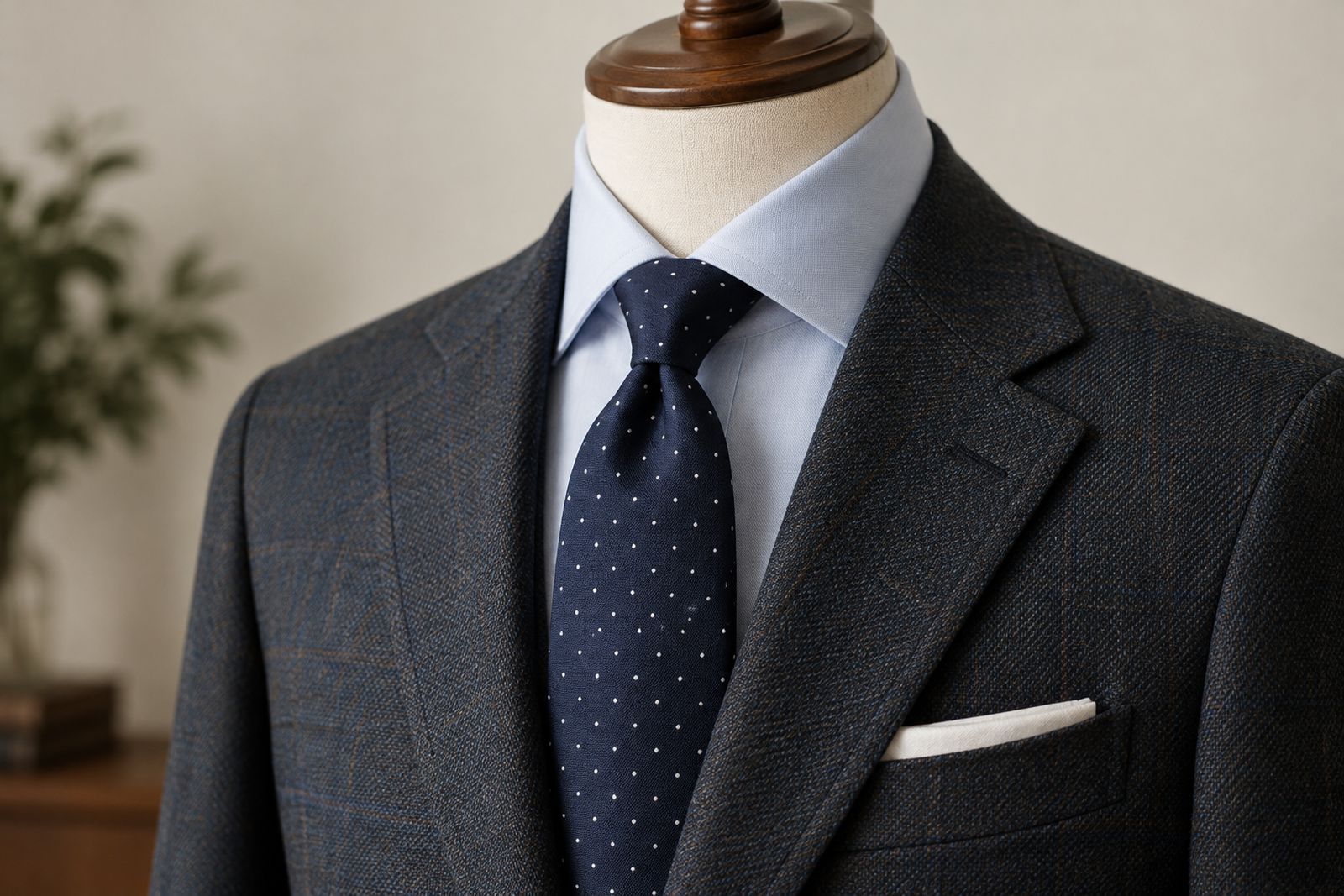
The short answer
To tie a half Windsor knot, start seam in, wide end on your right. Cross it over the narrow end, wrap it behind to the right, bring it up in front and down through the neck loop so it comes out on your left, cross it over the front to the right, bring it up through the neck loop from underneath, and tuck it down through the front band.
- Seven moves; the one that defines the knot is a single pass over and down through the neck loop, coming out on your left.
- A medium, near-symmetrical triangle: bigger than a four-in-hand, smaller than a full Windsor.
- Best with semi-spread and spread collars and light to medium silk ties.
- The safest all-round knot for interviews, offices and weddings.
- It uses more tie than a four-in-hand, so start the narrow end a few inches higher.
In this guide
- How to tie a half Windsor knot, step by step
- What a half Windsor should look like
- Half Windsor mistakes to avoid
- How to fix a crooked or loose half Windsor
- Which collar goes with a half Windsor?
- Half Windsor vs full Windsor
- Half Windsor vs four-in-hand
- Is a half Windsor professional?
- Which ties work best for a half Windsor?
- The tailor's view
- Questions people ask
The half Windsor knot is a neat, medium-sized triangle that sits squarely in a semi-spread or spread collar. It is fuller and more even than a four-in-hand and far less bulky than a full Windsor, which is why it suits so many business shirts. The steps are easy once you know the one move that defines it: the wide end passes over the neck loop once and comes out on the opposite side.
Half Windsor at a glance
- Size
- Medium
- Shape
- Near-symmetrical triangle
- Difficulty
- Moderate: seven moves
- Start
- Seam in, wide end on your right
- Best collars
- Semi-spread and spread; cutaway with a medium or heavier tie
- Best ties
- Light to medium-weight silk
- Tie length used
- More than a four-in-hand, less than a full Windsor
How to tie a half Windsor knot, step by step
These steps are written for someone facing a mirror. Left and right are your own left and right, which is also how they appear in the reflection. The neck loop is the loop around your neck above the crossing; the front band is the horizontal wrap you make in step 6. For the other knots and terms, see our hub on how to tie a tie.
Tie the half Windsor
- 1
Collar up, tie on
Fasten the top button and turn your collar up. Drape the tie around your neck with the seam against your shirt, wide end on your right, narrow end on your left.
- 2
Set the length
Let the wide end hang well below the narrow end, with the narrow end starting a few inches higher than you would use for a four-in-hand.
Tip: If you already know where the narrow end starts for your four-in-hand, raise it a few inches for a first try, then adjust from where the tip lands.
- 3
Cross over
Take the wide end across the front of the narrow end, from right to left.
- 4
Wrap behind
Pass the wide end behind the narrow end, back to the right. The back of the tie now faces out, which is correct at this stage.
- 5
Over and down through the neck loop
Bring the wide end up in front, over the top of the neck loop, and down through the loop behind the knot. Draw it out on your left and pull it snug.
Tip: This is the move people get wrong. The wide end goes in over the right side of the loop and comes out on your left. If it comes out on your right, you are tying a different variation; start again.
- 6
Across the front
Bring the wide end across the front of the knot, from left to right, with the right side of the tie facing out. This is the front band. Hook a finger under it.
- 7
Up through the neck loop
From the right, bring the wide end up behind the knot and through the neck loop from underneath, so the tip comes out at the top.
- 8
Down through the front band
Feed the wide end down through the front band and draw it through.
- 9
Dimple and tighten
Pinch a crease into the blade just below the knot. Hold the narrow end and slide the knot up to cover your collar button, pulling the wide end straight down.
- 10
Finish and check
Fold the collar down, tuck the narrow end into the keeper loop, and check that the tip touches the top of your belt buckle. If it misses, move the starting point by the same amount.
What a half Windsor should look like
A good half Windsor is a compact, near-symmetrical triangle, a little wider than it is tall. Because the wide end passes over the neck loop on one side only, it is not perfectly even, but the difference is slight once the knot is tight. It should fill the collar's V so that the collar points rest on the shirt either side of the knot, with no gap above it.
Half Windsor mistakes to avoid
- Starting with the narrow end too low. The half Windsor uses more tie than a four-in-hand, so the tip ends up short. Start the narrow end higher.
- A loose wrap in step 5. The pass over the neck loop sets the knot's width. Left loose, the knot sags and looks soft.
- A thick tie. Heavy wool, knitted and thickly lined ties turn a half Windsor into a lump. Use a four-in-hand with them.
- Pulling the wide end sideways. It drags the triangle off center. Pull straight down while you slide the knot up.
- Panicking at the seam. The back of the tie faces out during steps 4 and 5. It turns the right way round in step 6.
How to fix a crooked or loose half Windsor
| What you see | Why it happens | Fix |
|---|---|---|
| Triangle tilts to one side | Uneven tension, or the wide end pulled sideways | Loosen slightly, pull the wide end straight down and push the knot up with the narrow end centered |
| Knot looks long and narrow | Front band too loose | Retie and keep the front band snug around the knot before going up through the neck loop |
| Knot slides down by midday | Not pushed firmly against the narrow end | Hold the narrow end and slide the knot up until it meets the collar button |
| Gap between knot and collar | Knot not fully up, or collar too wide for the knot | Push the knot up; if the gap stays, use a full Windsor or a thicker tie |
| Collar points pushed apart | Knot too large for the collar or tie too thick | Switch to a four-in-hand or a thinner tie |
| Seam visible on the front | Front band laid inside out in step 6 | Retie, keeping the right side of the tie facing out as you cross the front |
Which collar goes with a half Windsor?
Semi-spread and spread collars suit the half Windsor best, because its width matches the gap between their points. It also works in a cutaway with a medium or heavier tie, and in a point collar with a thin tie. With a button-down, a four-in-hand usually looks better. Our guide to shirt collar types explains each style.
| Collar | Half Windsor? | Notes |
|---|---|---|
| Point | Sometimes | Only with a thin tie; otherwise the knot pushes the points apart |
| Button-down | Rarely | A casual collar that suits a smaller knot such as the four-in-hand |
| Semi-spread | Yes | The classic pairing |
| Spread | Yes | Fills the gap neatly |
| Cutaway | Yes, with care | Use a medium or heavier tie, or step up to a full Windsor |
Half Windsor vs full Windsor
The difference is one extra wrap. The half Windsor passes the wide end over the neck loop once; the full Windsor wraps each side of the loop, which makes it wider, more symmetrical and longer in the tie it uses. For most business shirts the half Windsor is the better choice. Keep the full Windsor for wide cutaway collars, thin ties and formal occasions; our Windsor knot guide shows how to tie it.
Half Windsor
Medium triangle
- Passes over the neck loop once
- Seven moves
- Uses a moderate length of tie
- Semi-spread, spread and some cutaway collars
- Light to medium ties
- The everyday business knot
Full Windsor
Large triangle
- Wraps both sides of the neck loop
- Nine moves
- Uses the most tie of any common knot
- Spread and cutaway collars only
- Thin to medium ties
- Formal events and wide collars
Half Windsor vs four-in-hand
The four-in-hand is smaller, quicker and leans to one side; the half Windsor is larger, more even and takes two more moves. Choose the four-in-hand for point and button-down collars and for thick ties, and the half Windsor for spread collars and thinner silk. If you wear both kinds of shirt, learn both knots. Our four-in-hand guide covers the smaller knot in detail.
Is a half Windsor professional?
Yes. The half Windsor is arguably the default business knot: neat, symmetrical enough to look deliberate, and in proportion with the semi-spread and spread collars found on many dress shirts. It is a strong choice for interviews, presentations, weddings and funerals. Pair it with a dark, quiet tie for the most formal settings, and see our guide to matching a tie to your shirt and suit for colors.
Which ties work best for a half Windsor?
Light to medium-weight silk ties of standard width, about 2¾ to 3½ inches (7 to 9 cm) at the widest point, make the best half Windsors. Thin, lightly lined silk gives a crisp, compact knot. Heavier woven silk and grenadine work if your collar is wide. Wool, cashmere and knitted ties are too bulky for it; tie them in a four-in-hand instead.
The tailor's view
Shirtmakers think about the knot when they cut a collar. A half Windsor wants a moderate tie space, the gap between the collar halves at the neckband, and points long enough to frame the knot without riding up over it. If you order a made-to-measure or bespoke shirt with a semi-spread or spread collar, tell the maker you tie a half Windsor; the collar can be cut so the knot fills it exactly. Also check the tie's length: our guide to tie length shows where the tip should land.
Practice the half Windsor five or six times in a row and step 5 becomes second nature. Once it does, you have the knot that suits most of your shirts; add the four-in-hand for narrow collars and you are covered.
Questions people ask
Half Windsor vs full Windsor: what is the difference?
The half Windsor passes the wide end over the neck loop once; the full Windsor wraps both sides of the loop. That extra wrap makes the full Windsor larger, more symmetrical and longer in the tie it uses. The half Windsor suits most spread collars; the full Windsor is for wide cutaway collars and thin ties.
Is a half Windsor professional?
Yes. It is one of the most professional knots you can tie, neat and near-symmetrical without looking showy. It suits interviews, offices, weddings and funerals, especially with a semi-spread or spread collar.
Which collar goes with a half Windsor?
Semi-spread and spread collars suit it best. It can work in a cutaway collar with a medium or heavier tie and in a point collar with a thin tie. With a button-down collar, a four-in-hand usually looks better.
Why does my half Windsor come out lopsided?
Usually because the wide end was pulled sideways while tightening, or the pass over the neck loop was left loose. Retie, keep that wrap snug, and pull the wide end straight down while you slide the knot up with the narrow end centered. A very slight imbalance is normal, because the wrap goes over one side only.
Why is my tie too short with a half Windsor?
The half Windsor uses more of the wide end than a four-in-hand, so the same starting point leaves the tip higher. Start with the wide end lower by however far the tip missed your belt. If the narrow end then becomes too short to reach the keeper loop, try a Pratt or buy an extra-long tie.
Should a half Windsor have a dimple?
A single centered dimple suits it well and gives the blade some shape below the knot. Pinch it in just before you slide the knot up. Very thin silk may not hold it, which is fine.
Is a half Windsor good for an interview?
Yes, particularly with a semi-spread or spread collar. It looks tidy and deliberate without drawing attention. If your interview shirt has a point or button-down collar, a four-in-hand is the better match.
TailorGuide is independent. Our guides are written and checked by our team and carry no paid endorsements. How we work.