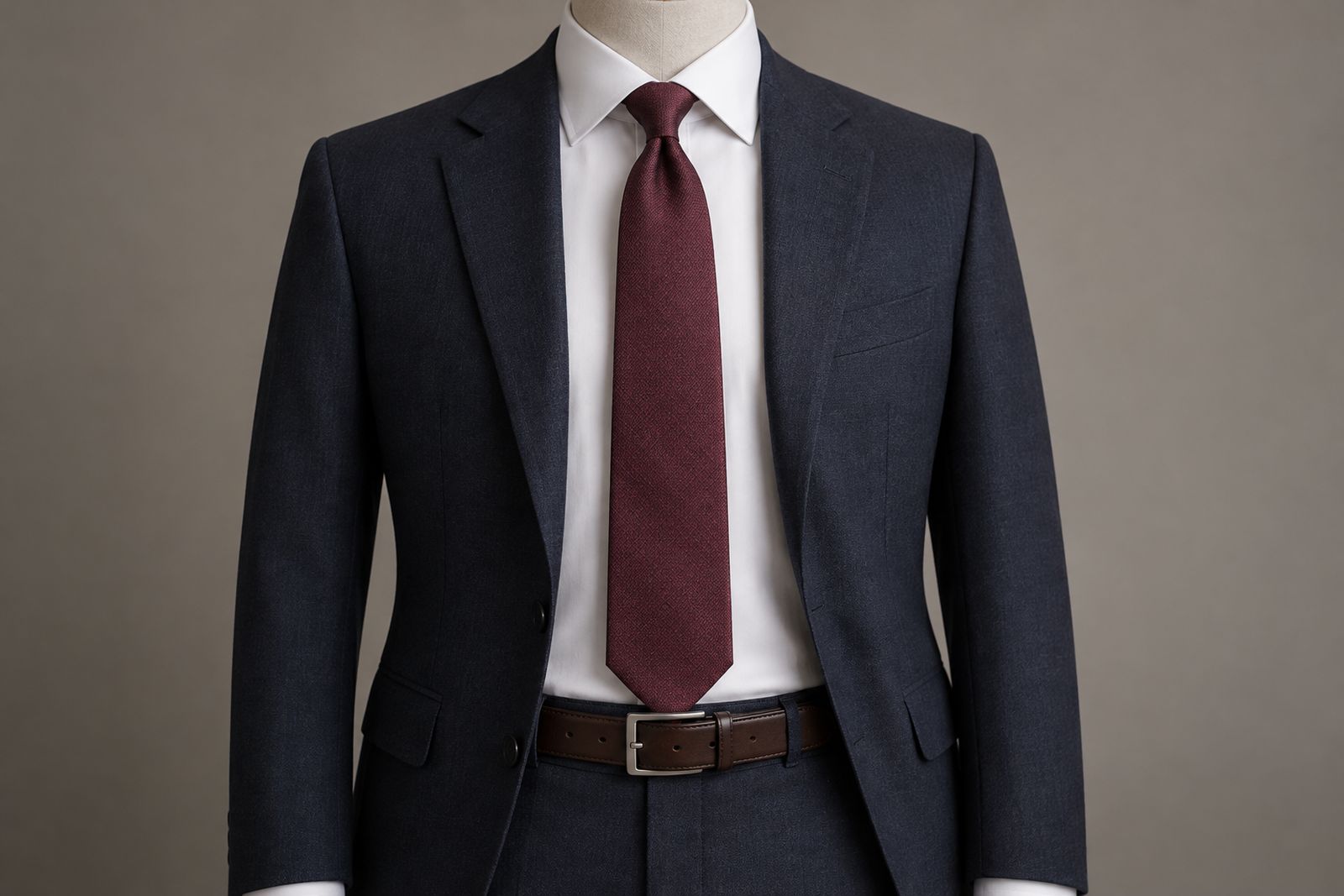
The short answer
A tie should be long enough for its tip to reach your waistband, touching the top of your belt buckle. Standard ties measure about 57 to 58 inches (145 to 148 cm) and suit most men with most knots. Men over about 6 ft 3 in (191 cm), with large necks, or who tie a full Windsor often need extra-long ties of 61 to 63 inches (155 to 160 cm).
- The tip should touch the top of your belt buckle; anywhere from the top of the waistband to the middle of the buckle is acceptable.
- Standard ties are about 57 to 58 inches (145 to 148 cm); extra-long ties about 61 to 63 inches (155 to 160 cm).
- Bigger knots use more tie: a full Windsor lands several inches higher than a four-in-hand from the same start.
- If the tip misses, move the starting point by exactly the distance it missed.
- The narrow end should finish shorter than the wide end and sit in the keeper loop.
In this guide
- Should your tie touch your belt?
- Standard and extra-long tie lengths
- Tie length by height and knot
- How your knot changes the length
- How long should a tie be for a tall man?
- Can a tie be too long?
- Trousers, waistcoats and braces
- What about the narrow end?
- How to find your tie length before you buy
- The tailor's view
- Questions people ask
How long should a tie be? Long enough that, once knotted, its tip reaches your waistband and touches the top of your belt buckle. A tie that stops above the waistband looks cropped and leaves a strip of shirt showing when your jacket is open. One that hangs below the belt looks careless. The rule never changes; what changes is how to hit it, because your height, neck, trousers and knot all move the tip.
Tie length at a glance
- Where the tip lands
- Touching the top of the belt buckle
- Acceptable range
- From the top of the waistband to the middle of the buckle
- Standard tie
- About 57 to 58 in (145 to 148 cm)
- Extra-long tie
- About 61 to 63 in (155 to 160 cm)
- Knot that uses most tie
- Full Windsor
- Knot that uses least tie
- Simple (oriental) knot, then the four-in-hand
Should your tie touch your belt?
Yes. The tip of the wide end should touch your belt, ideally resting at the top edge of the buckle. Anywhere from the top of the waistband to the middle of the buckle looks right. Above the waistband is too short; below the bottom edge of the belt is too long. Check standing up straight and side-on in a mirror, because looking down at the tie gives a distorted view of where the tip lands.
Standard and extra-long tie lengths
Most ready-made ties are about 57 to 58 inches (145 to 148 cm) long, measured flat from tip to tip. Extra-long ties, sometimes sold as XL or tall sizes, are about 61 to 63 inches (155 to 160 cm). A few makers also offer shorter lengths. Lengths vary by brand, so check the measurement rather than the label.
Scale from 52 in to 66 in, with cm below. Standard: 57 to 58 in. Extra-long: 61 to 63 in. Typical standard: at 57.5 in. Typical extra-long: at 62 in.
| Tie | Length | Usually suits |
|---|---|---|
| Standard | 57 to 58 in (145 to 148 cm) | Most men up to about 6 ft 2 in (188 cm), with most knots |
| Extra-long | 61 to 63 in (155 to 160 cm) | Tall men, necks of 17½ in (44.5 cm) or more, full Windsor wearers, low-rise trousers |
| Made to order | Any length | Very tall or very short men, or anyone between sizes |
Tie length by height and knot
Height is only a rough guide, because torso length, neck size and where your trousers sit matter more than overall height. Use this chart as a starting point, then check in the mirror.
| Your height | Tie to buy | Knots that land well |
|---|---|---|
| Under 5 ft 7 in (170 cm) | Standard; it may hang long | Half Windsor or full Windsor to take up spare length |
| 5 ft 7 in to 6 ft 1 in (170 to 185 cm) | Standard | Any knot |
| 6 ft 1 in to 6 ft 3 in (185 to 191 cm) | Standard for smaller knots; extra-long for Windsors | Four-in-hand, Kelvin, Pratt |
| Over 6 ft 3 in (191 cm) | Extra-long | Any knot with an extra-long tie |
Move up a row if your neck is 17½ in (44.5 cm) or more, your torso is long for your height, or you wear trousers low on the hips. Move down a row if you wear high-rise trousers at your natural waist.
How your knot changes the length
Every knot is made from the wide end, while the narrow end stays still. A bigger knot uses more of the wide end, so the tip finishes higher. Tie a full Windsor from the starting point you use for a four-in-hand and the tip can land several inches above your belt. This is why the same tie can be perfect with one knot and too short with another.
| Knot | Tie length used | Effect on where the tip lands |
|---|---|---|
| Simple (oriental) | Least | Longest finished tie; useful for tall men |
| Four-in-hand | Little | The tall man's everyday knot |
| Kelvin and Pratt | A little more | Medium knots that still suit tall men |
| Half Windsor | Noticeably more | Start the narrow end higher than for a four-in-hand |
| Full Windsor | The most | Start the narrow end high; tall men often need extra-long |
Our hub on how to tie a tie has the steps for every knot in the table, and our guide to which tie knot to wear explains which knot suits your collar.
How long should a tie be for a tall man?
The same rule applies: the tip touches the belt buckle. Tall men just need more tie to get there. If you are over about 6 ft 2 in (188 cm), first try a four-in-hand, which uses little length; if the tip still stops short, or the narrow end becomes too short to reach the keeper loop, buy extra-long ties of 61 to 63 inches (155 to 160 cm). Men over about 6 ft 3 in (191 cm), and anyone who wants to wear a half or full Windsor at that height, should buy extra-long as a matter of course.
Can a tie be too long?
Yes. A tie is too long when its tip hangs below your belt, or when you shorten the wide end to fix that and the narrow end ends up hanging below the blade. Shorter men meet this most often. The fixes, in order: tie a bigger knot, such as a half Windsor or full Windsor with a spread collar, which uses up length; start the narrow end higher; or have the tie shortened by a tie specialist. Tucking the spare narrow end into your shirt works in an emergency but leaves a lump.
Trousers, waistcoats and braces
The rule is about the waistband, not a fixed number of inches, so your trousers change how much tie you need. High-rise trousers worn at the natural waist bring the waistband up, so a tie needs less length; low-rise trousers on the hips need more. Our guide to how suit trousers should fit explains rise.
- Braces (suspenders). With no belt, the tip should reach the top of the waistband.
- Waistcoat (vest). The tip should still reach the waistband and stay hidden under the waistcoat. A tie that is too long can peek out below the waistcoat's points; see our guide to wearing a waistcoat.
- Double-breasted jacket. The jacket hides the tip when buttoned, but you will unbutton it, so the rule still applies.
- Belt worn low. If your belt sits below your natural waist, judge the length against the waistband, not the buckle.
What about the narrow end?
The narrow end should finish a few inches shorter than the wide end, hidden behind it and held by the keeper loop, the strip of fabric or label sewn across the back of the blade. If the narrow end is longer than the wide end, the tie is too long for that knot, or you started the narrow end too low. If it is too short to reach the keeper loop, it will swing free; a tie bar, worn between the third and fourth shirt buttons, holds both ends in place.
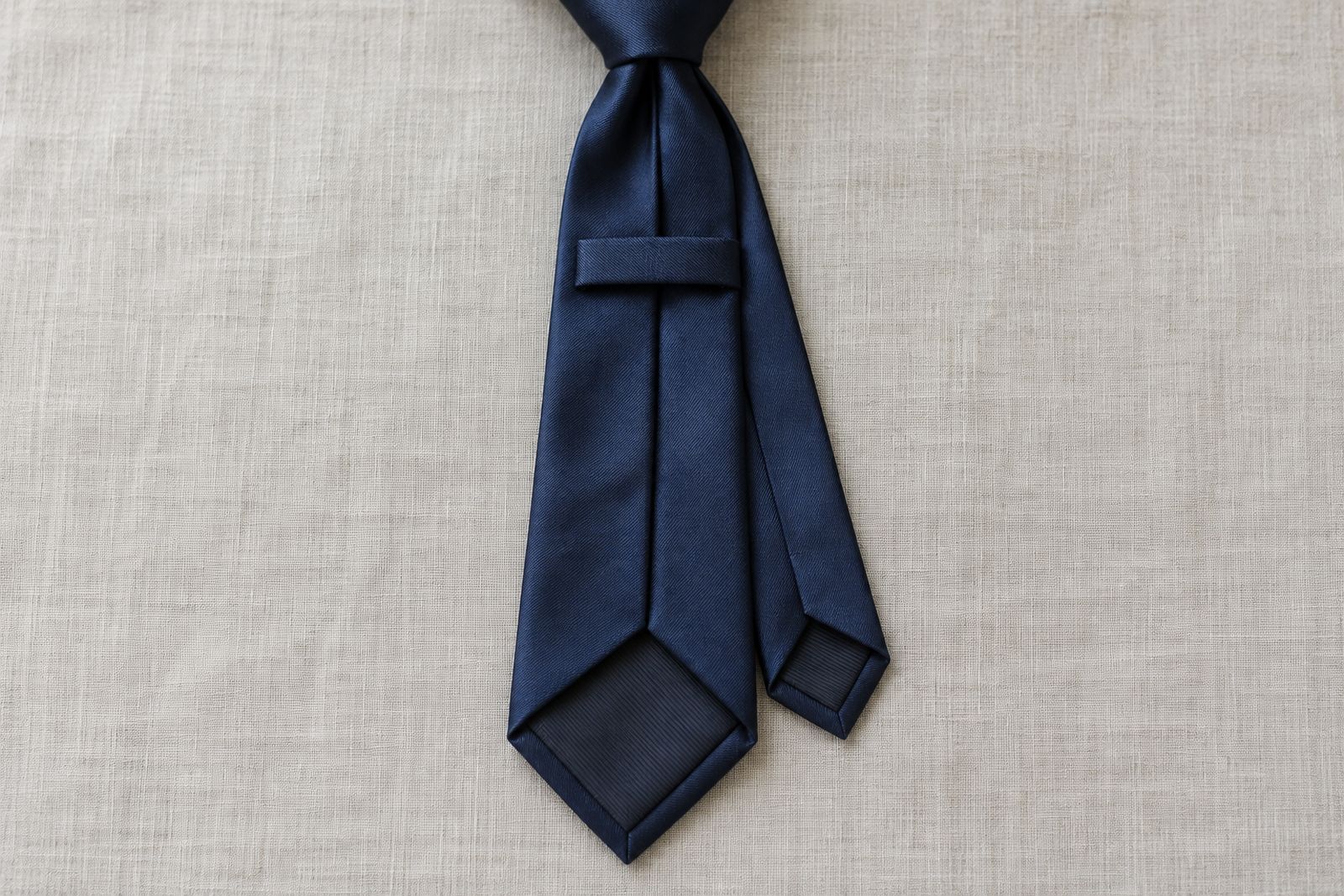
How to find your tie length before you buy
- 1
Use a tie that already works
Pick a tie that, tied in your usual knot, lands at the top of your belt buckle.
- 2
Measure it flat
Untie it and lay it flat on a table. Measure from the tip of the wide end to the tip of the narrow end, following the center of the tie.
- 3
Buy within an inch
Look for ties within about 1 inch (2.5 cm) of that length. Most product pages list the length; if one does not, ask.
- 4
Adjust for your knot
If you plan to tie a bigger knot than usual, such as a full Windsor instead of a four-in-hand, allow extra length or choose an extra-long size.
- 5
Give the number to a tie maker
For made-to-order ties, give the maker this measurement and the knot you tie. That is all they need to cut your length exactly.
The tailor's view
A tie can be shortened but, in practice, not lengthened. A tie specialist or skilled alterations tailor can shorten a tie by taking it apart, removing length and re-finishing it, leaving the blade's shape unchanged. Made-to-order ties can be cut to any length, which is the simplest answer for very tall or very short men. When a tailor fits a suit, the trouser rise also decides where your waistband sits, so if you change from low-rise to high-rise trousers, expect your ties to land differently.
Once the length is right, check the width: our guide to tie width shows how to match the blade to your lapels. Then choose colors with our guide to matching a tie to your shirt and suit.
Questions people ask
Should your tie touch your belt?
Yes. The tip should touch your belt, ideally at the top edge of the buckle. Anywhere from the top of the waistband to the middle of the buckle is acceptable; above the waistband is too short and below the belt is too long.
How long is a standard tie?
A standard tie is about 57 to 58 inches (145 to 148 cm) long, measured flat from tip to tip. Extra-long ties are about 61 to 63 inches (155 to 160 cm). Exact lengths vary by maker, so check the listed measurement.
How long should a tie be for a tall man?
Long enough to reach the belt buckle with the knot he wears. Men up to about 6 ft 3 in (191 cm) can often manage with a standard tie and a four-in-hand. Taller men, men with large necks and anyone tying a Windsor at that height usually need an extra-long tie of 61 to 63 inches (155 to 160 cm).
What length tie should I buy?
Measure a tie that already lands at your belt buckle with your usual knot and buy within about 1 inch (2.5 cm) of that length. If you have no tie to measure, buy standard if you are under about 6 ft 2 in (188 cm) with a neck under 17½ inches (44.5 cm), and extra-long if you are taller or larger in the neck.
Can a tie be too long?
Yes. A tie is too long when the tip hangs below the belt, or when correcting that leaves the narrow end hanging below the blade. Tie a bigger knot such as a half Windsor to use up length, or have the tie shortened by a tie specialist.
Why is my tie too short?
Either the wide end started too high, the knot is too big for the tie's length, or the tie is simply too short for you. Retie with the wide end lower by the amount the tip missed; if the narrow end then cannot reach the keeper loop, use a smaller knot or buy extra-long.
Should the narrow end of a tie be shorter than the wide end?
Yes. The narrow end should finish a few inches shorter than the wide end, hidden behind it and held by the keeper loop on the back of the blade. If it hangs below the wide end, retie with a bigger knot or start the narrow end higher.
TailorGuide is independent. Our guides are written and checked by our team and carry no paid endorsements. How we work.