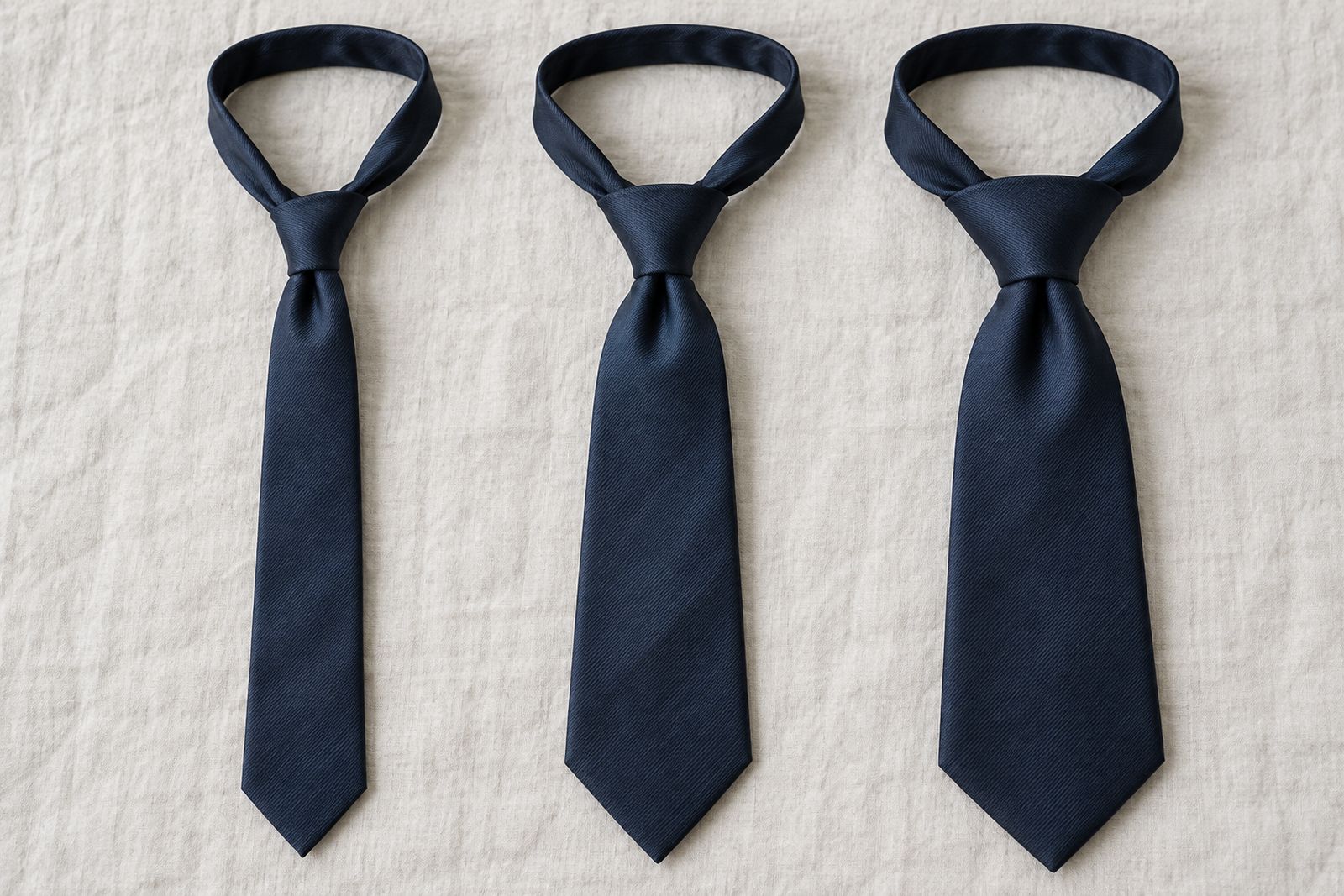
The short answer
Use the knot that fills your collar. For point and button-down collars, tie a four-in-hand. For semi-spread and spread collars, tie a half Windsor. For wide spread and cutaway collars with a thin tie, tie a full Windsor. Then adjust for the tie itself: thick ties need smaller knots, thin ties need bigger ones.
- The collar decides first: the knot should fill the gap between the collar points without forcing them apart.
- Point and button-down collars: four-in-hand. Spread collars: half Windsor. Cutaways: full Windsor or a thick half Windsor.
- Thick wool, knit and heavy silk ties: stay small. Thin silk: go bigger.
- Tall men should favor knots that use less tie, such as the four-in-hand and Pratt.
- For interviews, the half Windsor and four-in-hand are both correct; decorative knots are not.
In this guide
- Four-in-hand vs half Windsor vs Windsor: what actually differs
- Which tie knot goes with which collar?
- How tie thickness changes the knot
- Knot size, face and build
- Height and tie length
- Which tie knot is most professional?
- Half Windsor or four-in-hand for an interview?
- Which tie knots should you avoid?
- Where the Pratt, Kelvin and simple knot fit
- The tailor's view
- Questions people ask
Which tie knot to use depends on four things, in this order: the collar, the tie, your build and the occasion. Start with the occasion instead and you end up with a Windsor that forces the collar points apart, or a tiny four-in-hand lost in a cutaway. Get the collar right and the other three questions usually settle themselves.
| Your situation | Tie this | Avoid |
|---|---|---|
| Point collar, medium silk tie | Four-in-hand | Full Windsor |
| Button-down collar | Four-in-hand or simple knot | Half or full Windsor |
| Semi-spread collar, medium silk tie | Half Windsor or Pratt | Simple knot |
| Spread collar, medium silk tie | Half Windsor | Simple knot |
| Cutaway collar, thin silk tie | Full Windsor | Four-in-hand |
| Cutaway collar, heavy silk or grenadine | Half Windsor | Simple knot |
| Knitted, wool or cashmere tie | Four-in-hand or simple knot | Any Windsor |
| Thin, lightly lined silk with a point collar | Kelvin | Simple knot |
| Skinny tie under 2¼ in (6 cm) | Four-in-hand | Any Windsor |
| Tall man with a standard-length tie | Four-in-hand or Pratt | Full Windsor |
| Shorter man whose ties hang too long | Half Windsor or full Windsor, with a spread collar | Simple knot |
| Job interview | Four-in-hand (point collar) or half Windsor (spread collar) | Decorative knots |
| Wedding or formal event | Half Windsor or full Windsor | Simple knot |
| Funeral | Four-in-hand or half Windsor in a dark tie | Decorative knots |
If two rows disagree, the collar row wins: a knot that fits the collar can always be adjusted with a thicker or thinner tie.
Four-in-hand vs half Windsor vs Windsor: what actually differs
The three knots are built the same way and finish the same way. The difference is how many times the wide end wraps the neck loop before the final tuck: never for the four-in-hand, once for the half Windsor, once on each side for the full Windsor. Each wrap adds width, symmetry and tie length used.
Four-in-hand
Small, asymmetric
- Five moves; only the simple knot is quicker
- Uses little tie
- Point, button-down and semi-spread collars
- Best with medium to thick ties
- Reads relaxed but correct
Half Windsor
Medium, near-symmetrical
- Seven moves
- Uses moderate length
- Semi-spread, spread and some cutaway collars
- Best with light to medium silk
- Reads neat and businesslike
Full Windsor
Large, symmetrical
- Nine moves
- Uses the most tie
- Spread and cutaway collars only
- Best with thin to medium silk
- Reads formal and deliberate
Which tie knot goes with which collar?
Match the knot to the space between your collar points. A point collar leaves a narrow V and wants a small knot; a spread collar leaves a wider gap that a half Windsor fills; a cutaway leaves so much room that only a broad knot or a thick tie looks right. The test is simple: once the knot is tight, the collar points should lie flat on the shirt, with no gap above the knot and no points lifting over it.
If you are not sure what your shirts have, our guide to shirt collar types shows each style, and the matrix below sets every common situation against the four knots most men use.
| Four-in-hand | Pratt | Half Windsor | Full Windsor | |
|---|---|---|---|---|
| Point collar | ||||
| Button-down collar | ||||
| Semi-spread collar | ||||
| Spread collar | ||||
| Cutaway collar | ||||
| Wool, knit or thick tie | ||||
| Thin silk tie | ||||
| Skinny tie | ||||
| Tall, standard-length tie | ||||
| Job interview | ||||
| Formal event |
How tie thickness changes the knot
The same knot in two different ties can differ in size more than two different knots in the same tie. A thick tie, whether heavy silk, wool, cashmere or knit, makes a big knot from few wraps, so it wants a four-in-hand or simple knot. A thin, lightly lined silk tie makes a small knot, so a half Windsor or Kelvin gives it the presence it lacks. When a knot looks wrong, change the tie before you change the knot.
| Tie | Knot size it produces | Best knots |
|---|---|---|
| Thin, lightly lined silk | Small | Half Windsor, full Windsor (wide collar), Kelvin (narrow collar) |
| Medium silk, standard lining | Medium | Four-in-hand, Pratt, half Windsor |
| Heavy woven silk or grenadine | Large | Four-in-hand, half Windsor in a wide collar |
| Wool, cashmere or knit | Very large | Four-in-hand, simple knot |
| Skinny tie, any fabric | Small, narrow | Four-in-hand |
Knot size, face and build
Keep the knot in proportion with the man wearing it. A broad face, thick neck or large frame can carry a half Windsor or full Windsor, and a four-in-hand in a thin tie can look undersized on him. A narrow face and slim neck suit a four-in-hand, Kelvin or Pratt; a full Windsor can look heavy under a narrow chin. This is about proportion, not rules, and the collar still comes first: a broad man in a point collar is better served by a four-in-hand in a thicker tie than by a Windsor that splays the collar.
Height and tie length
Height changes the choice through length rather than looks. The bigger the knot, the more of the wide end it uses, so a tall man in a full Windsor often finds the tip stops well above his belt. Tall men and men with long torsos should favor the four-in-hand or Pratt, or buy extra-long ties. Shorter men have the opposite problem, and a half Windsor or full Windsor usefully takes up spare length. Our guide to tie length has the numbers.
Which tie knot is most professional?
The half Windsor and the four-in-hand are equally professional; the right one is whichever fits your collar. If one knot has to cover most business shirts, choose the half Windsor, because it suits the semi-spread and spread collars found on so many of them. The full Windsor is professional too, but it reads as more formal, and in the wrong collar it looks forced. What looks unprofessional is never the knot itself: it is a loose knot below an open collar button, a crooked triangle or a tip hanging past the belt.
Half Windsor or four-in-hand for an interview?
Look at the interview shirt's collar. With a point or button-down collar, tie a four-in-hand; with a semi-spread or spread collar, tie a half Windsor. Both say the same thing: that you know how to dress and did not think about it too long. Choose a quiet tie in a solid color or small pattern, tie it snug, and check the length before you leave. Our interview suit guide covers the rest of the outfit.
Which tie knots should you avoid?
- Decorative knots such as the Eldredge and Trinity. Braided and three-lobed knots tied with the narrow end belong at parties, not interviews, funerals or meetings.
- A full Windsor in a point or button-down collar. The knot is wider than the gap, so it pushes the points up and out.
- Any Windsor in a wool, cashmere or knitted tie. The result is a lump under the chin.
- A simple knot or thin four-in-hand in a cutaway. The knot looks lost, with bare collar showing on either side.
- The deliberately long narrow end. Letting the narrow end hang below the blade is a fashion affectation; in an office it looks like a mistake.
- A loose knot with the collar button open. It reads as end-of-day or careless at any hour.
Where the Pratt, Kelvin and simple knot fit
These three fill the gaps between the main knots. The Pratt, also called the Shelby, is a neat, fairly symmetrical medium knot that sits between the four-in-hand and the half Windsor; it is ideal for tall men who want a fuller knot than a four-in-hand without the length a half Windsor uses. The Kelvin is a four-in-hand with an extra turn, useful when a thin tie makes a four-in-hand look meager. The simple knot is smaller still and suits thick ties and tall men whose ties land short. All three start with the tie inside out; our hub on how to tie a tie has the steps for each.
The tailor's view
When a knot never looks right, a tailor or shirtmaker will usually look at the collar before the knot. A collar that is too tight squeezes the knot and puckers around it; one that is too loose lets the knot sink and opens a gap above it. If your collars fit, and our guide to how a dress shirt should fit explains how to check, the knot choice becomes simple.
Buying made-to-measure shirts lets you choose the collar around your knot rather than the other way round. Tell the maker which knot you tie and how thick your ties are, and the spread and the tie space, the gap between the collar halves at the neckband, can be cut to suit.
Pick your knot from the collar, adjust for the tie, and you will rarely need more than two knots. Learn them properly with our step-by-step guides to the four-in-hand and the half Windsor, then add the full Windsor if you own cutaway collars.
Questions people ask
Which tie knot is most professional?
The four-in-hand and the half Windsor are equally professional; choose by collar. A four-in-hand suits point and button-down collars, a half Windsor suits semi-spread and spread collars. If you want one knot for most business shirts, choose the half Windsor.
Half Windsor or four-in-hand for an interview?
Let the shirt collar decide: four-in-hand for a point or button-down collar, half Windsor for a semi-spread or spread collar. Both are entirely appropriate. Tie it snug, keep the tie quiet and check that the tip reaches your belt.
What tie knot goes with a spread collar?
A half Windsor is the natural match for a spread collar. A Pratt also works, and a full Windsor suits a wide spread with a thin tie. A four-in-hand works only with a thick tie that fills the gap.
Which tie knots should you avoid?
Avoid decorative knots such as the Eldredge and Trinity at work, a full Windsor in a point or button-down collar, and any Windsor in a thick wool or knit tie. Avoid a tiny knot in a cutaway collar too. Above all, avoid a loose knot with the collar button showing.
Does knot choice depend on face shape?
Somewhat. Broad faces and thick necks can carry larger knots like the half or full Windsor, while narrow faces and slim necks suit a four-in-hand or Pratt. The collar matters more than the face, though, so start there.
What is the best tie knot for a tall man?
The four-in-hand or the Pratt, because both use relatively little tie. A full Windsor often leaves a tall man's tie short of his belt. If even a four-in-hand lands high, buy extra-long ties.
Is the Windsor knot too formal for everyday wear?
It can look heavy for an ordinary office day, especially with a semi-spread collar. Keep the full Windsor for cutaway collars and formal occasions, and wear a half Windsor or four-in-hand the rest of the time.
TailorGuide is independent. Our guides are written and checked by our team and carry no paid endorsements. How we work.