The short answer
To measure your shirt size, wrap a tape around the base of your neck where the collar sits and add about ½ inch (1.3 cm), or measure a well-fitting collar from the button to the far end of the buttonhole. For the sleeve, measure from the center back of your neck, over the shoulder, to the wrist bone. A 15½ 34 shirt has a 15½-inch neck and a 34-inch sleeve.
- Neck: measure snugly at the base of the neck, then add about ½ inch (1.3 cm).
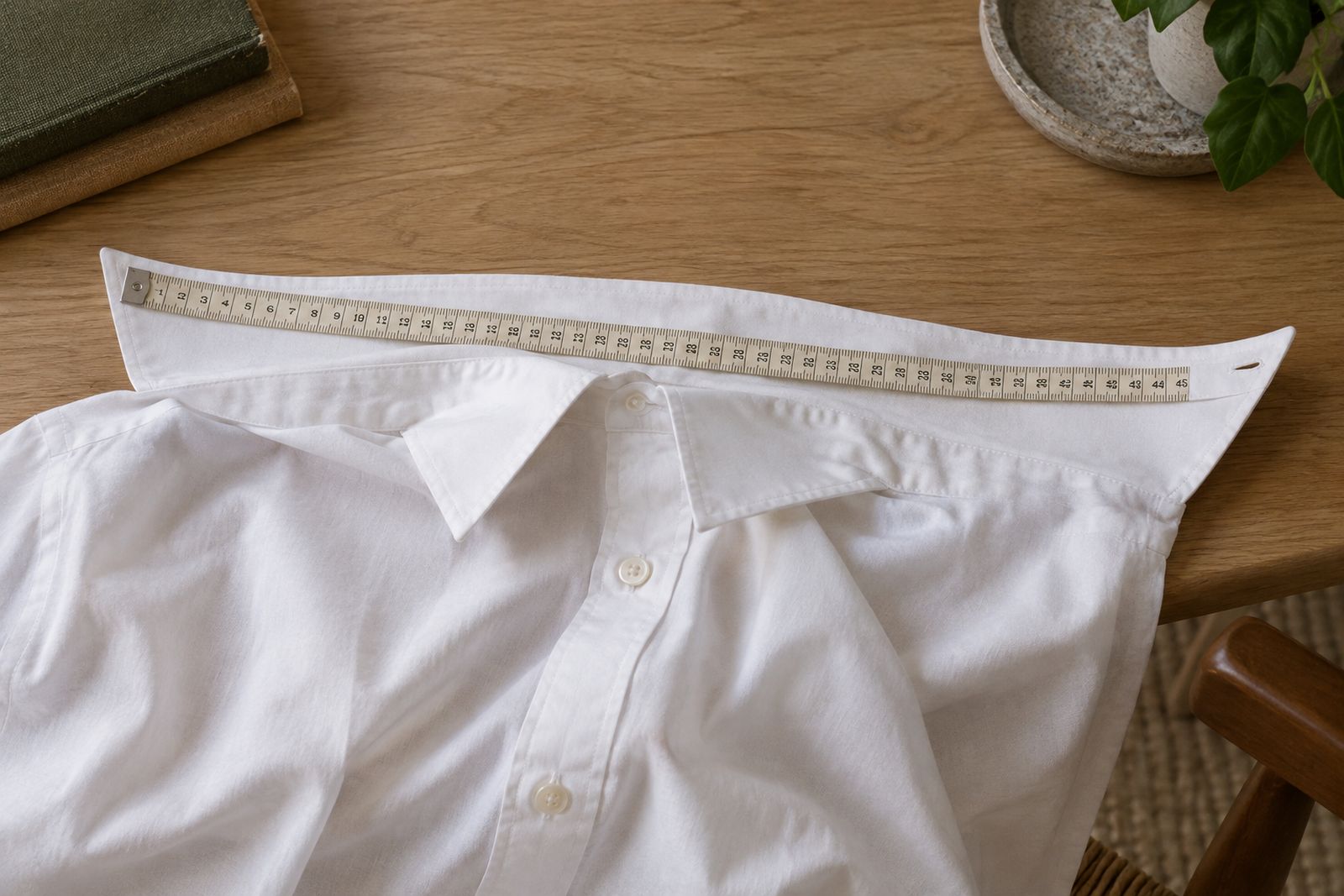
- Or measure a good shirt's collar band laid flat, from the center of the button to the far end of the buttonhole.
- Sleeve (US sizing): from the center back of the neck, over the shoulder, to the wrist bone.
- 15½ 34/35 means a 15½-inch (39 cm) neck and a sleeve of 34 to 35 inches (86 to 89 cm).
- European collar sizes are the neck in centimeters: a 39 is about 15½ inches.
- A fastened collar should let two fingers slide in flat.
In this guide
- How do you measure your neck for a dress shirt?
- How is dress shirt sleeve length measured?
- What does 15½ 34/35 mean on a dress shirt?
- Dress shirt size chart: inches and centimeters
- Chest and wrist: measurements for made-to-measure shirts
- Should you size up for shrinkage?
- How to check the fit when the shirt arrives
- Common shirt measuring mistakes
- The shirtmaker's view
- Questions people ask
Knowing how to measure shirt size properly saves you from collars that choke and sleeves that vanish inside your jacket. A dress shirt is sized by two numbers: the neck (collar) size and the sleeve length. You can take both from your body or from a shirt that already fits. Below are the exact steps for each, a decoder for size labels, and a chart in inches and centimeters.
Before you start
- You need
- A soft tailor's tape measure, a mirror and a helper for the sleeve
- Wear
- A thin T-shirt or nothing on top; never measure over a collar
- Time
- About 10 minutes
- Record
- Inches and centimeters, to the nearest ¼ inch (6 mm)
- Backup method
- Measure a shirt that already fits well
How do you measure your neck for a dress shirt?
Measure around the base of your neck where the shirt collar sits, keeping the tape snug and level, then add about ½ inch (1.3 cm) for comfort. Round the result to the nearest half inch, the way neck sizes are sold. If you measure 15 inches (38 cm), your collar size is 15½.
Measuring your neck
- 1
Stand naturally
Stand straight with your head level and your eyes forward. Looking down or tilting your head changes the measurement.
- 2
Place the tape at the base of the neck
Wrap the tape around your neck where a collar sits: just below the Adam's apple at the front and across the base of the neck at the back. Use the mirror to keep it level all the way round.
Tip: Measuring higher up the neck gives a smaller number and a collar that will feel tight.
- 3
Keep it snug, not tight
The tape should lie flat against the skin without pressing in. Do not slip a finger underneath; the comfort allowance comes in the next step.
- 4
Add about ½ inch (1.3 cm)
Read the tape where it overlaps and add about ½ inch (1.3 cm). This is the room you need to breathe, swallow and turn your head with the top button fastened.
Tip: Do not add both a finger under the tape and the extra ½ inch, or the collar will be a size too big.
- 5
Round to the nearest half inch
Neck sizes run in half inches (14½, 15, 15½ and so on). If you land between two sizes, choose the larger: a collar cannot be let out.
Method 2: measure a shirt that fits
If you own a shirt whose collar feels right when fastened, it gives a more reliable number than your neck, because it already includes the comfort allowance.
Measuring a shirt collar
- 1
Unbutton and lay flat
Unbutton the collar and lay the collar band flat on a table, opened out, with no creases.
- 2
Measure button to buttonhole
Measure along the band from the center of the collar button to the far end of the buttonhole, the end where the button sits when the collar is fastened.
- 3
Use that number as your size
That measurement is your collar size. Do not add anything to it.
How is dress shirt sleeve length measured?
In US sizing, sleeve length is measured from the center back of the neck, across the top of the shoulder and down the outside of the arm to the wrist bone. It is a single long measurement, usually between 32 and 37 inches (81 and 94 cm), which is why a man with a short arm and broad shoulders can wear the same sleeve number as a man with a long arm and narrow shoulders.
Measuring your sleeve length
- 1
Stand relaxed
Stand straight with your arm hanging naturally and a slight bend at the elbow, as it would be when you are wearing the shirt and moving.
- 2
Start at the center back of the neck
Ask your helper to hold the end of the tape at the center back of your neck, on the prominent bone at its base where a collar seam would sit.
- 3
Run over the shoulder
Take the tape across the top of the shoulder to the shoulder point, the outer edge of the shoulder bone, keeping it flat.
- 4
Run down the arm to the wrist bone
Continue down the outside of the arm, over the elbow, to the wrist bone, the knob on the outside of the wrist.
Tip: Stopping above the wrist bone gives a sleeve that will retreat inside your jacket cuff when you reach forward.
- 5
Read and round
Read the measurement and round to the nearest whole inch. If you fall between two sizes, choose the longer, since a sleeve can be shortened but not lengthened.
Measuring your own sleeve length alone is unreliable, because reaching for the tape changes the arm's position. Without a helper, measure a shirt instead: lay it flat, and measure from the center back of the collar, along the shoulder seam and down the sleeve to the end of the cuff.
What does 15½ 34/35 mean on a dress shirt?
On a dress shirt, 15½ 34/35 means a 15½-inch (39 cm) neck and a sleeve that fits arms measuring 34 to 35 inches (86 to 89 cm). The first number is always the neck; the second is the sleeve. A combined sleeve size like 34/35 is a compromise that lets a brand stock fewer sizes, so it fits less precisely than a single number such as 34 or 35.
| Label | Neck | Sleeve | What it tells you |
|---|---|---|---|
| 15½ 34 | 15½ in (39 cm) | 34 in (86 cm) | A precise US size: neck and a single sleeve length |
| 15½ 34/35 | 15½ in (39 cm) | 34 to 35 in (86 to 89 cm) | A combined sleeve that suits either length less exactly |
| 16 / 41 | 16 in (41 cm) | Standard or not stated | Neck in inches and centimeters; sleeve set by the brand |
| 39 | About 15½ in | Usually one standard length | A European collar size in centimeters |
| M (15 to 15½) | 15 to 15½ in (38 to 39 cm) | Usually one length | A letter size covering two neck sizes; least precise |
Fit names such as slim, tailored and classic describe the body of the shirt, not the neck or sleeve, and every brand cuts them differently. Check the brand's chest and waist measurements if you are between fits. Our guide to how a dress shirt should fit explains what each area should do.
Dress shirt size chart: inches and centimeters
European collar sizes are simply the neck measurement in centimeters, rounded to a whole number. Brands round slightly differently, so treat the table as a guide and check the maker's own chart.
| US neck (in) | Exact (cm) | Usual European size | Usual letter size |
|---|---|---|---|
| 14 | 35.6 | 36 | S |
| 14½ | 36.8 | 37 | S |
| 15 | 38.1 | 38 | M |
| 15½ | 39.4 | 39 | M |
| 15¾ | 40.0 | 40 | M or L, by brand |
| 16 | 40.6 | 41 | L |
| 16½ | 41.9 | 42 | L |
| 17 | 43.2 | 43 | XL |
| 17½ | 44.5 | 44 | XL |
| 18 | 45.7 | 45 or 46 | XXL |
| US sleeve (in) | Centimeters |
|---|---|
| 32 | 81 |
| 33 | 84 |
| 34 | 86 |
| 35 | 89 |
| 36 | 91 |
| 37 | 94 |
Many European ready-to-wear shirts come in one standard sleeve length, sometimes with an extra-long option, rather than in numbered sleeve sizes.
Chest and wrist: measurements for made-to-measure shirts
If you are ordering made-to-measure or from a brand that sizes by chest, take two more measurements. For the chest, wrap the tape around the fullest part of the chest, under the arms and across the shoulder blades, keeping it level and breathing normally. Give the body measurement only; the shirtmaker adds the ease for the fit you choose.
For the wrist, measure around the wrist bone. A shirtmaker uses it to size the cuff, adding room so the cuff can slide over the hand without being unbuttoned in a barrel cuff, or sit neatly with cufflinks in a French cuff. Tell them which wrist you wear a watch on: they will usually make that cuff slightly larger so it closes over the watch.
Should you size up for shrinkage?
Do not size up a full neck size for shrinkage. Most cotton dress shirts shrink a little in the first few washes, mostly in the collar and sleeve length, and reputable makers either pre-shrink their fabric or cut in a small allowance. Buy your measured size, wash at a moderate temperature and avoid hot tumble drying, which causes most shrinkage. If you are between two neck sizes, choose the larger.
How to check the fit when the shirt arrives
Try the shirt on with the top button fastened and, if you will wear one, a tie. Then check it with your jacket on, because the sleeve length is judged against the jacket cuff.
Shirt fit checks
- Two fingers slide in flat between the fastened collar and your neck.
- The collar does not gape at the back or ride up under a tie knot.
- The shoulder seam sits at the edge of your shoulder bone.
- With your arms at your sides, the cuff ends just past the wrist bone, around the base of your thumb.
- With a jacket on, about ¼ to ½ inch (6 to 13 mm) of cuff shows.
- When you reach forward, the cuff stays at your wrist rather than sliding up your forearm.
- At the back of the neck, the collar shows about ¼ to ½ inch (6 to 13 mm) above the jacket collar.
For how much cuff should show beyond the jacket, see our guide to suit sleeve length.
Common shirt measuring mistakes
- Measuring over a shirt collar, which adds bulk and gives a size too large.
- Tilting the tape higher at the front than the back, or the reverse.
- Adding a finger and ½ inch, which doubles the comfort allowance.
- Measuring your own sleeve without help, which usually gives a short result.
- Stopping the sleeve above the wrist bone, so the cuff retreats when you move.
- Choosing a letter size when your neck falls at the edge of its range.
The shirtmaker's view
A shirtmaker measures more than neck and sleeve, but those two numbers still decide whether a shirt can be worn with a tie. A good maker will take the neck at the base, check it against the collar of a shirt you like, and ask how you like a collar to feel: some men want it close, others want room to breathe. They will also look at your shoulders, because a sloping or square shoulder changes how the sleeve hangs. If you are ordering abroad or online, send both the body measurements and those of a favorite shirt laid flat. For how London's shirtmakers work, see our guide to Jermyn Street shirtmakers.
Once you know your size, choose the collar style that suits your face and tie knot in our guide to shirt collar types. If you are measuring for a whole suit, our guide to measuring yourself for a suit covers the rest.
Questions people ask
What does 15½ 34/35 mean on a dress shirt?
It means a 15½-inch (39 cm) neck and a sleeve that fits arms of 34 to 35 inches (86 to 89 cm). The first number is the neck size and the second is the sleeve length. Combined sleeve sizes fit less precisely than a single number such as 34 or 35.
How do I measure my neck for a dress shirt?
Wrap a soft tape measure around the base of your neck, just below the Adam's apple, keeping it snug and level. Add about ½ inch (1.3 cm) for comfort and round to the nearest half inch. Alternatively, measure a well-fitting shirt's collar from the button to the far end of the buttonhole.
How is dress shirt sleeve length measured?
In US sizing, sleeve length is measured from the center back of the neck, across the shoulder and down the outside of the arm to the wrist bone. Ask a helper to measure, with your arm slightly bent. Some brands measure from the shoulder seam instead, so check the size chart.
Should I size up for shrinkage?
No, do not size up a full size. Most cotton shirts shrink slightly in the first washes, and reputable makers pre-shrink the fabric or allow for it. Buy your measured size, avoid hot tumble drying, and choose the larger size only if you fall between two.
What if I am between two neck sizes?
Choose the larger neck size. A collar cannot be let out, and a tight collar is uncomfortable and pulls under a tie, while a collar that is a little loose is hidden by the knot. The difference between neighboring sizes is only ½ inch (1.3 cm).
What does a size 41 shirt mean?
A size 41 shirt has a 41 cm collar, the European equivalent of a 16-inch neck. European shirt sizes are the neck measurement in centimeters, rounded to a whole number. The sleeve length is usually standard unless a separate sleeve size is given.
How tight should a dress shirt collar be?
A dress shirt collar should let you slide two fingers in flat with the top button fastened. Any tighter and it will feel restrictive and wrinkle under a tie; much looser and it will sag beneath the knot. If you need to loosen your collar to breathe, it is a size too small.
TailorGuide is independent. Our guides are written and checked by our team and carry no paid endorsements. How we work.