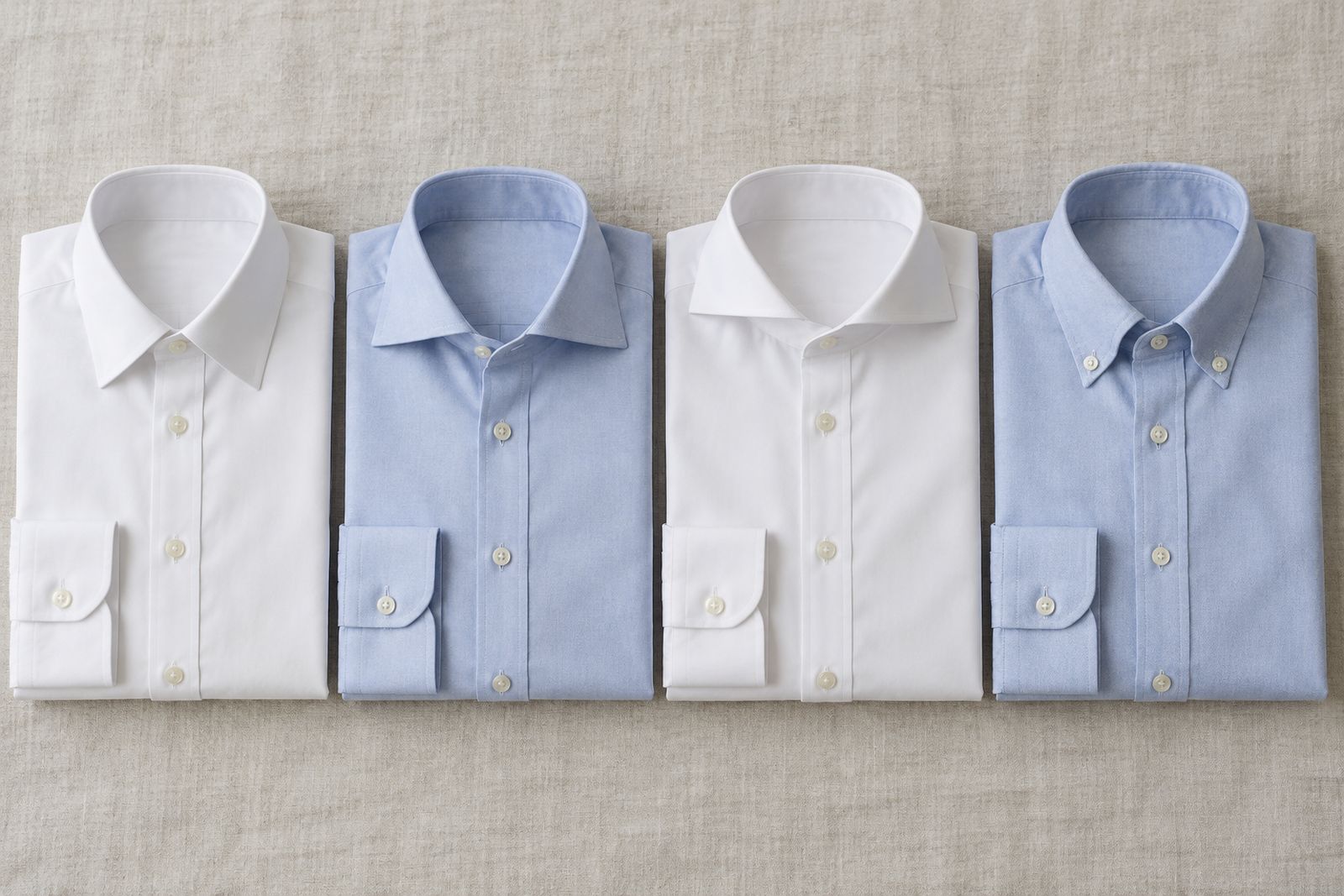
The short answer
The main shirt collar types are point, spread, cutaway, button-down, club and wing, plus tab, pin and band collars. A spread collar is the most versatile with a suit, with or without a tie. A point collar suits round faces and slim knots, a cutaway needs a fuller knot, a button-down is casual by origin, and a wing collar is for white tie.
- Spread or semi-spread: the most versatile collar with a suit, tie or no tie.
- Match the knot to the gap: four-in-hand for point, half Windsor for spread, fuller knots for cutaway.
- Point collars lengthen a round face; spread and cutaway collars balance a long, narrow one.
- Button-downs are casual by origin but fine with soft-shouldered or casual suits.
- Wing collars belong with white tie and some black tie; a turndown collar is now the black tie norm.
- At the back of the neck, show about ¼ to ½ inch (6 to 13 mm) of shirt collar above the jacket collar.
In this guide
- What are the main shirt collar types?
- Point, spread and cutaway collars
- Button-down, club and wing collars
- Tab, pin and band collars
- Which collar is best with a tie?
- Spread vs point collar: which should you choose?
- Which collar suits your face and build?
- Which collar should you wear for each occasion?
- Collar details that matter: stays, interlining and height
- How to keep a collar crisp
- Common collar mistakes
- The shirtmaker's view: what to ask for
- Questions people ask
Shirt collar types differ in two main ways: how far apart the points sit, called the spread, and how the points are held in place. Those two things decide which tie knot fills the gap, how the collar frames your face, and whether the shirt belongs with a business suit, a sport coat or a dinner suit. Here is every common collar, what it is for and how to choose.
Collar spread
The collar spread is the distance between the two collar points, together with the angle at which they leave the neckband. A narrow spread points down toward the chest; a wide spread points out toward the shoulders.
Collar stay
A collar stay is a thin strip of plastic, metal or horn slipped into a pocket on the underside of each collar point to keep it straight and flat. Button-down collars do not use them.
What are the main shirt collar types?
There are six collars you will meet on dress shirts, from the narrow point to the formal wing, plus three specialist styles. The table summarizes them; the sections below explain each one.
| Collar | Spread | Formality | Best knot | Best for |
|---|---|---|---|---|
| Point | Narrow | Business | Four-in-hand | Round faces, slim ties, traditional business dress |
| Semi-spread | Moderate | Business | Four-in-hand or half Windsor | Almost everyone and almost every occasion |
| Spread | Wide | Business to formal | Half Windsor or four-in-hand in a thicker tie | Business, weddings, wearing open |
| Cutaway | Very wide | Business to formal | Half Windsor, Windsor, or a thick four-in-hand | Long faces, wide lapels, strong looks |
| Button-down | Narrow to moderate | Casual to smart casual | Four-in-hand | Sport coats, soft-shouldered or casual suits |
| Club | Narrow, rounded points | Smart, vintage | Small four-in-hand | Period looks, slim ties |
| Wing | Standing band, small folded-out tips | Formal evening | Bow tie only | White tie and some black tie |
| Tab and pin | Narrow | Dressy, vintage | Small four-in-hand | Lifting and framing a small knot |
| Band | No collar points | Casual | No tie | Summer and casual wear |
Point, spread and cutaway collars
These three collars are the core of a dress shirt wardrobe. They differ only in how far apart the points sit, which is why one shirtmaker's semi-spread can look like another's spread. Judge the collar by the gap it leaves for the knot, not by its name.
Point collar
A point collar has a narrow spread, with points that run down toward the chest and leave a small gap for the tie. It is the traditional American business collar. The vertical lines lengthen the face, so it suits round and wide faces, and it pairs best with a slim four-in-hand knot. Very long points look dated; moderate points look classic.
Spread and semi-spread collars
A spread collar has points angled outward, toward the shoulders, leaving a wider gap for the knot. A semi-spread sits between point and spread and is the most versatile collar there is: it suits most faces, takes a four-in-hand or a half Windsor, and looks right under almost any lapel. A good spread with stays also stands up neatly when worn without a tie, which makes it the best collar for an open-necked shirt under a suit.
Cutaway collar
A cutaway collar is an extreme spread collar whose points are cut back so sharply that they run nearly horizontally toward the shoulders. It is a confident, European look. The wide gap needs a fuller knot, such as a half Windsor or a Windsor, or a four-in-hand in a thick tie; a skinny knot looks lost in it. Cutaways balance long, narrow faces and widen round ones. Worn without a tie, a cutaway tends to splay and collapse.
Button-down, club and wing collars
These three collars each carry a clear association, casual, vintage or formal evening, so they are the ones most often worn in the wrong place.
Button-down collar
A button-down collar has small buttons that fasten the collar points to the shirt front. The style is commonly traced to polo players, who wanted collars that would not flap, and it became a staple of American Ivy League dress. Because of that sporting origin it is casual by nature, most often made in a soft oxford cotton with a soft, often unlined collar that rolls rather than lying flat.
A button-down is acceptable with a soft-shouldered or casual suit, a sport coat, tweed or a cotton suit, and it looks excellent with a knitted or wool tie. It is less suited to a sharp worsted business suit in a conservative office and never belongs with black tie. Always fasten the buttons; unfastened button-down points look careless.
Club collar
A club collar has rounded rather than pointed tips. It reads as vintage and slightly playful, suits slim ties and small knots, and is often worn with a collar pin or bar. It is a distinctive choice for social occasions and relaxed offices rather than a first business shirt.
Wing collar
A wing collar is a short standing band with small tips folded out horizontally, like wings, under which a bow tie sits. It is formal evening wear: the stiff wing collar is correct with white tie, and some men wear a softer wing collar with black tie. Today a turndown collar is the norm for black tie, and the wing collar is never worn with a long tie or a business suit. See our guides to white tie and black tie.
Tab, pin and band collars
A tab collar has two small fabric tabs that fasten together behind the tie knot, pulling the collar points in and pushing the knot up and forward. A pin collar does the same job with a metal pin or bar threaded through small holes in the points. Both suit slim knots, look dressy and slightly period, and are worn only with a tie. A band collar has only the neckband, with no turned-down collar at all; it is a casual summer shirt and never takes a tie.
One more variation is worth knowing: the two-button collar, which has a taller neckband fastened with two buttons side by side. The extra height lets the collar stand proudly under a jacket without a tie and keeps it in proportion on a long neck. It is an Italian favorite, usually cut as a spread or cutaway.
Which collar is best with a tie?
A semi-spread or spread collar is best with a tie, because it suits the two most useful knots, the four-in-hand and the half Windsor, and frames the knot without leaving a gap. The rule is simple: the wider the spread, the fuller the knot. A small knot in a wide cutaway leaves gaps; a large knot in a narrow point collar forces the points apart.
| Four-in-hand | Half Windsor | Windsor | Bow tie | No tie | |
|---|---|---|---|---|---|
| Point | |||||
| Semi-spread | |||||
| Spread | |||||
| Cutaway | |||||
| Button-down | |||||
| Club | |||||
| Wing | |||||
| Tab or pin |
Tie thickness matters as much as the knot. A heavy wool or grenadine tie tied in a four-in-hand can fill a spread collar as well as a thin silk in a half Windsor. Our guide to which tie knot to wear compares the knots, and how to tie a tie shows each one step by step.
Spread vs point collar: which should you choose?
Choose a spread (or semi-spread) collar if you want one collar for everything, and a point collar if you have a round face, wear slim ties or prefer a traditional American look. The spread is more modern and more flexible; the point is narrower and more vertical.
Spread collar
Points angled out
- Wider gap for the knot
- Best with a half Windsor or a thick four-in-hand
- Balances long and narrow faces
- Stands up well when worn open
- Suits medium to wide lapels
Point collar
Points angled down
- Narrow gap for the knot
- Best with a slim four-in-hand
- Lengthens round and wide faces
- Tends to fall flat when worn open
- Suits narrow to medium lapels
Which collar suits your face and build?
Choose a collar that balances your face rather than repeating its shape. A round face looks longer with a point collar; a long face looks better balanced with a spread or cutaway. Scale matters too: large men need larger collar points and taller collars to stay in proportion, and slight men look best in smaller ones.
| Face or build | Best collars | Use with care |
|---|---|---|
| Round or wide face | Point, narrow semi-spread | Cutaway and very short points, which widen the face |
| Long or narrow face | Spread, cutaway | Long, narrow point collars, which lengthen it further |
| Square face, strong jaw | Semi-spread, point with moderate length | Very sharp cutaways, which repeat the angles |
| Long neck | Taller collar band, sometimes with two buttons | Low collars, which expose more neck |
| Short or thick neck | Lower collar band, spread or semi-spread | Tall collars that crowd the jaw |
| Large build | Longer points, taller collar | Small collars, which look undersized |
| Slight build | Shorter points, moderate spread | Large collars, which overwhelm the face |
Which collar should you wear for each occasion?
Formality runs from wing at the top, through spread and point, to button-down and band at the bottom. Match the collar to the formality of the suit and the event.
| Occasion | Best collar | Also works | Avoid |
|---|---|---|---|
| Formal business and interviews | Semi-spread, spread | Point | Button-down in conservative fields, band |
| Relaxed office | Semi-spread, button-down | Club, point | Wing |
| Suit without a tie | Semi-spread or spread with stays | Button-down | Cutaway, which collapses open |
| Wedding (guest or groom) | Spread, cutaway | Semi-spread | Band |
| Black tie | Turndown spread or semi-spread | Soft wing collar | Button-down |
| White tie | Stiff wing collar | Nothing else | Any turndown collar |
| Smart casual and weekends | Button-down | Band, soft semi-spread | Wing |
Collar details that matter: stays, interlining and height
Three details decide how a collar looks after a day of wear. Stays keep the points straight: removable stays should come out before washing and go back in before wearing. Interlining is the stiffening layer inside the collar: a fused interlining is crisp and holds its shape, while an unfused one is softer and rolls more naturally, which suits button-downs and relaxed shirts. Height of the collar band should suit your neck: a taller band for a long neck, a lower one for a short neck.
The collar should also suit your jacket. Wide lapels look best with wider spreads and longer points; narrow lapels with smaller collars. At the back of the neck, the shirt collar should show about ¼ to ½ inch (6 to 13 mm) above the jacket collar. If none shows, the shirt collar is too low or the jacket collar sits too high. For the fit around the neck, see how a dress shirt should fit.
How to keep a collar crisp
A collar wears out before the rest of the shirt, so it is worth caring for. Take removable stays out before every wash, because they can bend, mark the fabric or break through the points in a machine. Press the collar from the points toward the center back, so any small creases are pushed to where the jacket hides them rather than to the tips. Unbutton a button-down before washing and ironing.
When a collar begins to fray along the fold, many shirtmakers can replace it with a new one cut from spare fabric, which is one reason to buy a few extra lengths of your favorite shirting when ordering made-to-measure or bespoke. A shirt with a worn collar but a sound body is worth repairing; a shirt with a frayed collar is not worth wearing under a suit.
Common collar mistakes
- A small knot in a wide collar, which leaves gaps on either side of the knot.
- A Windsor in a point collar, which forces the points apart and makes them lift.
- Missing or bent stays, which let the points curl.
- Unbuttoned button-down points, which look careless.
- A wing collar with a long tie, or a wing collar with a business suit.
- Collar points that escape over the lapels, a sign the points are too long for the jacket.
The shirtmaker's view: what to ask for
A good shirtmaker will ask what knots you tie, how often you wear a tie, the width of your lapels and whether you wear the shirt with a jacket or alone. Those answers decide the spread, the point length and the interlining. Bring a shirt whose collar you like, and the tie you wear most. If you are ordering made-to-measure, ask to try on collar samples before you choose, because collar names mean different things at different makers. London's shirtmaking tradition is centered on Jermyn Street; our guide to Jermyn Street shirtmakers explains how it works.
Choosing a collar
- Do you wear a tie most days? Choose a semi-spread or spread with stays.
- Do you mostly go without a tie? Choose a firm semi-spread or a button-down.
- Which knot do you tie? Match the spread to the knot.
- Does the collar balance your face, rather than repeat its shape?
- Do the points stay under your lapels?
- Does the collar show ¼ to ½ inch (6 to 13 mm) above your jacket collar at the back?
If you own one style, make it a semi-spread. It handles business, weddings and open-necked wear, and every other collar is a variation you can add once you know what you like.
Questions people ask
What collar is best with a tie?
A semi-spread or spread collar is best with a tie. It suits the two most useful knots, the four-in-hand and the half Windsor, and frames the knot without gaps. A point collar is better for slim knots, and a cutaway for fuller ones.
What is the difference between a spread and a point collar?
A spread collar has points angled out toward the shoulders, leaving a wide gap for the knot, while a point collar has points angled down toward the chest, leaving a narrow gap. The spread is more versatile and suits fuller knots and long faces. The point suits slim knots and round faces.
What is a cutaway collar?
A cutaway collar is an extreme spread collar whose points are cut back so they run almost horizontally toward the shoulders. It needs a fuller knot, such as a half Windsor or Windsor, or a thick tie. It balances long faces and suits wide lapels.
Which collar suits a round face?
A point collar or a narrow semi-spread suits a round face, because its downward lines lengthen the face. Avoid cutaway collars and very short points, which make a round face look wider. Moderate point length looks best.
Can you wear a button-down collar with a suit?
Yes, with the right suit. A button-down is casual by origin, so it suits soft-shouldered, cotton, tweed and casual suits and sport coats. It is less suited to a sharp worsted business suit in a conservative office and is never worn with black tie.
What collar is best without a tie?
A semi-spread or spread collar with stays and a firm interlining is best without a tie, because it stands up under the lapels. A button-down also works well open. Cutaway collars tend to collapse when worn without a tie.
What collar do you wear with black tie?
A turndown collar, usually a spread or semi-spread, is the standard with black tie today, worn with a bow tie. Some men wear a soft wing collar with black tie, but the stiff wing collar is properly reserved for white tie. Never wear a button-down with black tie.
TailorGuide is independent. Our guides are written and checked by our team and carry no paid endorsements. How we work.