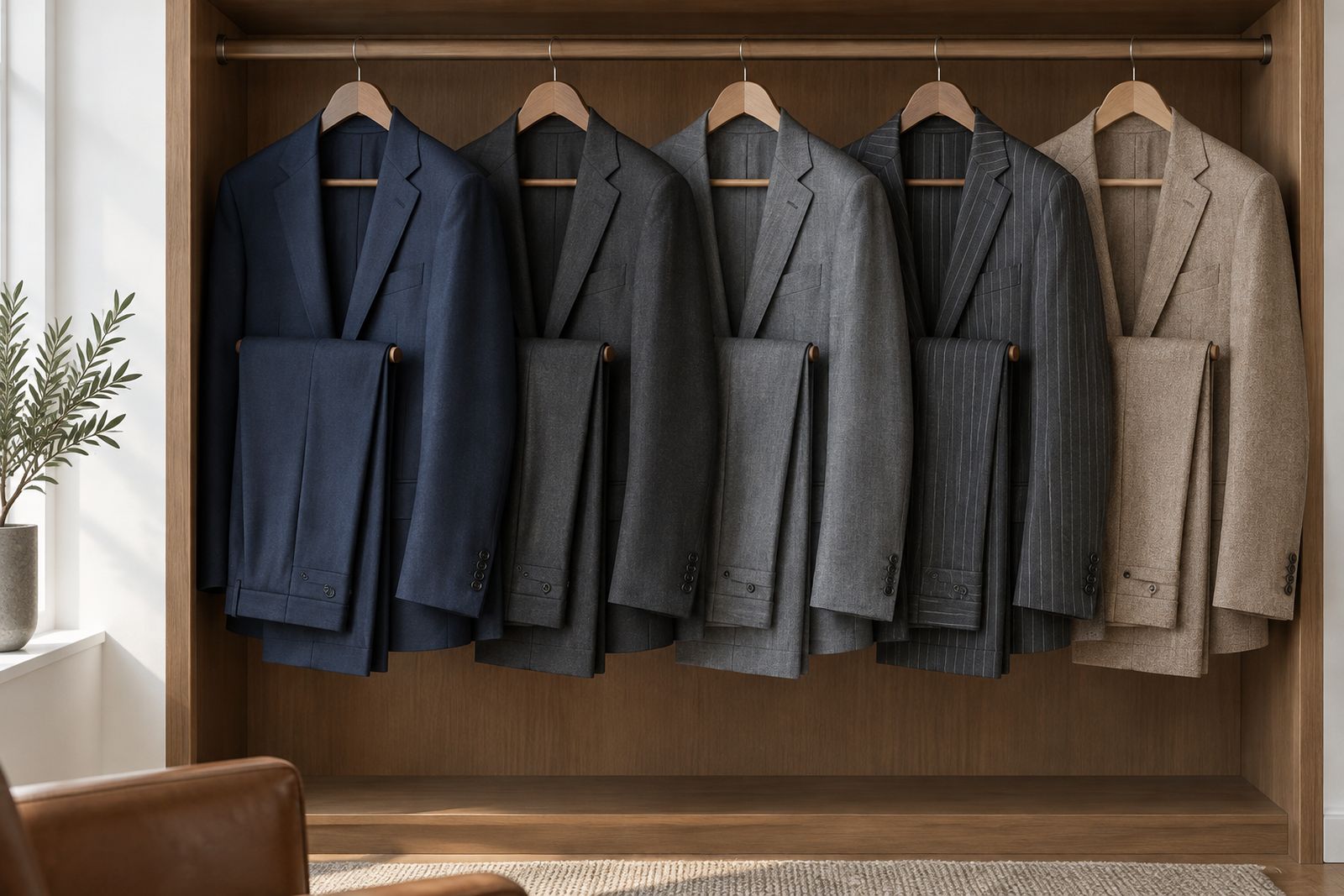
The short answer
Most men need two or three suits: a navy suit first, a charcoal suit second, and a third for variety, such as mid-gray or a subtle pattern. If you wear a suit every working day, own at least four or five so each can rest a day between wears. Add seasonal, patterned and evening suits only after the basics.
- Occasional wearers need one or two suits; daily wearers need at least four or five.
- Buy navy first, charcoal second, then mid-gray or a subtle pattern.
- Don't buy black as a first suit: it is narrower in use than navy or charcoal.
- Rest a suit at least a day between wears, and order two pairs of trousers where you can.
- A year-round worsted of about 9 to 11 oz (280 to 340 g) suits the first two suits in most climates.
In this guide
- How many suits should a man own?
- What color should your first suit be?
- The suit wardrobe, step by step: what to buy next
- What your wardrobe covers at one, two, three and five suits
- How many suits for your situation?
- What about black, brown and patterned suits?
- Which fabric and weight for each suit?
- How often should you rotate suits?
- When should you replace a suit?
- Should you buy ready-to-wear, made-to-measure or bespoke?
- The tailor's view: planning suits as a set
- Questions people ask
How many suits should a man own? Fewer than most shops would like, and more than one if you wear them often. The number depends on how many days a week you wear a suit, because a suit needs rest between wears to last. The order you buy them in matters just as much: the first two suits should cover almost every occasion between them, and everything after that is variety.
At a glance
- A few times a year
- 1 or 2 suits
- About once a week
- 2 or 3 suits
- Two or three days a week
- 3 or 4 suits
- Every working day
- At least 4 or 5 suits
- Build order
- Navy, then charcoal, then mid-gray or a subtle pattern, then seasonal suits
How many suits should a man own?
A man who wears a suit occasionally needs one or two; a man who wears one every working day needs at least four or five. The reason is rotation. Wool recovers its shape and dries out when it rests, so a suit worn on consecutive days creases more, smells sooner and wears out faster. Rest each suit at least a day between wears, and longer if you can.
| How often you wear a suit | Minimum | Comfortable | Why |
|---|---|---|---|
| A few times a year (weddings, funerals, interviews) | 1 | 2 | One navy suit covers almost everything; a charcoal adds a somber option |
| About once a week | 2 | 3 | Two suits let you alternate; a third adds variety |
| Two or three days a week | 3 | 4 | Each suit gets at least a day's rest |
| Every working day | 4 | 5 or more | Each suit is worn about once a week and lasts years longer |
More suits cost less over time than you might expect: five suits worn once a week each last far longer than two suits worn two or three times a week each. You spend more up front and less on replacements.
What color should your first suit be?
Your first suit should be navy. A solid navy suit is the most versatile suit a man can own: it is right for interviews, business, weddings and most evening events, it works with both brown and black shoes, and it suits almost every complexion. Charcoal is the close second, slightly more formal and more somber, which makes it the better choice for funerals and very conservative offices. Our guide to suit colors compares every common color.
Navy or charcoal for a first suit?
Choose navy unless your work is very conservative or you expect to wear the suit mostly at funerals and formal daytime events. Navy has more range: it can be dressed down with a knit tie and brown suede shoes, or up with a white shirt and black oxfords. Charcoal looks serious in any setting but has less range on the casual side. Either is a sound first suit; neither should be black.
| Detail | Recommendation | Why |
|---|---|---|
| Color | Solid navy, or charcoal | Covers the widest range of occasions |
| Fabric | Wool worsted, Super 100s to 130s | Durable, holds a crease, resists wrinkles |
| Weight | About 9 to 11 oz (280 to 340 g) | Wearable for most of the year in most climates |
| Jacket | Single-breasted, two-button, notch lapel | The most widely appropriate cut |
| Pockets and vents | Flap pockets; double or single vent | Standard and easy to wear |
| Trousers | Flat front or single pleat; plain hem or turn-ups (cuffs) | Either is correct for a business suit |
The suit wardrobe, step by step: what to buy next
Build a suit wardrobe in order, so that each new suit adds a color, a fabric or an occasion the others do not cover. This ladder shows the usual sequence. Skip a rung only if your life makes it irrelevant: a man who never attends black tie does not need a dinner suit.
Buy first
1. Navy, solid
Interviews, business, weddings, most evenings; brown or black shoes
2. Charcoal, solid
Formal business, funerals, winter evenings; a second suit for rotation
3. Mid-gray, or navy or gray with a subtle pattern
A quiet chalk stripe, pinstripe or check adds variety to a working week
4. A seasonal suit
A lighter suit for summer or a flannel for winter, depending on your climate
5. Evening or occasion
A dinner suit (tuxedo) if you attend black tie, or a three-piece
6. Personal choices
Brown, green, tan, double-breasted, tweed: suits for pleasure rather than need
Buy later
Classic
First suit: navy
The widest range of any suit
Navy
Suit
White
Shirt
Burgundy
Tie
Dark brown
Shoes
Classic
Second suit: charcoal
More formal; right for funerals and conservative offices
Charcoal
Suit
Light blue
Shirt
Navy
Tie
Black
Shoes
Works
Third suit: mid-gray
Lighter and more relaxed; good in daylight and warmer months
Mid-gray
Suit
White
Shirt
Bottle green
Tie
Dark brown
Shoes
Avoid
Black as a first suit
Narrow in use by day; reads as funeral or evening wear
Black
Suit
White
Shirt
Silver
Tie
Black
Shoes
What your wardrobe covers at one, two, three and five suits
Here is what a wardrobe built in that order covers at each size. Most men who wear suits once or twice a week stop happily at three.
| Suits | What to own | What it covers |
|---|---|---|
| 1 | Navy solid | Interviews, business meetings, weddings, most evening events |
| 2 | Navy and charcoal solids | Adds funerals and formal business; allows simple rotation |
| 3 | Add mid-gray, or a navy or gray subtle pattern | Rotation for two or three days a week, with visible variety |
| 5 | Add a summer-weight and a winter-weight suit | Daily rotation, comfortable across the year |
| 5 plus | Add a dinner suit (tuxedo), then personal choices | Black tie, and suits worn for pleasure |
Plan the set rather than the individual suit. Three navy suits that look alike give you rotation but not variety; a navy, a charcoal and a mid-gray give you both. For combinations, see what to wear with a navy suit and what to wear with a gray suit.
How many suits for your situation?
The general rule bends with your life. These are the common cases and how the wardrobe changes for each.
| Situation | Suits | What to prioritize |
|---|---|---|
| Graduate or first job search | 1 | Navy, conservative cut, year-round weight; add charcoal with the first paycheck |
| Office where suits are optional | 2 or 3 | Navy and charcoal, plus odd jackets and trousers for the other days |
| Law, finance or another suit-every-day job | 5 or more | Navy, charcoal and gray solids, then subtle stripes; two pairs of trousers each |
| Frequent business travel | 3 or more | At least one in a high-twist worsted that sheds creases in a suitcase |
| A year full of weddings | 2 | Navy and a lighter suit, such as mid-gray, for summer and daytime weddings |
| Formal evenings several times a year | Basics plus a dinner suit | A dinner suit (tuxedo) is cheaper over time than renting repeatedly; see our black tie guide |
What about black, brown and patterned suits?
Black suits are narrower in use than they look. They suit funerals and some evening events, but in daylight a black suit can look severe, and it is not a substitute for black tie, which calls for a dinner suit with silk facings. Buy one later if your life needs it; our guide to the black suit explains when it works.
Brown and green suits are country and casual colors in the traditional English view, and work best once the navy, charcoal and gray basics are covered. Patterns follow the same logic: a pinstripe or chalk stripe reads as business, a check or windowpane as more relaxed. A strong pattern is also memorable, so it shows repeat wear more than a solid does; keep bold patterns for the fourth suit onward.
Which fabric and weight for each suit?
The first two suits should be year-round worsteds; seasonal suits come later, chosen for your climate. This table gives sensible starting points. Fabric weight is quoted per running yard (oz) or running meter (g).
| Suit | Fabric | Weight |
|---|---|---|
| Navy (first) | Wool worsted, Super 100s to 130s | About 9 to 11 oz (280 to 340 g) |
| Charcoal (second) | Wool worsted; flannel if you live somewhere cold | Worsted about 9 to 11 oz (280 to 340 g); flannel about 11 to 13 oz (340 to 400 g) |
| Summer suit | Tropical wool, wool-linen or linen | Tropical wool about 7 to 9 oz (220 to 280 g); linen often heavier |
| Winter suit | Flannel or tweed | Flannel about 11 to 13 oz (340 to 400 g); tweed heavier |
Our guide to the best year-round suit fabric explains how weight, weave and fiber change comfort across the seasons.
How often should you rotate suits?
Rotate so that no suit is worn two days in a row, and ideally so that each suit is worn no more than once or twice a week. After wearing, empty the pockets, brush the suit, and hang it on a shaped hanger with room around it so creases drop out and moisture evaporates. Our guide to caring for a suit covers the daily and seasonal routine.
When should you replace a suit?
Replace a suit when the fabric fails or the fit can no longer be fixed, not when it simply feels old. A well-kept navy suit can stay in a wardrobe for many years. These are the signs that it is time.
- Shine on the seat, elbows or trouser knees that steaming and brushing no longer lift: the fibers have flattened through wear and pressing.
- Thinning at the seat or inner thighs, where the fabric becomes translucent against the light. Once it tears there, repairs rarely last.
- Fraying at the sleeve edges, trouser hems or pocket mouths beyond what a tailor can neatly turn or repair.
- Fit that has moved beyond the seam allowance: if a tailor cannot let it out or take it in far enough, the suit has reached the end of its useful life for you.
If only the trousers have gone, a tailor may be able to make a new pair if matching fabric is still available, but colors shift between dye lots, so the match is rarely exact. That is the strongest argument for buying two pairs at the start.
Should you buy ready-to-wear, made-to-measure or bespoke?
Buy your first two suits as well as you can afford, in whichever tier fits you best. For most men that means good made-to-measure or a well-altered ready-to-wear suit. Leave bespoke until you know what you like and wear suits often enough to justify it; the honest arithmetic is in is a bespoke suit worth it, and the tiers are compared in bespoke vs made-to-measure.
If you do go to a tailor, staying with the same one helps. Each order refines your pattern or your measurements, so the third suit usually fits better than the first.
The tailor's view: planning suits as a set
Tell your tailor how often you wear a suit, where, and what you already own. A good tailor will steer you away from repeating what you have and toward the gap in your wardrobe.
What to tell your tailor
- How many days a week you wear a suit, and in what kind of setting.
- The suits you already own, with their colors and weights.
- Your climate, and whether you travel or commute a lot.
- Whether you need a suit for black tie, funerals or weddings in the coming year.
- Whether you want the jacket to work alone; most smooth worsted suit jackets look wrong as odd jackets.
That last point surprises many people. A suit jacket in a smooth, flat worsted rarely looks right with jeans or chinos; a sport coat in a textured fabric does. If you want separates, buy them as separates. Start with navy, then charcoal, and let the rest of the wardrobe follow how you actually live.
Questions people ask
What color should your first suit be?
Your first suit should be solid navy. It works for interviews, business, weddings and most evening events, pairs with brown or black shoes, and suits almost every complexion. Charcoal is the close second.
Navy or charcoal for a first suit?
Choose navy unless your work is very conservative or you will wear the suit mostly at funerals and formal daytime events, where charcoal is better. Navy has more range on the casual side. Either is a sound choice; black is not.
What suits should every man own?
Every man who wears suits should own a solid navy suit and a solid charcoal suit. Those two cover nearly every occasion between them. A mid-gray or subtly patterned suit is the natural third.
How often should you rotate suits?
Rotate so that no suit is worn two days in a row, and ideally so each is worn only once or twice a week. Resting a suit lets the wool recover its shape and dry out. Daily suit wearers need at least four or five suits to manage this.
Is one suit enough?
One suit is enough if you wear a suit only a few times a year. Make it navy, in a year-round worsted, and keep it well pressed. Once you wear a suit weekly, add a charcoal suit so each can rest.
Can you wear the same suit two days in a row?
You can, but it shortens the suit's life and it will look more creased on the second day. Wool needs about a day to recover. If you must, hang it carefully overnight and steam out the creases in the morning.
Should my first suit be black?
No. A black suit is narrower in use than navy or charcoal: it can look severe in daylight and is not a substitute for a dinner suit at black tie. Buy navy first and add black later only if your life calls for it.
How many suits do I need for work?
If you wear a suit every working day, own at least four or five so each is worn about once a week. If you wear one two or three days a week, three or four is enough. Build them in the order navy, charcoal, mid-gray or pattern.
TailorGuide is independent. Our guides are written and checked by our team and carry no paid endorsements. How we work.