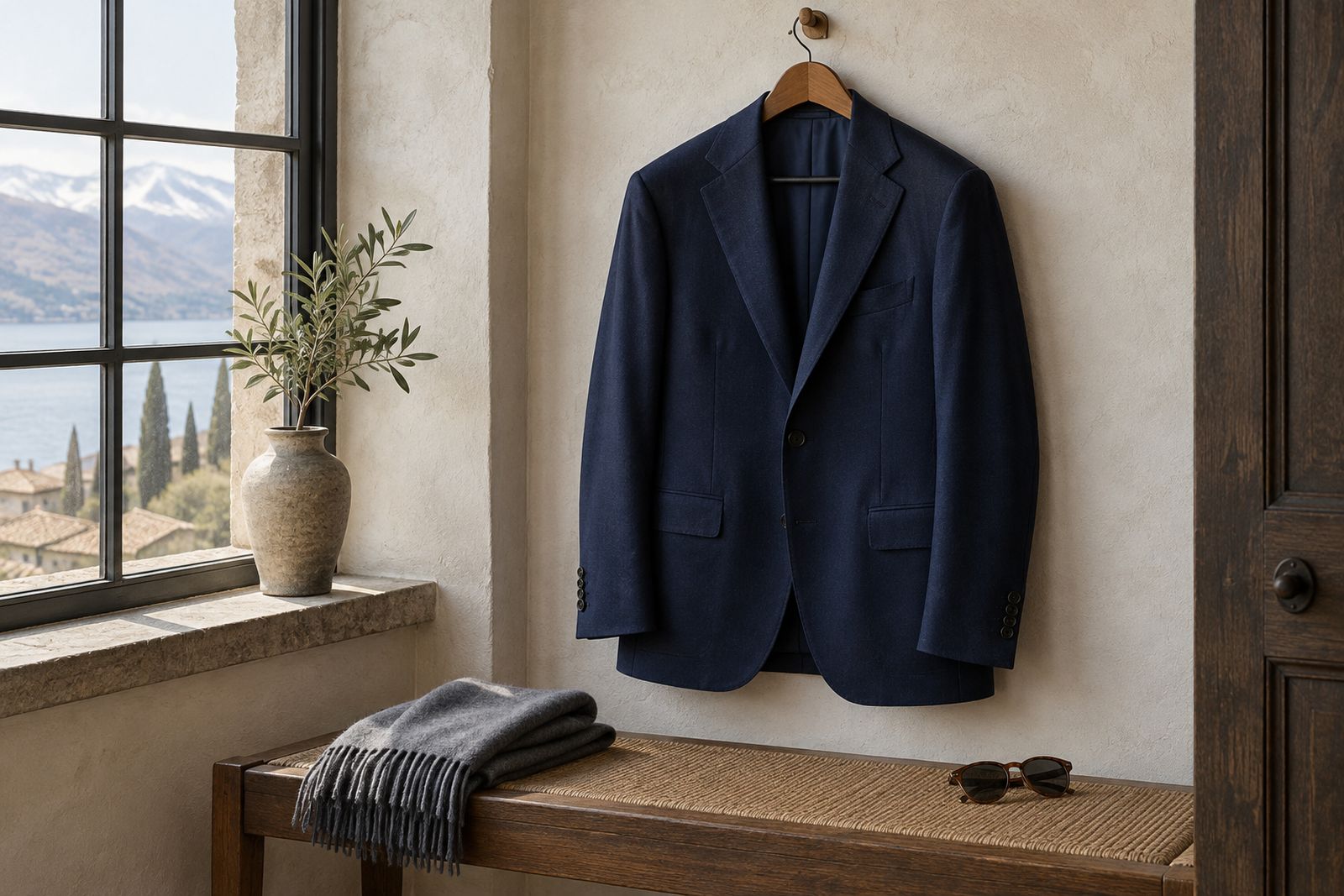
The short answer
The best year-round suit fabric is a worsted wool of about 9 to 11 oz (280 to 340 g), with 10 oz (310 g) the most versatile, in Super 100s to 130s and a plain weave, fine twill or subtle texture such as birdseye or sharkskin. In hot climates drop to 8 to 9 oz (250 to 280 g); in cool ones go up to 11 oz (340 g).
- Worsted wool, 9 to 11 oz (280 to 340 g), Super 100s to 130s.
- About 10 oz (310 g) is the most versatile single weight.
- Choose a plain weave, fine twill, sharkskin, birdseye or nailhead in navy or mid-gray.
- Go lighter, 8 to 9 oz (250 to 280 g), in hot climates and up to 11 oz (340 g) in cool ones.
- A half or full canvas and a cupro lining widen the comfort range.
In this guide
- What is the best year-round suit fabric?
- What weight suit is best for all seasons?
- Is a 9 oz suit year-round?
- Year-round suit weight by climate
- Which weaves work in every season?
- What is the most versatile suit fabric?
- Is a year-round suit warm enough for winter?
- Construction for a four-season suit
- Common mistakes when choosing a year-round suit
- When to add a second suit, and in what fabric
- The tailor's view
- Questions people ask
A year-round suit fabric has one job: to be comfortable on as many days of the year as possible without looking out of season. Most of us spend the day in heated or air-conditioned buildings, so the suit has to handle a warm office, a cold street and a crowded train, often on the same day. The right answer is more specific than 'wool', and it is the one good tailors have given for decades: a mid-weight worsted with a smooth, reasonably open weave.
The year-round suit fabric at a glance
- Fiber
- Worsted wool
- Weight
- 9 to 11 oz (280 to 340 g), ideally about 10 oz (310 g)
- Super number
- Super 100s to 130s
- Weave
- Plain weave, fine twill, sharkskin, birdseye or nailhead
- Colors
- Navy, mid-gray, charcoal
- Construction
- Half or full canvas; cupro lining
What is the best year-round suit fabric?
The best year-round suit fabric is a worsted wool of 9 to 11 oz (280 to 340 g) in Super 100s to 130s. Worsted yarn is smooth and strong, so the suit looks sharp and survives regular wear. The mid weight drapes well and resists creasing, yet stays light enough for a warm office. A Super number in the everyday range balances softness with durability; see Super numbers explained.
Year-round fabric
A year-round (or four-season) fabric is a mid-weight suit fabric, usually worsted wool of about 9 to 11 oz (280 to 340 g), that is comfortable indoors in every season and outdoors in all but the hottest and coldest weather.
Why worsted rather than other wools or fibers? Woolen fabrics such as flannel are too warm for summer, and linen and cotton are too light and casual for winter. Our guide to worsted vs woolen explains the difference between the two kinds of wool yarn.
What weight suit is best for all seasons?
About 10 oz (310 g) is the best single weight for a suit worn in all seasons. It sits in the middle of the year-round band of 9 to 11 oz (280 to 340 g): heavy enough to drape cleanly and shed creases, light enough not to overheat you indoors. Weight is quoted per running length of fabric, in ounces per running yard from English mills and grams per running meter from Italian ones, with 1 oz about 31 g.
Scale from 200 g to 500 g, with oz below. Tropical and summer: 220 to 280 g. Year-round: 280 to 340 g. Autumn and winter: 370 to 430 g. Heavy tweeds and flannels: 430 to 500 g. Most versatile: about 10 oz: at 310 g.
Fabrics between 11 and 12 oz (340 and 370 g) are sometimes sold as three-season weights: good from autumn to spring, warm in summer. Below 9 oz (280 g), you are in summer territory.
Is a 9 oz suit year-round?
A 9 oz (280 g) suit is year-round for some people and climates, not all. It sits at the light edge of the band. In a warm climate, or if you run hot and spend most days indoors, it can work in every month, with an overcoat on cold days. In a cool, damp climate it will feel thin in winter, and it creases and wears faster than a 10 or 11 oz (310 or 340 g) fabric.
If you do choose 9 oz, ask for a two-ply yarn and a firm weave, so the light weight does not cost you drape and durability.
Year-round suit weight by climate
Adjust the band for where you live. These ranges assume you spend most of the working day indoors.
| Climate | Example | Year-round pick | Notes |
|---|---|---|---|
| Cool and mild, rarely hot | London | 10 to 11 oz (310 to 340 g) | The heavier end drapes well and suits most of the year; add a lighter suit for heatwaves |
| Hot summers, cold winters | New York, Milan | 9.5 to 10.5 oz (295 to 325 g) | Rely on an overcoat in winter rather than a heavy suit, and add a summer suit later |
| Hot most of the year, cold air-conditioning | Dubai | 8 to 9 oz (250 to 280 g) | Light enough for outdoors, with enough body for chilled offices; half-lined |
| Hot and humid all year | The tropics | 7.5 to 9 oz (230 to 280 g) | High-twist open weaves; in effect, a summer suit worn all year |
Which weaves work in every season?
Weave matters almost as much as weight. A year-round fabric should be smooth enough to look formal, open enough to breathe and firm enough to resist creasing.
| Weave | Why it works year-round | Watch for |
|---|---|---|
| Plain weave | Breathes well and looks clean; at 9 to 10 oz (280 to 310 g) it bridges summer and winter | Light plain weaves crease more than twills |
| Fine twill (serge) | Smooth, durable, drapes well and holds a crease | Slightly warmer than a plain weave of the same weight |
| Sharkskin | Crisp two-tone twill with a subtle sheen | The sheen can look flashy in lighter grays |
| Birdseye and nailhead | Tiny texture that reads as solid from a distance | Strong color contrasts can look busy up close |
| High-twist plain weave | Breathes like a summer fabric, resists creasing like a heavier one | Drier, grainier hand; reads slightly less formal |
| Fine herringbone | Subtle texture with good drape | Reads autumnal in heavier weights |
Leave these for particular seasons: flannel and tweed for autumn and winter, linen and seersucker for summer. Heavy gabardine is tough and smart but breathes poorly, so it is better in cooler months.
What is the most versatile suit fabric?
The most versatile suit fabric is a navy worsted wool of about 10 oz (310 g) in a plain weave or fine twill. Navy works for business, interviews, weddings and dinners, pairs with almost any shirt and tie, and suits nearly every complexion. Mid-gray is a close second. Both are covered in our guide to suit colors.
| Spring | Summer | Autumn | Winter | |
|---|---|---|---|---|
| Worsted, 10 oz (310 g) | ||||
| Worsted, 8 oz (250 g) | ||||
| High-twist wool, 9 to 10 oz (280 to 310 g) | ||||
| Worsted flannel, 11 oz (340 g) | ||||
| Woolen flannel, 13 oz (400 g) | ||||
| Linen | ||||
| Tweed |
Winter ratings assume an overcoat outdoors. Indoors, a 10 oz (310 g) worsted is comfortable in every season in a heated building.
Which colors and patterns read as year-round?
Color carries a season as clearly as weight. Navy, mid-gray and charcoal look right in every month. Light gray, tan and stone read as summer; brown, olive and bold checks read as autumn and winter. Subtle patterns such as a fine pinstripe, a birdseye or a faint check stay year-round; strong glen checks and windowpanes lean toward the cooler months. If this is your only suit, keep it plain or near-plain.
Is a year-round suit warm enough for winter?
Yes, for most people who spend winter days indoors. The suit only has to keep you comfortable in a heated building; outdoors, the overcoat, scarf and gloves do the work. That is why a heavy suit is rarely the best first purchase, even in a cold city: a mid-weight suit under a good coat covers more of the year than a heavy suit you cannot wear once spring arrives. If you need more warmth, a waistcoat (vest) or a fine knit under the jacket adds a layer you can remove. Our guide to overcoat styles covers the coat side.
Construction for a four-season suit
How the suit is made widens or narrows its comfort range as much as the fabric does.
- Canvas. A half or full canvas chest breathes and molds to you; a heavily fused front is warmer and stiffer. See fused vs canvas.
- Lining. A full cupro (Bemberg) lining is the most versatile choice in cool and mixed climates: it breathes, and it lets the jacket slide over fine knitwear in winter. In hot climates, choose a half lining.
- Trousers lined to the knee. Common in European tailoring, a knee lining helps the trousers hang and glide over the leg.
- Moderate shoulders. A light pad is comfortable in every season; heavy padding adds warmth and weight.
- Room for a layer. Leave enough ease to wear a fine-gauge sweater or a waistcoat (vest) under the jacket in winter without strain.
Common mistakes when choosing a year-round suit
- Going too fine. Super 150s and above wears out quickly in a suit worn often.
- Going too light. Outside hot climates, an 8 oz (250 g) fabric is a summer suit, however it is sold.
- Choosing flannel as your only suit. It is ideal in the cold months and too warm for the rest of the year.
- Choosing black. Black reads as evening or funeral wear; navy and gray are the year-round colors.
- Ignoring the lining. A polyester lining makes any fabric feel hotter.
When to add a second suit, and in what fabric
A year-round suit is the right first suit. Your second should fill the gap the first leaves, which depends on your climate and how often you wear a suit.
| Your situation | First suit | Second suit |
|---|---|---|
| Office suit three or more days a week, mixed climate | Navy worsted, about 10 oz (310 g) | Mid-gray worsted, same weight, so the two can alternate |
| Cold winters, suit worn often | Navy worsted, about 10 oz (310 g) | Mid-gray or charcoal flannel, 12 to 13 oz (370 to 400 g) |
| Hot summers, suit worn often | Navy worsted, 9.5 to 10 oz (295 to 310 g) | High-twist wool or mohair blend, 8 to 9 oz (250 to 280 g) |
| Hot climate all year | Navy high-twist wool, 8 to 9 oz (250 to 280 g) | Mid-gray or light gray in the same fabric |
| Suit for occasions only | Navy worsted, about 10 oz (310 g) | Charcoal for formal and somber occasions, or a summer suit for weddings |
The tailor's view
Ask a good tailor for a year-round fabric and expect questions back: where you live, how often you will wear the suit, whether you commute on foot or by car, and whether your office runs warm or cool. The answers move the recommendation by an ounce or two and from one weave to another. A good tailor will then show you two or three books of mid-weight worsteds, not the whole shop.
What to tell your tailor
- Where you live and where you travel most
- How many days a week you will wear the suit
- Whether your office runs warm or cool
- Whether you run hot or cold
- Whether you want to wear knitwear under the jacket in winter
- Whether you want a second pair of trousers
Start with navy or mid-gray worsted at about 10 oz (310 g). Once you know where it falls short, add a summer suit from our guide to the best suit fabric for hot weather or a winter flannel. For the full picture of fibers and weaves, see suit fabrics explained.
Questions people ask
What weight suit is best for all seasons?
About 10 oz (310 g) is the best single weight for a suit worn all year, within a year-round band of 9 to 11 oz (280 to 340 g). It drapes well and resists creasing but stays comfortable indoors. Go lighter in hot climates and heavier in cool ones.
Is a 9 oz suit year-round?
A 9 oz (280 g) suit is year-round in warm climates and for people who run hot, but it sits at the light edge of the band. In a cool climate it will feel thin in winter, and it creases more than a 10 oz (310 g) suit. Choose a two-ply yarn and a firm weave if you go this light.
What is the most versatile suit fabric?
A navy worsted wool of about 10 oz (310 g), in Super 100s to 130s and a plain weave or fine twill, is the most versatile suit fabric. It suits business, weddings and interviews in most seasons. Mid-gray worsted is a close second.
Can you wear a year-round suit in summer?
Yes, in mild summers and air-conditioned offices. In real heat, especially with humidity, a 10 oz (310 g) worsted will feel warm outdoors, and a lighter open-weave summer suit is more comfortable. Carrying the jacket between buildings helps.
Is flannel a year-round fabric?
No. Woolen flannel is an autumn and winter fabric, usually 12 oz (370 g) or more, and it is too warm for summer. A lighter worsted flannel of about 10 to 11 oz (310 to 340 g) stretches further but is still best in the cooler months.
Should a year-round suit be fully lined?
In cool and mixed climates, a full cupro (Bemberg) lining is the most versatile choice, because it breathes and slides easily over knitwear. In hot climates, choose a half-lined jacket. Avoid polyester linings in any season.
What is a three-season suit?
A three-season suit usually means a fabric of about 11 to 12 oz (340 to 370 g), comfortable from autumn through spring but warm in summer. It suits cool climates well. In hot or mixed climates, a true year-round weight of about 10 oz (310 g) is more useful.
TailorGuide is independent. Our guides are written and checked by our team and carry no paid endorsements. How we work.