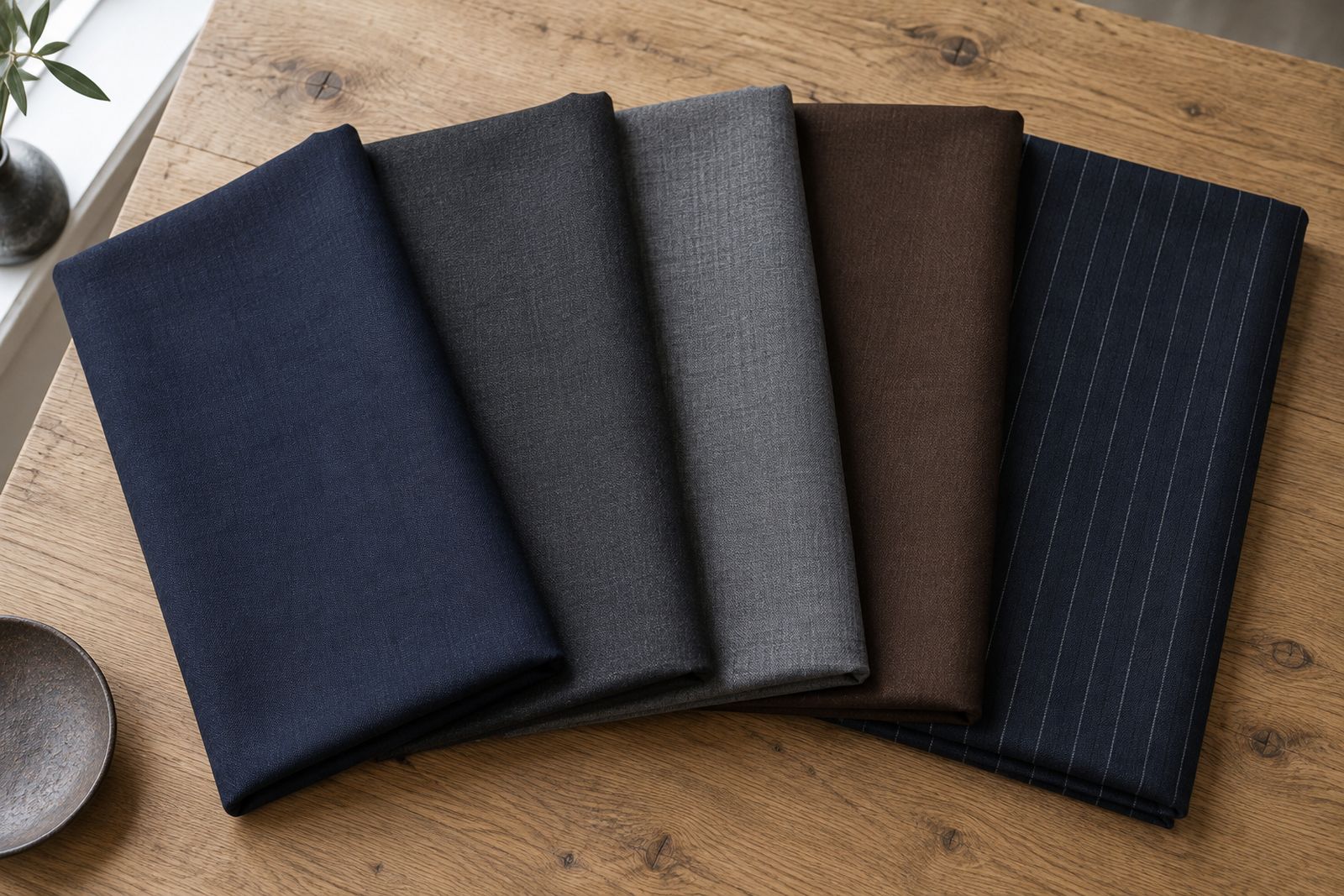
The short answer
The best suit colors for men are navy and charcoal, in that order. Navy is the most versatile first suit: it works for business, interviews, weddings and evenings, with black or brown shoes. Charcoal comes second and is slightly more formal. Then add mid gray, then a brown suit or a pattern such as a navy chalk stripe. Leave black until last.
- First suit: plain dark navy in a year-round worsted of about 9 to 11 oz (280 to 340 g).
- Second suit: charcoal, which covers the formal and somber occasions navy handles less well.
- Third suit: mid gray, the best of the three with brown shoes and in daylight.
- Fourth and fifth: brown, a stripe or a check, chosen for the life you actually lead.
- Black is an evening and funeral color and the least versatile choice for a first suit.
- Judge every color in daylight and on the largest sample the tailor can show you.
In this guide
- What color should your first suit be?
- The suit color build order: suits 1 to 5
- Why navy and charcoal come first
- Which suit colors if you only wear a suit occasionally?
- Is a gray suit a good choice?
- Is a brown suit a good choice?
- When should you add a patterned suit?
- What about black, light gray, tan and other colors?
- Which suit color is best for each occasion?
- Mistakes to avoid when choosing a suit color
- The tailor's view: choosing color from a fabric book
- Questions people ask
The best suit colors for men are the ones you can wear most often, to the most places, with the fewest changes of shirt and shoe. That is why the standard advice to a first-time buyer is navy first, charcoal second, then branch out. Below is the order to buy them in, what each color does well, and the colors to leave until you already own the basics.
The suit color build order
- Suit 1
- Navy, plain or nearly plain
- Suit 2
- Charcoal, plain
- Suit 3
- Mid gray
- Suit 4
- Brown, or a navy or gray stripe or check
- Suit 5
- A seasonal color (light gray, tan, olive) or black for evening
- Avoid as a first suit
- Black, light colors, bold patterns, shiny fabrics
What color should your first suit be?
Your first suit should be navy. A plain dark navy suit is right for a job interview, a conservative office, a daytime or evening wedding and a business dinner, and it is acceptable at most funerals, though charcoal is the safer choice there. It works with black shoes and with every shade of brown, with white, light blue and pink shirts, and with nearly any tie you already own.
Navy also suits almost every complexion. It is dark enough to look formal and to frame the face, but softer than black, so it does not drain color from fair skin or flatten the features of darker skin the way pure black can.
Choose a true dark navy rather than a bright or royal blue, and keep the pattern plain or nearly plain: a solid worsted, a fine twill, a sharkskin or a birdseye that reads as solid from a few feet away. A worsted of about 9 to 11 oz (280 to 340 g) works through most of the year in a temperate climate; our guide to year-round suit fabric explains the choice in detail.
The suit color build order: suits 1 to 5
Each suit in the sequence should add an occasion or a season the earlier ones cannot cover. That is why the second suit is charcoal rather than a second navy, and why patterns and seasonal colors wait until the plain dark suits are in place.
| Order | Color | Best for | Shoes | Why it sits here |
|---|---|---|---|---|
| 1 | Navy, plain | Office, interviews, weddings, dinners | Black, dark brown, mid brown | Covers the widest range of occasions and pairs with almost everything |
| 2 | Charcoal, plain | Formal business, funerals, evenings, winter | Black, dark brown, oxblood | More formal and more somber than navy, and clearly different from it |
| 3 | Mid gray | Daytime business, spring and summer, weddings | Brown in any shade, black | A lighter, friendlier color that shows off brown shoes |
| 4 | Brown, or a navy or gray stripe or check | Relaxed offices, autumn and winter, weekends, or more variety at work | Brown, oxblood | Adds character once the plain suits are covered |
| 5 | Light gray, tan, olive, or black for evening | Summer, smart casual events, evening parties | Brown and tan; black with black | Fills a specific gap in your calendar |
If you work in a conservative office and wear a suit every day, buy a second navy or charcoal in a different weight before moving to step 4.
Classic
Suit 1: navy
The most versatile suit you can own
Navy
Suit
White
Shirt
Burgundy
Tie
Dark brown
Shoes
Classic
Suit 2: charcoal
Formal business and evening
Charcoal
Suit
Light blue
Shirt
Navy
Tie
Black
Shoes
Classic
Suit 3: mid gray
Daytime, and best with brown shoes
Mid gray
Suit
White
Shirt
Bottle green
Tie
Mid brown
Shoes
Works
Suit 4: brown
Autumn, winter and relaxed settings
Chocolate brown
Suit
Light blue
Shirt
Olive green
Tie
Dark brown
Shoes
Works
Suit 5: light gray
Summer daytime and weddings
Light gray
Suit
Pale pink
Shirt
Navy
Tie
Tan
Shoes
Avoid
Black as a first suit
Fine later for evening; too narrow to start with
Black
Suit
White
Shirt
Black
Tie
Black
Shoes
Why navy and charcoal come first
Navy and charcoal are the two most versatile suit colors because they are dark enough for formal business and evening, yet they are not black. Dark colors read as serious and hide creases, small stains and wear. Between them, the two cover every occasion where a suit is expected, and they are different enough that nobody will think you wore the same suit twice.
Navy
Suit 1
- Slightly friendlier and more approachable
- Works with black, dark brown, mid brown and tan shoes
- Excellent with burgundy, green, orange and yellow ties
- Right for interviews, weddings, dinners and most offices
- Looks good in daylight and under artificial light
Charcoal
Suit 2
- Slightly more formal and more serious
- Best with black shoes; dark brown and oxblood also work
- Excellent with burgundy, navy, silver and purple ties
- Right for formal business, funerals and winter evenings
- Looks especially sharp in flannel in cold months
If you expect to attend a funeral or a very formal business event in the next year, you can reasonably buy charcoal first. Otherwise navy wins, because it handles celebrations and daytime events better than charcoal does.
Which suit colors if you only wear a suit occasionally?
If you wear a suit a few times a year, for weddings, interviews and the occasional funeral, you need fewer colors, not different ones. The build order still holds, but it stops sooner. Match the number of suits to how often you wear them, and let the occasions you actually attend decide the second color.
| How you wear suits | Suits | Colors |
|---|---|---|
| A few times a year (weddings, interviews, funerals) | 1 to 2 | Navy; add charcoal if you attend formal or somber events |
| Once or twice a week, relaxed office | 2 to 3 | Navy, mid gray, then charcoal or brown |
| Every day, conservative office | 4 to 5 | Navy and charcoal in two weights each, then a pinstripe |
| Mostly social events and summers | 2 to 3 | Navy, light gray, then a mid blue or tan |
Is a gray suit a good choice?
A gray suit is a very good choice, and the shade decides how you wear it. Charcoal, the darkest gray, is a formal business color. Mid gray is lighter and more relaxed, at its best in daylight and with brown shoes, which makes it the natural third suit. Light gray is a spring and summer color for daytime events and weddings; it looks out of place in a formal office in winter.
Mid gray is also the most forgiving color for experimenting with ties and shirts. Almost any tie color shows up well against it, from navy and burgundy to green, orange and pale yellow. Our guide to gray suit combinations covers each shade separately.
Is a brown suit a good choice?
A brown suit is a good choice once you own navy and charcoal. Brown is warmer and more relaxed than blue or gray, which makes it excellent in autumn and winter fabrics such as flannel, tweed and heavier twills, in relaxed offices and at daytime and country events. It is less suited to the most conservative business settings, to interviews in formal industries and to evening events.
Brown pairs naturally with brown shoes in every shade, with cream, white and light blue shirts, and with green, navy, orange and burgundy ties. Black shoes tend to look heavy and abrupt against it. A dark chocolate brown is the easiest place to start; mid and tobacco browns are more casual and depend more on your coloring.
When should you add a patterned suit?
Add a pattern only after the plain suits, usually as the fourth or fifth suit. Patterns are memorable: a plain navy suit can be worn twice a week without anyone noticing, while a bold check cannot. Once you have the plain colors, a pattern adds variety at work without adding a new color to coordinate.
| Pattern | What it looks like | Formality | Best for |
|---|---|---|---|
| Pinstripe | Thin, crisp, evenly spaced lines on navy or charcoal | High | Formal business, finance and law |
| Chalk stripe | Softer, wider-looking lines, often on flannel | High | Winter business, a warmer alternative to pinstripe |
| Birdseye, sharkskin, nailhead | Tiny woven patterns that read as solid at a distance | High | Any occasion a plain suit suits, with added texture |
| Glen check (Prince of Wales check) | A woven check of small and large blocks | Medium | Relaxed offices, daytime weddings, weekends |
| Windowpane | Thin lines forming large squares | Medium to low | Smart casual, social events |
| Herringbone | A zigzag weave, often in tweed or flannel | Medium to low | Autumn and winter, country and casual settings |
Narrow, low-contrast stripes read quieter than widely spaced, high-contrast ones. For a first patterned suit, choose a stripe or check you can only just see from across a room. Patterns also change the rules for shirts and ties: a striped suit is easiest with a plain shirt and a solid or small-patterned tie, as our guide to matching a tie to your shirt and suit explains.
What about black, light gray, tan and other colors?
Every other suit color is a specialist. Each does one or two jobs very well and many jobs badly, which is why they belong at the end of the build order rather than the start.
| Color | Verdict | Best for | Watch out for |
|---|---|---|---|
| Black | Specialist | Evening events, funerals, creative industries | Severe in daylight, hard to pair with ties and brown shoes, and not a substitute for a tuxedo |
| Light gray | Seasonal | Summer weddings, daytime events, warm climates | Shows marks, and looks too light for formal business |
| Tan or khaki | Seasonal | Summer, smart casual, linen or cotton suits | Casual by nature; linen versions wrinkle readily |
| Olive or green | Bold | Autumn, smart casual, creative offices | Narrower range of shirt and tie pairings |
| Mid or bright blue | Bold | Weddings, parties, social daytime events | Reads less serious in business; cheaper versions often look shiny |
| Burgundy, cream and other colors | Bold | Evening parties, summer events, dinner jackets | Very limited use for the cost of a suit |
Black deserves a word of its own, because many men buy it first on the assumption that it is the most formal color. Traditionally it is an evening, formal and funeral color, and it is less versatile for business than navy or charcoal. Our guide to wearing a black suit sets out where it works.
Which suit color is best for each occasion?
Navy or charcoal is right for almost every occasion where a suit is expected. The table below shows where other colors join them and where they do not belong.
| Occasion | Best | Also works | Avoid |
|---|---|---|---|
| Conservative office (finance, law) | Navy, charcoal | Pinstripe, mid gray | Brown, light colors, black |
| Relaxed office | Navy, mid gray | Brown, subtle checks | Black, very light colors |
| Job interview | Navy, charcoal | Mid gray | Black, bold patterns, bright blue |
| Daytime wedding (guest) | Navy, mid or light gray | Brown, mid blue | Black, which looks severe in daylight |
| Evening wedding or formal dinner | Navy, charcoal | Black, midnight blue | Light gray, tan |
| Funeral | Charcoal, black | Dark navy | Light or bright colors, bold patterns |
| Summer events, hot climates | Light gray, mid blue, tan | Navy in a lightweight fabric | Heavy dark flannels |
| Black tie | A black or midnight blue dinner suit (tuxedo) | Nothing else | An ordinary black suit |
Complexion
Navy and charcoal suit almost everyone, which is another reason they come first. Beyond them, look at the contrast between your hair and your skin. If they are close in depth, softer combinations such as mid gray or brown with a light blue shirt tend to look natural. If they contrast strongly, you can carry crisp combinations such as charcoal with a white shirt and a dark tie. Hold the fabric under your chin in daylight and trust what you see.
Climate
In hot climates, lighter colors absorb less sunlight and look more at home in daylight, so light gray, mid blue and tan move up the order. Navy still earns its place in a lightweight, open-weave fabric. In cold climates, charcoal, brown and patterned flannels become more useful than light colors.
Mistakes to avoid when choosing a suit color
- Buying black first because it seems the most formal. It is the narrowest of the dark colors.
- Choosing a fashion color as your only suit. Bright blue or green is a fine third or fourth suit and a poor first one.
- Judging color under shop lights. A navy can look black indoors and noticeably brighter outside.
- Buying a bold pattern too early. It limits your shirt and tie choices and is recognized every time you wear it.
- Picking a shiny fabric. A sheen makes any color look cheaper and more dated, and it shows wear sooner.
- Ignoring the season. A heavy flannel bought for summer, or a linen bought for winter, works against you whatever its color.
The tailor's view: choosing color from a fabric book
A small swatch in a fabric book rarely looks the same as a finished suit. Color spread across a whole jacket looks darker and stronger than it does on a 2-inch (5 cm) sample, and the light in a fitting room is rarely daylight. A good tailor will hand you the largest sample available, walk you to a window and hold it against your shirt.
Before you choose a suit color
- Look at the fabric in daylight, then under indoor light.
- Hold the sample under your chin with the shirt you wear most often.
- Put a very dark navy next to a black sample: some navies read as black indoors.
- Ask the fabric weight and whether it is a year-round, summer or winter fabric.
- Ask whether a plain weave or a fine texture such as birdseye would wear better for daily use.
- Ask the tailor which color they would choose for your work and your complexion, and why.
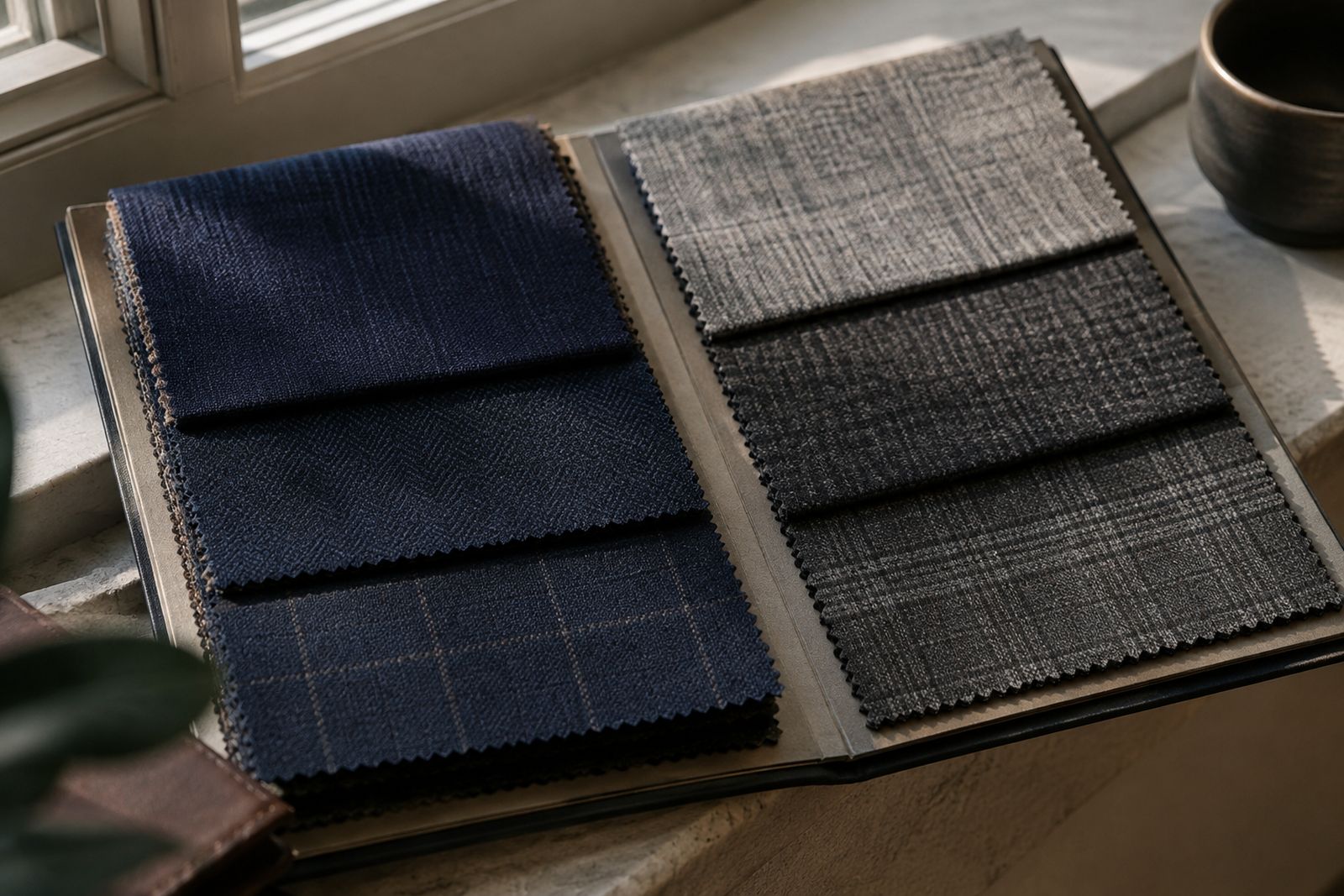
Start with navy, follow with charcoal and let the third suit be the one your calendar asks for. To plan the rest of your rotation, read how many suits a man needs, and when you are ready to commission, see our ranking of the best tailors in London.
Questions people ask
What color should my first suit be?
Your first suit should be plain dark navy. It suits interviews, offices, weddings and dinners, works with black or brown shoes, and pairs with nearly every shirt and tie. Charcoal is the only serious alternative, and a better first choice only if you mainly need a suit for funerals or very formal business.
What are the most versatile suit colors?
Navy and charcoal are the most versatile suit colors, followed by mid gray. All three work with white and light blue shirts, a wide range of ties and both black and brown shoes. Together they cover nearly every occasion where a suit is expected.
What suit colors should every man own?
Every man who wears suits regularly should own navy and charcoal. A third suit in mid gray completes a wardrobe that covers business, celebrations and funerals. Brown, patterns and seasonal colors are worth adding only after those three.
Is a brown suit a good choice?
A brown suit is a good fourth suit, especially in autumn and winter fabrics such as flannel and tweed. It is warmer and more relaxed than navy or gray, so it suits relaxed offices, daytime events and weekends rather than formal business or evenings. Wear it with brown shoes rather than black.
Is a black suit a good first suit?
A black suit is a poor first suit. Traditionally it is an evening, formal and funeral color, so it looks severe in daylight and in most offices, and it limits your choice of ties and shoes. Buy navy or charcoal first and add black later if your evenings call for it.
Should I wear navy or charcoal to a job interview?
Both are correct for a job interview. Navy reads slightly more approachable, while charcoal reads slightly more formal and serious, which suits conservative fields such as law and finance. Either one with a white or light blue shirt and a quiet tie is a safe choice.
What suit color is best for a wedding guest?
Navy is the safest suit color for a wedding guest, at any time of day. Mid and light gray work well for daytime and summer weddings, and charcoal suits evening ceremonies. Avoid black at a daytime wedding and anything that could compete with the wedding party.
TailorGuide is independent. Our guides are written and checked by our team and carry no paid endorsements. How we work.