The short answer
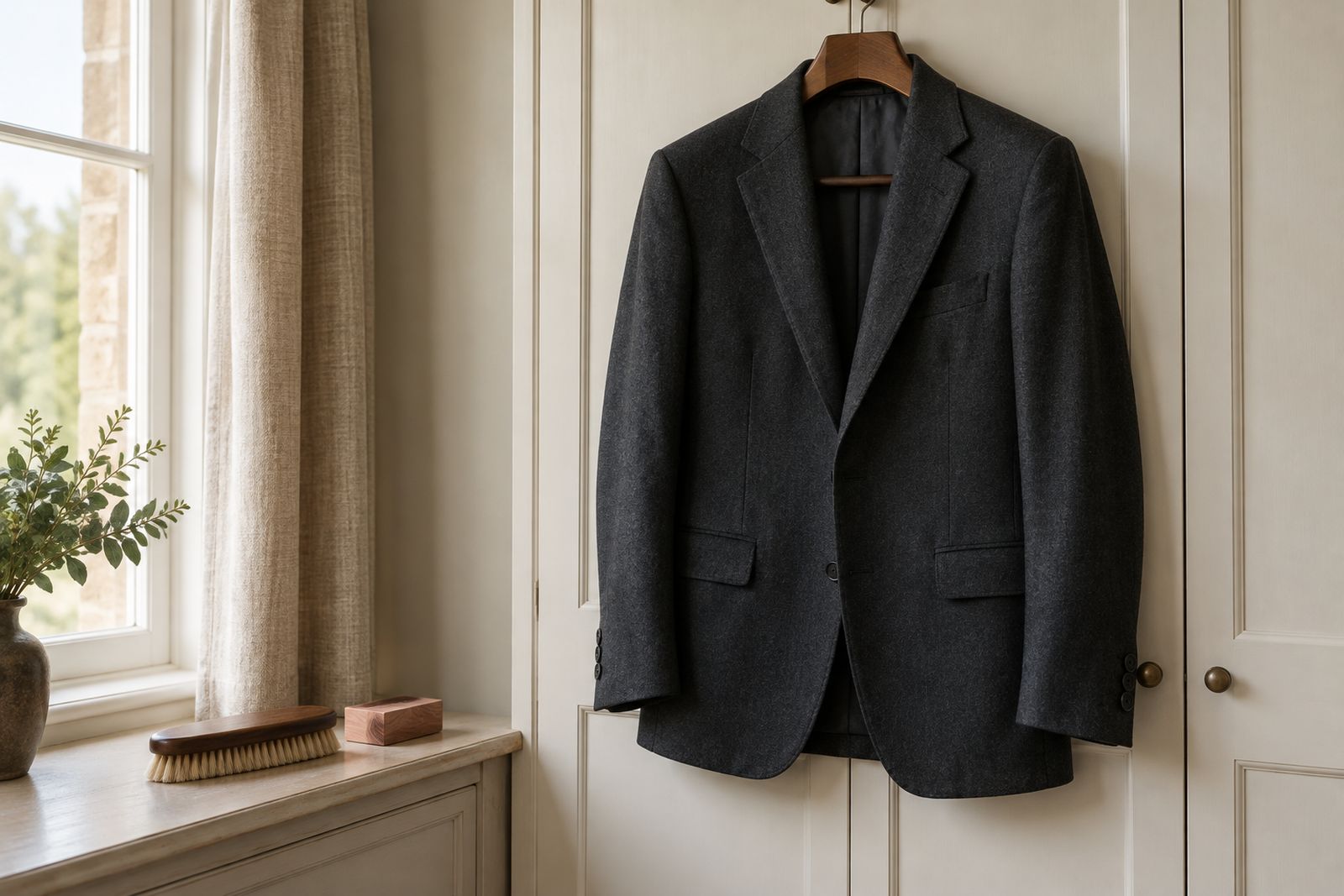
To care for a suit, rest it at least 24 hours between wears, empty the pockets, hang it on a wide, shaped wooden hanger and brush it with a natural-bristle brush after every wear. Steam out wrinkles instead of ironing, spot clean small marks, and dry clean only when the suit is soiled or smells. Store it clean, in a breathable cotton bag, away from moths.
- Rest a suit at least 24 hours between wears, ideally 48.
- Brush it after every wear with a natural-bristle clothes brush.
- Hang jackets on wide, shaped hangers; hang trousers by the hems or over a felted bar.
- Steam weekly, press occasionally, dry clean only when soiled or smelly.
- Clean a suit before storing it: moth larvae prefer soiled wool.
- Fix loose buttons, open seams and fraying hems early, before they spread.
In this guide
- How to care for a suit: the daily, weekly, seasonal and yearly routine
- What to do after you take off a suit
- How often should you wear the same suit?
- Should you brush a suit? Yes, after every wear
- Which hangers are best for suits?
- Steaming and spot cleaning between wears
- Pressing vs dry cleaning: what's the difference?
- Which fix for which problem?
- How to store a suit and protect it from moths
- How long does a suit last?
- When to see a tailor for repairs
- Common suit care mistakes
- Questions people ask
Knowing how to care for a suit matters as much as what you paid for it. A good wool suit wears out mostly from three habits: wearing it day after day without rest, hanging it on the wrong hanger, and sending it to the dry cleaner too often. Fix those three, add a minute of brushing after each wear, and a suit holds its shape and color far longer.
What follows is the routine a good tailor gives a client, from the evening you take a suit off to the day you put it away for summer. Each part links to a deeper guide where you need more detail.
Suit care at a glance
- After each wear
- Empty the pockets, hang on a shaped hanger, brush, air overnight
- Between wears
- Rest at least 24 hours, ideally 48
- Weekly
- Check for marks, spot clean, steam out creases
- Each season
- Professional press if needed; clean before storing
- Once a year
- Check buttons, seams, hems and linings; tailor visit if needed
- Dry cleaning
- Only when soiled or smelly; once or twice a season at most with regular wear
How to care for a suit: the daily, weekly, seasonal and yearly routine
Good suit care is a rhythm, not a rescue. Most of the work is small and frequent. The harsh treatments, pressing and dry cleaning, are rare. The table sets out the whole routine in one place.
| When | What to do | Time | Why it matters |
|---|---|---|---|
| After each wear | Empty the pockets, hang the jacket on a shaped hanger and the trousers by the hems, brush, leave out to air overnight | 2 to 3 minutes | Removes grit and lets moisture and creases leave the fabric |
| Between wears | Rest the suit at least 24 hours, ideally 48, before wearing it again | None | Wool needs time to recover its shape |
| Weekly | Check for spots and treat them; steam the elbows, the back and the backs of the knees | 5 to 10 minutes | Fresh marks lift easily; creases release before they set |
| Each season | Professional press if the suit looks tired; dry clean only if soiled; clean anything going into storage | One visit to a cleaner | Restores shape and removes soil that attracts moths |
| Once a year | Inspect buttons, seams, linings, hems and pocket bags; refresh cedar and lavender; check the fit | 15 minutes, plus a tailor visit if needed | Small repairs prevent bigger damage |
| Only when needed | Dry clean when a stain will not shift or a smell will not air out | Rarely | Every clean and press wears the fabric a little |
What to do after you take off a suit
The first few minutes after you take a suit off do more for it than anything a dry cleaner can do. Body heat and moisture are still in the fabric, so creases drop out easily if the suit goes straight onto a proper hanger.
After every wear
- Empty every pocket. A phone, keys and a wallet stretch the pockets and pull the jacket out of line.
- Hang the jacket on a wide, shaped hanger and fasten one button (the top button of a two-button jacket, the middle of a three) so the fronts hang straight.
- Take the belt out of the trousers (pants) so it does not drag the waistband out of shape.
- Hang the trousers upside down by the hems from a clamp hanger, or fold them along the crease over a felted bar.
- Brush the jacket and trousers before they go back in the wardrobe.
- Leave the suit outside the wardrobe overnight, or in a ventilated wardrobe with space around it, so moisture can escape.
- Look for marks under good light, especially on the lapels, the jacket front, the cuffs and the trouser thighs.
How often should you wear the same suit?
Wear the same suit no more than one day in two, and give it at least 24 hours of rest between wears, ideally 48. Wool fiber is naturally crimped and elastic. Given time on a good hanger, it springs back: creases at the elbows and knees fall out, and the moisture your body puts into the fabric over a day evaporates.
Worn every day, a suit never recovers. Creases deepen and set, the seat and elbows start to bag, and sweat stays in the fabric, which means more cleaning and faster wear. Two suits in rotation each last longer than one suit worn daily, and a working wardrobe of three or more is kinder still. Our guide to how many suits a man needs shows how to build that rotation.
Rest applies within the day too. Take the jacket off for long drives and for meetings where you can hang it up, and unbutton it whenever you sit. A buttoned jacket strains the button and pulls creases across the front.
Should you brush a suit? Yes, after every wear
Yes. Brushing is the most useful minute you can spend on a suit each day. A day's wear leaves dust, grit, crumbs, hair and skin flakes in the weave. Grit abrades the fibers every time the fabric flexes, and soiled wool attracts clothes moths. A brush lifts all of it in a minute without water, heat or chemicals.
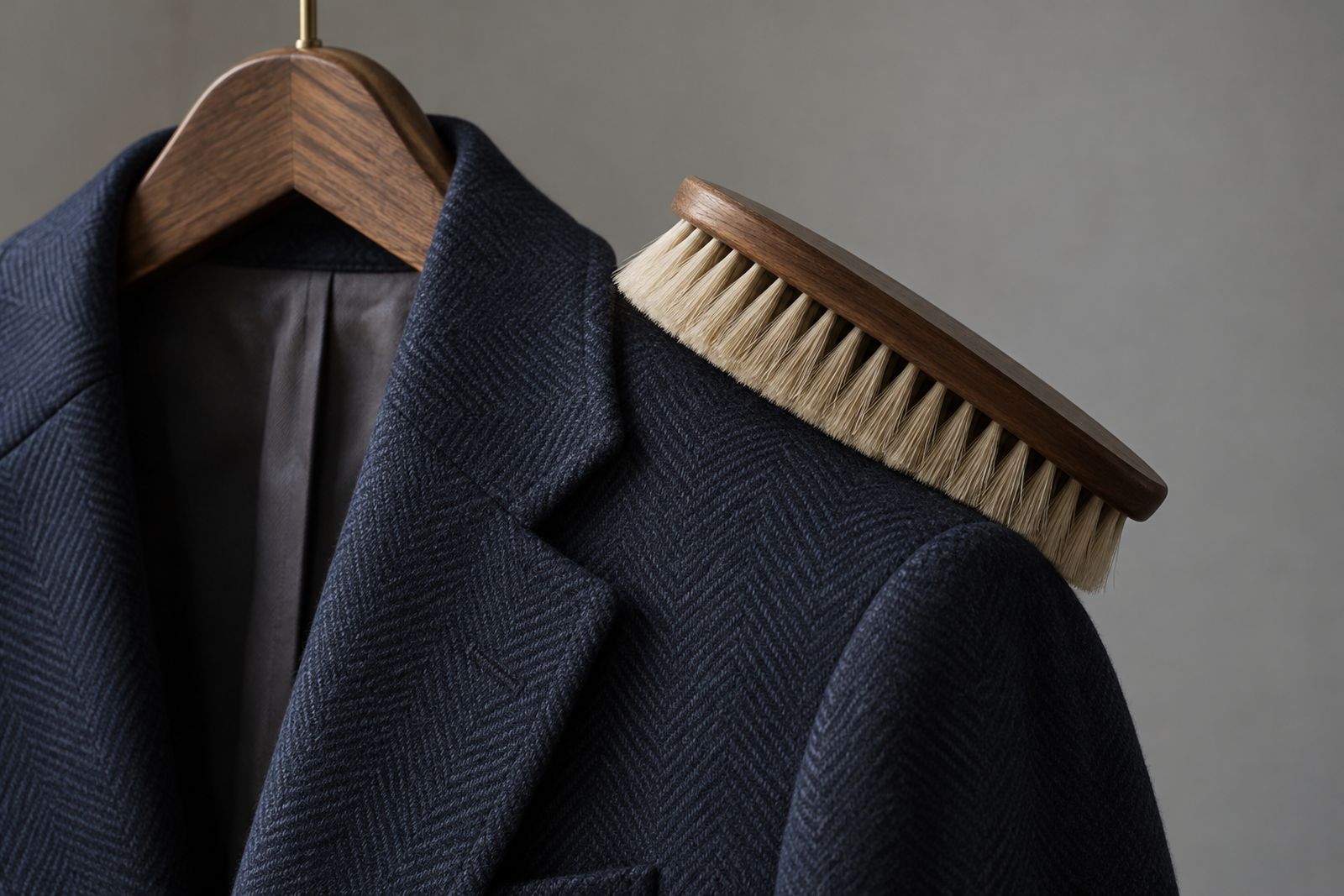
Use a clothes brush with natural bristles, which flex down into the weave and lift dust out. Horsehair is soft and suits fine worsteds, flannels and cashmere. Boar bristle is stiffer and better for tweeds and heavier wools.
How to brush a suit
- 1
Hang it at chest height
Put the jacket on its hanger on a door hook or wardrobe rail, so you can reach every part and the fabric is held still.
- 2
Start under the collar
Lift the collar and brush beneath it, then along the gorge, the seam where collar meets lapel. Dust collects here more than anywhere else.
- 3
Brush the shoulders and back
Use short, brisk strokes downward from the collar to the hem, with a slight flick of the wrist at the end of each stroke to throw the dust off the fabric.
Tip: For embedded dust, give a few short strokes upward, against the nap, then finish with downward strokes so the fibers lie flat again.
- 4
Do the fronts and sleeves
Brush each front from shoulder to hem, then each sleeve from the shoulder down to the cuff. Lift the pocket flaps and brush beneath them.
- 5
Brush the trousers
Lay the trousers flat or hang them from the waistband and brush from the waist down to the hems. Brush out the grit that collects inside turn-ups (cuffs).
- 6
Leave mud until it dries
Never brush wet mud or a damp suit, which pushes dirt into the weave. Let the suit dry on its hanger at room temperature, then brush.
Which hangers are best for suits?
The best hanger for a suit jacket is a wide wooden hanger with shaped, rounded shoulder ends, sized to the jacket. The ends should fill the shoulders and stop just inside the sleevehead (the top of the sleeve), so the jacket's weight rests on its shoulder structure rather than on two thin points. Most men's suit hangers are about 17 to 19 inches (43 to 48 cm) wide. Choose the width that matches your jacket rather than the widest you can find: ends that poke into the sleeves push out bumps.
Wire and thin plastic hangers distort shoulders. Their narrow ends dent the shoulder and let the jacket's weight drag the chest out of shape. Trousers need their own treatment: hung by the hems or folded along the crease, never folded across the knee on a bare wire.
| Hanger | Use it for | Why |
|---|---|---|
| Wide wooden hanger with shaped shoulder ends | Suit jackets, blazers, overcoats | Supports the shoulder structure and keeps the chest and lapels in shape |
| Clamp hanger (trouser clip) | Trousers, hung upside down by the hems | The weight of the trousers pulls creases out of the knees and seat |
| Hanger with a felted or non-slip bar | Trousers folded along the crease | Holds trousers without slipping, with a softer fold than a bare bar |
| Wire hanger | Nothing; return it to the cleaner | Thin ends dent the shoulders and the wire can rust onto fabric |
| Thin plastic hanger | Shirts at most | Too narrow to support a tailored shoulder |
Steaming and spot cleaning between wears
How to steam a suit
Steaming is the everyday way to remove creases and freshen a suit. Steam relaxes the wool fibers so creases at the elbows, the back and the backs of the knees fall out under the garment's own weight, and it helps release light odors. Nothing touches the fabric, so there is no risk of shine.
Hang the suit on its proper hanger, hold a handheld steamer an inch or two (2.5 to 5 cm) from the fabric and work from the top down, keeping the head moving. Steam the lining too. Then leave the suit to cool and dry for 15 to 30 minutes before you wear it, or the creases return. Never steam over a stain, because heat can set it. Our guide to getting wrinkles out of a suit covers steaming, pressing and hotel-room methods step by step.
How to spot clean a suit
Spot clean small marks as soon as you can, before they set. Lift off any solids with a blunt knife edge, then blot (never rub) with a clean white towel dampened in cold water. If water alone does not shift the mark, add a drop of wool detergent, test it first on a hidden area such as the inside of a trouser hem, and work from the edge of the mark toward its center so you do not spread it.
Finish by blotting with plain water and dampening slightly beyond the mark, feathering the edges so no water ring forms as it dries. Let it dry at room temperature, away from radiators. Oil and grease are different: water will not move them, so cover the mark with cornstarch or talc for several hours to draw the oil out, then brush it away. Our guide to cleaning a suit at home has a stain-by-stain table.
Pressing vs dry cleaning: what's the difference?
Pressing reshapes a suit; dry cleaning cleans it. Most suits need pressing far more often than cleaning, and the two are easy to confuse because cleaners sell both over the same counter.
Pressing
Pressing is shaping and smoothing a garment with steam, heat and pressure, using an iron or a pressing machine. It removes wrinkles and restores trouser creases but does not clean.
Dry cleaning
Dry cleaning is washing a garment in a liquid solvent instead of water, then drying and pressing it. It removes oil, grease and general soil that water-based spot cleaning cannot.
Home steaming
Weekly, or after a trip
- Removes everyday creases
- Freshens light odors
- Nothing touches the fabric, so no shine
- Will not restore a sharp trouser crease
Professional pressing
A few times a year
- Restores crisp lines and trouser creases
- Ask for 'press only' when the suit is clean
- Ask for the lapels to be left rolled, not flattened
- Far less wear than a full clean
Dry cleaning
Only when soiled
- Removes oil, sweat and stains
- Solvent, tumbling and pressing wear the fabric a little each time
- Clean the jacket and trousers together
- Once or twice a season at most with regular wear
For a suit worn once or twice a week, once or twice a season is usually plenty of dry cleaning. Each clean tumbles the suit in solvent and finishes it on hot presses, which slowly flattens the fabric's surface and, done heavily, can flatten the shape a canvassed chest was built to hold. Read how often to dry clean a suit for the signs that a clean is due and how to brief your cleaner.
Which fix for which problem?
Match the treatment to the problem and always start with the gentlest one. Most of what goes wrong with a suit in a normal week is dust, creases or a faint smell, and none of those needs a cleaner.
Gentlest: use often
Rest and air
After every wear
Brush
After every wear
Steam
Weekly, or as needed
Spot clean
When a mark appears
Press
A few times a year
Dry clean
Only when soiled or smelly
Harshest: use rarely
| Brush | Air | Steam | Spot clean | Press | Dry clean | |
|---|---|---|---|---|---|---|
| Dust, lint and crumbs | ||||||
| Creases at elbows and knees | ||||||
| Light odor (food, smoke) | ||||||
| Small food or drink spot | ||||||
| Oil or grease mark | ||||||
| Lost trouser crease | ||||||
| Heavy soiling or sweat |
How to store a suit and protect it from moths
Store a suit clean, in a breathable cotton garment bag, in a cool, dark, dry place with air around it. Clothes moth larvae feed on wool, and they prefer soiled fabric, so a suit put away with sweat or food on it is the one most likely to be eaten. Clean anything you have worn before it goes away for a season.
Use cotton or other breathable bags rather than the thin plastic covers from the dry cleaner. Plastic traps moisture against the fabric, which can lead to mildew and musty smells, and those open-ended covers do not keep moths out anyway. Keep suits out of damp basements and hot attics, and out of direct sunlight, which fades color along the shoulders.
Do cedar and lavender keep moths away?
They help a little, but they are deterrents, not protection. Cedar blocks and hangers give off an aromatic oil that moths dislike, and lavender sachets work in a similar way, but the effect is mild. Both fade with time: sand cedar lightly to refresh it and replace lavender sachets each year. Cleanliness, closed bags and regular inspection do the real work.
Before you put a suit away for the season
- Have it cleaned if it has been worn since its last clean; at the least, brush it thoroughly and check every spot.
- Empty the pockets and remove belts, pocket squares and lapel pins.
- Hang it on its shaped hanger and fasten one button.
- Zip it into a breathable cotton garment bag, one suit per bag.
- Add cedar or lavender to the wardrobe as a mild deterrent.
- Store it somewhere cool, dark and dry, with space around it.
- Take it out every month or two to air it, brush it and look for damage. Moths favor dark, undisturbed places.
How long does a suit last?
A well-made wool suit, rotated with others and cared for as above, can stay in service for many years; the same suit worn daily without rest looks tired far sooner. Four things decide which way it goes.
- Rotation. Rest between wears does more for a suit's life than any product you can buy.
- Fabric. Sturdy worsteds of around 10 to 12 oz (310 to 370 g) stand up to wear better than very fine, lightweight fabrics with high Super numbers, which feel softer but are more delicate. See Super numbers explained.
- Construction. A canvassed jacket can be cleaned, pressed and altered many times; a fused front can bubble with heat and age. See fused vs canvas.
- Trousers. Trousers wear out before jackets, at the seat, the inner thighs and the hems. A second pair ordered with the suit spreads that wear across two pairs and keeps the suit wearable for longer.
When to see a tailor for repairs
Take a suit to a tailor as soon as you notice a loose button, an opening seam or a fraying hem. Small faults spread: a split seam at the seat widens every time you sit, and a trouser hem wears through quickly once its edge has gone. Caught early, most repairs are quick and inexpensive.
| Problem | What a tailor does | When to go |
|---|---|---|
| Loose or lost button | Re-sews it with a thread shank so it sits clear of the fabric | As soon as it wobbles |
| Seam opening at the seat, armhole or pocket corners | Re-sews the seam and reinforces the stress point | At the first gap |
| Thin or shiny inner thighs or crotch | Adds a reinforcing patch inside before the fabric wears through | When the fabric looks thin there |
| Fraying trouser hem | Re-hems and adds heel tape (kick tape) inside the back of the hem to take the wear | When the edge starts to fray |
| Torn lining or holed pocket bag | Patches or replaces the lining section or the pocketing | Before small items fall through |
| Moth hole, burn or snag | Sends it to a specialist for invisible reweaving, using threads taken from a seam allowance | Promptly, before the hole grows |
| Fit has changed | Lets out or takes in the waist, seat and jacket within the seam allowances | When it pulls or hangs loose |
Common suit care mistakes
- Wearing the same suit two days running.
- Leaving a phone, keys and a wallet in the pockets.
- Hanging the jacket on a wire hanger or the back of a chair.
- Dry cleaning every few wears to remove creases that a steamer would fix.
- Cleaning the trousers without the jacket, so the two fade at different rates.
- Putting a hot iron directly on wool, which leaves a shine that rarely comes out.
- Storing a suit in the cleaner's plastic cover.
- Putting a worn suit away for the summer without cleaning it.
- Machine washing a wool suit, which shrinks and felts it beyond repair.
Start tonight: empty the pockets, hang the suit properly and give it a brush. If you are traveling, read how to pack a suit. And if you are ready for a suit built to be cared for over decades, start with our ranking of the best tailors in London.
Questions people ask
How do you make a suit last longer?
Rotate it so it rests at least 24 hours between wears, hang it on a wide, shaped wooden hanger, and brush it after every wear. Steam out wrinkles and dry clean only when the suit is soiled or smells. Fix loose buttons and fraying hems early, and consider a second pair of trousers, since trousers wear out first.
How often should you wear the same suit?
No more than one day in two. Wool needs at least 24 hours, ideally 48, on a good hanger to recover its shape and let moisture evaporate. If you wear a suit five days a week, three suits in rotation give each one that rest.
Should you brush a suit after every wear?
Yes. A minute with a natural-bristle clothes brush removes the dust and grit that abrade wool and the soil that attracts moths. Brush downward with short, brisk strokes, starting under the collar.
How long does a suit last?
It depends on how often you wear it, the fabric and the construction. A well-made wool suit worn in rotation and cared for properly can last many years, while the same suit worn every day looks tired much sooner. The trousers usually wear out first, which is why a second pair is worth ordering.
Can you iron a suit?
Yes, but never with the iron directly on the wool. Set the iron to the wool setting (two dots, about 300°F (150°C)), lay a damp cotton pressing sheet over the fabric, and press by lifting and lowering the iron rather than sliding it. Leave the lapels rolled, not pressed flat.
How should you store a suit you rarely wear?
Clean it first, then hang it on a shaped wooden hanger inside a breathable cotton garment bag, in a cool, dark, dry wardrobe with space around it. Add cedar or lavender as a mild deterrent, and take the suit out every month or two to air it and check for moth damage.
Should you hang suit trousers upside down?
Yes. Hanging trousers upside down by the hems from a clamp hanger lets their weight pull creases out of the knees and seat. Line up the creases before you clamp them. Folding them along the crease over a felted bar also works well.
TailorGuide is independent. Our guides are written and checked by our team and carry no paid endorsements. How we work.