The short answer
Smart casual for men means polished, well-fitted casual clothes: chinos, wool trousers or dark jeans; a collared shirt, polo, fine knit or plain T-shirt; and loafers, suede boots or clean leather sneakers. An unstructured jacket is optional but lifts any outfit. No tie is needed. Shorts, athletic wear, big logos and worn-out clothes fall below the code.
- Smart casual starts from casual clothes and smartens them: better fabrics, better fit, leather shoes.
- Dark, plain jeans are fine; faded, ripped or very skinny ones are not.
- Clean, minimal leather sneakers usually pass; running shoes and canvas high-tops do not.
- An unstructured jacket or overshirt is the quickest way to the smart end of the range.
- At a smart casual wedding, lean dressier: jacket, chinos or wool trousers, loafers.
In this guide
- What does smart casual mean for men?
- Is smart casual the same as business casual?
- Smart casual outfits: eight examples
- What colors work for smart casual?
- Smart casual yes and no list
- Can you wear jeans for smart casual?
- Can you wear sneakers for smart casual?
- What is smart casual for a wedding?
- Smart casual in summer and winter
- Smart casual at restaurants, clubs and hotels
- Can you wear a T-shirt or shorts for smart casual?
- Smart casual at work
- A smart casual capsule wardrobe
- The tailor's view: the details that make it smart
- Questions people ask
Smart casual for men is the dress code that sounds easiest and causes the most second-guessing. It appears on invitations to dinners, parties, weekend weddings and company events, and it promises freedom while quietly expecting effort. The idea is simple: casual clothes, chosen and worn well. The difficulty is knowing where the line sits, especially with jeans and sneakers. In short: dark, plain jeans and clean leather sneakers usually pass; anything athletic, faded or covered in logos does not.
Smart casual
Smart casual is a social dress code for polished, well-fitted casual clothes: tailored or neat trousers including dark jeans, a collared shirt, polo, knit or plain T-shirt, and leather shoes or clean sneakers, with an optional unstructured jacket and no tie required.
Smart casual at a glance
- Trousers
- Chinos, wool trousers, dark plain jeans
- Tops
- Oxford or casual shirt, polo, fine knitwear, plain T-shirt under a layer
- Layer
- Unstructured jacket, overshirt or cardigan, optional
- Shoes
- Loafers, derbies, suede or leather boots, clean leather sneakers
- Tie
- Not needed
- Below the code
- Shorts (usually), athletic wear, flip-flops, big logos, anything worn out
What does smart casual mean for men?
Smart casual means clothes you could wear on a good weekend, made sharper by fabric, fit and shoes. It starts from casual clothing and smartens it up: jeans become dark and plain, the T-shirt gains a jacket or gives way to a shirt, sneakers become leather and spotless, or give way to loafers. On the ladder of men's dress codes it sits below business casual and above casual.
The code has a range. At its smart end, a navy jacket, an oxford shirt, wool trousers and loafers is close to business casual. At its casual end, a fine knit, dark jeans and white leather sneakers is close to casual. Where you pitch it depends on the venue, the time of day and the host. An evening at a good restaurant asks for the smart end; a daytime barbecue for the casual end.
Where to pitch it: smart casual by setting
| Setting | Where to pitch it | A safe outfit |
|---|---|---|
| Wedding | Smart end | Jacket, collared shirt, wool trousers or chinos, loafers; tie optional |
| Members' club or smart restaurant | Smart end | Jacket, shirt, chinos or wool trousers, loafers or boots |
| Restaurant dinner or date | Middle | Shirt or fine knit, dark jeans or chinos, loafers or boots, jacket optional |
| Company party or away day | Middle | Shirt, chinos or dark jeans, leather shoes or clean sneakers |
| Gallery opening or launch | Middle, with personality | Overshirt or jacket, knit or T-shirt, dark trousers, boots or sneakers |
| Daytime party or barbecue | Casual end | Polo or linen shirt, chinos, clean sneakers or loafers |
Is smart casual the same as business casual?
No, though they overlap. Business casual is an office code that starts from the suit and removes the tie; smart casual is a social code that starts from casual clothes and smartens them up. In practice the line is jeans and sneakers: smart casual usually allows dark jeans and clean leather sneakers, while business casual often does not. Smart casual also allows more texture, color and personality, and it never expects a tie.
Business casual
Office code
- Starts from the suit and removes the tie
- Blazer or sport coat expected for meetings
- Chinos and wool trousers; jeans depend on the office
- Collared shirts and fine knitwear
- Leather shoes; sneakers only in relaxed offices
- Conservative colors and patterns
Smart casual
Social code
- Starts from casual clothes and smartens them
- Unstructured jacket or overshirt optional
- Chinos, wool trousers and dark jeans
- Shirts, polos, knits, plain T-shirts under a layer
- Leather shoes, boots or clean leather sneakers
- More texture, color and personality
Smart casual outfits: eight examples
These eight outfits cover the seasons and the usual settings, from a summer lunch to a winter dinner. Each one is a formula, so swap colors freely within it.
| Outfit | Top | Trousers | Shoes | Layer | Best for |
|---|---|---|---|---|---|
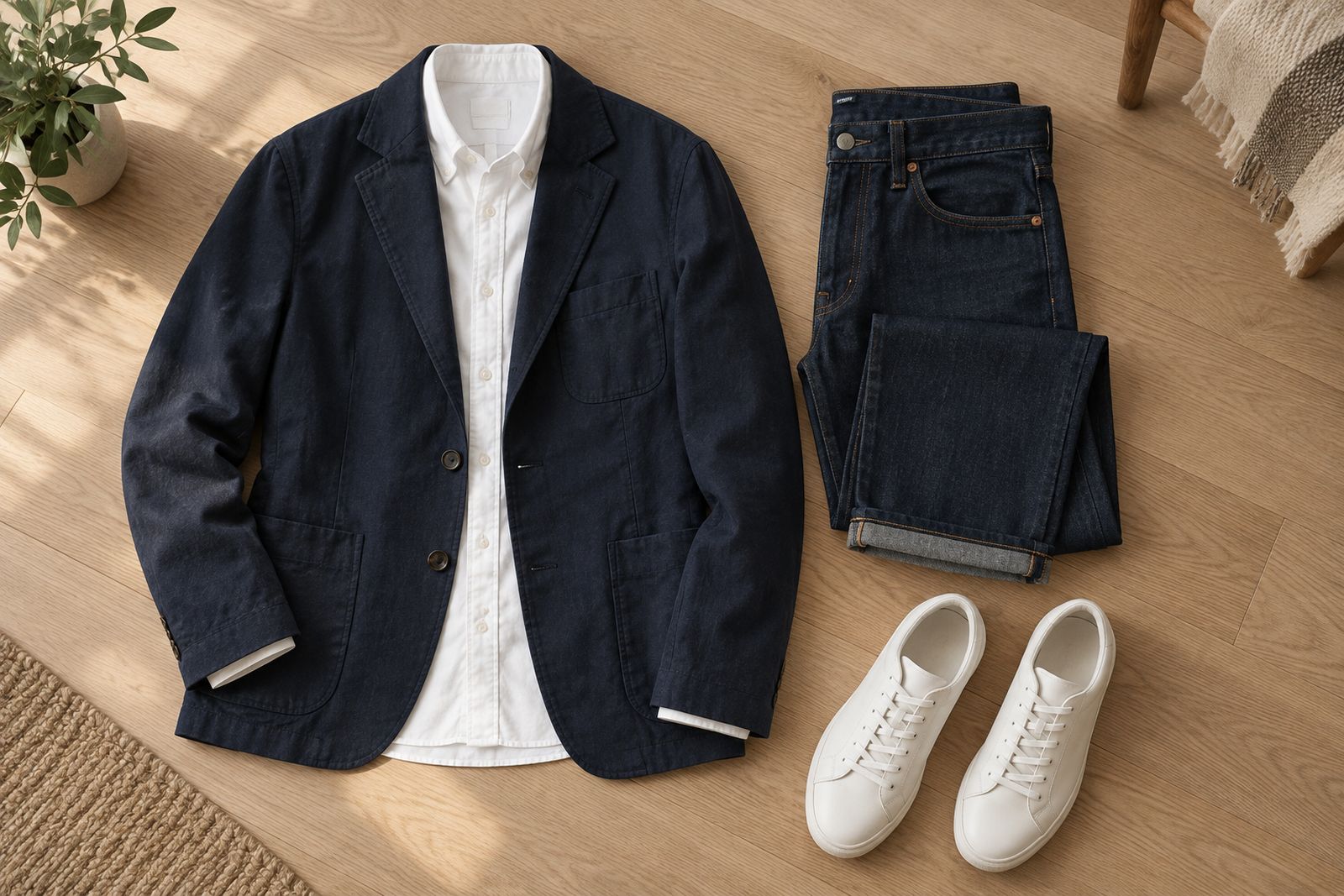
| 1. Restaurant dinner | White oxford shirt | Dark, plain jeans | Brown suede loafers | Navy unstructured blazer | Dinners, dates, evening drinks |
| 2. Spring classic | Light blue oxford shirt | Stone chinos | Brown leather loafers | Navy or olive cotton jacket | Lunches, daytime events |
| 3. Summer lunch | Knitted polo, plain color | Light gray tropical wool or stone chinos | White leather sneakers or suede loafers | None | Warm daytime events |
| 4. Summer evening | Linen shirt in white or pale blue | Navy cotton or linen-blend trousers | Suede loafers | Unlined linen-blend jacket, optional | Terraces, summer parties |
| 5. Autumn weekend | Merino crew neck over an oxford shirt | Dark jeans | Suede chukka boots | Waxed or quilted jacket for outside | Weekend lunches, country pubs |
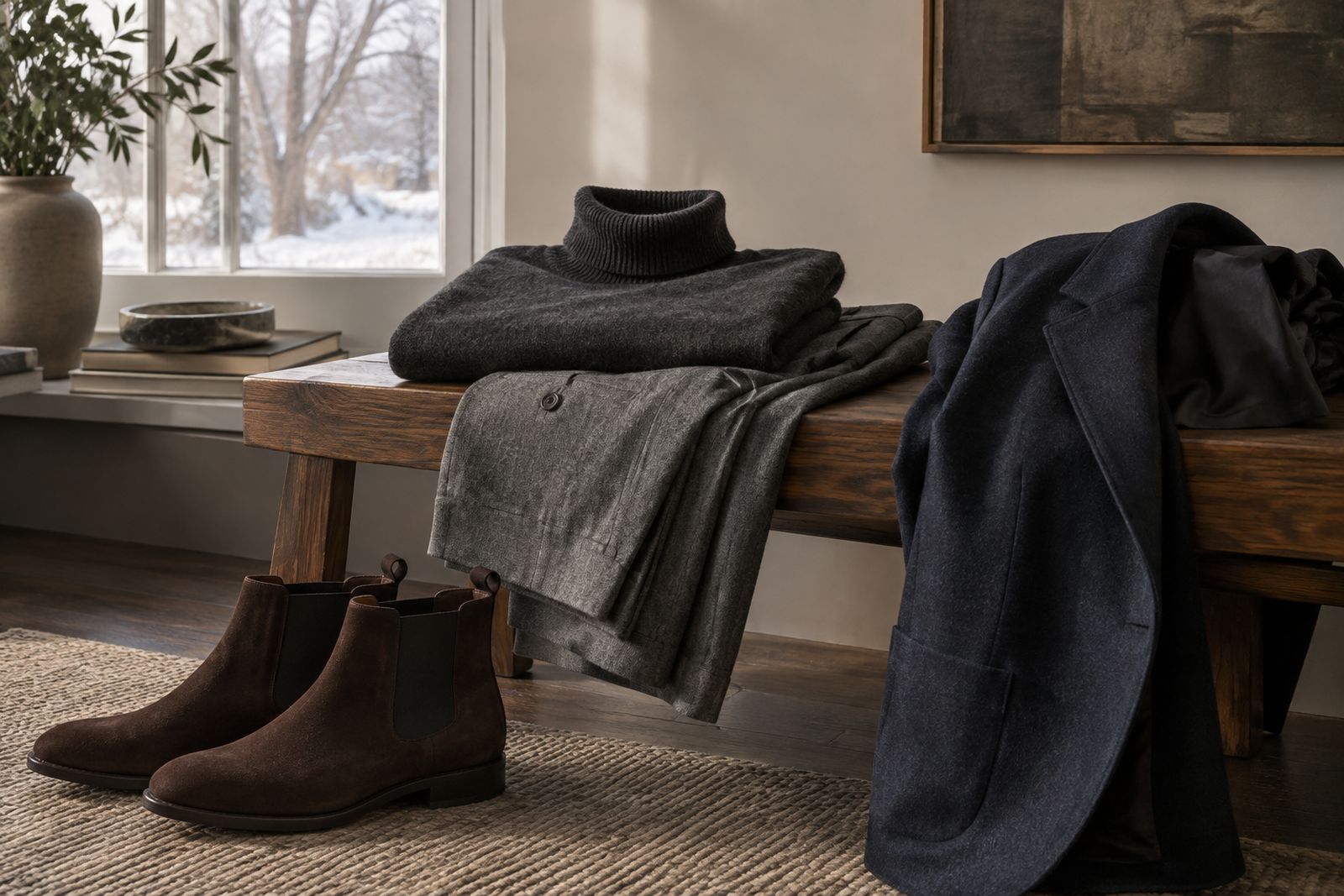
| 6. Winter evening | Charcoal or navy roll-neck | Gray flannel trousers | Black or dark brown chelsea boots | Navy blazer | Winter dinners and parties |
| 7. Creative office | Plain white or navy T-shirt | Navy chinos | White leather sneakers | Wool overshirt | Studios, start-ups, relaxed work events |
| 8. Smart casual wedding | White or light blue shirt | Mid-gray wool trousers or stone chinos | Brown loafers | Navy or light gray jacket; optional tie | Daytime and relaxed weddings |
Classic
Blazer, oxford shirt, dark jeans
Navy
Jacket
Dark indigo denim
Trousers
White
Shirt
Brown suede
Shoes
Classic
Olive jacket, stone chinos
Olive cotton
Jacket
Stone
Trousers
Light blue
Shirt
Dark brown
Shoes
Works
Roll-neck and flannels
Navy
Jacket
Mid-gray flannel
Trousers
Charcoal roll-neck
Shirt
Black chelsea boot
Shoes
Works
Overshirt, T-shirt, sneakers
Charcoal wool overshirt
Jacket
Navy chinos
Trousers
White T-shirt
Shirt
White leather sneakers
Shoes
Avoid
Hoodie, joggers, running shoes
Casual or athletic wear, below smart casual.
Black joggers
Trousers
Gray hoodie
Shirt
Running shoes
Shoes
What colors work for smart casual?
Neutral bases make smart casual easy: navy, gray, stone, olive, brown and white, with denim in dark indigo. Add one point of color at a time, in a knit, a shirt or a jacket, rather than several. Earth tones and soft blues read as relaxed but considered; head-to-toe black reads as evening or creative. Keep patterns to one item, such as a striped shirt or a checked jacket, with plain pieces around it.
Smart casual yes and no list
| Item | Smart casual? | Notes |
|---|---|---|
| Unstructured jacket or blazer | Yes | The quickest way to the smart end |
| Oxford or casual shirt | Yes | Tucked or untucked if cut to the right length |
| Polo shirt | Yes | Knitted or plain piqué; no large logos |
| Fine knitwear | Yes | Crew neck, V-neck, roll-neck, cardigan |
| Plain T-shirt | Yes, with a layer | White, navy, gray or black, under a jacket or overshirt |
| Chinos and wool trousers | Yes | Pressed, hemmed, in neutral colors |
| Dark, plain jeans | Yes | No fading, rips or heavy distressing |
| Loafers, derbies, boots | Yes | Suede and leather both work |
| Leather sneakers | Usually | Plain, clean and minimal; not at the dressier end |
| Tie | Optional | Rarely needed; a knitted tie suits the code |
| Tailored shorts | Rarely | Only at daytime summer events where the host clearly allows them |
| Graphic T-shirts, big logos | No | Casual wear |
| Hoodies, joggers, athletic wear | No | Casual or gym wear |
| Running shoes, flip-flops | No | Change them before you go |
Can you wear jeans for smart casual?
Yes. Dark, plain, well-fitted jeans are one of the defining items of smart casual, and they are what most clearly separates it from business casual. Choose a dark indigo or black wash with no fading, rips or heavy distressing, in a straight or slim-tapered leg that sits cleanly over your shoes. Wear them with a shirt, a knit or a jacket, and leather shoes or clean sneakers. Light, faded, ripped or very baggy jeans belong to casual.
Can you wear sneakers for smart casual?
Usually, if they are the right sneakers. Plain, low-profile leather sneakers in white, black or navy, kept clean, are widely accepted at smart casual events. Canvas high-tops, running shoes and anything with chunky soles or bright branding are not. At the dressier end of smart casual, such as a wedding, a smart restaurant or an evening event at a club, choose loafers or boots instead. Our guide to shoes with a suit explains how the main shoe styles rank in formality.
What is smart casual for a wedding?
At a wedding, smart casual means the smart end of the range: a jacket, a collared shirt, chinos or wool trousers and leather shoes. A tie is optional. For a daytime summer wedding, a light gray, stone or navy jacket with contrasting trousers and suede loafers is ideal; a light suit worn without a tie also works. Avoid jeans and sneakers unless the couple has said they are welcome, and avoid white or ivory, which can compete with the couple. Our guides to wedding guest attire and beach and summer weddings cover each setting.
Smart casual in summer and winter
Summer
In heat, smart casual moves to lighter fabrics and colors while keeping the same structure. Linen and cotton-linen shirts, knitted polos in cotton or silk blends, and trousers in linen blends, cotton or tropical wool around 7 to 9 oz (220 to 280 g) all work. Stone, sand, light gray, pale blue and olive suit daylight. An unlined cotton or linen-blend jacket can be carried and put on at the door. Suede loafers or white leather sneakers finish it; see our guide to linen suits for how linen behaves through a day.
Winter
In cold weather, texture carries the outfit. Flannel trousers, heavier chinos or dark jeans; roll-necks, shawl-collar cardigans and lambswool crew necks; jackets in tweed, flannel or brushed cotton. Suede chukka boots and polished chelsea boots replace sneakers. A navy or camel overcoat or a waxed jacket goes over the top. Darker colors suit the season: navy, charcoal, brown, bottle green and burgundy.
Smart casual at restaurants, clubs and hotels
When a restaurant, members' club or hotel bar posts a smart casual dress code, it usually means a short list of things it does not allow: sportswear, shorts, flip-flops, caps and sometimes sneakers. A collared shirt or fine knit, chinos or dark jeans and leather shoes passes almost everywhere. Some clubs add "jackets required" for certain rooms; others refuse jeans. Check the venue's website before you go, and if it says nothing, a jacket you can remove is the safe choice.
Can you wear a T-shirt or shorts for smart casual?
A plain T-shirt, yes, as long as it is under a layer such as an unstructured jacket, an overshirt or a cardigan, and is well fitted, in a solid neutral color, and in good condition. On its own, a T-shirt reads as casual. Shorts are rarely smart casual. At a daytime summer event where the host clearly expects them, tailored shorts in cotton or linen, worn with a linen shirt or knitted polo and loafers, can work. In any doubt, wear lightweight trousers.
Smart casual at work
Some employers, particularly in Britain, use "smart casual" as their office dress code where Americans would say business casual. In that context, read it conservatively for the first few weeks: chinos or wool trousers, collared shirts, fine knitwear and leather shoes, with a jacket for meetings. Add dark jeans and leather sneakers only once you see senior colleagues wearing them. For a company party or away day described as smart casual, the social meaning applies, and dark jeans with a shirt and jacket is a safe choice.
A smart casual capsule wardrobe
Fifteen pieces that cover most smart casual invitations
- Navy unstructured jacket with patch pockets
- Wool or cotton overshirt in charcoal, olive or navy
- White and light blue oxford shirts
- One linen shirt for summer
- Navy merino crew neck and a charcoal roll-neck
- Two plain T-shirts in white and navy, well fitted
- Stone chinos and navy chinos
- Dark, plain indigo jeans
- Brown suede loafers and suede chukka or chelsea boots
- One pair of clean, minimal white leather sneakers
The tailor's view: the details that make it smart
In smart casual, fit and condition matter more than in any other code, because the clothes themselves are simple. A plain white shirt and good chinos look smart when they fit and careless when they don't. A tailor can fix most of what goes wrong for a modest cost.
What to ask a tailor to adjust
- Shorten shirts you wear untucked so the hem ends around the middle of the trouser fly, not below the seat.
- Hem chinos and jeans so they sit cleanly on the shoe with a slight break or none.
- Taper trouser legs below the knee if they flap over sneakers or loafers.
- Shorten jacket sleeves so a little shirt cuff shows, about ¼ to ½ inch (6 to 13 mm), or a knit cuff sits at the wrist bone.
- Take in an unstructured jacket at the waist if it hangs like a box.
- Choose jackets with soft shoulders and patch pockets; they look right with jeans in a way suit jackets do not.
Build smart casual around a few pieces that fit: a navy unstructured jacket, white and blue oxford shirts, a fine knit, stone chinos, dark jeans, brown loafers and one pair of clean leather sneakers. Our guide to suit jackets, blazers and sport coats explains which jacket to choose, and if your office uses the term instead, see business casual.
Questions people ask
Is smart casual the same as business casual?
No. Business casual is an office code that starts from the suit and removes the tie, while smart casual is a social code that starts from casual clothes and smartens them. Smart casual usually allows dark jeans and clean leather sneakers, which business casual often does not.
Can you wear jeans for smart casual?
Yes. Dark, plain, well-fitted jeans are a defining smart casual item. Wear them with a shirt, knit or jacket and leather shoes or clean sneakers, and avoid faded, ripped or baggy styles.
Can you wear sneakers for smart casual?
Usually, if they are plain, low-profile leather sneakers kept clean. Running shoes, canvas high-tops and chunky or heavily branded styles are not smart casual. At the dressier end, such as a wedding or a smart restaurant, wear loafers or boots.
What is smart casual for a wedding?
The smart end of the range: a jacket, a collared shirt, chinos or wool trousers and leather shoes, with a tie optional. A light suit without a tie also works for a daytime wedding. Avoid jeans, sneakers and white unless the couple says otherwise.
Can you wear a T-shirt for smart casual?
Yes, if it is plain, well fitted and worn under a layer such as an unstructured jacket, overshirt or cardigan. A T-shirt on its own reads as casual. Avoid graphics and logos.
Can you wear shorts for smart casual?
Rarely. Tailored cotton or linen shorts can work at a daytime summer event where the host clearly expects them, worn with a linen shirt or knitted polo and loafers. Otherwise, choose lightweight trousers.
Do you need a jacket for smart casual?
No, but it helps. An unstructured jacket or overshirt is the quickest way to the smart end of the code, and it can come off if the room is more relaxed than you expected. For evening events and weddings, wear one.
Does smart casual mean a tie?
No. Smart casual does not expect a tie, though a knitted tie with a jacket can suit the dressier end. If an invitation expects ties, it will usually say cocktail or lounge suit instead.
TailorGuide is independent. Our guides are written and checked by our team and carry no paid endorsements. How we work.