The short answer
Business casual for men means smart separates without a tie: a collared shirt or fine knit, chinos or wool trousers, and leather shoes such as loafers, derbies or chukka boots, with a blazer or sport coat when meeting clients. Jeans, polo shirts and leather sneakers depend on the workplace. Shorts, T-shirts, hoodies and athletic shoes are out almost everywhere.
- The core formula: collared shirt, chinos or wool trousers, leather shoes. No tie needed.
- Add a blazer or sport coat for meetings, presentations and anything client-facing.
- Jeans, polos and leather sneakers are workplace-dependent: copy senior colleagues, not the newest hire.
- Shorts, T-shirts on their own, hoodies and running shoes are out almost everywhere.
- In heat, keep the formula and change the fabrics: linen blends, tropical wool, unlined jackets.
In this guide
- What does business casual mean for men?
- Business casual yes, maybe and no list
- Business casual outfit examples
- Can you wear jeans for business casual?
- Is a polo business casual?
- Do you need a blazer for business casual?
- What shoes are business casual?
- Business casual in winter
- Business casual in hot climates
- Business casual vs business formal vs smart casual
- Business casual at interviews, conferences and events
- A business casual capsule wardrobe
- The tailor's view: making separates look sharp
- Questions people ask
Business casual for men is the most common office dress code and the least clearly defined. Ask ten employers what it means and you will get ten answers, from "a jacket, just no tie" to "anything without holes". The core is consistent, though: tailored separates, a collared shirt, leather shoes, and no tie required. Start with that core, and add jeans, polos or sneakers only once you see senior colleagues wearing them.
Business casual
Business casual is an office dress code that removes the tie and the matching suit from business formal, while keeping tailored trousers, collared shirts and leather shoes. A blazer or sport coat is optional and expected for client-facing work.
Business casual at a glance
- Always fine
- Collared shirts, fine knitwear, chinos, wool trousers, loafers, derbies, blazers
- Depends on the office
- Dark jeans, polo shirts, leather sneakers, short-sleeved shirts
- Almost never
- Shorts, T-shirts on their own, hoodies, running shoes, sandals
- Tie
- Not required; optional
- Jacket
- Optional day to day; wear one for clients and presentations
- The test
- Match what senior colleagues wear on an ordinary day
What does business casual mean for men?
Business casual means dressing like a professional who is not wearing a suit. It starts from business formal and removes things: first the tie, then the requirement that jacket and trousers match, then, in most offices, the jacket itself. What stays is the tailored trouser, the collared shirt and the leather shoe. On the ladder of men's dress codes it sits below business formal and above smart casual.
The confusion comes from the range between offices. In a law firm or a bank that has relaxed its rules, business casual may still mean a blazer and pressed wool trousers every day. In a technology company, it may mean dark jeans and a knitted polo. Both are correct for their setting. The safest guide is to watch what senior people wear on an ordinary day, not on a day with a client meeting, and match them.
| Conservative office | Typical office | Relaxed or tech office | |
|---|---|---|---|
| Blazer or sport coat | |||
| Tie | |||
| Chinos | |||
| Wool trousers | |||
| Fine knitwear | |||
| Dark jeans | |||
| Polo shirt | |||
| Leather sneakers |
Business casual yes, maybe and no list
Use this list as the default. Where your office has a written policy, it wins.
| Item | Verdict | Notes |
|---|---|---|
| Blazer or sport coat | Yes | The single item that lifts any business casual outfit |
| Suit worn without a tie | Yes | The dressiest version of business casual |
| Dress shirt or oxford shirt | Yes | White, light blue, pink, fine stripes or small checks |
| Fine-gauge knitwear | Yes | Merino or cashmere crew necks, V-necks and cardigans, over a collared shirt |
| Chinos | Yes | Navy, stone, olive, gray; pressed and hemmed |
| Wool or flannel trousers | Yes | Gray in any shade is the most useful color |
| Loafers, derbies, oxfords | Yes | Brown, dark brown, burgundy or black |
| Chukka and chelsea boots | Yes | Suede or polished leather |
| Tie | Optional | Never wrong, rarely needed |
| Polo shirt | Maybe | Knitted or plain piqué polos in relaxed offices; not with a logo |
| Dark, plain jeans | Maybe | Only where colleagues wear them; never faded or ripped |
| Leather sneakers | Maybe | Plain, clean and minimal, in relaxed offices only |
| Short-sleeved button-up shirt | Maybe | In hot climates and relaxed offices; not under a jacket |
| T-shirt | No | Except under a jacket in the most relaxed offices |
| Shorts | No | Even in heat, unless your office explicitly allows them |
| Hoodie, sweatshirt | No | A fine knit does the same job |
| Running or athletic shoes | No | Change at the door |
| Sandals and flip-flops | No | Not in any office dress code |
Business casual outfit examples
These ten formulas cover the range from the dressiest business casual to the most relaxed. Each works in a typical office; the notes say where.
| Outfit | Jacket or layer | Shirt | Trousers | Shoes | Best for |
|---|---|---|---|---|---|
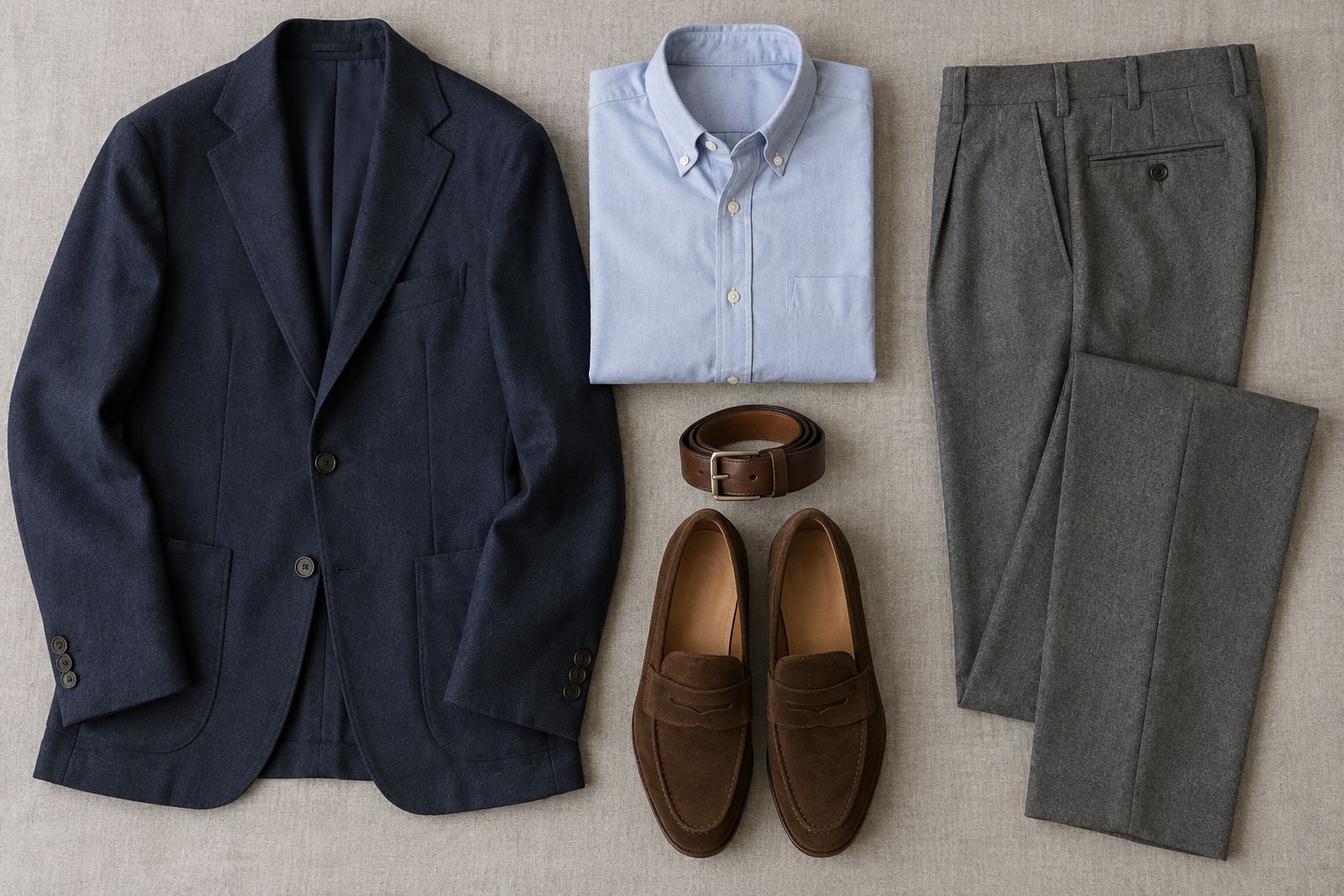
| 1. Client meeting | Navy blazer | White or light blue | Mid-gray wool trousers | Dark brown loafers or oxfords | Meetings, presentations, first weeks in a job |
| 2. Suit, no tie | Navy or gray suit | White or light blue | Matching suit trousers | Brown derbies | Client-facing days in a business casual firm |
| 3. Everyday standard | None | Light blue oxford shirt | Navy or stone chinos | Brown derbies | Ordinary office days |
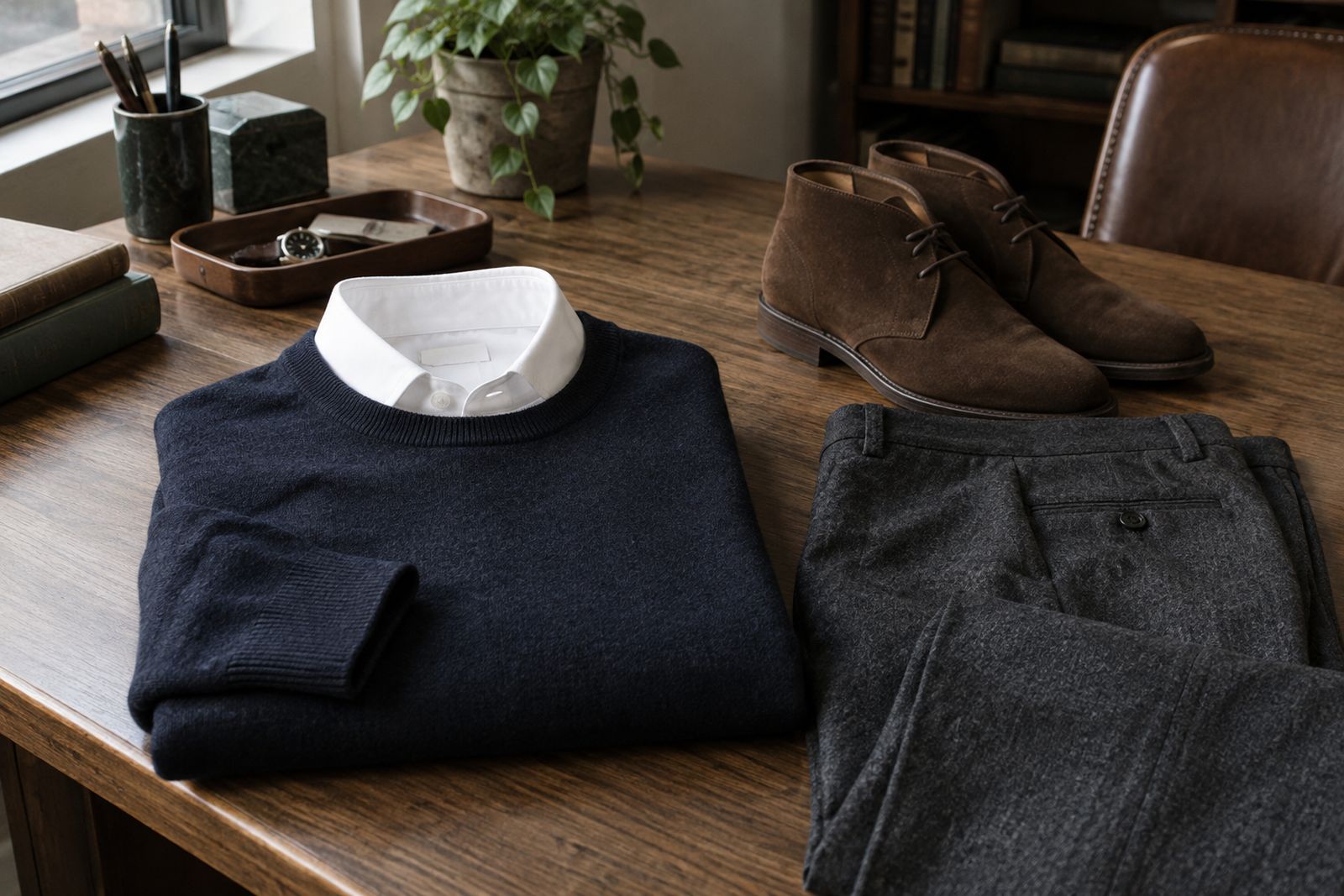
| 4. Winter layers | Navy or gray merino crew neck over the shirt | White or fine-striped shirt | Charcoal flannel trousers | Suede chukka boots | Cold-weather office days |
| 5. Soft tailoring | Unstructured brown or olive sport coat | White shirt | Dark navy chinos | Brown suede loafers | Autumn, creative offices |
| 6. Cardigan | Fine navy cardigan | Striped shirt | Khaki chinos | Brown loafers | Relaxed office days |
| 7. Relaxed summer | None | Knitted polo, plain color | Charcoal or stone wool trousers | Suede loafers | Relaxed offices in warm months |
| 8. Relaxed Friday | Navy blazer | White shirt | Dark, plain jeans | Brown derbies or chelsea boots | Offices where jeans are allowed |
| 9. Hot climate | Unlined linen-blend jacket, carried for meetings | Lightweight cotton or linen-blend shirt | Tropical wool or linen-blend trousers | Unlined loafers | Heat and humidity |
| 10. Video call | Fine knit or sport coat | Collared shirt in a solid color | Chinos or wool trousers, in case you need to stand | Optional | Remote work and video interviews |
Classic
Navy blazer, gray trousers
Navy
Jacket
Mid-gray wool
Trousers
Light blue
Shirt
Dark brown
Belt
Dark brown
Shoes
Classic
Oxford shirt and chinos
Navy chinos
Trousers
Light blue oxford
Shirt
Mid-brown
Belt
Mid-brown
Shoes
Works
Knit over shirt, flannels
Navy merino
Jacket
Charcoal flannel
Trousers
White
Shirt
Snuff suede
Shoes
Works
Olive sport coat, stone chinos
Olive
Jacket
Stone
Trousers
White
Shirt
Dark brown suede
Shoes
Avoid
Logo polo, shorts, running shoes
Weekend wear, not business casual.
Khaki shorts
Trousers
Bright logo polo
Shirt
Running shoes
Shoes
Can you wear jeans for business casual?
Only if your workplace allows them, and only dark, plain, well-fitted jeans. Traditional business casual excludes jeans altogether, and many offices still do. Where they are accepted, wear them as you would chinos: with a collared shirt or fine knit, leather shoes and, ideally, a blazer. Faded, ripped, very skinny or very baggy jeans are not business casual anywhere. If you are new to an office, wait a week and see before you wear them.
Is a polo business casual?
In relaxed offices, yes; in conservative ones, no. A polo is the most casual collared shirt, and whether it passes depends on the office and the polo. The best choices are knitted polos in merino or fine cotton, or plain piqué polos in solid colors, with no large logo. Tuck it in if the hem is long, and wear it with chinos or wool trousers and leather shoes. A sport polo with a bold logo and a stretchy collar is weekend wear.
Do you need a blazer for business casual?
Not every day, but you should own one and keep it close. A blazer or sport coat turns any business casual outfit into something suitable for a client, a presentation or an unexpected meeting with senior people. Many men keep one on the back of the office door. Navy is the most versatile; gray, brown and olive add variety. A softer, unstructured jacket looks more at home in business casual than a stiff suit jacket worn as a blazer. Our guide to suit jackets, blazers and sport coats explains the difference.
What shoes are business casual?
Business casual shoes are leather or suede shoes and boots: loafers, derbies, plain oxfords, monk straps, chukka boots and chelsea boots. Brown in any shade is the most versatile color for business casual, and burgundy works well; black is fine, especially with gray and charcoal trousers. Match your belt to your shoes. In relaxed offices, plain leather sneakers in white or a dark color can pass, kept clean. Running shoes, sandals and worn-out sneakers do not. See our guide to shoes with a suit for how the styles rank in formality.
Business casual in winter
Cold weather makes business casual easier, because texture does the work a tie would otherwise do. Swap chinos for gray or charcoal flannel trousers, wear a fine merino or lambswool knit over a collared shirt, and choose a sport coat in tweed, flannel or a brushed wool. Suede chukka boots and polished chelsea boots handle wet streets better than loafers. Over the top, a navy or camel overcoat works with everything; see our guide to overcoat styles. A padded jacket is fine for the commute, but take it off at the door rather than wearing it at your desk.
Business casual in hot climates
In hot, humid cities such as Dubai, Miami or Houston, business casual keeps the same formula and changes the fabrics. Choose shirts in lightweight cotton poplin, cotton-linen or linen; trousers in tropical wool around 7 to 9 oz (220 to 280 g), cotton-linen or linen blends; and unlined loafers. A jacket for meetings should be unlined or quarter-lined, in a linen blend or open-weave wool, and can be carried rather than worn between buildings.
- Short-sleeved shirts: acceptable in many hot-climate offices on their own, but never under a jacket.
- Polos: more widely accepted in heat; choose knitted or plain piqué.
- Shorts: still out in most offices, even in heat, unless policy says otherwise.
- Socks: thin cotton or merino, or no-show socks with loafers where that is accepted.
- Air conditioning: offices in hot cities are often cold inside; a light knit at your desk solves it.
Our guides to the best suit fabric for hot weather and staying cool in a suit cover the fabric choices in more depth.
Business casual vs business formal vs smart casual
Business casual sits between the suit-and-tie of business formal and the social polish of smart casual. The clearest lines are the tie above it and jeans and sneakers below it.
| Business formal | Business casual | Smart casual | |
|---|---|---|---|
| Jacket | Matching suit jacket | Blazer or sport coat, optional | Unstructured jacket or overshirt, optional |
| Tie | Yes | Optional | Rarely |
| Shirt | Dress shirt, white or light blue | Dress or oxford shirt, fine knitwear, polo in relaxed offices | Oxford shirt, polo, fine knit, plain T-shirt |
| Trousers | Suit trousers | Chinos, wool or flannel trousers | Chinos, wool trousers, dark jeans |
| Shoes | Oxfords | Loafers, derbies, chukka boots | Loafers, boots, clean leather sneakers |
| Jeans | No | Depends on the office | Yes, dark and plain |
Business casual at interviews, conferences and events
When an invitation to a conference, a work dinner or an industry event says business casual, wear the dressier end of the code: a blazer or sport coat, a collared shirt, wool trousers or chinos, and leather shoes. You will meet people who do not know you, and a jacket is the simplest way to look prepared. You can take it off if the room is relaxed.
For a job interview at a business casual company, the safe choice is one level above the company's everyday norm: a blazer with trousers, or a suit without a tie. Our guide to what to wear to a job interview covers each type of interview.
A business casual capsule wardrobe
Fifteen pieces and two belts cover a working week in most offices, with enough combinations that no outfit repeats.
Business casual capsule for men
- Navy blazer, soft-shouldered
- Gray or brown sport coat
- Two white shirts and two light blue shirts, one of each an oxford
- One fine-striped or small-check shirt
- Navy merino crew neck and a gray V-neck or cardigan
- Mid-gray wool trousers and charcoal flannels
- Navy chinos and stone chinos
- Dark brown loafers
- Brown derbies or chukka boots
- Dark brown leather belt and a mid-brown suede or leather belt
The tailor's view: making separates look sharp
Business casual is harder to get right than a suit, because separates don't come as a set that was designed to fit together. Fit does more work than any single garment. The most common fault a tailor sees is trousers that are too long: chinos and wool trousers bought off the rack and worn unhemmed, pooling over loafers. The second is shirts that billow at the waist when tucked in. Both are cheap and quick to fix.
What to ask your tailor for
- Hem chinos and wool trousers with a slight break or none, so they sit cleanly over loafers.
- Taper wide trouser legs below the knee if they flap.
- Take in shirts at the side seams or with back darts if they billow when tucked.
- Shorten blazer sleeves to show ¼ to ½ inch (6 to 13 mm) of shirt cuff.
- Check that a sport coat sits cleanly at the collar; that is harder to fix later.
Get the fit right and business casual looks deliberate in any office. If your role puts you in front of clients, keep a navy suit for the days that call for one; our guide to how a suit should fit covers what to check. For the social cousin of this code, see smart casual.
Questions people ask
Can you wear jeans for business casual?
Only if your workplace allows them, and only dark, plain, well-fitted jeans worn with a collared shirt and leather shoes. Traditional business casual excludes jeans, and many offices still do. Faded or ripped jeans are not business casual anywhere.
Is a polo business casual?
In relaxed offices, yes; in conservative ones, no. Choose a knitted polo or a plain piqué polo with no large logo, and wear it with chinos or wool trousers and leather shoes. Sport polos are weekend wear.
Do you need a blazer for business casual?
Not every day, but keep one at work. A blazer or sport coat lifts any business casual outfit for client meetings and presentations. Navy is the most versatile, and a softer, unstructured jacket suits the code best.
What shoes are business casual?
Leather or suede loafers, derbies, plain oxfords, monk straps, chukka boots and chelsea boots. Brown is the most versatile color; burgundy and black also work. Plain leather sneakers pass only in relaxed offices.
Do you have to wear a tie for business casual?
No. Business casual removes the tie requirement, though wearing one is never wrong. If you do wear one, wear it with a collared shirt and a jacket, not with a polo or knitwear on its own.
Are sneakers business casual?
Only plain, clean leather sneakers, and only in relaxed offices where colleagues wear them. Running shoes, canvas sneakers and anything worn out are not business casual. When in doubt, wear loafers.
What is the difference between business casual and smart casual?
Business casual is an office code that starts from the suit and removes the tie; smart casual is a social code that starts from casual clothes and smartens them up. The practical difference is that smart casual usually allows dark jeans and clean leather sneakers, while business casual often does not.
Can you wear a short-sleeved shirt for business casual?
In hot climates and relaxed offices, often yes, provided it is a plain, collared, well-fitted shirt. Never wear a short-sleeved shirt under a jacket. In conservative offices, stick to long sleeves and roll them if you need to.
TailorGuide is independent. Our guides are written and checked by our team and carry no paid endorsements. How we work.