The short answer
Dress codes for men run in eight levels, from most to least formal: white tie (tailcoat), black tie (dinner jacket and bow tie), black tie optional (dinner jacket or dark suit), cocktail or lounge suit (dark suit and tie), business formal (conservative suit and tie), business casual (separates, no tie), smart casual (polished separates, jeans allowed) and casual. Each rung down removes one layer of formality.
- White tie and black tie are evening codes: tailcoat or dinner jacket, never a business suit.
- Black tie optional means a dinner jacket is preferred and a dark suit and tie is accepted.
- "Lounge suit" on a British invitation means a business suit and tie, not something relaxed.
- Business casual usually excludes jeans and sneakers; smart casual usually allows dark jeans and clean leather sneakers.
- When the wording is unclear, dress one rung up in a way you can adjust: a tie can come off, it cannot be found at the door.
In this guide
- What are the levels of dress code for men?
- White tie: the most formal dress code
- Black tie: the standard for formal evenings
- Black tie optional: dinner jacket preferred, dark suit accepted
- Cocktail attire and lounge suit: the dark suit rung
- Business formal: the conservative suit
- Business casual vs smart casual: where the line falls
- Casual: still a dress code
- What does the dress code on an invitation mean? A wording decoder
- What is the difference between formal and semi-formal?
- How to dress when the dress code is unclear
- The tailor's view: one wardrobe for every rung
- Questions people ask
Dress codes for men are shorthand. A host who writes "black tie" on an invitation is telling you exactly what to wear in two words, and a manager who says "business casual" is doing the same, if less precisely. The trouble is that most codes are never explained, and the same words can mean different things in London, New York and a start-up office. The fixed points are few: white tie means a tailcoat, black tie a dinner jacket, and everything from cocktail down to business formal a suit and tie.
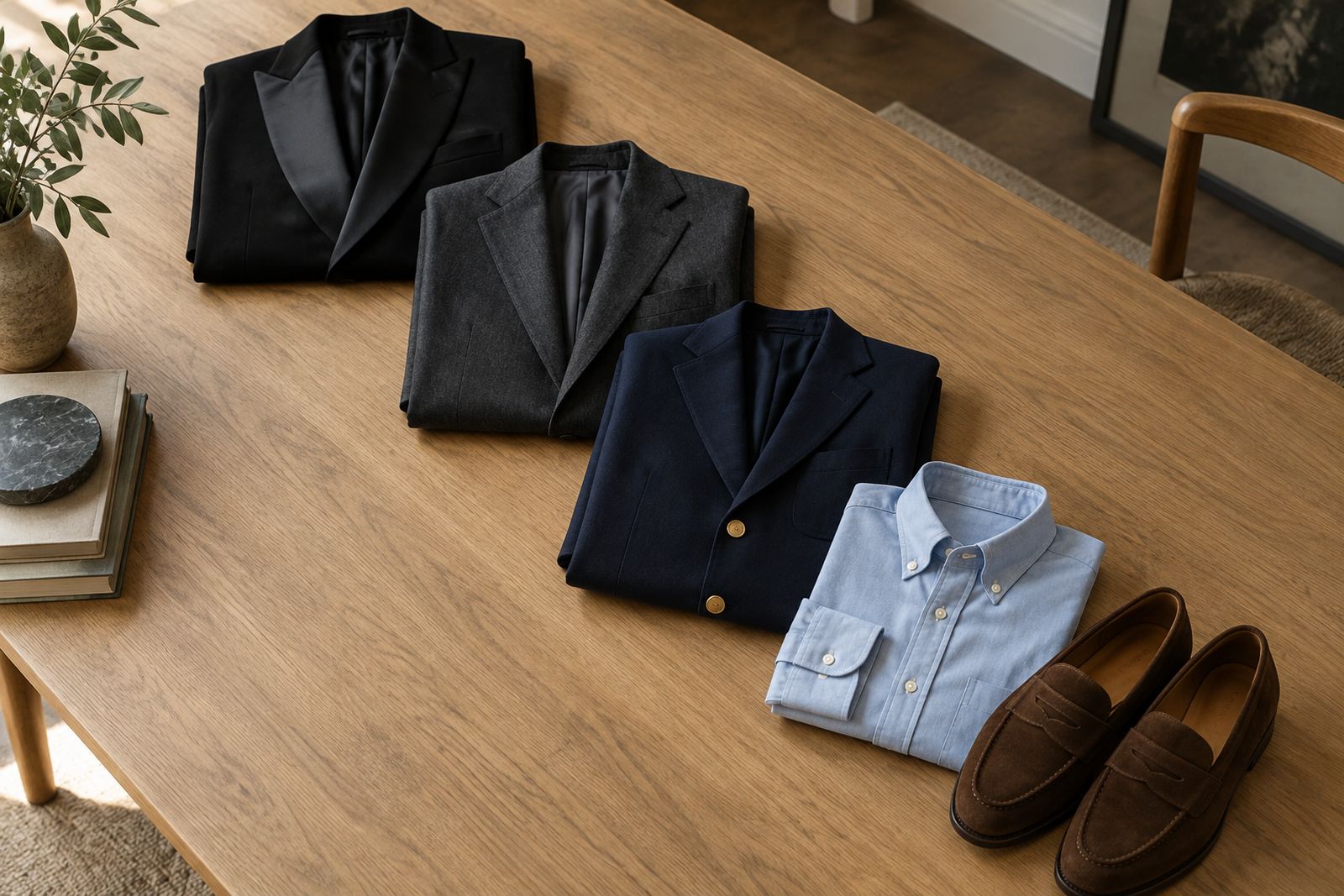
Think of the codes as a ladder. Each rung down removes something. The tailcoat becomes a dinner jacket, the dinner jacket becomes a dark suit, the suit loses its tie, then the jacket and trousers stop matching, then the jacket goes. Once you can see the ladder, you can place any invitation on it.
Most formal
White tie
Black tailcoat, white piqué waistcoat and bow tie, wing collar
Black tie
Dinner jacket (tuxedo), black bow tie, evening only
Black tie optional
Dinner jacket preferred; dark suit and tie accepted
Cocktail / lounge suit
Dark suit and tie; tie sometimes optional at cocktail events
Business formal
Conservative navy or charcoal suit, tie, dark leather shoes
Business casual
Separates, collared shirt, no tie needed, jacket optional
Smart casual
Polished separates; dark jeans and clean sneakers can work
Casual
Your choice, clean and fitted, suited to the place
Least formal
What are the levels of dress code for men?
There are eight levels of men's dress code in common use, from most to least formal: white tie, black tie, black tie optional, cocktail (lounge suit in Britain), business formal, business casual, smart casual and casual. The top three are evening codes built around formal eveningwear. The next two are suit codes. The bottom three are separates codes, where the jacket and trousers no longer have to match and the tie is no longer expected.
| Dress code | Jacket | Shirt and neckwear | Trousers | Shoes |
|---|---|---|---|---|
| White tie | Black tailcoat, cut short in front with long tails behind | Stiff-fronted white shirt, detachable wing collar, white piqué bow tie and waistcoat | Matching, two braids down each outside seam | Black patent oxfords or opera pumps |
| Black tie | Black or midnight blue dinner jacket, lapels faced in satin or grosgrain | White dress shirt, studs, French cuffs, black self-tie bow tie | Matching, single braid, no belt loops, no turn-ups | Black patent or highly polished plain oxfords, or opera pumps |
| Black tie optional | Dinner jacket preferred, or a dark navy or charcoal suit | Black tie shirt and bow tie, or a white shirt and dark silk tie | Matching | Black oxfords |
| Cocktail / lounge suit | Dark suit: navy, charcoal, dark pattern | Dress shirt and tie; tie optional at some cocktail events | Matching suit trousers | Black or dark brown oxfords; dark loafers at the relaxed end |
| Business formal | Navy or charcoal suit, plain or with a quiet pattern | White or light blue shirt, conservative silk tie | Matching suit trousers | Black or dark brown oxfords |
| Business casual | Blazer or sport coat optional | Collared shirt or fine knit, no tie needed | Chinos, wool or flannel trousers | Loafers, derbies, chukka boots |
| Smart casual | Unstructured jacket or overshirt optional | Oxford shirt, polo, fine knit, or a plain T-shirt under a jacket | Chinos, wool trousers or dark jeans | Loafers, suede boots, clean leather sneakers |
| Casual | None needed | Anything clean and in good condition | Jeans, chinos, shorts where suitable | Sneakers, boat shoes, sandals where suitable |
Hosts and workplaces vary. Treat this as the default and follow the invitation or your office where they say otherwise.
White tie: the most formal dress code
White tie is the most formal dress code a man will meet. It means a black evening tailcoat, cut short at the front with long tails behind and worn open, never buttoned. Under it go a white piqué waistcoat, a stiff-fronted white shirt with a detachable wing collar, and a white piqué bow tie. The trousers match the coat and carry two lines of braid down each outside seam. Shoes are black patent oxfords or opera pumps, and white gloves are optional.
You will see white tie at state banquets, the Nobel Prize banquet in Stockholm, the Vienna Opera Ball and a small number of traditional balls and dinners. The detail that separates a correct outfit from one that looks wrong is the waistcoat: it must not show below the front of the coat. Our white tie guide takes each garment in turn, with the fitting points a tailor checks.
Black tie: the standard for formal evenings
Black tie means a dinner jacket (a tuxedo in American English) with matching trousers, a white dress shirt and a black bow tie, worn only in the evening. It is the dress code of galas, formal dinners, evening weddings, award ceremonies and opening nights. Every part is specified:
- Jacket: black or midnight blue, with peak or shawl lapels faced in satin or grosgrain. Notch lapels are acceptable but less traditional.
- Trousers: matching, with a single braid down each outside seam, no belt loops (braces or side adjusters instead) and no turn-ups (cuffs).
- Shirt: white, with a turndown collar, a pleated or piqué bib, studs and French cuffs.
- Neckwear: a black self-tie bow tie.
- Waist: a cummerbund or a low-cut waistcoat, so no shirt shows between the jacket button and the trousers.
- Shoes: black patent or highly polished plain oxfords, or opera pumps, with black over-the-calf socks.
In warm climates an ivory or white dinner jacket, worn with the usual black trousers, is correct. A white pocket square is an optional finishing touch. Our black tie guide covers every item and the mistakes to avoid, and tuxedo vs suit explains exactly how a dinner jacket differs from a business suit.
Black tie optional: dinner jacket preferred, dark suit accepted
Black tie optional means the host would like guests in dinner jackets but will welcome a man in a dark suit and tie. If you own a dinner suit, wear it: the host has told you what they hope to see. If you don't, a well-fitted navy or charcoal suit, a white shirt, a dark silk tie and black oxfords is the correct alternative. "Black tie preferred" and "black tie invited" push a little harder toward the dinner jacket. Our black tie optional guide sets out both outfits side by side.
Cocktail attire and lounge suit: the dark suit rung
Cocktail attire for men means a suit and, by default, a tie. It sits below black tie and above everyday business wear, and it is the usual code for evening parties, receptions and many weddings. Dark suits are the safe choice. The evening setting allows a little more personality than the office: a richer tie, a pocket square, a velvet jacket at a winter party. Some hosts now treat the tie as optional; if you are unsure, wear one and take it off if nobody else has. Our cocktail attire guide gives outfit formulas by season.
What does lounge suit mean on an invitation?
Lounge suit is the British term for an ordinary business suit, two-piece or three-piece, worn with a shirt and tie. On a British wedding or reception invitation, "lounge suits" means a suit and tie, not something relaxed. The name dates from the nineteenth century, when the lounge suit was the informal alternative to the frock coat and morning coat. For an evening event choose navy, charcoal or a dark pattern; for a daytime summer event a mid-gray, mid-blue or lighter wool is fine.
Business formal: the conservative suit
Business formal, also written as business attire or business professional, means a suit and tie in a conservative style. In practice that is a navy or charcoal suit, plain or with a quiet stripe or check, a white or light blue shirt, a silk tie in a restrained color, and black or dark brown oxfords with a matching belt. It remains the norm in parts of law, banking, government and client-facing advisory work, and it is the default for interviews in those fields: see what to wear to a job interview.
What makes business formal look right is fit and condition, not fashion. The jacket should sit cleanly at the shoulder, the sleeve should show about ¼ to ½ inch (6 to 13 mm) of shirt cuff, and the trousers should have a slight break or none. How a suit should fit covers each point.
Business casual vs smart casual: where the line falls
Business casual and smart casual both drop the tie and let the jacket and trousers be separate pieces, but they come from different directions. Business casual is an office code: it starts from the suit and removes things. Smart casual is a social code: it starts from casual clothes and smartens them up. The practical difference is jeans and sneakers. Business casual usually excludes them; smart casual usually allows dark, plain jeans and clean leather sneakers.
The business casual formula
A collared shirt (oxford, poplin, or a knitted polo in a relaxed office) with chinos or wool trousers and leather shoes such as loafers, derbies or chukka boots. Add a blazer, sport coat or knit layer for client meetings. Full detail and a yes, maybe and no item list are in our business casual guide.
The smart casual formula
An oxford shirt, a fine knit or a plain T-shirt with chinos, wool trousers or dark jeans, and loafers, suede boots or clean leather sneakers. An unstructured jacket or an overshirt turns it from weekend wear into something considered. See our smart casual guide for outfits by season and setting.
Offices vary more than any other setting. One firm's business casual still means a jacket every day; another's means anything without holes. Watch what senior people wear on an ordinary Tuesday and match them, not the most casual person in the room.
| Black tie | Cocktail | Business formal | Business casual | Smart casual | Casual | |
|---|---|---|---|---|---|---|
| Dark suit | ||||||
| Necktie | Bow tie | |||||
| Blazer or sport coat | ||||||
| Chinos | ||||||
| Dark jeans | ||||||
| Polo shirt | ||||||
| Loafers | ||||||
| Leather sneakers |
Casual: still a dress code
Casual means you choose, but it is not permission to look careless. Clothes should be clean, fitted and suited to the place: a casual barbecue and a casual dinner at a good restaurant call for different things. Gym wear, beachwear and slogan T-shirts are casual for the gym, the beach and your own sofa. When a host writes "casual" for an evening event, a collared shirt or good knit with chinos or dark jeans, and leather shoes or clean sneakers, is a sound default.
What does the dress code on an invitation mean? A wording decoder
Invitations rarely use the ladder's tidy names. Hosts write "formal", "festive" or "dressy casual" and leave guests to interpret. This table translates the wording you are most likely to see.
| Wording on the invitation | What it means | What to wear |
|---|---|---|
| White tie | The most formal evening code | Tailcoat, white piqué waistcoat and bow tie, wing collar, patent shoes |
| Evening dress | An older British term that usually signals white tie | Ask the host if unsure; prepare for white tie |
| Black tie, dinner jacket, DJ, tuxedo | Formal evening code | Dinner suit, white dress shirt, black self-tie bow tie |
| Black tie optional | Dinner jacket preferred, dark suit accepted | Dinner suit, or a navy or charcoal suit with a dark tie |
| Black tie preferred, black tie invited | A firmer nudge toward the dinner jacket | Dinner suit if you can; dark suit and tie if not |
| Creative black tie | Black tie with personal touches | A dinner suit with one twist: a velvet jacket, a colored bow tie, a patterned waistcoat |
| Formal (US invitations) | Usually black tie optional | Dinner suit, or at least a dark suit and tie |
| Morning dress | Daytime formal code | Morning coat, striped or checked gray trousers, waistcoat, tie |
| Lounge suit, lounge suits | A business suit (UK usage) | Suit and tie; darker for evening |
| Semi-formal | A suit, not a dinner jacket (modern usage) | Suit and tie; darker for evening, lighter allowed by day |
| Cocktail, cocktail attire | Evening suit code | Dark suit and tie; tie optional only if the host says so |
| Festive attire | Cocktail with seasonal color | Suit or velvet jacket, a brighter tie or pocket square |
| Business, business attire | Office formal | Conservative suit and tie |
| Smart casual, dressy casual | Polished separates | Jacket optional, no tie; chinos or dark jeans, leather shoes |
| Jacket required | A club or restaurant rule | A jacket; tie usually optional unless stated |
| Decorations | Wear orders and medals | Miniatures with evening dress, if you hold them |
| Casual | Your choice | Clean, fitted everyday clothes suited to the venue |
What is the difference between formal and semi-formal?
On a modern invitation, formal usually means black tie optional, or at least a dark suit and tie, while semi-formal means a suit and tie with no expectation of a dinner jacket. For a semi-formal evening event choose a dark suit; for a daytime one a mid-gray or lighter blue suit is fine. The words cause confusion because older etiquette used them differently: "semi-formal" once meant black tie (the less formal of the two evening codes) and "informal" meant a lounge suit. If an invitation from a traditional host says "informal", a suit and tie is still the safe reading.
How to dress when the dress code is unclear
When an invitation gives no code, or a code you cannot place, read the event instead. Four things tell you more than the wording does.
Read the event
- Time: after about 6 pm, go darker and more formal; before then, lighter colors and fabrics are acceptable.
- Venue: a hotel ballroom or private members' club sets a higher floor than a garden, a bar or a home.
- Host and purpose: a wedding, a client dinner and a friend's birthday carry different expectations under the same words.
- Season and climate: lighter fabrics and colors in heat do not lower formality if the cut and accessories stay correct.
- If still unsure, ask. A one-line message to the host is never wrong and beats guessing.
The tailor's view: one wardrobe for every rung
A small wardrobe covers the whole ladder, provided each piece fits. A tailor building one from scratch would start with the garments that cover the most rungs, then add the dinner suit as the single specialist piece most men need. White tie is usually hired or made only once a man knows he will wear it regularly.
| Garment | Dress codes it covers | What to ask your tailor for |
|---|---|---|
| Dinner suit, black or midnight blue | Black tie, black tie optional, creative black tie | Single-breasted, one button, peak or shawl lapels faced in silk; trousers with a single braid and side adjusters, no belt loops |
| Charcoal suit | Black tie optional (as the alternative), cocktail, lounge suit, business formal, funerals, interviews | Plain or a very quiet stripe in a year-round worsted around 9 to 11 oz (280 to 340 g) |
| Navy suit | Cocktail, lounge suit, business formal, daytime weddings, interviews | Plain navy worsted, two buttons and notch lapels for the widest range |
| Navy blazer or sport coat | Business casual, smart casual | A softer shoulder than your suits, with patch or flap pockets |
| Gray wool trousers and chinos | Business casual, smart casual, casual | A clean line with a slight break or none, so they work with loafers |
| Black oxfords, plain or cap toe | Every suit code; a plain-toe pair, highly polished, also works at black tie | Closed lacing, no broguing; choose plain toe if it may double for evening |
If you buy one formal garment beyond your business suits, make it the dinner suit. A man who owns one is never caught short by black tie optional, and a good one lasts for decades because the style barely changes. Our guide to bespoke vs made-to-measure explains how to commission one, and our ranking of London's best tailors lists the houses we would trust with it.
Start with the rung the invitation names, check the time and venue, and dress for the host rather than for yourself. Then follow the link to the guide for that rung, where each outfit is set out item by item. For weddings, where codes are stretched furthest, our guide to what to wear as a wedding guest applies the ladder to the ceremony and the reception.
Questions people ask
What are the levels of dress code for men?
From most to least formal, the eight common levels are white tie, black tie, black tie optional, cocktail or lounge suit, business formal, business casual, smart casual and casual. White tie and black tie are evening codes, the middle levels are suit codes, and the bottom three allow separates without a tie. Morning dress is a daytime formal code that sits beside the ladder.
What is the difference between formal and semi-formal?
On modern invitations, formal usually means black tie optional or at least a dark suit and tie, while semi-formal means a suit and tie with no dinner jacket expected. Choose a dark suit for a semi-formal evening event and a lighter one by day if you like. Older etiquette used semi-formal to mean black tie, which is why the terms confuse people.
What does lounge suit mean on an invitation?
Lounge suit is the British term for an ordinary business suit worn with a shirt and tie. It does not mean relaxed or casual clothing. For an evening event choose a dark suit; for a daytime summer event a mid-gray or lighter blue suit is fine.
Is cocktail attire more formal than business casual?
Yes. Cocktail attire means a suit and, by default, a tie, while business casual means separates with no tie required. Cocktail sits two rungs higher on the ladder, just below black tie optional. Wearing chinos and an open-collared shirt to a cocktail event will usually leave you underdressed.
What is the most formal dress code for men?
White tie is the most formal dress code for men. It requires a black evening tailcoat, a white piqué waistcoat, a stiff-fronted shirt with a detachable wing collar, a white piqué bow tie, trousers with two braids and black patent shoes. It is reserved for state banquets, some royal and diplomatic occasions and a few traditional balls.
Is it better to be overdressed or underdressed?
Slightly overdressed is almost always better, because it reads as respect for the host, while underdressing reads as indifference. The safest approach is to dress one rung up in a way you can adjust, such as wearing a tie you can remove. Arriving in a dinner jacket at a business casual event is a different matter: overshoot by one rung, not three.
What does dressy casual mean for men?
Dressy casual means the same as smart casual: polished separates without a tie. Think chinos or wool trousers, an oxford shirt or fine knit, leather shoes and an optional unstructured jacket. Dark, plain jeans are usually acceptable, but shorts, athletic wear and worn-out sneakers are not.
Can I wear a suit to a black tie event?
Strictly, no: black tie means a dinner jacket, and a business suit is the dress code below it. If you have no dinner jacket and cannot hire one, a dark navy or charcoal suit with a white shirt and dark silk tie is the least-wrong choice. Avoid a black business suit, which looks like an imitation dinner jacket.
TailorGuide is independent. Our guides are written and checked by our team and carry no paid endorsements. How we work.