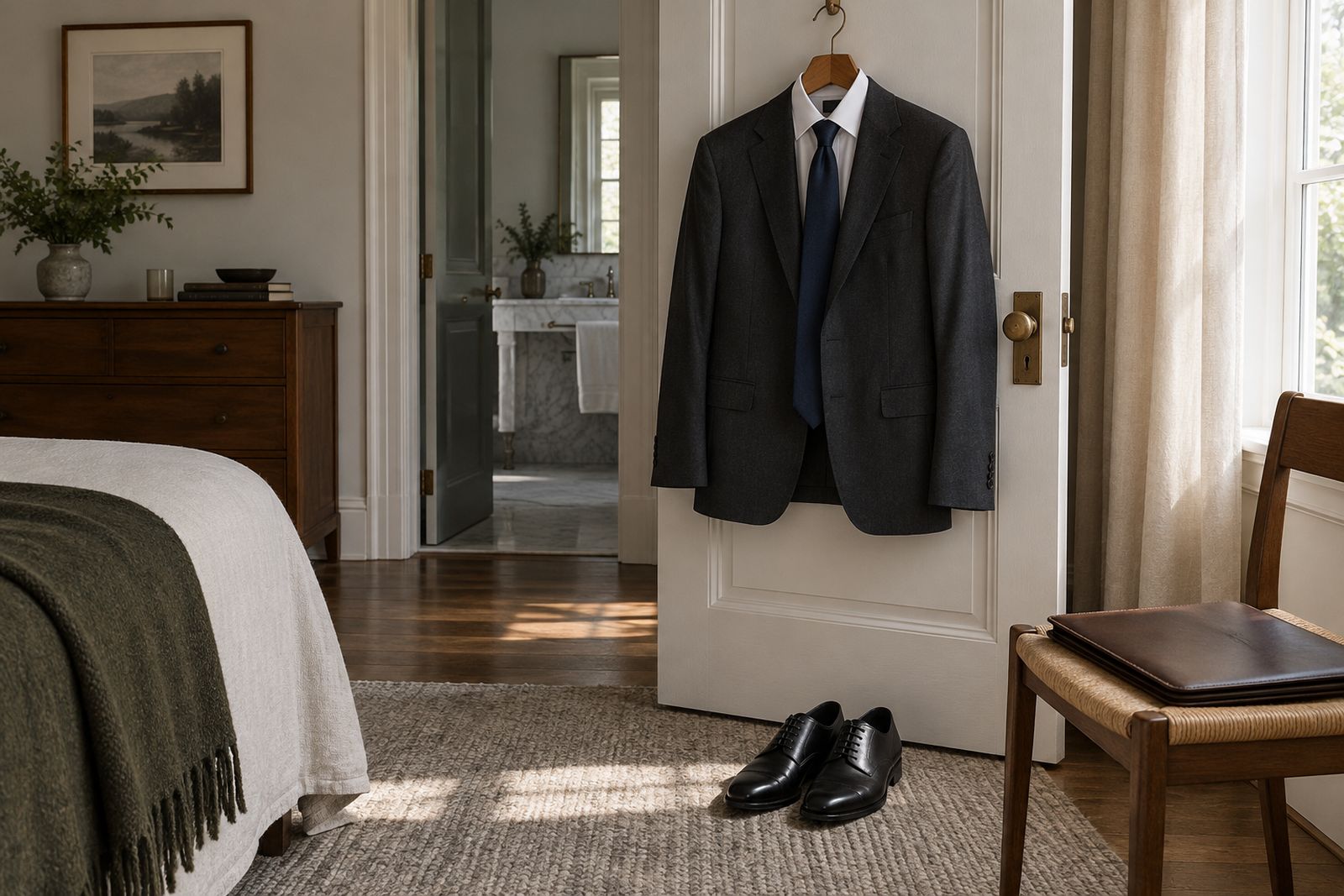
The short answer
For most job interviews, men should wear a well-fitted navy or charcoal suit, a white or light blue shirt, a conservative silk tie and polished black or dark brown oxfords. In casual industries, dress one level above the company's everyday norm: a blazer and trousers, or a suit without a tie. Fit, cleanliness and grooming matter more than what the suit cost.
- Navy or charcoal suit, white or light blue shirt, conservative tie, polished dark shoes.
- In casual industries, dress one level above what employees wear day to day.
- Fit beats price: sleeves showing ¼ to ½ inch (6 to 13 mm) of cuff, trousers with a slight break.
- Avoid loud patterns, novelty ties, strong fragrance and anything that needs explaining.
- Get alterations done at least a week before, and lay everything out the night before.
In this guide
- Should you wear a suit to an interview?
- What to wear by interview type
- What color suit is best for an interview?
- Fit matters more than price
- Should you wear a tie to an interview?
- Shirt, shoes and accessories
- What to wear to a business casual interview
- Creative and tech interviews
- What should men wear to a video interview?
- Interviews in hot weather
- Second interviews and assessment days
- Grooming
- What not to wear to a job interview
- The day-before checklist
- The tailor's view: buying a suit for interviews
- Questions people ask
What to wear to a job interview is one of the few clothing questions where the stakes are clear and the goal is simple. Your clothes should make you look prepared, competent and respectful of the people you are meeting, then get out of the way so the conversation is about you. For most interviews that means a well-fitted dark suit. For others, it means something a step down. The rule that decides which: dress one level above what the company's staff wear on an ordinary day.
The interview outfit at a glance
- Suit
- Navy or charcoal, plain or a very quiet pattern, well fitted
- Shirt
- White or light blue, plain, freshly ironed
- Tie
- Silk in navy, burgundy or another dark color, small pattern or plain
- Shoes
- Black or dark brown oxfords or derbies, polished
- Belt and socks
- Belt matching the shoes; dark socks long enough to cover the shin
- Casual industries
- One level above the company norm: blazer and trousers, or a suit without a tie
Should you wear a suit to an interview?
Yes, for most interviews. In law, finance, consulting, sales, government, hospitality management and most corporate roles, a suit and tie is still the expected standard, and arriving without one is a risk you don't need to take. In industries where nobody wears a suit, the rule changes: dress one level above the company's everyday norm. That shows you took the meeting seriously without suggesting you misread the culture.
If you are unsure what the norm is, find out. Ask the recruiter or the person arranging the interview; it is a normal question and the answer is useful. Look at photos of staff on the company's website and social media. If the information is still unclear, wear a suit: you can leave the tie off in the parking lot or the lobby if you see you are overdressed.
What to wear by interview type
Interviews fall into four broad types. The table gives the outfit for each; the sections below explain the reasoning.
| Interview type | Examples | Wear | Tie? |
|---|---|---|---|
| Corporate | Law, banking, consulting, accounting, government, senior roles anywhere | Navy or charcoal suit, white or light blue shirt, black or dark brown oxfords | Yes |
| Business casual company | Most offices, marketing, many public-sector and healthcare roles | Suit without a tie, or a navy blazer with gray wool trousers, collared shirt, leather shoes | Optional; bring one |
| Creative or tech | Design studios, start-ups, software, media | Chinos or dark trousers, collared shirt or fine knit, clean leather shoes; unstructured jacket optional | Usually no |
| Video interview | First-round and remote roles | The outfit you would wear in person, in solid colors that work on camera | As in person |
| Corporate | Business casual company | Creative or tech | |
|---|---|---|---|
| Suit | |||
| Tie | |||
| Blazer and trousers | |||
| Collared shirt | |||
| Fine knitwear | |||
| Dark jeans | |||
| Leather shoes |
What color suit is best for an interview?
Navy or charcoal. Both are conservative, flattering on almost everyone and appropriate in every industry. Navy reads slightly warmer and more approachable; charcoal slightly more serious. Mid-gray is a good third choice, especially for daytime interviews. Plain is safest; a faint pinstripe or a fine herringbone is fine in corporate settings. Our guide to suit colors explains which to buy first.
A black suit is acceptable but not ideal. It is associated with evening events and funerals, and in daylight it can look severe; navy and charcoal do the same job better. Avoid light colors such as tan and light gray, bold checks, strong pinstripes and fabrics with a high shine. They draw attention to the suit.
Classic
Navy suit, burgundy tie
Navy
Suit
White
Shirt
Burgundy silk
Tie
Black leather
Belt
Black oxford
Shoes
Classic
Charcoal suit, navy tie
Charcoal
Suit
Light blue
Shirt
Navy silk
Tie
Black leather
Belt
Black oxford
Shoes
Works
Mid-gray suit, navy tie
Mid-gray
Suit
White
Shirt
Navy silk
Tie
Dark brown leather
Belt
Dark brown oxford
Shoes
Avoid
Bold check suit, novelty tie
Memorable for the wrong reasons.
Tan check
Suit
Patterned pink
Shirt
Bright novelty print
Tie
Tan loafer
Shoes
Fit matters more than price
Interviewers do not know what your suit cost, but they notice at once whether it fits. A modest suit that has been altered to fit you looks better than an expensive one that hasn't. The points that show most are the shoulders, the sleeves and the trouser length.
Interview suit fit checks
- The shoulder seam ends where your shoulder ends, with no dent below it.
- The jacket closes with one button without pulling into an X across the front.
- The jacket covers your seat.
- The sleeve shows about ¼ to ½ inch (6 to 13 mm) of shirt cuff with your arms at your sides.
- The trousers sit at your waist without a belt pulling them up, with a slight break or none.
- The shirt collar closes with room for one finger, so the tie knot sits up cleanly.
Sleeves and trouser hems are quick, inexpensive alterations. Shoulders are not: if the shoulders do not fit in the shop, choose another suit. Our guide to how a suit should fit covers every point in detail.
Should you wear a tie to an interview?
For corporate interviews, yes. For business casual companies, a tie is optional: wear one or carry one, and decide in the lobby. For creative and tech companies, usually not; a suit without a tie, or a jacket with an open-collared shirt, is the stronger choice, and a full suit and tie can suggest you have not understood the culture. Whatever you choose, do it with confidence. Fiddling with a tie in the interview is worse than either choice.
Choose a silk tie in a dark, conservative color: navy, burgundy, dark green or gray, plain or with a small, regular pattern such as a fine dot or a narrow stripe. Width should suit your lapels, usually about 2¾ to 3½ inches (7 to 9 cm) at the widest point. Tie it in a four-in-hand or half Windsor so the tip reaches the middle of your belt buckle. See tie width and how to match a tie to your shirt and suit.
Shirt, shoes and accessories
- Shirt: white or light blue, plain or a very fine stripe, freshly ironed. A spread or point collar; button-down collars are more casual. Long sleeves, even in summer.
- Shoes: black oxfords are the most formal choice, and dark brown oxfords or derbies are fine with navy or gray. Polish them the night before. See shoes with a suit.
- Belt: leather, matching the shoes, with a plain buckle. Or braces, if your trousers are cut for them.
- Socks: dark, matching the trousers or the shoes, and long enough that no shin shows when you sit.
- Watch and jewelry: a simple watch on a leather strap or metal bracelet; keep jewelry minimal.
- Bag: a plain leather or nylon bag or folder for your papers. Leave the gym bag at home.
- Coat: a plain dark overcoat or raincoat in bad weather, taken off before you are shown in.
What to wear to a business casual interview
For a business casual interview, wear the top of the business casual range: a navy blazer with mid-gray wool trousers, a white or light blue shirt and leather shoes, or a suit worn without a tie. Bring a tie in your bag. Avoid jeans, polo shirts and sneakers even if employees wear them; an interview is not an ordinary day. Our business casual guide explains the code, and the rule still applies: one level above the everyday norm.
Creative and tech interviews
In companies where employees wear T-shirts and sneakers, a full suit and tie can look like you have not done your homework. Go one level up instead: chinos or well-cut dark trousers, a collared shirt or a fine knit, clean leather shoes and, if you like, an unstructured jacket. In some studios, dark jeans with a shirt and jacket is the right pitch. The aim is to look like the most put-together version of someone who already works there. Fit and condition matter as much here as in a bank.
What should men wear to a video interview?
Wear exactly what you would wear in person, from head to toe. Dressing fully helps you feel prepared, and you may need to stand. On camera, solid colors work best: plain navy, gray or charcoal jackets and plain white or light blue shirts. Very fine stripes, small checks and herringbones can shimmer on camera, and bright white can glare under strong light, so a pale blue shirt is often the better choice. Test your outfit on a call with a friend the day before, with the same light and camera.
Interviews in hot weather
Heat does not change what you wear to a corporate interview, but it changes how you get there. Choose a suit in a lighter worsted around 7 to 9 oz (220 to 280 g), ideally half-lined, in navy or mid-gray. Carry the jacket on the way and put it on before you enter the building. A thin cotton undershirt under the dress shirt keeps sweat from showing. Arrive ten minutes early so you have time to cool down. Our guide to staying cool in a suit has more.
Second interviews and assessment days
For a second interview, wearing the same suit is fine; nobody expects a new one. Change the shirt and tie so the outfit looks fresh. For a full assessment day or a day of back-to-back meetings, choose a suit that you can sit in comfortably for hours, and keep a spare shirt in your bag if the day is long or hot. If the company told you at the first interview that the dress code is relaxed, you can follow their lead, but stay at the smart end.
Grooming
Grooming is part of the outfit. Get a haircut a few days before, not the morning of, so it has time to settle. Trim or shave your beard as you normally keep it, cleanly. Clean and trim your nails. Use deodorant and, if you wear fragrance, one light application. None of this is about fashion; it is about showing the same care you would bring to the job.
What not to wear to a job interview
- Novelty ties, bold patterns or anything designed to start a conversation.
- Black shirts, dark shirts with dark suits, or short-sleeved shirts with a tie.
- Scuffed, worn-down or unpolished shoes; sneakers in any corporate setting.
- Strong fragrance; if you wear any, one light application.
- Ill-fitting clothes borrowed for the day, especially with sleeves covering the hands.
- Visible logos on any garment.
- Anything new and untested; wear new shoes around the house first.
The day-before checklist
The night before your interview
- Try on the full outfit, including shoes, and check the fit in a mirror, sitting and standing.
- Press the shirt and hang it; check the collar and cuffs for marks.
- Brush or steam the suit and empty the pockets; on a new suit, cut the temporary tacking stitches from the vents and the label from the sleeve.
- Polish the shoes and check the heels for wear.
- Lay out belt, socks, tie, watch and anything else in one place.
- Pack a spare tie, a lint roller and a small comb in your bag.
- Check the weather and set out a coat or umbrella.
- For a video interview, test the camera, the light and how the outfit looks on screen.
The tailor's view: buying a suit for interviews
If you are buying a suit for interviews, buy the suit you will wear most afterward: a plain navy or charcoal suit in a year-round worsted wool of about 9 to 11 oz (280 to 340 g), single-breasted with two buttons and notch lapels, and flat-front or single-pleat trousers. It will serve for interviews, offices, weddings and funerals. Our guide to year-round suit fabric explains the weight.
Leave time for alterations: at least a week, and two if you can. Most tailors can shorten sleeves and hem trousers within days, but busy periods vary. Ask for sleeves showing a little shirt cuff and trousers with a slight break or none. Do not have a new suit altered to be very tight; you will sit, gesture and shake hands, and the suit has to move with you. Our guide to what a tailor can alter explains what is quick and what is not.
Then forget about it. The best interview outfit is one you stop thinking about once you have put it on, so all your attention goes to the conversation.
Questions people ask
Should you wear a suit to an interview?
Yes, for most interviews, and always for corporate roles in fields such as law, finance and consulting. In casual industries, dress one level above the company's everyday norm instead, such as a blazer and trousers or a suit without a tie. If you cannot find out the norm, wear a suit.
What color suit is best for an interview?
Navy or charcoal. Both are conservative and appropriate in every industry; navy reads slightly more approachable and charcoal slightly more serious. Mid-gray is a good third choice and black is acceptable but less ideal. Avoid light colors and bold patterns.
Should you wear a tie to an interview?
For corporate interviews, yes. For business casual companies, a tie is optional, so carry one and decide on arrival. For creative and tech companies, usually not; a jacket with an open collar fits better.
What should you wear to a business casual interview?
The top of the business casual range: a navy blazer with gray wool trousers, a collared shirt and leather shoes, or a suit without a tie. Bring a tie in your bag. Avoid jeans, polos and sneakers, even if employees wear them.
Can you wear a black suit to an interview?
You can, but navy or charcoal is better. A black suit is associated with evening events and funerals and can look severe in daylight. If black is your only suit, wear it with a white or light blue shirt and a navy or burgundy tie to soften it.
Is it OK to overdress for an interview?
Slightly overdressed is better than underdressed, because it signals that you take the opportunity seriously. The aim is one level above the company's norm, not three. A full suit and tie at a casual start-up can suggest you have not researched the culture.
What should men wear to a video interview?
The same outfit you would wear in person, from head to toe, in case you need to stand. Choose solid colors, since very fine stripes and small checks can shimmer on camera, and consider pale blue over bright white. Test the look on a call the day before.
Can you wear brown shoes to an interview?
Yes, dark brown oxfords or derbies are fine with a navy or mid-gray suit in most interviews. Black oxfords are the more formal choice and the safest with charcoal. Whichever you choose, polish them and match your belt.
TailorGuide is independent. Our guides are written and checked by our team and carry no paid endorsements. How we work.