The short answer
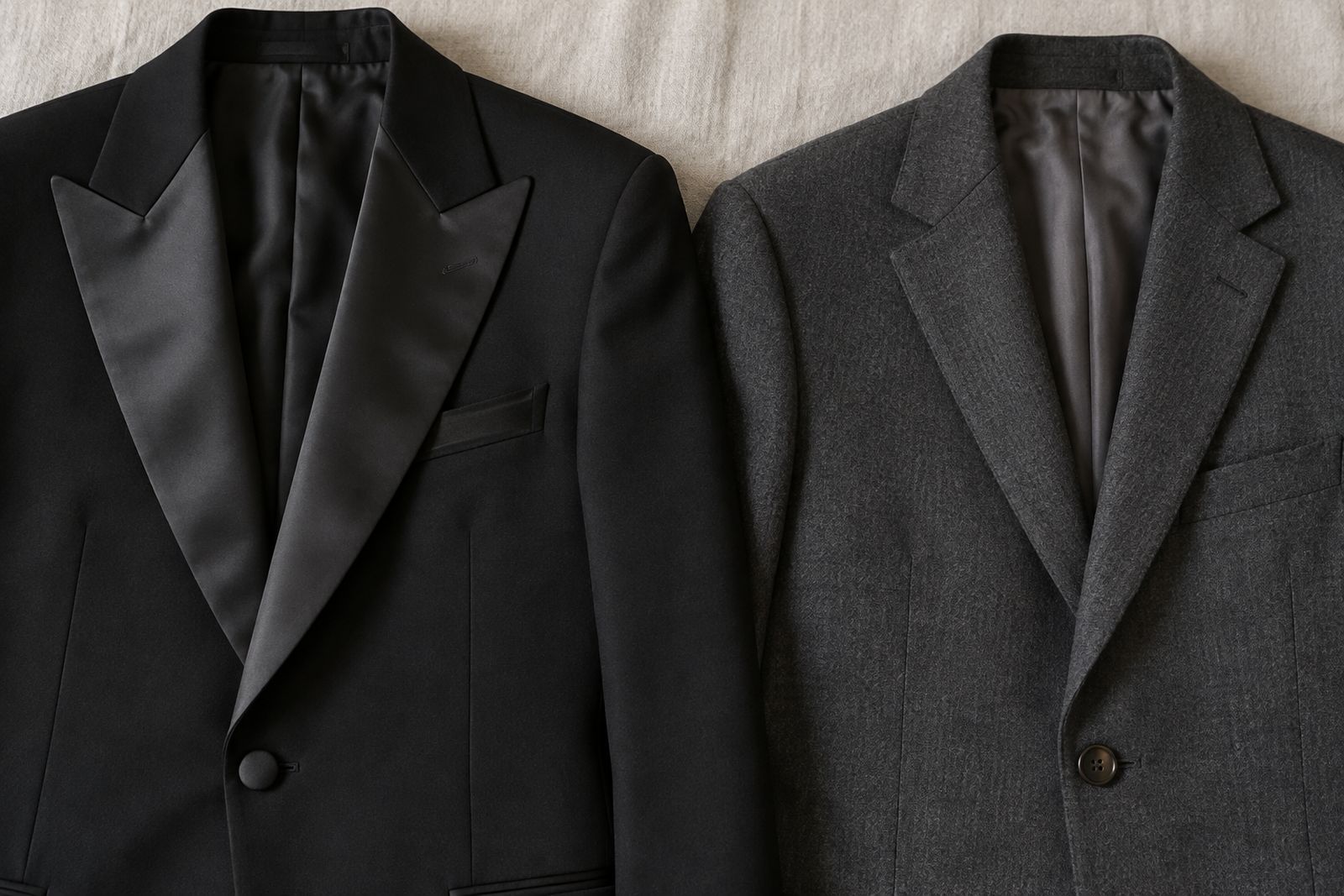
The difference between a tuxedo and a suit is in the finish. A tuxedo, or dinner jacket, has lapels faced in satin or grosgrain, buttons covered to match, jetted pockets with no flaps, and trousers with a silk braid down each side and no belt loops. It is worn only in the evening, with a bow tie. A suit is worn day or night, with a necktie.
- A tuxedo's lapels are faced in satin or grosgrain; a suit's lapels are the same fabric as the body.
- Tuxedo trousers carry a single silk braid down each side and have no belt loops.
- Tuxedo buttons are covered in silk or fabric; pockets are jetted, with no flaps.
- A tuxedo is evening wear only, worn with a black bow tie.
- A suit covers everything from the office to a cocktail party; a tuxedo covers black tie.
In this guide
- What makes a tuxedo different from a suit?
- Satin facings: the detail that defines a tuxedo
- Trouser braid and the waistband
- Covered buttons and jetted pockets
- Fabrics and colors: tuxedo vs suit
- When to wear a tuxedo and when to wear a suit
- Can a suit be worn to a black tie event?
- Should a groom wear a suit or tuxedo?
- Can you wear a tuxedo jacket as a blazer?
- Can a tailor turn a suit into a tuxedo?
- Where did the tuxedo come from?
- Rent or buy? The tailor's view
- Questions people ask
The tuxedo vs suit question comes up before every gala, prom and evening wedding, usually from someone hoping the answer is "near enough". It isn't. A tuxedo, which the British call a dinner jacket, is built on the same pattern as a single-breasted suit, but it is finished with silk, stripped of everyday details and reserved for the evening. Those differences are small on a hanger and obvious in a room full of people who got it right.
Tuxedo (dinner jacket)
Evening only
- Lapels faced in satin or grosgrain
- Peak or shawl lapels; notch acceptable
- Buttons covered in silk or fabric
- Jetted pockets, no flaps
- Trousers with one silk braid per side
- No belt loops; braces or side adjusters
- Black or midnight blue
- Worn with a black bow tie
Suit
Day or evening
- Lapels in the same fabric as the body
- Usually notch lapels; peak common too
- Horn, corozo or plastic buttons
- Flap pockets, sometimes patch
- Plain trouser seams
- Belt loops or side adjusters
- Navy, gray, brown, patterns and more
- Worn with a long necktie, or none
What makes a tuxedo different from a suit?
A tuxedo differs from a suit in five details: silk-faced lapels, covered buttons, jetted pockets, braided trousers without belt loops, and evening-only use with a bow tie. Everything else about the two, from the shoulder to the sleeve length, follows the same rules of fit. The table sets out each difference.
| Detail | Tuxedo | Suit |
|---|---|---|
| Lapel facing | Satin or grosgrain silk | Same fabric as the jacket |
| Lapel style | Peak or shawl; notch acceptable but less traditional | Notch most common; peak also standard |
| Buttons | Covered in silk or the jacket fabric; usually one on the front | Horn, corozo or plastic; usually two on the front |
| Pockets | Jetted, no flaps | Flap pockets as standard |
| Vents | Traditionally none; double vents common | Single or double vents |
| Trouser side seam | One silk braid matching the lapel facing | Plain |
| Trouser waist | No belt loops; braces or side adjusters | Belt loops or side adjusters |
| Turn-ups (cuffs) | Never | Optional |
| Colors | Black or midnight blue; ivory jacket in warm climates | Any: navy, gray, brown, patterns |
| Shirt | White dress shirt, studs, French cuffs | Any dress shirt |
| Neckwear | Black bow tie | Long tie, or none |
| Waist | Cummerbund or low-cut waistcoat | Nothing, or a matching waistcoat |
| Shoes | Black patent or highly polished plain oxfords, or opera pumps | Oxfords, derbies, loafers, brown or black |
| When | Evening only | Day or evening |
Satin facings: the detail that defines a tuxedo
The lapels of a tuxedo are faced, meaning covered, in silk: satin, which is smooth and catches the light, or grosgrain, which has a fine horizontal rib and a matte look. The facing runs from the top of the lapel down to the first button. On a shawl collar it covers the whole rolled collar. This one detail is what the eye reads first, and it is why a black business suit never passes for a tuxedo: its lapels are plain wool.
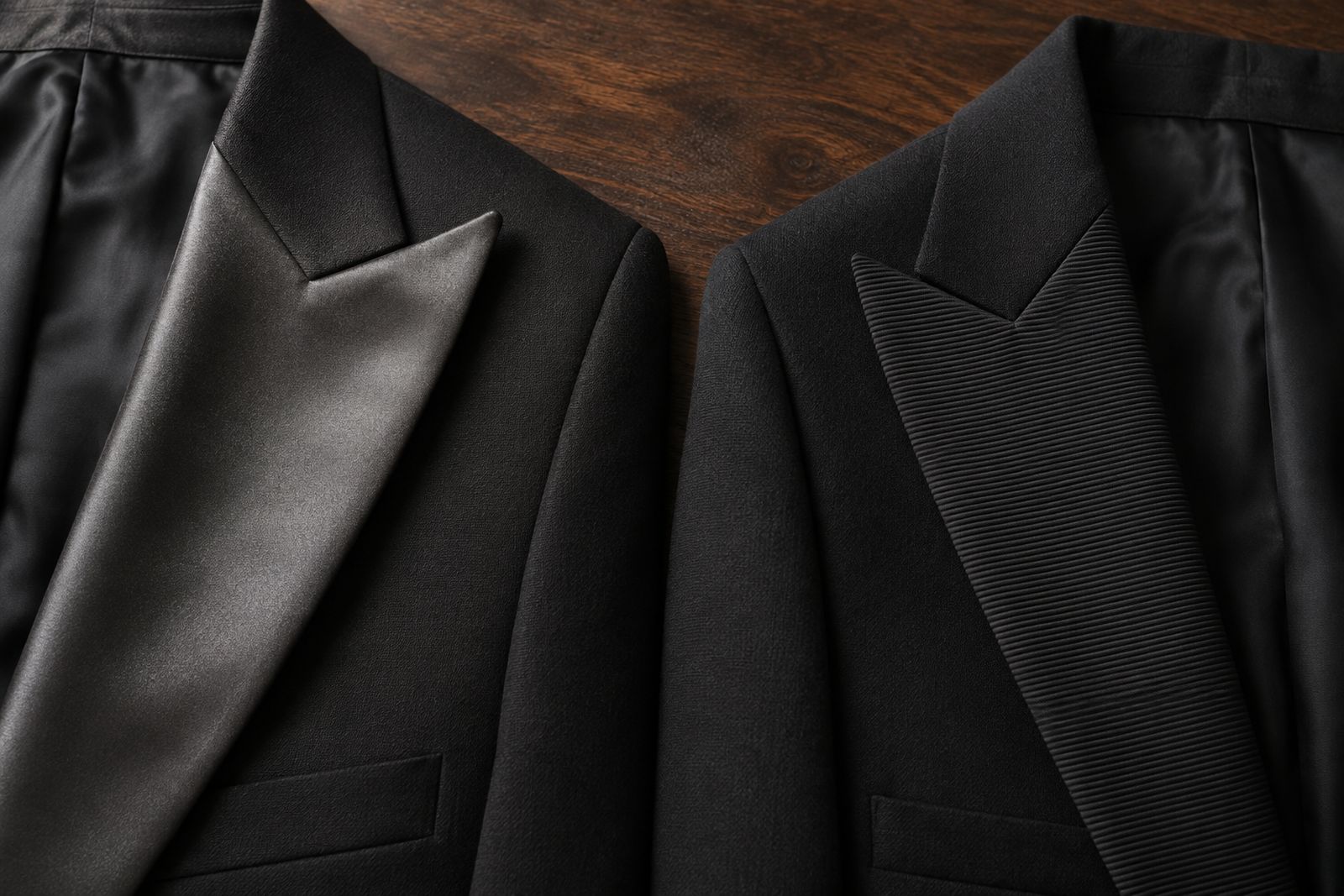
Peak and shawl lapels are traditional on a tuxedo. Notch lapels are acceptable but less traditional, because the notch is the lapel of the business suit. On a suit, notch is the default and peak is a stronger, slightly dressier choice. Our guide to lapels shows all three shapes.
Trouser braid and the waistband
Tuxedo trousers are made from the same fabric as the jacket and carry a single strip of silk braid down each outside seam, matching the lapel facing. They have no belt loops, because a belt would show below the jacket button. Instead they are held up by braces (suspenders) or by side adjusters, and the waist is covered by a cummerbund or low-cut waistcoat. They never have turn-ups (cuffs). Suit trousers have plain seams, usually belt loops, and turn-ups if you want them.
Covered buttons and jetted pockets
A tuxedo's buttons are covered in the same silk as the lapels or in the jacket fabric, so nothing on the front catches the eye except the facings. A suit uses horn, corozo or plastic buttons. A tuxedo's hip pockets are jetted: a slit with narrow piped edges and no flap, which keeps the line clean. Most suits have flap pockets. The breast pocket is the same on both.
Fabrics and colors: tuxedo vs suit
A tuxedo comes in black or midnight blue, a very dark navy that reads as a rich near-black under artificial light. The one standard exception is the ivory dinner jacket, worn with black trousers at evening events in warm climates. Velvet jackets in bottle green, burgundy or navy belong to creative black tie and hosting at home. The fabrics are fine and smooth: barathea, a fine pebbly twill; grain de poudre, a dense matte weave; or wool blended with mohair for a subtle sheen and crease resistance.
A suit can be any color and pattern, from navy and charcoal to brown flannel, tan cotton or a bold check, and in any fabric from worsted to linen. That range is exactly why a suit works at so many events and a tuxedo works at so few. Our guide to suit colors covers which to buy first.
When to wear a tuxedo and when to wear a suit
Wear a tuxedo when the invitation says black tie, and choose it at black tie optional if you own one. Wear a suit for everything else: business, interviews, daytime weddings, cocktail parties, funerals. A tuxedo is evening wear only, traditionally from about 6 pm, so even at a formal daytime event a suit or morning dress is correct.
| Event | Wear | Notes |
|---|---|---|
| Black tie gala or dinner | Tuxedo | A suit is underdressed; hire if you must |
| Black tie optional wedding or dinner | Tuxedo preferred, dark suit accepted | Navy or charcoal suit with a dark long tie |
| Evening wedding, black tie, as the groom | Tuxedo | The groom sets the top of the range |
| Daytime wedding | Suit, or morning dress if specified | A tuxedo before evening is a mistake |
| Cocktail party | Suit | A tuxedo is overdressed unless the host asks for it |
| Prom or school formal | Tuxedo is usual; a dark suit is fine | Follow the school's dress code |
| Business dinner | Suit | Unless the invitation says black tie |
| Job interview | Suit | Navy or charcoal |
| Funeral | Dark suit | Never a tuxedo |
| New Year's Eve party | Suit, or tuxedo if the host says black tie | A velvet jacket suits a festive or creative code |
Can a suit be worn to a black tie event?
Strictly, no. Black tie means a tuxedo, and a suit is the dress code one rung below it. If you cannot buy or hire a tuxedo, the least-wrong choice is your darkest navy or charcoal suit, a white shirt, a dark silk tie and black oxfords: an outfit that looks like a deliberate suit rather than a failed tuxedo. If the invitation says black tie optional, that same outfit is fully correct. Our black tie and black tie optional guides cover both codes in detail.
Should a groom wear a suit or tuxedo?
It depends on the time and the formality of the wedding. For an evening wedding with a black tie dress code, the groom should wear a tuxedo. For a daytime wedding, a suit is correct; in Britain, a formal daytime wedding may call for morning dress instead. For a summer evening wedding in a warm place, an ivory dinner jacket with black trousers is a correct alternative to a dark tuxedo. The groom should be at the top of the wedding's formality range, never below his guests. See wedding suits for grooms.
Can you wear a tuxedo jacket as a blazer?
Not convincingly. The satin lapels and covered buttons read as eveningwear wherever they appear, so a tuxedo jacket with jeans or chinos looks like half of a costume. The same goes for tuxedo trousers: the braid makes them impossible to wear as odd trousers. The exception is the velvet evening jacket, often with a shawl collar, which is a separate garment designed to be worn with dark trousers at evening parties and creative black tie events. If you want a jacket that does both, a velvet one is the honest answer.
Can a tailor turn a suit into a tuxedo?
In principle, a tailor can face a suit's lapels in silk and cover its buttons, but the result rarely convinces. The flap pockets, belt loops, plain trouser seams and everyday fabric all remain, and the work costs a meaningful fraction of a new dinner suit. It is better spent on hiring or buying a real one. The reverse is also true: a tuxedo cannot be made into a useful suit.
Where did the tuxedo come from?
The dinner jacket began in Britain in the second half of the nineteenth century as a shorter, more comfortable alternative to the evening tailcoat for informal dinners. Henry Poole is usually credited with making an early version for the Prince of Wales, later Edward VII, in the 1860s. The American name comes from Tuxedo Park, New York, where members of the Tuxedo Club adopted the tailless jacket in the 1880s. The tailcoat survives as white tie, and the dinner jacket has been the standard for formal evenings ever since.
Rent or buy? The tailor's view
If you wear black tie once a year or more, buy a tuxedo. A suit wears out because you wear it often; a tuxedo is worn a few times a year and changes so little in style that a good one lasts decades. That makes it one of the best garments to buy well, or to have made. Rental makes sense for a one-off, but hired tuxedos are cut to fit a range of men, and it shows at the collar, the sleeves and the trouser length.
What to check when buying a tuxedo
- Lapels faced in real silk satin or grosgrain, not a shiny polyester.
- Buttons covered in silk or the jacket fabric.
- Jetted pockets, no flaps.
- Trousers with a single braid matching the lapels, side adjusters or brace buttons, and no belt loops.
- Black or midnight blue in a fine worsted or wool-mohair blend.
- A jacket that covers your seat and sleeves that show ¼ to ½ inch (6 to 13 mm) of shirt cuff.
- Trousers hemmed with a slight break or none, and no turn-ups.
If you own one good suit and one good tuxedo, you are dressed for nearly every invitation you will receive. Start with the suit, add the tuxedo when the black tie invitations begin, and our guide to men's dress codes will tell you which one each invitation is asking for.
Questions people ask
What makes a tuxedo different from a suit?
A tuxedo has lapels faced in satin or grosgrain, covered buttons, jetted pockets with no flaps, and trousers with a silk braid down each side and no belt loops. It is worn only in the evening with a black bow tie. A suit has plain lapels, ordinary buttons and flap pockets, and is worn day or night with a necktie.
Can a suit be worn to a black tie event?
Strictly, no: black tie means a tuxedo. If you cannot buy or hire one, wear your darkest navy or charcoal suit with a white shirt, dark silk tie and black oxfords. That same outfit is fully correct at a black tie optional event.
Should a groom wear a suit or tuxedo?
For an evening black tie wedding, a tuxedo. For a daytime wedding, a suit, or morning dress if the wedding is formal and British in style. The groom should be at the top of the wedding's formality range, not below his guests.
Can you wear a tuxedo jacket as a blazer?
Not convincingly. The satin lapels and covered buttons read as eveningwear, so a tuxedo jacket with jeans or chinos looks like half a costume. A velvet evening jacket is the garment designed to be worn with odd trousers at evening events.
Is a tuxedo more formal than a suit?
Yes. A tuxedo is formal eveningwear, one level below the white tie tailcoat, while a suit covers business and cocktail dress codes. Wearing a tuxedo to a suit-level event usually leaves you overdressed.
Can you wear a regular tie with a tuxedo?
Traditionally, no. A tuxedo is worn with a black bow tie, and a long tie mixes the tuxedo with the dress code below it. If you want a long tie, wear a dark suit instead.
Is a black suit the same as a tuxedo?
No. A black suit has plain wool lapels, ordinary buttons, flap pockets and trousers without braid. A tuxedo has silk-faced lapels, covered buttons, jetted pockets and braided trousers, and it can be black or midnight blue.
TailorGuide is independent. Our guides are written and checked by our team and carry no paid endorsements. How we work.