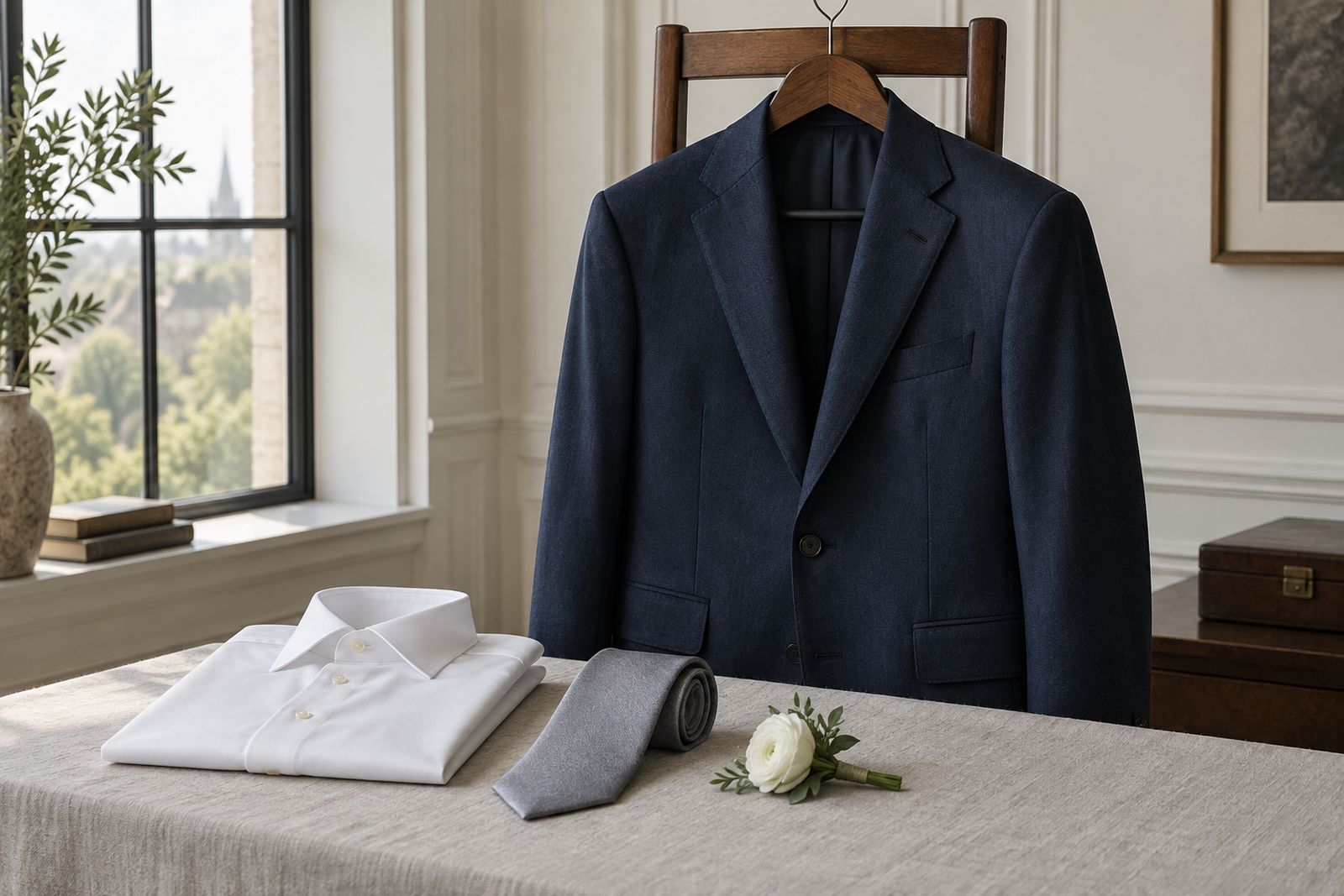
The short answer
The best wedding suits for men follow the time of day: a well-fitted lounge suit in navy, charcoal or a seasonal shade for most weddings, a tuxedo for ceremonies starting around 6 p.m. or later, and morning dress for formal daytime weddings. Order bespoke 4 to 6 months ahead and made-to-measure 2 to 3 months ahead.
- Daytime wedding: lounge suit or morning dress. Evening wedding (from about 6 p.m.): tuxedo.
- Navy and charcoal work in every season; light gray, tan and blue suit spring and summer.
- Start bespoke 4 to 6 months out, made-to-measure 2 to 3 months out.
- Book the final fitting 2 to 4 weeks before the wedding, wearing the shoes and shirt you will marry in.
- Set the groom apart from the groomsmen with one clear difference: color, a waistcoat, a different tie or lapel.
In this guide
- Should a groom wear a suit, tuxedo or morning dress?
- Which wedding suit suits your venue and season?
- What color suit should a groom wear?
- What fabric is best for a wedding suit?
- How far in advance should you order a wedding suit?
- Should the groom match the groomsmen?
- How should a wedding suit fit?
- What should a groom wear with the suit?
- Common wedding suit mistakes
- What to tell your tailor
- Questions people ask
Choosing between wedding suits for men starts with three facts on the invitation: the time of the ceremony, the season and the venue. Those three decide whether you wear a lounge suit, a tuxedo or morning dress, which colors and fabrics make sense, and how early you need to order. Fit then decides whether it looks like your suit or a costume. The sections below take each decision in the order a tailor would.
At a glance
- Daytime wedding
- Lounge suit (navy, gray, blue, tan) or morning dress if formal
- Evening wedding
- Tuxedo (dinner suit) in black or midnight blue, from about 6 p.m.
- Safest colors
- Navy and charcoal, in any season
- Bespoke lead time
- 4 to 6 months; start at 6 if you can
- Made-to-measure lead time
- Order 2 to 3 months ahead
- Fittings
- Bespoke 3 or more for a first suit; made-to-measure usually 1 to 2
Should a groom wear a suit, tuxedo or morning dress?
A groom should wear a lounge suit for most daytime weddings, a tuxedo for evening weddings, and morning dress for formal daytime weddings, mostly in Britain. The dividing line is the clock. Black tie is evening dress and traditionally starts at about 6 p.m.; a tuxedo at a noon ceremony is a common American habit, but it is a mistake by the traditional rules. Morning dress is formal daywear, traditionally the daytime counterpart of white tie, and is never the dress code for an event that starts in the evening.
| Option | When | What it includes | Formality |
|---|---|---|---|
| Lounge suit | Any daytime ceremony; evening weddings marked semi-formal or cocktail | Matching jacket and trousers, shirt, silk tie, leather shoes; a waistcoat is optional | Formal to semi-formal |
| Morning dress | Formal daytime ceremonies, usually before the evening | Black or gray morning coat, striped or checked gray trousers, waistcoat, white or pale shirt, silk tie, black oxfords | Formal daywear |
| Tuxedo (dinner suit) | Ceremonies or receptions from about 6 p.m.; invitations that say black tie | Black or midnight blue jacket with silk-faced lapels, matching trousers with a side stripe, white dress shirt, black bow tie, black patent or polished shoes | Formal eveningwear |
| Tailcoat (white tie) | Only when the invitation says white tie | Black tailcoat, white pique waistcoat and bow tie, wing-collar shirt | Most formal; rare at weddings |
Morning dress
Morning dress is formal daywear built around the morning coat: a single-breasted coat with one button whose fronts curve away from the waist into tails at the back, worn with striped or checked gray trousers and a waistcoat.
Lounge suit
A lounge suit is the British term for an ordinary two-piece or three-piece business suit. On a British invitation it means a suit and tie, not a tuxedo.
If you are torn between the two evening options, our guide to tuxedo vs suit explains the differences in detail, and the black tie guide covers every piece of a dinner suit. For an invitation that says black tie optional, see black tie optional: the groom should usually be at the formal end of whatever the guests are asked to wear.
Which wedding suit suits your venue and season?
Once you know the formality, the venue and season narrow the color and fabric. A city church in December and a garden in July both call for a lounge suit, but not the same one. Use the table as a starting point, then adjust for your own coloring and the couple's plans.
| Wedding | Best choice | Colors | Fabric |
|---|---|---|---|
| City church or civil ceremony, daytime | Lounge suit, or morning dress if formal | Navy, charcoal, mid-gray | Worsted wool, 9 to 11 oz (280 to 340 g) |
| Country house or garden, spring or summer | Lounge suit, two- or three-piece | Light or mid-gray, mid-blue, tan, stone | Tropical wool, fresco or wool-linen, 8 to 10 oz (250 to 310 g) |
| Beach or hot destination | Unlined or half-lined lounge suit, tie optional if the couple agrees | Sand, stone, light gray, light blue | Linen, cotton, wool-linen or fresco |
| Evening reception at a hotel or ballroom | Tuxedo | Black or midnight blue | Barathea or wool with grosgrain or satin lapel facings |
| Autumn wedding, barn or country venue | Three-piece suit | Charcoal, brown, olive, forest green | Flannel or a fine tweed, 11 to 14 oz (340 to 430 g) |
| Winter wedding, any time of day | Three-piece suit, or tuxedo for the evening | Charcoal, navy, deep green; velvet dinner jacket for a bold evening look | Flannel or heavier worsted, 12 to 14 oz (370 to 430 g) |
For a beach or hot-weather ceremony, the fabric matters more than the color; our beach wedding attire guide covers it in full. For a winter wedding, think about the coat as well as the suit: guests photograph the arrival, and a well-cut overcoat over a dark suit looks right in every frame.
What color suit should a groom wear?
Navy is the most reliable color for a groom's wedding suit because it flatters almost every complexion, photographs as a clear dark color and works from spring to winter. Charcoal is the second safe choice and reads more formal. After those two, choose by season: lighter grays, blues and tans in spring and summer; browns, greens and deeper blues in autumn and winter.
Classic
Navy, any season
Silver tie and dark brown shoes for day; black oxfords for a formal city wedding
Navy
Suit
White
Shirt
Silver gray
Tie
Dark brown
Shoes
Classic
Charcoal, autumn and winter
The most formal lounge suit color; black shoes
Charcoal
Suit
Pale blue
Shirt
Burgundy
Tie
Black
Shoes
Works
Light gray, spring and summer
Best in daylight and outdoors
Light gray
Suit
White
Shirt
Dusty rose
Tie
Mid brown
Shoes
Works
Tan or stone, summer and outdoors
Needs sun; looks flat in a dim church
Tan
Suit
White
Shirt
Navy
Tie
Dark brown suede
Shoes
Bold
Forest green, autumn
Strong in a country setting; ask how it sits with the wedding colors
Forest green
Suit
White
Shirt
Gold
Tie
Dark brown
Shoes
Classic
Midnight blue tuxedo, evening
Reads deep and rich under artificial light
Midnight blue
Suit
White
Shirt
Black silk
Tie
Black patent
Shoes
Avoid
Black lounge suit with black shirt and tie
Looks severe in daylight and flattens in photographs
Black
Suit
Black
Shirt
Black
Tie
Black
Shoes
| Season | Strong choices | Use with care |
|---|---|---|
| Spring | Navy, mid-gray, light gray, mid-blue | Tan before the weather warms |
| Summer | Light gray, sand, stone, tan, light or mid-blue, navy in a light fabric | Charcoal and black in full sun |
| Autumn | Charcoal, navy, brown, olive, forest green | Pale colors after the clocks change |
| Winter | Charcoal, navy, deep green; midnight blue or black tuxedo for evening | Light gray, tan and linen |
Fit your color to your complexion as well as the season. Men with strong contrast between hair and skin carry navy and charcoal best; men with lower contrast often look better in mid-gray, mid-blue or brown. Our guide to suit colors explains how to judge this.
What fabric is best for a wedding suit?
A worsted wool of 9 to 11 oz (280 to 340 g) is the best all-round fabric for a wedding suit: it drapes well, resists creasing through a long day and suits three seasons. Go lighter and more open for summer and heat; go heavier or softer for winter. You will wear it from the morning preparations to the last dance, sitting, standing for photographs and dancing, so choose for comfort as much as appearance.
| Season | Fabric | Typical weight | Why |
|---|---|---|---|
| Summer and heat | Tropical worsted, fresco (high-twist open weave), wool-linen blends | 7 to 10 oz (220 to 310 g) | Breathes, and fresco recovers from creases quickly |
| Summer, relaxed | Linen or cotton | 9 to 12 oz (280 to 370 g) | Cool and textured; linen creases, which is part of its look |
| Spring and autumn | Worsted wool, plain weave or twill | 9 to 11 oz (280 to 340 g) | Clean drape, holds a press, the all-round choice |
| Autumn and winter | Wool flannel, fine tweed | 11 to 14 oz (340 to 430 g) | Soft and warm, photographs with depth |
| Winter evening | Barathea or wool for a tuxedo; velvet for a dinner jacket | Varies | Formal sheen, warm under a coat |
Avoid very high Super numbers for a wedding suit. A Super 150s or finer fabric feels soft but creases and shines faster, and it is the wrong choice for a long day of hugging, sitting and dancing. A Super 100s to 130s worsted is a sound middle. For more detail, see suit fabrics explained and, for a summer date, the best suit fabric for hot weather.
How far in advance should you order a wedding suit?
Order a bespoke wedding suit 4 to 6 months before the wedding, because a first bespoke suit needs a new pattern and three fittings, and busy houses often take three to four months. Order made-to-measure 2 to 3 months ahead, and buy ready-to-wear 6 to 8 weeks ahead to leave time for alterations. Spring and summer are peak wedding season, and tailors and alteration shops are busiest then.
Stage 1: Decide formality and budget
6+ months before
Confirm time of day, dress code, venue and who is wearing what
Stage 2: Choose tailor and fabric
4 to 6 months before
Consultation, measurements and fabric selection from swatch books
Stage 3: Baste fitting
3 to 4 months before
A loosely tacked jacket to check balance, shoulders and length
Stage 4: Forward fitting
2 to 3 months before
Refine sleeves, waist and trousers; confirm buttons and details
Stage 5: Final fitting
2 to 4 weeks before
Wear the wedding shirt and shoes; last small adjustments
Stage 6: Collect and wear in
1 to 2 weeks before
Wear it for an evening at home; store on a broad hanger
| Route | When to start | What takes the time | Fittings |
|---|---|---|---|
| Bespoke | 4 to 6 months ahead | A new paper pattern, hand construction and the gaps between fittings | 3 for a first suit, sometimes more |
| Made-to-measure | 2 to 3 months ahead | Factory production of about 4 to 8 weeks, then a fitting and alterations | Usually 1 to 2 |
| Ready-to-wear plus alterations | 6 to 8 weeks ahead | Alterations of 1 to 3 weeks, longer in peak season | 1, plus collection |
| Rental | Reserve 2 to 3 months ahead | Delivery a few days before; little time to change sizes | A try-on on delivery |
Should the groom match the groomsmen?
The groom should coordinate with the groomsmen but not match them exactly; he should be identifiable in a group photograph at a glance. The simplest approach is to dress the groomsmen in the same color and formality as the groom, then set the groom apart with one or two clear differences.
| Approach | How it works | Best for |
|---|---|---|
| Same suit, different details | Everyone in the same color; the groom adds a waistcoat, a different tie or a different boutonniere | Large parties and rentals; the tidiest photographs |
| Same color family, different shade | Groomsmen in mid-gray, groom in charcoal; or groomsmen in navy, groom in midnight blue | Groomsmen who buy or already own their suits |
| Groom in a different color | Groomsmen in navy, groom in a light gray or tan; or groomsmen in black tuxedos, groom in midnight blue | Small parties and grooms who want to stand out clearly |
Ways to set the groom apart
- A three-piece suit for the groom, two-piece for the groomsmen. See the three-piece suit.
- A different lapel: peak lapels for the groom, notch for the groomsmen.
- A different tie or bow tie color, or a pocket square only the groom wears.
- A larger or different boutonniere.
- A double-breasted jacket for the groom in the same fabric as the groomsmen's single-breasted suits.
Organizing the groomsmen
Groomsmen planning checklist
- Fix the color, fabric weight and dress code before anyone buys.
- Agree who pays for what before measurements are taken.
- Collect measurements or sizes 3 months out for made-to-measure, 2 to 3 months out for rentals.
- Ask out-of-town groomsmen to get measured by a local tailor rather than measuring themselves.
- Set a try-on date at least 2 weeks before the wedding for anyone buying ready-to-wear.
- Specify shoes, socks, belt or braces, shirt collar and tie so the details match.
How should a wedding suit fit?
A wedding suit should fit like any good suit, with extra attention to comfort over a long day. The jacket collar should rest against your shirt collar, the shoulders should end at your own shoulder, the jacket should button without pulling into an X, and the sleeves should show about ¼ to ½ inch (6 to 13 mm) of shirt cuff. Trousers should sit at your natural waist or just below it, with little or no break.
What to do at each fitting
- Wear or bring the exact shirt and shoes you will marry in; shoe height changes the trouser length.
- Sit down, raise both arms, and hold the pose of a first dance; nothing should bind across the back or seat.
- Check that the shirt cuff shows evenly on both sides when your arms hang naturally.
- Look at the back in a three-way mirror: no horizontal folds under the collar, no vents pulling open.
- Put your phone and wallet where you will carry them on the day and check the line of the jacket.
- Ask the tailor to show you where seam allowance remains, in case of late weight change.
For the full set of fit rules, see how a suit should fit. If you are going bespoke for the first time, bespoke fittings explained tells you what happens at the baste, forward and finished fittings.
What should a groom wear with the suit?
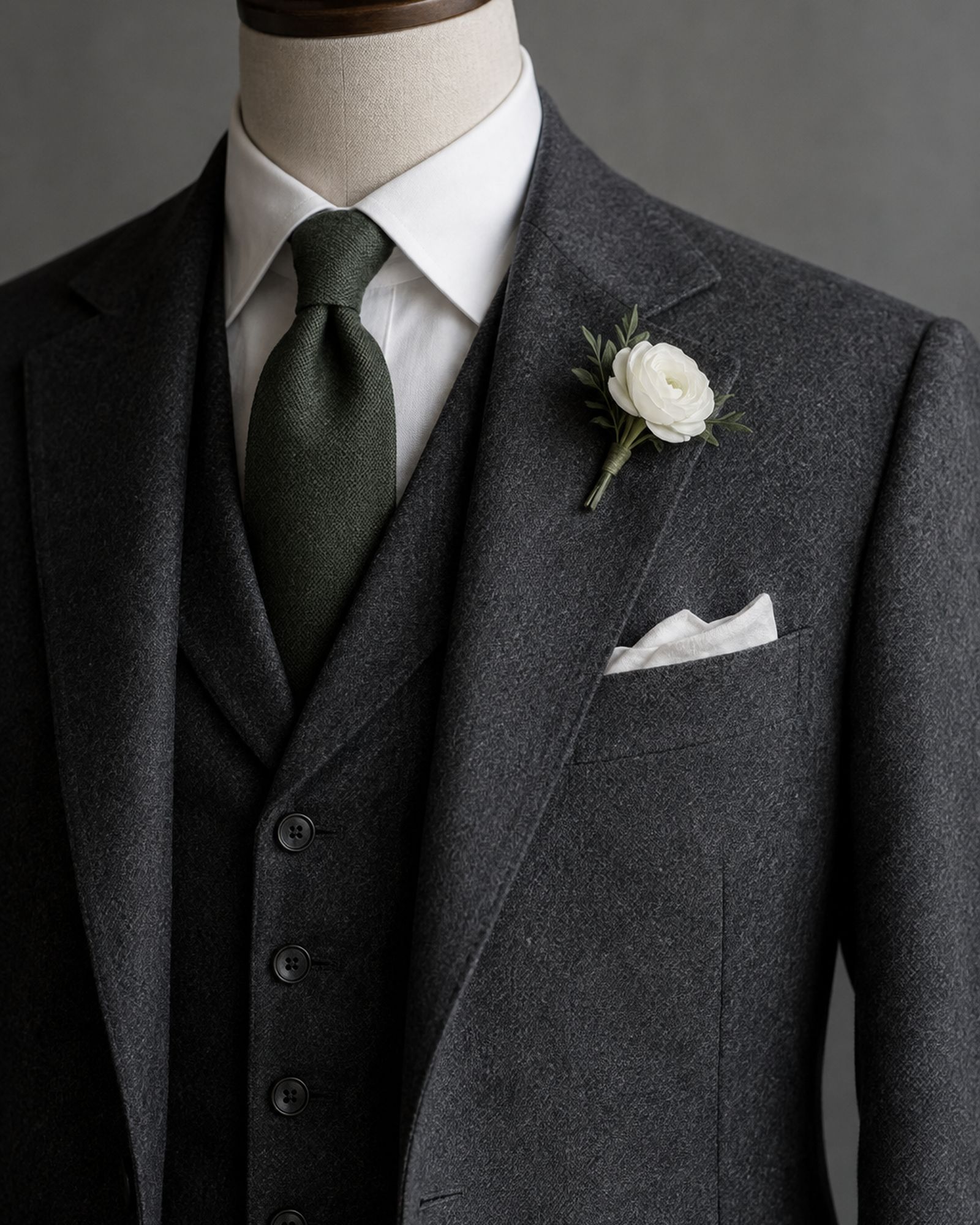
The shirt, tie and shoes should be one step plainer than the suit, so the eye goes to your face. A white shirt is the safest choice; pale blue works with navy and gray. Choose a silk tie in a solid, a fine pattern or a grenadine weave, and match its formality to the suit: plain dark silk for a city wedding, a lighter color or texture for a garden.
- Shirt: white or pale blue, spread or semi-spread collar, double (French) or single cuffs. Have it fitted in the neck so the collar does not gap above the tie knot.
- Tie: silk, about 3 to 3½ inches (7.5 to 9 cm) wide to suit a classic lapel. Bow tie only with a tuxedo, or by deliberate choice at a relaxed wedding.
- Shoes: black oxfords for a city, formal or evening wedding; dark brown oxfords or loafers with navy, gray or tan in daylight. See which shoes to wear with a suit.
- Pocket square: white linen in a simple fold, or a muted color that does not echo the tie exactly.
- Boutonniere: on the left lapel, through the lapel buttonhole or pinned just below it, with the stem behind the lapel.
- Waistcoat or belt: if you wear a waistcoat, wear braces, not a belt. See how to wear a waistcoat.
Common wedding suit mistakes
- Wearing a tuxedo at a midday ceremony when the guests are in suits.
- Choosing a fashionable extreme: very short jackets, skinny lapels or a tight trouser that will date the photographs.
- Ordering too late and taking the suit home without a final fitting.
- Buying new shoes on the week of the wedding and not wearing them in.
- Choosing a heavy suit for a summer date or a pale linen for a winter church.
- Matching the tie exactly to the bridesmaids' dresses; a harmonizing shade looks more considered.
What to tell your tailor
A good tailor will ask about the wedding before they ask about the suit. Arrive with the facts, and you will get better advice and a realistic schedule.
Bring these answers to the first appointment
- The date, the ceremony time and the venue, indoors or out.
- The dress code on the invitation and what the guests and groomsmen will wear.
- The wedding colors, with a photograph or swatch if possible.
- Whether you want to wear the suit again afterward, which favors navy or charcoal and a year-round fabric.
- Any plans to change weight before the day.
- Your budget, including shirt, tie and shoes.
If you want a suit you will wear for years after the wedding, choose navy or charcoal in a year-round worsted and add the wedding-day character through the tie, waistcoat and flowers. To find a tailor with the time to make it properly, start with our ranking of the best tailors in London and book a consultation early.
Questions people ask
Should a groom wear a suit or a tuxedo?
Wear a suit for a daytime wedding and a tuxedo for a ceremony or formal reception starting around 6 p.m. or later. A tuxedo is evening dress, so it looks out of place at a midday ceremony. If the invitation says black tie, the groom wears a tuxedo whatever the hour.
What color suit should a groom wear?
Navy is the safest color for a groom because it suits nearly every complexion and works in every season. Charcoal is the next choice and reads more formal. For spring and summer, light gray, mid-blue, tan and stone work well; for autumn and winter, consider charcoal, brown or forest green.
Should the groom match the groomsmen?
The groom should coordinate with the groomsmen but stand apart in at least one clear way. Common methods are a waistcoat, a different tie, a different lapel style or a slightly different color. The aim is a party that looks planned with a groom anyone can pick out in a photograph.
How far in advance should you order a wedding suit?
Order a bespoke wedding suit 4 to 6 months ahead. Made-to-measure needs about 2 to 3 months, and ready-to-wear with alterations needs 6 to 8 weeks. Leave more time for a spring or summer wedding, when tailors are busiest.
Can a groom wear a black suit?
A groom can wear a black suit to an evening wedding, but navy or charcoal is usually the better choice. Black lounge suits look severe in daylight and lose detail in photographs. If the event is formal and in the evening, a black or midnight blue tuxedo is the more correct option.
Should a groom wear a three-piece suit?
A three-piece suit is an excellent choice for a groom, especially in autumn and winter. The waistcoat sets him apart from the groomsmen and keeps him looking finished after the jacket comes off at the reception. Wear braces rather than a belt, and leave the bottom waistcoat button undone if the waistcoat is cut for it.
Is it better to rent or buy a wedding suit?
Buy if you will wear the suit again, especially a navy or charcoal suit in a year-round fabric. Rentals suit large groomsmen parties and tuxedos you will rarely wear, but the fit is limited and the try-on usually happens only days before the wedding.
TailorGuide is independent. Our guides are written and checked by our team and carry no paid endorsements. How we work.