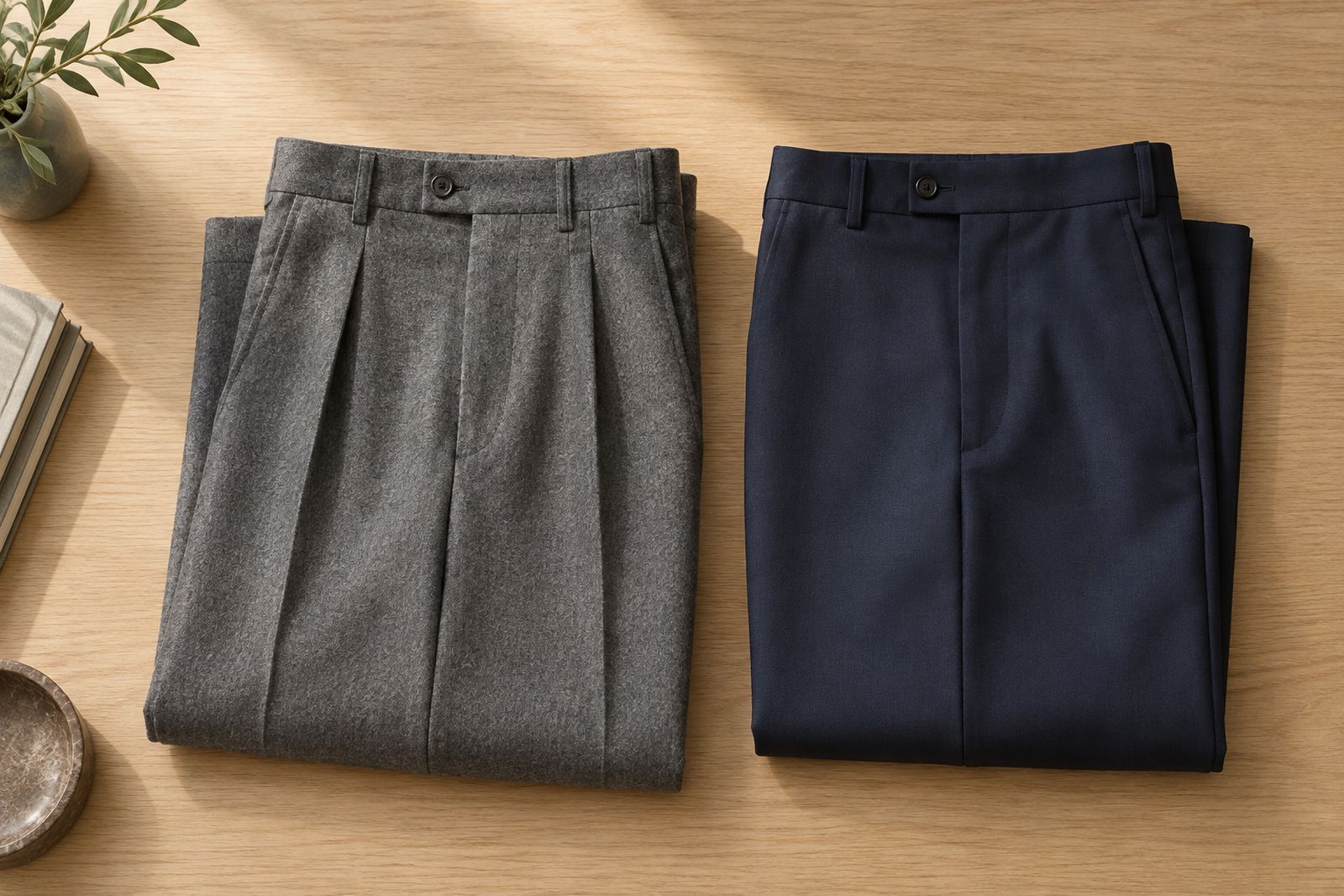
The short answer
Flat-front trousers have no folds at the waistband and give a clean, slim line; they suit slim and average builds and low to mid rises. Pleated trousers have one or two folds on each side that open to give room through the hips and thighs, so they sit and move more comfortably and suit fuller builds, wider legs and higher rises. Fit matters more than the choice.
- Flat fronts give the cleanest line on slim and average builds.
- Pleats add room through the hips and thighs, so the trousers sit and move more comfortably.
- Forward pleats open toward the fly; reverse pleats open toward the pockets.
- Pleats need a mid or high rise; on low-rise trousers they have nowhere to fall.
- Pleats that pull open when you stand still mean the trousers are too tight at the hips.
- Pleats have returned to mainstream tailoring in recent years, alongside wider, higher-rise trousers.
In this guide
- Pleated vs flat-front trousers: what is the difference?
- Forward pleats vs reverse pleats
- Single vs double pleats
- Why the rise matters
- Do pleated pants make you look bigger?
- Who should wear pleats, and who should wear flat fronts?
- Are pleated pants back in style?
- Pleats beyond the business suit: formal, linen and casual trousers
- How pleated trousers should fit
- The tailor's view: what to ask for
- Questions people ask
Pleated vs flat-front is one of the oldest arguments in menswear, and for most of the 2000s and 2010s it looked settled in favor of flat fronts. It never really was. Pleats exist for a practical reason, to give the trousers room where your body moves, and when they are cut well and paired with the right rise they look sharp, not sloppy. The right choice depends on your build, the cut of the trousers and how you wear them.
Pleated vs flat front at a glance
- Flat front
- No folds at the waist; clean, slim line; best on slim and average builds
- Pleated
- One or two folds per side; more room through hips and thighs
- Forward pleats
- Fold opens toward the fly
- Reverse pleats
- Fold opens toward the side pockets
- Rise
- Pleats need a mid or high rise; flat fronts work at any rise
- Fit test
- Pleats should lie closed when you stand still
Pleated vs flat-front trousers: what is the difference?
Flat-front trousers are cut to sit smoothly from the waistband over the hips, with no folds at the front. Pleated trousers have one or more folds of fabric stitched into the waistband on each side, which open when you sit, stride or bend and close again when you stand. The pleat is extra fabric, so pleated trousers are cut fuller through the hips and upper thigh, usually tapering toward the hem.
| Flat front | Pleated | |
|---|---|---|
| Look | Clean, slim and modern | Fuller at the top, tapering to the hem; classic |
| Room in the hips and thighs | Less | More |
| Comfort when sitting | Can pull across the front and make pockets gape | Pleats open, so the front stays smooth |
| Best rise | Low, mid or high | Mid or high |
| Leg shape | Slim, tapered or straight | Fuller thigh tapering to the hem, or wide |
| Pairs well with | Single-breasted suits, chinos, slim cuts | Double-breasted suits, turn-ups (cuffs), braces |
| Pressing | Simple | Pleats need careful pressing to stay sharp |
Neither style is more formal than the other. Both appear in business suits and in formal wear.
Flat front
No pleats
- Smooth front from waistband to hem
- Slimmest line
- Works at any rise
- Least room when sitting
Forward pleats
Fold opens toward the fly
- Draws the eye toward the center
- Often reads cleaner when standing
- Front crease runs down from the pleat
- Suits most builds
Reverse pleats
Fold opens toward the pockets
- Opens toward the hips
- Can look fuller
- Front crease runs down from the pleat
- Common on many ready-made pleated trousers
Forward pleats vs reverse pleats
Forward pleats fold so that the opening faces the fly, toward the center of the trousers. Reverse pleats fold the other way, so the opening faces the side pockets. Both give the same practical benefit, extra room through the hips and thighs, and in both the trousers' front crease runs down the leg from the main pleat.
The difference is mostly visual. Forward pleats lead the eye toward the center and are often described as reading cleaner when you stand; reverse pleats open toward the hips and can make the top of the trousers look a little fuller. Whether either type stays neatly closed depends far more on the cut and fit than on the direction of the fold. If pleats splay open when you stand still, the trousers are too tight across the hips or seat, whichever way the pleats face.
Single vs double pleats
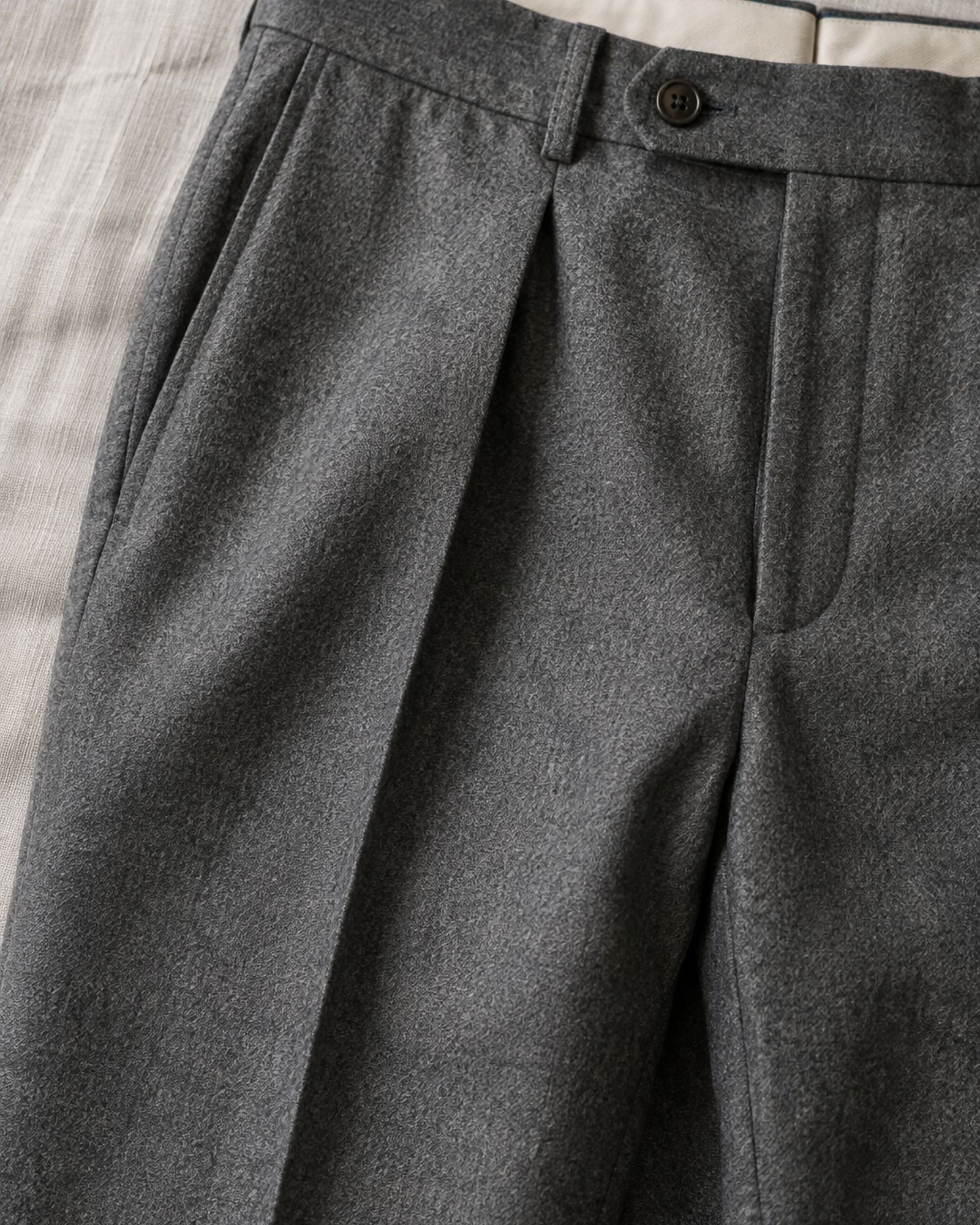
A single pleat on each side adds a modest amount of room and is the most versatile choice: it works with slim-tapered and straight legs, and it is barely noticeable under a jacket. Double pleats, a deeper main pleat with a second, smaller one between it and the pocket, add more room and more drape. They suit wider legs, high rises and fuller builds, and they look most at home with double-breasted suits and heavier fabrics such as flannel. Triple pleats exist but are rare and only make sense on very full trousers.
Why the rise matters
The rise is the distance from the crotch seam to the top of the waistband, and it decides where the trousers sit on your body. A low rise sits on the hips, a mid rise just below the navel, and a high rise at or near the natural waist, around the navel. Pleats need a mid or high rise to work, because they are designed to fall from the waist over the curve of the hips. On low-rise trousers the pleats start below that curve, have nowhere to fall and simply bulge.
A higher rise has other benefits that suit pleats. It keeps the shirt tucked in, it means no triangle of shirt shows between the jacket button and the waistband, and it lengthens the leg line. That is why pleats, high rises and braces (suspenders) tend to appear together: braces hold the trousers at the natural waist, where pleats hang best. Flat fronts work at any rise, which is part of the reason they took over when low-rise trousers were fashionable.
Do pleated pants make you look bigger?
Well-fitted pleated trousers do not make you look bigger; badly fitted ones do. Pleats that are too deep on a slim frame, or pleats that pull open because the trousers are too tight, add visual volume at the hips. Pleats that lie closed and fall into a clean crease can actually make a man with a fuller stomach or seat look slimmer, because the front stays smooth instead of pulling across and the side pockets do not flare open.
The leg shape matters too. Pleated trousers that are full in the thigh and taper toward the hem look modern and balanced. Pleated trousers that stay wide all the way down need a longer jacket and a confident style to carry them.
Who should wear pleats, and who should wear flat fronts?
Flat fronts suit slim and average builds, slim or tapered cuts and anyone who wants the cleanest possible line. Pleats suit men with athletic thighs or a fuller seat or stomach, tall men, anyone who sits for long periods, and anyone who likes a wider, higher-rise trouser. The matrix gives a quick guide.
| Flat front | Single pleat | Double pleat | |
|---|---|---|---|
| Slim build | |||
| Athletic thighs or seat | |||
| Fuller stomach | |||
| Tall | |||
| Shorter | |||
| Sit for long periods | |||
| Slim, tapered look | |||
| Wide, high-rise look |
Match the trousers to the jacket as well. A double-breasted suit usually looks best with pleated, higher-rise trousers, while a slim single-breasted suit pairs naturally with flat fronts. Pleats and turn-ups (cuffs) are a traditional pairing: the weight of the turn-up helps the fuller leg hang straight.
Are pleated pants back in style?
Yes. Pleated trousers have come back into mainstream menswear in recent years along with wider, higher-rise cuts, after years in which slim flat fronts dominated. In 2026 you will find pleats from tailors, mainstream brands and fashion labels alike. Flat fronts have not gone anywhere; they remain the default on most slim suits and chinos. The difference now is that pleats are a real option again rather than a sign of an outdated suit, as long as the cut is modern: a mid or high rise, a moderate pleat and a leg that tapers.
Pleats beyond the business suit: formal, linen and casual trousers
The same logic applies outside the office. Black tie trousers can be pleated or flat-fronted; both are correct, and pleats sit especially well with the high rise and braces that traditional evening trousers use. Turn-ups, however, are never worn on evening trousers, whichever front you choose.
In summer fabrics, pleats are practical as well as stylish. A pleated linen or cotton trouser holds a little more air around the legs and hangs away from the body, which makes it cooler in heat; see our guide to linen suits. Casual chinos are still most often flat-fronted, but relaxed pleated chinos with a higher rise have become common, and they pair well with a soft, unstructured jacket.
How pleated trousers should fit
Pleated trousers are less forgiving of poor fit than flat fronts, because the pleats show every bit of strain. Check these points in the mirror, standing and sitting. For the full trouser fit picture, see how suit trousers should fit.
Pleated trouser fit checks
- Standing still, the pleats lie closed and flat.
- Sitting or striding, they open a little and close again when you stand.
- The front crease runs straight from the main pleat to the hem.
- The trousers sit at or near your natural waist, not on your hips.
- The side pockets lie flat without gaping.
- The seat is smooth, with no horizontal pulls or loose folds below it.
- The leg tapers gently to a hem with a quarter or half break.
The tailor's view: what to ask for
A tailor cannot add pleats to flat-front trousers, because the front was cut without the extra fabric. Removing pleats is possible in theory, by stitching them down or converting them into darts, but the front was cut for pleats and rarely looks right afterward, so it is not worth paying for. Choose the style you want when you buy or order. Our guide to what a tailor can alter covers what is realistic.
If you are ordering made to measure or bespoke
- Decide on flat front, single or double pleats, and forward or reverse.
- Agree the rise and where the waistband should sit on your body.
- Ask for a moderate pleat depth unless you want a deliberately full trouser.
- Choose belt loops, side adjusters or brace buttons; pleats work especially well with braces.
- Decide on turn-ups at the same time, since they affect the hem and the length you need.
If you are buying ready-made, try both styles in the same size and look at yourself sitting down as well as standing. Then have the length set properly; our guide to hemming suit trousers shows how to pin it.
Questions people ask
Are pleated pants back in style?
Yes. Pleats have returned to mainstream menswear in recent years along with wider, higher-rise trousers, and in 2026 they are widely available. Flat fronts remain the default on slim suits and chinos, so both are current.
Do pleated pants make you look bigger?
Not if they fit. Pleats that lie closed and fall into a clean crease can make a fuller figure look slimmer by keeping the front smooth. Pleats that splay open or are too deep on a slim frame add visual bulk.
What is the difference between forward pleats and reverse pleats?
Forward pleats fold so the opening faces the fly; reverse pleats fold so it faces the side pockets. Both add the same room through the hips and thighs. Forward pleats often read a little cleaner, but fit decides whether either stays neatly closed.
Single or double pleats: which is better?
Single pleats are more versatile and work with slim-tapered and straight legs. Double pleats add more room and drape and suit wider legs, higher rises and fuller builds, especially with double-breasted suits.
Can a tailor remove pleats from trousers?
It is possible to stitch pleats down or turn them into darts, but the front was cut with extra fabric for the pleats, so the result rarely looks right. It is usually better to buy flat-front trousers instead.
Should pleated trousers have cuffs?
They often do, and it is a traditional pairing because the weight of the turn-up helps the fuller leg hang straight. It is not a rule: pleated trousers with a plain hem are perfectly correct.
Are flat-front trousers more formal than pleated ones?
No. Neither style is more formal. Both appear in business suits and formal wear; the choice is about build, comfort and the style of the suit.
TailorGuide is independent. Our guides are written and checked by our team and carry no paid endorsements. How we work.