The short answer
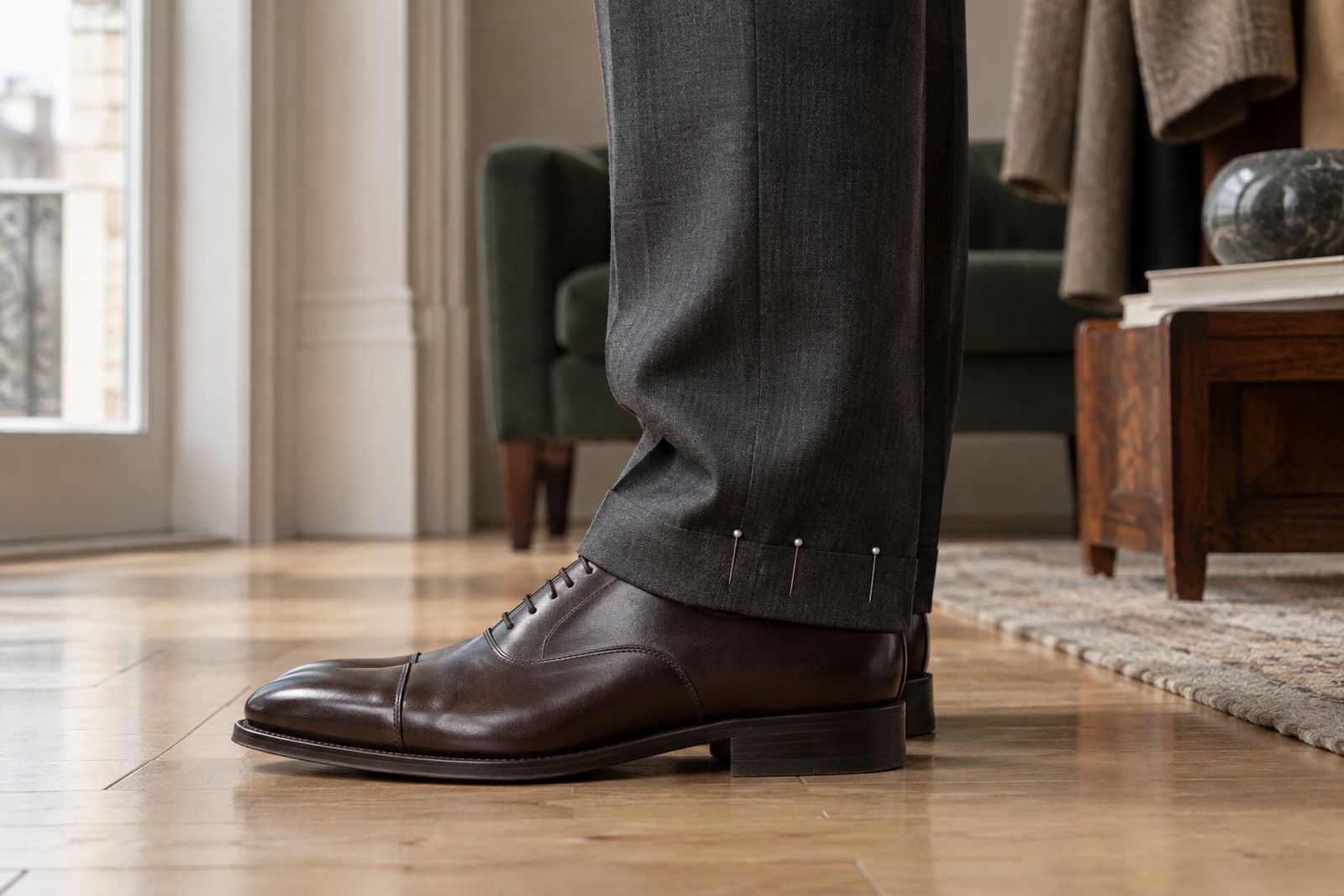
To hem dress pants, wear them at the height you normally do, with the shoes you will wear, and stand naturally looking straight ahead. Fold the excess under until the front crease meets the shoe with the break you want, pin the front and back of each leg, then measure the inseam and tell your tailor the length, hem style and any turn-ups (cuffs).
- Pin in the shoes you will wear, with the trousers sitting at your real waist height.
- Stand naturally and look straight ahead; looking down pulls the hem up.
- Pin both legs: many people have one leg slightly longer than the other.
- A slanted hem sits about ½ to ¾ inch (1.3 to 2 cm) lower at the back than the front.
- Turn-ups (cuffs) need a straight hem and about 4 inches (10 cm) of spare length.
- Ask the tailor to leave spare fabric inside the hem so the trousers can be let down later.
In this guide
- How to hem dress pants: pinning the length, step by step
- Should trousers be hemmed with shoes on?
- How much break do you want?
- Hem styles: plain, slanted and turn-ups
- What is a slanted hem on trousers?
- Turn-ups (cuffs): how deep, and how much length you need
- How to brief your tailor
- Can you hem dress pants by hand?
- Common hemming mistakes
- How much does it cost to hem suit pants?
- Questions people ask
Hemming suit trousers is simple sewing, but the result depends on a decision made in front of the mirror: exactly where the hem should fall. Pin the length wearing the wrong shoes, or while looking down at your feet, and the most precise stitching in the world will give you trousers that are too short or pool around your ankles. Here is how to hem dress pants properly, whether you are briefing a tailor or doing it yourself.
Before you start
- Wear
- The shoes you will wear with the suit, and a tucked-in shirt
- Waist
- Trousers at the height you normally wear them, belt or braces done up
- You need
- A mirror, pins, a tape measure and ideally a second person
- Decide first
- The break: none, quarter, half or full
- Hem styles
- Plain, slanted or turn-ups (cuffs)
- Typical cost
- About $15 to $40 for a plain hem, as of 2026
How to hem dress pants: pinning the length, step by step
Pinning the length correctly is most of the job. If a tailor pins your trousers, these are the steps they should follow; if they do not, ask. If you are doing it at home, a second person makes it much easier, because bending to pin your own hem changes where the trousers sit.
Pinning trousers for a hem
- 1
Sort out the waist first
If the waist needs taking in or letting out, have it pinned or altered before the hem. Put the trousers on at the height you normally wear them and fasten your belt or adjust your braces. A waist that sits an inch lower makes the trousers an inch longer.
Tip: Empty your pockets and tuck in your shirt so the trousers hang as they will in wear.
- 2
Put on the right shoes
Wear the shoes you will wear most often with these trousers. Dress shoes, loafers and boots all have different heel heights and shapes, and each changes where the hem should fall.
- 3
Stand naturally
Stand with your feet about hip-width apart and your weight even, and look straight ahead into a mirror. Do not look down at your feet: bending your head and back pulls the trousers up and gives you a hem that is too short.
Tip: If you are pinning alone, use a full-length mirror and only bend at the knees to place each pin, then straighten up to check.
- 4
Choose the break
Decide how much the trousers should rest on your shoe: no break, a quarter break, a half break or a full break. The front crease is your guide; it should meet the top of the shoe with the amount of fold you want.
- 5
Fold and pin the front
Fold the excess fabric up inside the leg until the front of the hem sits where you want it. Place one pin horizontally through both layers at the front crease.
- 6
Check and pin the back
Look at the back of the leg. On a straight hem, the back usually falls to around the top of the shoe's heel. On a slanted hem it sits a little lower down the heel. It should never touch the ground. Pin at the back and at each side so the fold stays level.
- 7
Pin the other leg separately
Repeat on the second leg instead of copying the first. Many people have one leg slightly longer, or stand with one hip a little higher, and the difference often shows at the hem.
Tip: If the two legs end up more than about ¼ inch (6 mm) apart, ask the tailor to hem them to different lengths.
- 8
Walk, sit and measure
Walk a few steps and sit down to check nothing pulls or drags, then stand and check again in the mirror. Finally, measure the inseam of each leg, from the crotch seam to the folded edge, and write both down in inches and centimeters.
Should trousers be hemmed with shoes on?
Yes, trousers should always be hemmed with shoes on, and ideally with the exact shoes you will wear with them. The height of the heel and the shape of the shoe's front decide where the break falls. A hem pinned in socks will be too short in shoes; a hem pinned in chunky sneakers will be too long with slim dress shoes. If you wear the suit with two very different pairs, pin for the pair you will wear most often, or for the dressier pair if the suit is mainly for formal occasions. Our guide to which shoes to wear with a suit helps you decide.
How much break do you want?
The break is the fold or dent in the front of the trousers where the hem rests on the shoe. It is the main style decision in a hem, and it should match the width of the leg. Our guide to trouser break covers each option in detail.
| Break | What it looks like | Best with |
|---|---|---|
| No break | Hem just touches or skims the top of the shoe, no fold | Slim, tapered trousers; cropped modern suits |
| Quarter break | Slight touch on the shoe, a very small dent | Most modern suits; the safest choice |
| Half break | One clear, soft fold at the front | Classic suits with medium-width legs |
| Full break | One deep fold; hem covers more of the shoe | Wide, traditional trousers |
Hem styles: plain, slanted and turn-ups
There are three main ways to finish suit trousers. All of them should be sewn with a blind stitch, by hand or machine, so no stitching shows on the outside.
| Hem style | What it is | When to choose it |
|---|---|---|
| Plain (straight) | Folded and stitched level all the way around | Any suit; the default |
| Slanted | Front slightly shorter than the back | Slim to medium legs where you want a clean front and more coverage at the heel |
| Turn-ups (cuffs) | Hem folded outward to form a cuff, usually 1½ to 1¾ inches (4 to 4.5 cm) deep | Business and casual suits, pleated trousers, heavier fabrics; not for black tie |
Whatever the style, ask for a heel guard: a narrow strip of tape stitched inside the back of the hem where your shoe heel rubs. It takes the wear instead of the fabric, and good tailors add it as a matter of course.
What is a slanted hem on trousers?
A slanted hem is a trouser hem cut and stitched at an angle, so it sits higher at the front and lower at the back. Typically the back is about ½ to ¾ inch (1.3 to 2 cm) lower than the front. The effect is a clean front with little or no break, while the back still reaches down over the heel instead of showing your socks when you walk.
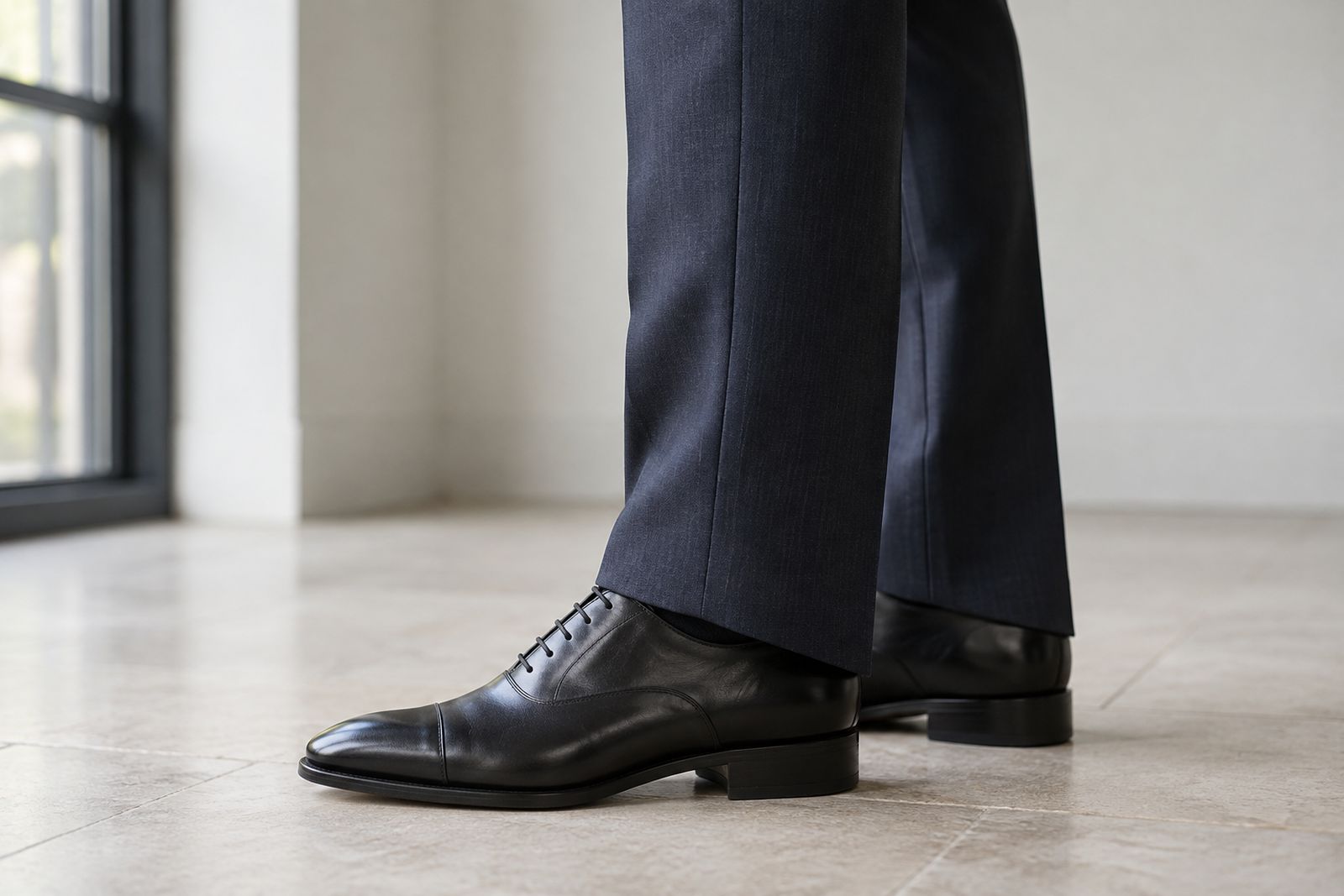
Slanted hems work best on slim and medium leg widths. On very wide trousers the angle is hard to see, and a slanted hem cannot be combined with turn-ups, which need a straight edge. If you want a slanted hem, say so before pinning, because it changes where the back pins go.
Turn-ups (cuffs): how deep, and how much length you need
Turn-ups, called cuffs in the US, are a hem folded outward to form a band at the bottom of the leg. They add weight to the hem, which helps trousers hang and keep their crease, and they suit pleated trousers and heavier fabrics. They are a little less formal than a plain hem and are never worn on black tie trousers. Our guide to trouser cuffs covers when to wear them.
- Depth. 1½ to 1¾ inches (4 to 4.5 cm) suits most men. Tall men can go to 2 inches (5 cm); shorter men often look better at 1¼ to 1½ inches (3.2 to 4 cm).
- Length needed. Roughly twice the turn-up depth plus a hem allowance, about 4 inches (10 cm) of fabric below the finished length for a 1½ inch (4 cm) turn-up. Many suit trousers are sold with an unfinished hem for this reason.
- Shape. Turn-ups must be straight, so they cannot be combined with a slanted hem.
- Break. Turn-ups look best with a quarter or half break; a deep break folds the turn-up awkwardly.
How to brief your tailor
A good tailor will ask the right questions, but a clear brief prevents mistakes, especially if the trousers are taken away and pinned by someone else. Give the tailor these details and check them on the ticket before you leave.
What to tell your tailor
- The finished inseam for each leg, in inches or centimeters, if they differ.
- The break you want: none, quarter, half or full.
- The hem style: plain, slanted, or turn-ups and their depth.
- That you want a blind-stitched hem, finished by hand if they offer it.
- A heel guard inside the back of each hem.
- To leave spare fabric folded inside, about 1½ to 2 inches (4 to 5 cm), rather than trimming it off, so the trousers can be let down later.
- To press the crease back in after hemming.
- The date you need them, if there is an event.
Can you hem dress pants by hand?
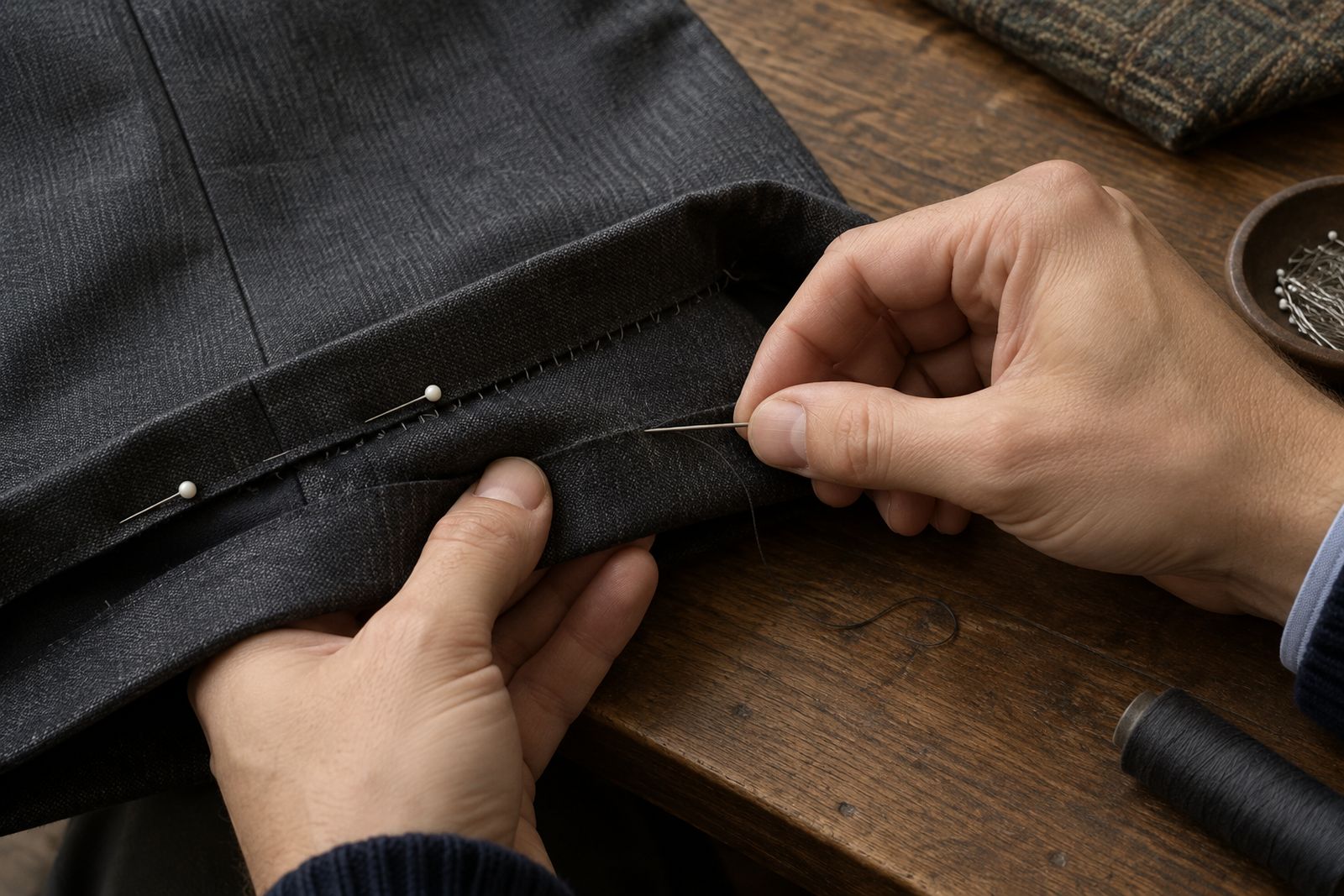
Yes, you can hem dress pants by hand with a blind stitch, and on wool suit trousers a careful hand hem is as good as a tailor's machine hem. You need a needle, thread matched to the fabric, pins, tailor's chalk, scissors, an iron and a thin cotton pressing sheet, such as a clean cotton dish towel. Pin the length first using the steps above.
Hemming suit trousers by hand
- 1
Unpick the old hem
Remove the old stitching with a seam ripper and press the fold flat under a damp pressing sheet, so the old crease is softened.
- 2
Mark the new length
Turn the leg inside out and mark the new fold line with chalk at your pinned length, all the way around. Measure from the old hem to keep the line level.
- 3
Trim and finish the edge
Leave a hem allowance of about 1½ to 2 inches (4 to 5 cm) below the fold line and trim the rest. Finish the raw edge with a zigzag machine stitch, an overlock or a hand overcast stitch so it cannot fray.
- 4
Fold and press
Fold along the chalk line, pin the allowance in place and press the fold with steam through the pressing sheet.
- 5
Blind stitch
Sew the allowance to the leg with a blind hem stitch, working from the inside. Take a small stitch through the folded edge, then catch only one or two threads of the outer fabric, and repeat about every ¼ to ⅜ inch (6 to 10 mm). Keep the thread slightly loose so the stitches do not pucker or show.
Tip: Check the outside every few inches. If you can see dimples, you are catching too much fabric or pulling too tight.
- 6
Press and add a heel guard
Press the finished hem through the pressing sheet and restore the front crease. If you like, sew a strip of heel tape inside the back of the hem.
Common hemming mistakes
- Pinning in socks, sneakers or shoes you will not wear with the suit.
- Wearing the trousers lower or higher on the waist than you normally do.
- Looking down at your feet while the hem is pinned.
- Hemming before the waist has been altered.
- Copying one leg's length to the other without checking.
- Choosing a full break on slim trousers, which leaves the fabric bunching.
- Letting the tailor trim off all the spare fabric, which rules out lengthening later.
- Deciding on turn-ups after the trousers have already been cut short.
How much does it cost to hem suit pants?
Hemming suit pants typically costs about $15 to $40 in the US and $16 to $45 in the UK for a plain hem, and about $25 to $55 for turn-ups, as of 2026. Prices vary by city and tailor, and hand-finished or slanted hems sit at the top of the range. See our suit alteration cost guide for other alterations, and what a tailor can alter for which jobs are worth doing.
Questions people ask
Should trousers be hemmed with shoes on?
Yes. Always pin a hem wearing the shoes you will wear with the trousers, because heel height and shoe shape change where the break falls. A hem pinned in socks will be too short once you put shoes on.
What is a slanted hem on trousers?
A slanted hem is cut at an angle so it sits higher at the front and lower at the back, typically by about ½ to ¾ inch (1.3 to 2 cm). It gives a clean front with little break while still covering the heel. It cannot be combined with turn-ups.
How much does it cost to hem suit pants?
Typically about $15 to $40 in the US and $16 to $45 in the UK for a plain hem as of 2026, and about $25 to $55 with turn-ups. Prices vary by city and tailor.
Can you hem dress pants by hand?
Yes. Mark the new length, leave a hem allowance of about 1½ to 2 inches (4 to 5 cm), finish the raw edge, then sew it with a blind hem stitch that catches only a thread or two of the outer fabric. Press through a thin cotton pressing sheet.
How much fabric do you need to add turn-ups to trousers?
Roughly twice the turn-up depth plus a hem allowance: about 4 inches (10 cm) below the finished length for a 1½ inch (4 cm) turn-up. If the trousers have already been hemmed short, there is usually not enough fabric.
Should both trouser legs be the same length?
Not necessarily. Many people have one leg slightly longer or stand with one hip higher, so pin each leg separately. If the difference is more than about ¼ inch (6 mm), ask the tailor to hem them to different lengths.
Can a tailor lengthen suit trousers?
Only as far as the fabric folded inside the hem allows, which is why you should ask for spare fabric to be left in when you shorten them. A faint line from the old fold may show on worn fabric.
TailorGuide is independent. Our guides are written and checked by our team and carry no paid endorsements. How we work.