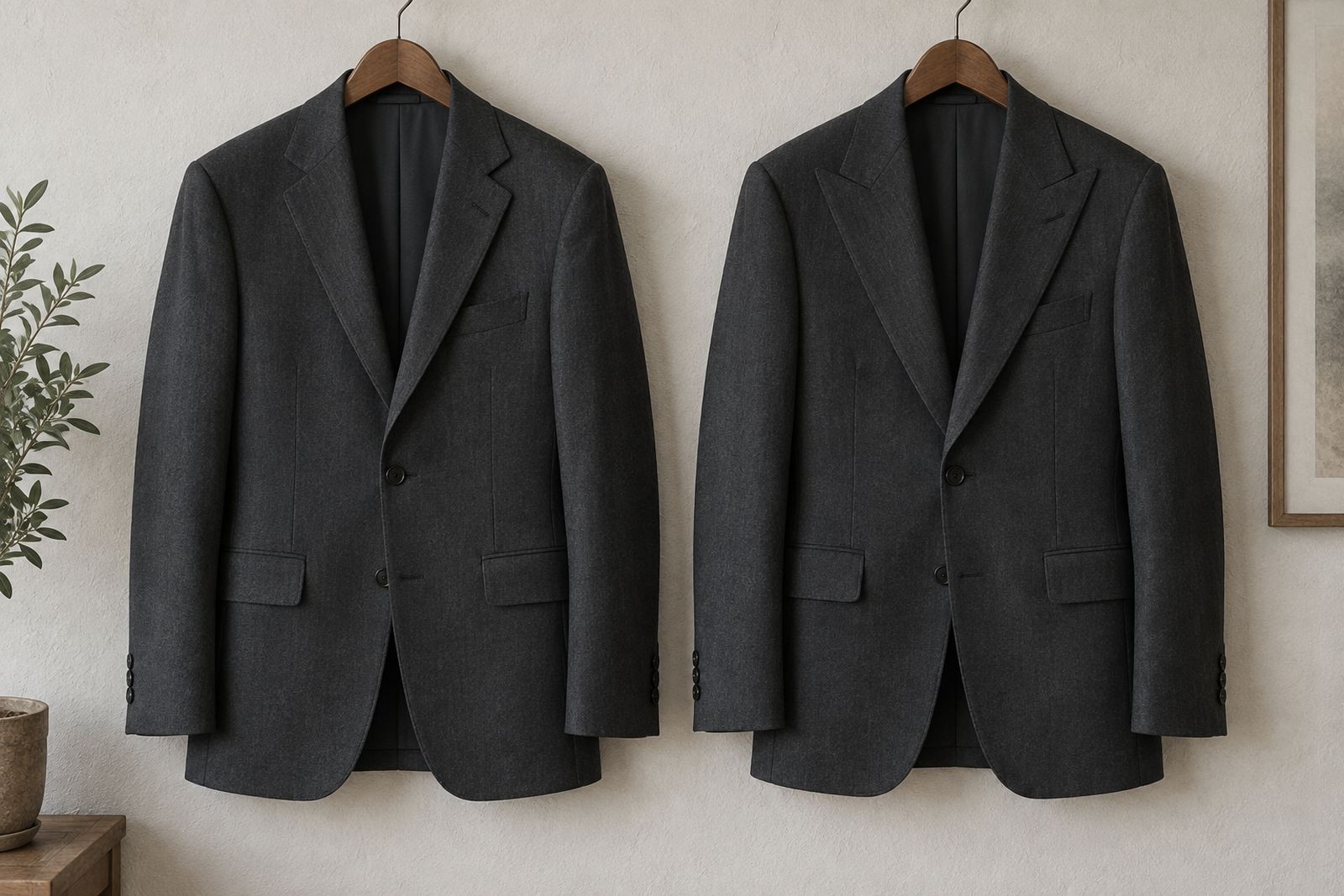
The short answer
Choose a notch lapel for your first suit and for everyday business: it is the most versatile and works everywhere. Choose a peak lapel for a double-breasted suit, a dinner jacket or a single-breasted suit you want to look dressier. Peak lapels are more formal and assertive, draw the eye up toward the shoulders and suit most builds when cut in proportion.
- Notch is the business standard and the safer choice for a first or only suit.
- Peak is more formal and assertive, and traditional on double-breasted and dinner jackets.
- A single-breasted suit with peak lapels is correct, just dressier.
- A double-breasted suit with notch lapels is unusual; choose peaks.
- Peak lapels can make the shoulders look broader and draw the eye upward.
- Keep either lapel about 3 to 3½ inches (7.5 to 9 cm) wide on a classic jacket.
In this guide
- What is the difference between peak and notch lapels?
- Peak vs notch lapel compared
- Are peak lapels more formal?
- Can you wear peak lapels to work?
- Do peak lapels make you look taller?
- Can a single-breasted suit have peak lapels?
- Can a double-breasted suit have notch lapels?
- How do lapels and button styles combine?
- Which lapel suits your build?
- What shirt and tie go with each lapel?
- Peak or notch for a wedding or black tie?
- What a good tailor checks on a peak or notch lapel
- Questions people ask
The peak vs notch lapel decision is one of the first you make when you buy or commission a suit, and one of the most visible. Both are correct. The difference is formality and character: the notch is quiet and versatile, the peak is sharper and more formal.
Peak vs notch at a glance
- Notch lapel
- Wedge-shaped gap where collar meets lapel
- Peak lapel
- Lapel points up and out toward the shoulder
- More formal
- Peak
- More versatile
- Notch
- On double-breasted
- Peak is traditional; notch is unusual
- On dinner jackets
- Peak or shawl is traditional; notch is acceptable
- Classic width
- About 3 to 3½ inches (7.5 to 9 cm) for either
What is the difference between peak and notch lapels?
The difference is the shape where the lapel meets the collar. A notch lapel meets the collar at an angle and leaves a wedge-shaped gap, the notch. A peak lapel has no open notch: its upper edge sweeps up into a point that rises toward the shoulder and nearly touches the collar.
Notch lapel
A notch lapel is a lapel that meets the collar at an angle, leaving a wedge-shaped gap at the gorge seam. It is the standard lapel on single-breasted business suits, sport coats and blazers.
Peak lapel
A peak lapel is a lapel whose upper edge rises into a point toward the shoulder. It comes from formal dress and is traditional on double-breasted jackets, dinner jackets and the evening tailcoat.
Peak vs notch lapel compared
| Notch lapel | Peak lapel | |
|---|---|---|
| Formality | Business standard | More formal |
| Character | Quiet, versatile | Sharp, assertive |
| Origin | The lounge suit, ancestor of the business suit | Formal dress: tailcoat and morning coat |
| Single-breasted | The norm | Correct, dressier |
| Double-breasted | Unusual | The norm |
| Dinner jacket | Acceptable, least traditional | Traditional, with the shawl |
| Sport coat or blazer | The norm | Rare, except on double-breasted blazers |
| Visual effect | Neutral; keeps the eye on the V | Draws the eye up and out; broadens the chest |
| Typical width | About 3 to 3½ inches (7.5 to 9 cm) | Often slightly wider than a notch on the same jacket |
| Best for | First suits, everyday business, interviews | Double-breasted suits, weddings, evening, a statement suit |
Are peak lapels more formal?
Yes. Peak lapels are more formal than notch lapels, because they come from formal dress: the evening tailcoat still has them, and they are one of the two traditional lapels on a dinner jacket. On a suit, a peak lapel adds a degree of formality without changing anything else. A charcoal single-breasted suit with peak lapels looks dressier than the same suit with notches.
Fabric still matters more than lapel shape. A peak lapel on a tweed jacket is less formal than a notch lapel on a navy worsted suit. Think of the lapel as a step up or down within the formality the fabric has already set.
Can you wear peak lapels to work?
Yes, in most offices. A single-breasted or double-breasted suit with peak lapels is entirely correct business wear with a long history. In very conservative settings, or at a job interview where you want nothing to distract, a notch lapel is the safer choice simply because it draws less attention. If peak lapels are your everyday style, keep them to a moderate width in navy, charcoal or gray, and they will look confident rather than showy.
Do peak lapels make you look taller?
They can help a little. The upward line of a peak lapel draws the eye up toward the shoulders and face, and the points broaden the chest, which together can make you look slightly taller and stronger through the upper body. The effect is modest. Correct jacket length, a fastening button at the natural waist and trousers with little break do far more for apparent height.
Can a single-breasted suit have peak lapels?
Yes. Peak lapels on a single-breasted suit are correct and have a long history in English tailoring. They make a single-breasted suit look dressier and more distinctive, which suits weddings, evening events and men who wear suits often and want some variety. The one-button single-breasted dinner jacket with peak lapels is a black tie classic. For a first or only suit, notch lapels are still the more practical choice.
Can a double-breasted suit have notch lapels?
It can, but it is unusual and tends to look unfinished. The wide, closed front of a double-breasted jacket needs the upward sweep of a peak to balance it; a notch on that front tends to look low and heavy. If you want a double-breasted suit, choose peak lapels. Our guide to single vs double-breasted suits covers the rest of that choice.
How do lapels and button styles combine?
The lapel works together with the number of buttons and the front of the jacket, so judge the combination rather than the lapel alone. Some pairings are classics, some are deliberate statements and a few rarely look right.
| Combination | How it reads | Verdict |
|---|---|---|
| Two-button, notch | The business standard | The safest choice for any first suit |
| Two-button, peak | A dressier, more confident business suit | Classic, for a second or third suit |
| One-button, peak | The dinner jacket classic; very dressy on a suit | Classic for evening |
| One-button, notch | Fashion-led on a suit; acceptable on a dinner jacket | Works, but less traditional |
| Three-button or three-roll-two, notch | Traditional; the three-roll-two is the Ivy League classic | Classic |
| Three-button, peak | High fastening leaves the peak little room | Rare and hard to balance |
| Double-breasted, peak | The traditional double-breasted front | Classic |
| Double-breasted, notch | Low and heavy at the gorge | Unusual; choose peaks instead |
If you are weighing a double-breasted suit, our guide to how to wear a double-breasted suit covers the button configurations and how they change the lapel roll.
Which lapel suits your build?
Both lapels suit most builds when they are cut in proportion. Width matters more than type: keep either lapel in proportion to your shoulders, and the type becomes a question of taste and formality.
| Notch | Peak | |
|---|---|---|
| Tall and slim | ||
| Average build | ||
| Shorter than average | ||
| Broad or athletic | ||
| Heavier through the middle | ||
| Slight, narrow shoulders |
- Shorter men: a peak lapel of moderate width draws the eye upward. Avoid wide peaks, which shorten the torso.
- Slight, narrow-shouldered men: a modest peak can add welcome breadth, but a wide one overwhelms. A notch is the easier choice.
- Broad or heavier men: both work. Keep the lapel generous enough to balance the chest, about 3¼ to 3½ inches (8.5 to 9 cm).
What shirt and tie go with each lapel?
Peak lapels look best with a spread or semi-spread collar and a tie whose width matches the lapel at its widest point; the stronger lapel needs a collar and knot with enough presence to hold their own. A narrow point collar can look pinched beneath wide peaks. Notch lapels are more forgiving: they sit happily over point, semi-spread and spread collars, and over a button-down on a sport coat. Our guides to shirt collars and tie width explain how to match each.
Peak or notch for a wedding or black tie?
For black tie, choose peak or shawl lapels faced in satin or grosgrain; a notch-lapel dinner jacket is acceptable but the least traditional choice. For a wedding, either lapel works on a suit; peaks look dressier, which suits a groom or a formal evening wedding. The table gives the choice by occasion.
| Occasion | Best choice | Notes |
|---|---|---|
| Job interview | Notch | Quiet and expected |
| Everyday office | Notch, or peak if you wear suits daily | Moderate width either way |
| Wedding guest | Either | Peak looks dressier |
| Groom's suit | Either; peak for a formal wedding | See our guide to wedding suits |
| Black tie | Peak or shawl, silk-faced | Notch is acceptable but least traditional |
| Funeral | Notch | Understated |
| Casual tailoring, sport coats | Notch | Peak only on a double-breasted blazer |
For more on dressing a groom and wedding party, see our guide to wedding suits, and for evening dress, our guide to black tie.
What a good tailor checks on a peak or notch lapel
A lapel looks right when both sides match, it rolls softly and its proportions follow your shoulders. A good tailor checks:
- Both notches, or both peaks, sit at exactly the same height and angle.
- On a peak lapel, the point rises toward the shoulder but stays well inside the shoulder line.
- The gap between the peak and the collar is small and even on both sides.
- The lapel lies against the chest without bowing out when the jacket is fastened.
- The lapel rolls softly to the fastening button rather than folding along a hard crease.
- The width suits your shoulders and matches your tie at its widest point.
For gorge height, roll, belly and the shawl lapel, read our full guide to suit lapels, and for every other named detail on a jacket, see the parts of a suit jacket. If you want a lapel cut to your shoulders, our ranking of the best tailors in London is a good place to start.
Questions people ask
Are peak lapels more formal than notch lapels?
Yes. Peak lapels come from formal dress such as the evening tailcoat, and they make a suit look dressier than the same suit with notch lapels. Fabric still sets the overall formality, so a peak lapel on tweed is less formal than a notch on navy worsted.
Can you wear peak lapels to work?
Yes, in most offices. Peak lapels are correct business wear on single and double-breasted suits. At an interview or in a very conservative office, notch lapels are the safer choice because they draw less attention.
Do peak lapels make you look taller?
They can help slightly. The upward points draw the eye toward the shoulders and face and broaden the chest. Jacket length, button position and trouser break have a much bigger effect on how tall you look.
Can a single-breasted suit have peak lapels?
Yes. A single-breasted suit with peak lapels is correct and looks dressier than one with notches. The one-button peak-lapel dinner jacket is a black tie classic.
Which lapel is better for a wedding?
Either works on a suit. Peak lapels look dressier and suit a groom or a formal evening wedding; notch lapels are the quieter choice for a guest. For black tie, choose peak or shawl lapels.
Is a notch lapel acceptable for black tie?
It is acceptable but the least traditional choice. Peak and shawl lapels faced in satin or grosgrain are the classic options for a dinner jacket. A notch-lapel dinner jacket looks closer to a business suit.
Which lapel is more versatile?
The notch lapel. It works on business suits, sport coats and blazers and at almost any occasion. That is why it is the right choice for a first or only suit.
TailorGuide is independent. Our guides are written and checked by our team and carry no paid endorsements. How we work.