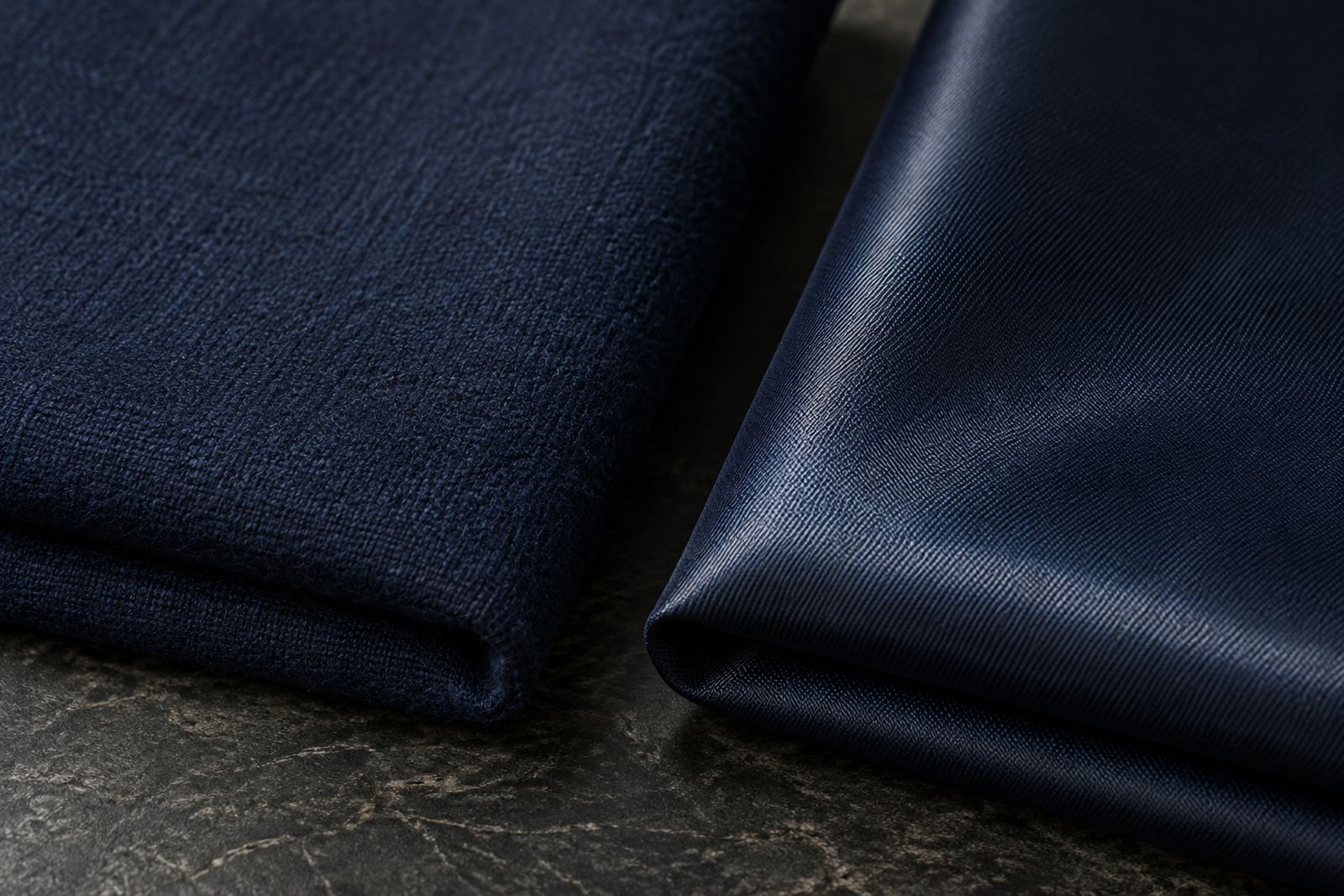
The short answer
Wool is better than polyester for almost every suit. Wool breathes, handles sweat, drapes well and ages gracefully; polyester traps heat, can look shiny and pills over time. Polyester's real advantages are a low price and strong crease resistance. A wool blend with a little elastane or polyester can make sense for travel or uniforms, but pure wool remains best for comfort.
- Pure wool is the most comfortable suit fabric; polyester does not breathe.
- Polyester is cheap, hard-wearing and crease-resistant, but can look shiny and pills.
- A mostly wool blend with a little elastane or polyester is reasonable for travel and uniforms.
- Check the fiber label first, then the shine, the hand and, if needed, a burn test on loose threads.
- If budget is the issue, a simple pure wool suit usually beats a polyester one.
In this guide
Polyester vs wool is usually framed as cheap against good, and that is mostly fair. But polyester has real strengths, and blends exist for good reasons. The useful question is which fiber suits the way you will wear the suit: how often, in what climate, and for how many years you want it to look right.
Polyester vs wool at a glance
- Most comfortable
- Pure wool
- Cheapest
- Polyester
- Best crease resistance
- Polyester, then high-twist wool
- Best in heat
- Pure wool in a light, open weave
- Ages best
- Pure wool
- Sensible blends
- Mostly wool, with a little elastane or polyester, for travel and uniforms
Is wool or polyester better for a suit?
Wool is better for almost every suit you will wear regularly. It breathes, absorbs sweat vapor, resists odor, drapes naturally and can be pressed and shaped by a tailor. Polyester wins on price and crease resistance, and it stands up well to abrasion. Those advantages matter for uniforms, costumes and suits worn a few times a year; they rarely outweigh the comfort gap in a suit you wear to work.
| Factor | Pure wool | Mostly wool blend | Polyester |
|---|---|---|---|
| Breathability | Excellent in open weaves | Good | Poor |
| Moisture handling | Absorbs water vapor into the fiber | Good | Absorbs almost none; sweat stays on the skin |
| Comfort in heat | Very good in light, open weaves | Good | Poor; feels clammy |
| Shine | Matte; may shine at the seat after years | Slight | Often shiny, worse after pressing |
| Crease resistance | Very good; creases drop out overnight | Very good | Excellent |
| Pilling | Low in worsteds | Low to moderate | Pills at friction points |
| Odor | Resists odor | Good | Holds odor |
| Drape | Natural and fluid | Good | Flatter and stiffer |
| Durability | Very good with rotation and care | Very good | Resists abrasion but looks tired sooner |
| Tailoring | Shapes with steam and pressing | Shapes reasonably | Resists shaping; can glaze under a hot iron |
| Care | Dry clean rarely; brush and steam | Much like wool | Sometimes washable; check the label |
| Price | Mid to high | Low to mid | Low |
Why polyester feels hot
Polyester is a plastic. Most polyester fiber is polyethylene terephthalate (PET), the same family of material used for many drinks bottles. It absorbs almost no moisture, well under 1 percent of its weight in normal conditions, so sweat cannot move into the fiber; it stays on your skin or condenses on the inside of the fabric. Wool takes a substantial amount of water vapor into the fiber before it feels damp, which buffers you as you start to sweat.
Weave adds to the problem. Polyester suiting is usually made from smooth, uniform yarns in dense weaves, which block air more than an open wool weave does. The result is the familiar clammy feeling after a short walk on a warm day.
Is a polyester suit bad?
A polyester suit is not bad for every purpose; it is a poor choice for regular wear. It is cheap, survives rough treatment and resists creasing, which makes it practical for uniforms, costumes, a suit worn twice a year or a suit for a teenager who will outgrow it. The problems appear when you wear it often or in heat: it is uncomfortable, it tends to look shiny under strong light, it pills where it rubs and it holds odor. It also cannot be shaped and pressed the way wool can, so it rarely looks as good after alterations.
Polyester suits: the honest trade-off
For
- +Low price
- +Excellent crease resistance
- +Resists abrasion and holds its color
- +Some can be washed at home
Against
- –Does not breathe or absorb sweat
- –Can look shiny, especially after pressing
- –Pills at friction points
- –Holds body odor
- –Resists tailoring and can glaze under a hot iron
- –Looks tired sooner than wool
Are wool blend suits good?
A wool blend can be very good or quite poor, depending on what the wool is blended with and in what proportion. Blends with other natural fibers, such as mohair, silk, linen or cashmere, are made for performance or luxury. Blends with polyester are usually made to cut cost or add crease resistance. Read the label: fibers are listed by percentage, largest first.
| Blend | Why it exists | Watch for | Good for |
|---|---|---|---|
| Wool with a few percent elastane | Stretch and comfort when moving | Stretch can weaken with heat and age | Travel, long days on your feet |
| Mostly wool with some polyester | Lower price, more crease resistance and durability | Less breathable than pure wool | Travel suits, uniforms, budget suits |
| Mostly polyester with some wool | Low price with a little wool in the hand | Behaves largely like polyester | Uniforms, occasional wear |
| Wool and viscose | Softer drape at lower cost | Creases; can lose shape when damp | Budget fashion suits |
| Wool with mohair, silk, linen or cashmere | Coolness, luster, softness or warmth | Higher price | Summer, evening and luxury suits |
A mostly wool travel suit with a little polyester or elastane is a reasonable choice if you live out of a suitcase; pair it with good packing habits from our guide on how to pack a suit.
Are stretch suits worth it?
Stretch suits are worth it if you move a lot, travel often or value comfort above all. A few percent of elastane (also called spandex, or by the brand name Lycra) gives a wool fabric noticeable give across the back, seat and knees. The trade-offs: elastane is sensitive to heat, so hard pressing and hot drying can damage it, and its recovery can fade over years of wear, leaving the seat and knees slightly baggy.
There is a second kind of stretch. Some mills make mechanical stretch wools, in which tightly twisted yarns and the weave itself give the fabric spring without any elastane. These keep the comfort of pure wool and avoid the aging problem, and they are worth asking about.
Wool with elastane
A few percent elastane
- Most stretch
- Very comfortable when moving
- Stretch can fade over the years
- Needs a cooler iron
Mechanical stretch wool
Stretch from yarn and weave
- Moderate stretch
- Pure wool comfort
- No elastane to wear out
- Less widely available
Pure wool, no stretch
Traditional suiting
- Natural give only
- Best breathability
- Ages well
- Easiest for a tailor to shape
How can you tell if a suit is polyester?
Start with the label, then use your eyes and hands, and if you still need to know, a careful burn test on a few loose threads.
How to tell polyester from wool
- 1
Read the fiber label
Fiber content labels are required by law in the US, UK and EU. Look inside the jacket, usually in an inside pocket or along a side seam, and inside the trouser waistband. Percentages are listed largest first.
Tip: The shell fabric and the lining are listed separately. The shell is what decides comfort.
- 2
Look for shine
Tilt a sleeve under a strong light. Polyester tends to show an even, glassy sheen; wool is matte or has a soft luster. Pressed edges, such as lapels and trouser creases, show it first.
- 3
Feel the hand
Wool feels dry, springy and slightly textured. Polyester feels smoother, slicker and more uniform, almost plasticky.
- 4
Breathe through it
Hold a single layer of the fabric to your mouth and blow. Air passes easily through an open wool weave and with more effort through a dense polyester. It is a rough test, but it predicts how the fabric will feel in heat.
- 5
Crush it
Squeeze a corner in your fist for 10 seconds. Wool and polyester both spring back, so this does not separate them, but cotton, linen and viscose will stay creased.
- 6
Burn a few loose threads
Take a few threads from an inside seam allowance or a spare swatch, never from the visible fabric, and hold them with tweezers over a sink or metal dish. Compare the result with the table below.
Tip: Work outdoors or by an open window, away from anything flammable, with water nearby. Melting polyester sticks to skin and burns.
| Fiber | Near a flame | Smell | What is left |
|---|---|---|---|
| Wool | Burns slowly, curls away and usually goes out on its own | Burning hair | Black ash that crushes to powder |
| Polyester | Shrinks from the flame, melts and drips | Sweet or chemical | Hard black bead |
| Cotton, linen, viscose | Burns quickly with a steady flame and an afterglow | Burning paper | Soft gray ash |
| Wool and polyester blend | A mix of the two | Hair with a chemical note | Crushable ash with hard beads |
When is a polyester blend worth it?
Match the fabric to the job. This matrix shows where each option makes sense.
| Pure wool | Wool and elastane | Mostly wool with polyester | Polyester | |
|---|---|---|---|---|
| Daily office suit | ||||
| Hot, humid weather | ||||
| Frequent travel | ||||
| Uniform or workwear | ||||
| Occasional wedding or funeral | ||||
| Long-term investment | ||||
| Tight budget |
The tailor's view
Most tailors prefer to work in wool, for practical reasons. Wool can be shrunk and stretched with steam and an iron, which is how a tailor shapes a chest, sets a sleeve cleanly and eases one seam into another. Polyester barely responds to steam, so seams pucker more easily and curves are harder to build in. Under a hot iron it can glaze, leaving a permanent shine. That is why good canvassed construction is rarely paired with polyester, and why alterations on polyester suits tend to show.
Before you buy a blend
- Read the label: what percentage is wool?
- Prefer blends that are mostly wool
- Check the shine under a strong light
- Ask whether the stretch comes from elastane or from the yarn and weave
- Ask how the suit should be cleaned and pressed
- Compare the price with a pure wool suit of simple construction
Better ways to save money than polyester
If price is the reason you are considering polyester, there are usually better trade-offs. A pure wool suit with simple construction in a sturdy Super 100s to 120s will be more comfortable and look better for longer than a polyester suit at a similar price. Choose navy or mid-gray so you wear it often. Our guides to bespoke on a budget and the signs of a quality suit show where to spend and where to save, and fused vs canvas explains the construction choices.
Pure wool for anything you wear often; a mostly wool blend for travel and hard use; polyester only when price or toughness truly outweighs comfort. For every other fiber, see suit fabrics explained, and for the numbers on wool labels, see Super numbers explained.
Questions people ask
Is a polyester suit bad?
A polyester suit is fine for occasional wear, uniforms or a tight budget, but it is a poor choice for regular wear. It does not breathe, can look shiny and pills over time. A pure wool or mostly wool suit is more comfortable and ages better.
Are wool blend suits good?
Wool blend suits are good when the blend is mostly wool and has a clear purpose, such as a little elastane for stretch or some polyester for travel. Blends with mohair, silk, linen or cashmere are made for performance or luxury. Blends that are mostly polyester behave largely like polyester.
How can you tell if a suit is polyester?
Check the fiber label inside the jacket first; it is required by law in the US, UK and EU. Polyester also tends to look glassy under strong light and feel slick and uniform. A burn test on a few loose threads settles it: polyester melts into a hard bead, while wool leaves a crushable ash and smells of burning hair.
Are stretch suits worth it?
Stretch suits are worth it if you move a lot or travel often, because a few percent of elastane adds real comfort. The stretch can weaken with heat and age, so press them with care. Mechanical stretch wools, which get their give from yarn twist and weave, avoid that problem.
Is polyester or wool better for hot weather?
Wool is far better in hot weather. A light, open-weave wool breathes and handles sweat, while polyester absorbs almost no moisture and feels clammy. Our guide to the best suit fabric for hot weather ranks the options.
Do polyester suits last longer than wool?
Polyester resists abrasion well, so it may not wear through as quickly, but it tends to look tired sooner as it pills and turns shiny. A well-made wool suit that is rotated and cared for usually looks good for longer. Longevity depends as much on construction and care as on fiber.
Can you iron a polyester suit?
Yes, but only on a low setting and through a pressing sheet. Polyester is heat-sensitive and can glaze, leaving a permanent shine, or even melt under a hot iron. A steamer is safer for everyday creases.
Why are polyester suits cheaper?
Polyester is an inexpensive synthetic fiber that is quick to produce, while fine wool is a natural fiber with limited supply and more processing. Polyester suits are also often made with simpler, fused construction. The lower price reflects both the fabric and the making.
TailorGuide is independent. Our guides are written and checked by our team and carry no paid endorsements. How we work.