The short answer
To pack a suit, turn one shoulder of the jacket inside out, tuck the other shoulder into it, and lay the jacket folded in half lengthwise with the lining facing out. Fold it once across the middle if needed and place it on top of your packed clothes. Fold the trousers along their creases. Pack the suit last, unpack it first, and steam it on arrival.
- Use the inside-out shoulder fold: lining out, shoulders nested, one soft fold across the middle.
- Fold structured jackets; roll only trousers and soft, unstructured jackets.
- Pack the suit last, on top, in a thin plastic bag or with tissue paper in the folds.
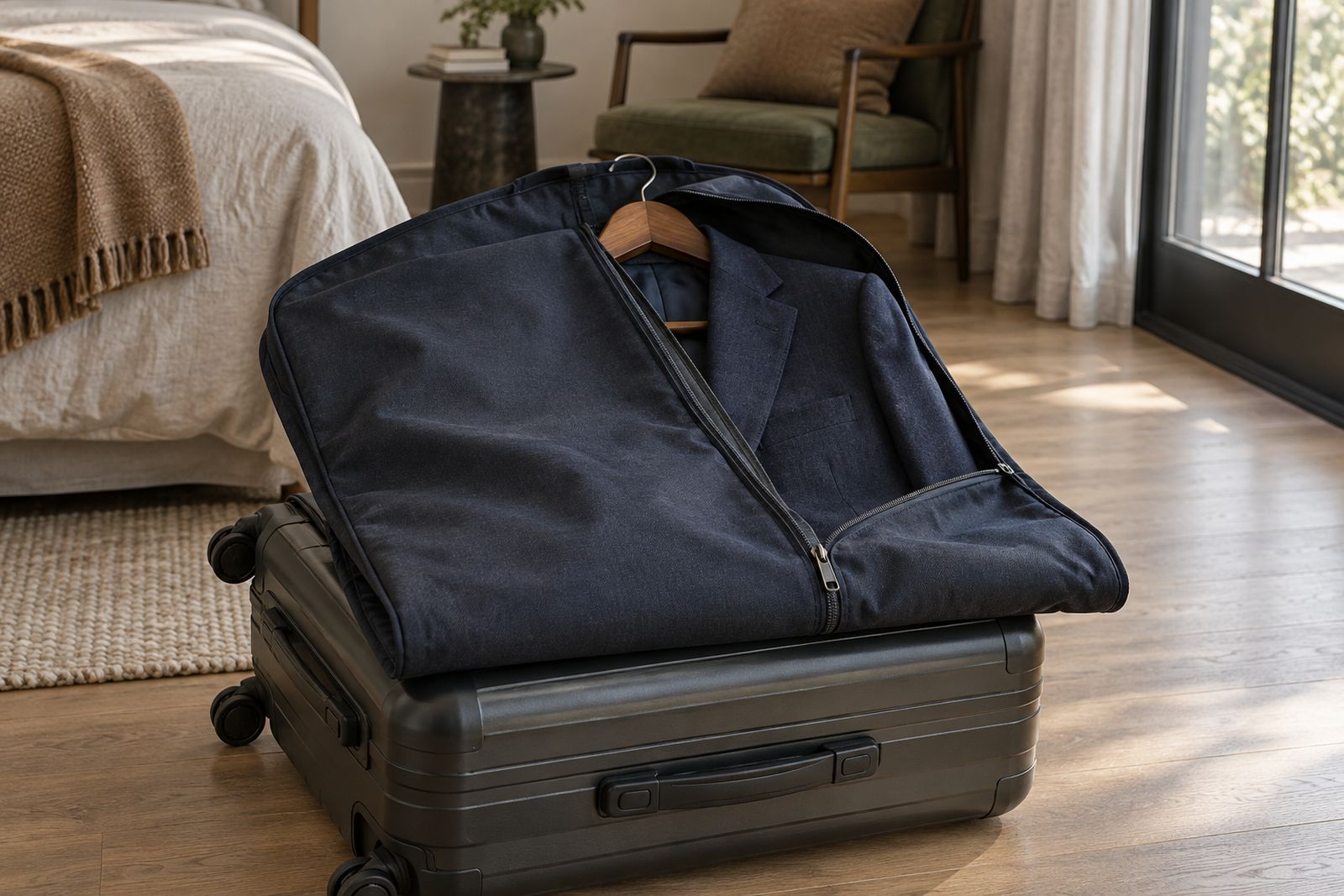
- A garment bag carried in the cabin is the safest way to fly with a new or expensive suit.
- Hang the suit as soon as you arrive; steam or a hot-shower bathroom removes most travel creases.
In this guide
- How to fold a suit jacket for travel
- Should you roll or fold a suit?
- How to pack suit trousers
- How to pack a suit in a suitcase or carry-on
- Can you carry a suit on a plane?
- Carrying a new tailored suit home on a flight
- How to unpack a suit and remove travel wrinkles
- Common packing mistakes
- Questions people ask
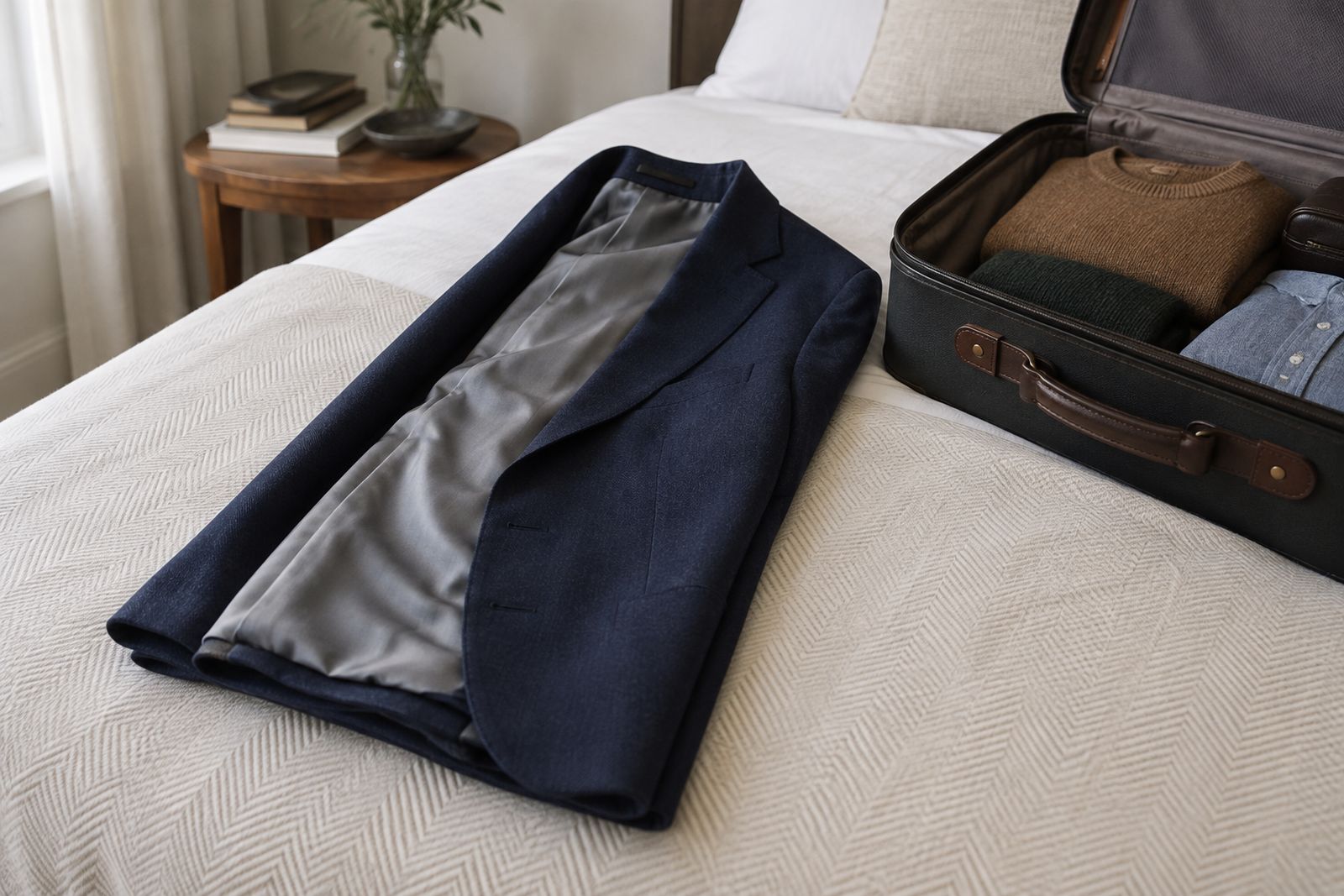
The best way to pack a suit is the inside-out shoulder fold. The jacket folds in half along its back with the lining outside and one shoulder tucked inside the other, then goes on top of everything else in your bag. It protects the shoulders, keeps the outer fabric away from friction and leaves just one soft fold to drop out at the other end.
Creases come from three things: sharp folds, weight pressing on those folds, and time. Every method here reduces at least one of them. Wool is on your side, because a good wool suit recovers from most packing creases within a day on a proper hanger. Linen and cotton do not, and need more care.
Packing a suit at a glance
- Jacket
- Inside-out shoulder fold, then one fold across the middle if needed
- Trousers
- Folded along the crease, laid flat or wrapped around other clothes
- Where in the bag
- On top, packed last
- Extras
- Tissue paper in the folds, or a thin plastic bag around the jacket
- Most protection
- A garment bag carried in the cabin
- On arrival
- Hang at once; steam or use a steamy bathroom
How to fold a suit jacket for travel
Fold a suit jacket for travel by turning one shoulder inside out and nesting the other shoulder inside it. The jacket then lies folded in half lengthwise, lining facing out, with its two shoulders supporting each other. You can lay it flat like that in a large case, or fold it once more across the middle for a carry-on.
The inside-out shoulder fold
- 1
Empty and unbutton
Empty every pocket and undo all the buttons. Anything left in a pocket presses its outline into the fabric.
- 2
Hold it by the shoulders
Hold the jacket upright by both shoulders with the front facing you, as if it were on a hanger.
- 3
Turn one shoulder inside out
Turn the left shoulder inside out, so its lining now shows on the outside. The left sleeve hangs down inside it.
- 4
Tuck in the other shoulder
Fold the jacket in half along the center back seam and slide the right shoulder, still right side out, into the inverted left shoulder until the two shoulders nest one inside the other.
Tip: Line the shoulder points up exactly. If one shoulder sits higher than the other, the fold crushes the shoulder pad.
- 5
Straighten the jacket
Lay it on a bed or table. The jacket is now folded in half lengthwise, with the lining outside and the outer fabric protected inside. Smooth the lining, let the sleeves lie straight inside the fold, and check that the lapels lie flat without kinks.
- 6
Fold once across the middle
If the jacket is too long for your bag, fold it once across the middle, at about the waist. Lay a rolled T-shirt or a few sheets of tissue paper in the fold first, so the jacket bends around something soft instead of creasing sharply.
- 7
Bag it and place it on top
Slip the folded jacket into a thin plastic bag, such as a dry cleaner's cover, and lay it on top of everything else in the case. The plastic reduces friction between layers, so folds stay soft. Take it out of the plastic as soon as you arrive.
Should you roll or fold a suit?
Fold a structured jacket; roll trousers and soft, unstructured jackets. Rolling avoids hard fold lines and saves space, but a jacket with a canvas chest and padded shoulders gets compressed all the way round when it is rolled. The inside-out fold leaves the shoulders intact and puts a single soft bend in the body.
| Method | Best for | Wrinkle risk | Space |
|---|---|---|---|
| Inside-out shoulder fold | Structured suit jackets | Low: one soft fold across the middle | Medium |
| Rolling | Trousers, unstructured jackets, knitwear | Medium: no sharp lines, but small creases all over | Small |
| Bundle (clothes wrapped around a soft core) | Trousers and shirts on longer trips | Low: every fold is padded by other clothes | Medium |
| Garment bag | Any suit, especially new or expensive ones | Lowest: hangs with one or two soft folds | Large |
If you do roll a jacket, make the inside-out shoulder fold first so the lining is outside, then roll it loosely. A loose roll creases far less than a tight one, and it should never be squeezed into a corner of the case. A heavily structured jacket from a canvassed suit is always better folded.
How to pack suit trousers
Fold suit trousers (pants) along their existing creases, never across them. Hold them upside down by the hems, line up the inseam and outseam of each leg so the creases fall into place, and lay them flat.
From there you have two good options. For a short trip, fold them in half or in thirds and lay them on top, near the jacket, with tissue paper at each fold. For a longer trip, lay them across the bottom of the case with the waist inside and the legs hanging over the edge, pack your other clothes on top, then fold the legs back over the pile. The trousers wrap around a soft core, so there is no sharp crease at all.
How to pack a suit in a suitcase or carry-on
Pack the suit last and unpack it first. Build a flat, firm base with everything else, then lay the suit on top, where nothing presses down on it.
Packing order for a suitcase or carry-on
- 1
Heavy items at the base
Shoes, toiletries and anything rigid go at the wheel end, so they stay at the bottom when the bag stands upright.
- 2
Fill the gaps
Fill the corners with socks, underwear and rolled T-shirts so the load cannot shift. Clothes that slide around in transit crease more than clothes that are held firmly.
- 3
Lay down shirts and knitwear
Fold shirts and lay them in a flat, even layer to make a level bed for the suit.
- 4
Add the trousers
Lay the trousers flat on top, folded along their creases, or wrap them around the pile as described above.
- 5
Put the jacket on last
Lay the folded jacket on top, lining out, inside its plastic bag. Pack nothing on top of it.
- 6
Close it gently
Do not sit on the case to close it. If it only shuts under pressure, take something out: compression turns soft folds into hard creases.
Tip: A carry-on with a flat, full-size lid compartment is the easiest to pack a jacket into without a second fold.
Can you carry a suit on a plane?
Yes. A suit can travel folded in your cabin bag or in a garment bag, and keeping it in the cabin is the safest way to fly with a good suit. Airlines usually count a garment bag as your cabin bag rather than an extra item, so check its folded dimensions against your airline's size limits before you fly.
On board, lay a garment bag flat on top of other bags in the overhead bin, folded once, rather than wedged beneath them. Some aircraft have a closet for hanging garments, often only in premium cabins, so ask the cabin crew, but do not rely on it.
Folded in a suitcase
Most trips
- Uses the inside-out shoulder fold
- Fits a carry-on or a checked bag
- One soft fold that drops out overnight
- Crushes if the bag is overfilled
Garment bag in the cabin
New or valuable suits
- Hangs nearly full length with one or two soft folds
- Usually counts as your cabin bag
- Keep it on top in the overhead bin
- Bulkier to carry through connections
Worn on the journey
One-suit trips
- Nothing to pack
- Take the jacket off before you sit
- Fold it lining-out in the overhead bin
- Trousers crease at the knees and seat
Should you wear the suit on the plane?
You can, and on a one-suit trip it saves space. Take the jacket off before you sit, fold it with the inside-out shoulder fold and lay it on top of the bags in the overhead bin. Sitting in a jacket for hours creases the back and crushes the vents. Expect the trousers to need steaming when you arrive.
Carrying a new tailored suit home on a flight
If you are flying home with a newly made suit, ask the tailor to pack it for you. Many tailors fold a finished suit with tissue paper in every fold and supply a garment bag, and they know how their own canvas and shoulders should be handled. Carry it in the cabin rather than checking it: a lost or crushed bag is much harder to put right when the suit is new and its maker is far away.
Have every adjustment finished before you leave. The maker has your pattern and knows how the suit was cut, so a sleeve or hem corrected at the final fitting is better than an alteration by someone else at home. Ask for a final press just before it is packed, and keep the garment bag for future trips.
How to unpack a suit and remove travel wrinkles
On arrival
- 1
Unpack the suit first
Take the suit out before anything else, remove it from any plastic and hang it at once. The sooner it hangs, the sooner the folds start to drop out.
- 2
Use the best hanger available
Hotel hangers are often thin. Use the widest one in the wardrobe, ask housekeeping for a suit hanger, or travel with a light shaped hanger of your own.
- 3
Let it hang
Give it a few hours, or overnight. A wool suit loses most light packing creases on its own.
- 4
Steam it
Hang it in the bathroom, close the door and run the shower as hot as it goes for 10 to 15 minutes, keeping the suit clear of the spray. Leave it in the steam for another 10 minutes, then hang it somewhere airy to dry for at least 30 minutes. A travel steamer does the same job faster.
Tip: Do not hang the suit where drips can reach it: water spots can mark some wools.
- 5
Press only what steam cannot fix
For a lost trouser crease, use the hotel iron on the wool setting through a damp cotton pillowcase or handkerchief, never directly on the fabric. Or send the suit to the hotel's pressing service and ask for 'press only'.
For the full method, including iron temperatures and how to press trousers, see how to get wrinkles out of a suit.
Common packing mistakes
- Folding the jacket with the outer fabric outside, where it rubs against everything else.
- Packing the suit first, at the bottom, under the weight of the rest of the bag.
- Overfilling the case so the lid compresses every fold.
- Leaving the suit folded in the bag overnight after you arrive.
- Rolling a structured jacket tightly, which crushes the chest canvas and shoulder pads.
- Packing shoes or toiletries on top of, or beside, the suit.
- Ironing out travel creases with the iron directly on the wool, which leaves a shine.
- Sending a suit for dry cleaning after every trip, when steaming is all it needs unless it is soiled; see how often to dry clean a suit.
Once you are home, give the suit a rest day, a brush and a night on a proper hanger before it goes back into rotation. Our guide to caring for a suit covers the routine that keeps it in shape between trips.
Questions people ask
How do you fold a suit jacket for travel?
Turn one shoulder inside out, tuck the other shoulder into it, and the jacket folds in half lengthwise with the lining facing out. Smooth it flat and, if your bag is short, fold it once across the middle around a rolled T-shirt or tissue paper. Lay it on top of everything else.
Can you carry a suit on a plane?
Yes. You can pack a suit folded in a cabin bag or carry it in a garment bag, which airlines usually count as your cabin bag. Lay it flat on top of other bags in the overhead bin, and ask the cabin crew whether there is a closet to hang it, without relying on one.
How do you pack a suit in a carry-on?
Put shoes and heavy items at the wheel end, fill the gaps with soft items, make a flat layer of shirts, then add the trousers folded along their creases. Lay the jacket on top last, folded inside out at the shoulders and slipped into a thin plastic bag. Do not overfill the bag.
How do you get wrinkles out of a suit in a hotel?
Hang it in the bathroom with the door closed and run a hot shower for 10 to 15 minutes, keeping the suit out of the spray. Leave it in the steam for another 10 minutes, then let it dry for 30 minutes before wearing. For trouser creases, use the hotel iron on the wool setting through a damp cotton pillowcase, or ask the hotel to press it.
Is it better to roll or fold a suit?
Fold the jacket and roll only the trousers or a soft, unstructured jacket. Rolling compresses a structured jacket's canvas and shoulder pads all over, while the inside-out shoulder fold protects the shoulders and leaves a single soft fold.
Is a garment bag worth it?
For a new, expensive or formal suit, yes. A garment bag lets the suit travel nearly full length with one or two soft folds, and you can keep it with you in the cabin. For a well-made wool suit on a short trip, the inside-out fold in a suitcase is usually enough.
Does putting a suit in a plastic bag stop wrinkles?
It helps. A thin plastic bag, such as a dry cleaner's cover, reduces friction between the suit and the clothes around it, so folds stay soft instead of setting into creases. Take the suit out of the plastic as soon as you arrive.
TailorGuide is independent. Our guides are written and checked by our team and carry no paid endorsements. How we work.