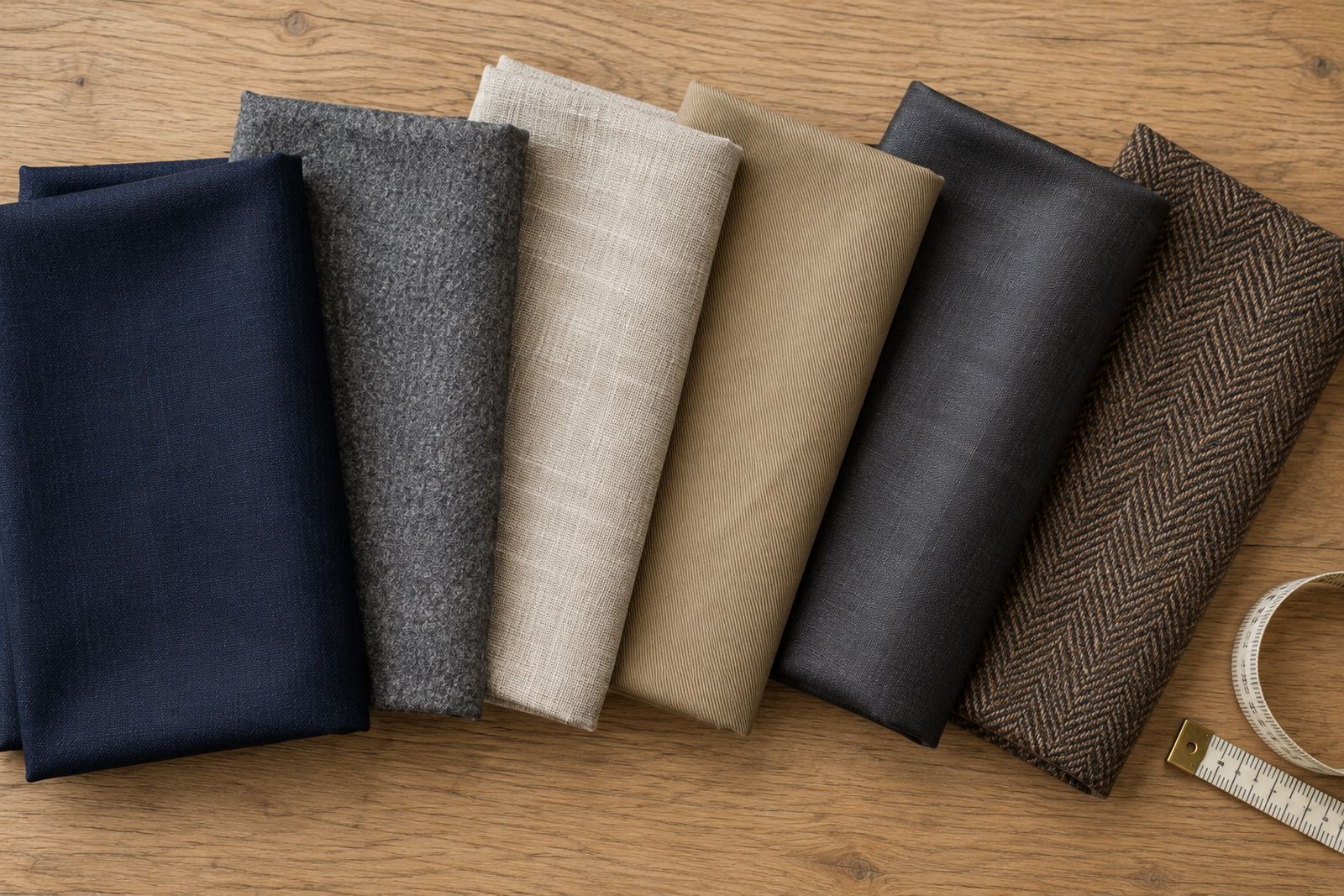
The short answer
Worsted wool is the best fabric for most suits: it breathes, recovers from creases, drapes well and lasts for years. Choose about 9 to 11 oz (280 to 340 g) for year-round wear. Linen, cotton and mohair blends suit hot weather; flannel, tweed and cashmere blends suit cold weather. Polyester is cheaper and resists creasing, but it does not breathe.
- Worsted wool in a plain weave or fine twill is the right first suit fabric for almost everyone.
- Weight matters as much as fiber: 7 to 9 oz (220 to 280 g) for heat, 12 to 14 oz (370 to 430 g) for winter.
- Super 100s to 130s is the everyday sweet spot; higher numbers feel softer but wear faster.
- Linen and cotton breathe well but crease; mohair blends stay crisp in heat.
- Polyester costs less and resists creases, but it traps heat and can look shiny.
In this guide
- What is the best fabric for a suit?
- Wool: the default suit fabric
- How heavy should suit fabric be?
- Linen
- Cotton
- Mohair
- Silk
- Cashmere and other luxury fibers
- Polyester, viscose and other synthetics
- Blends: when mixing fibers makes sense
- Which suit fabric for which climate and season?
- What suit fabric is best for everyday wear?
- Common suit fabric mistakes
- The tailor's view: how to choose from a fabric book
- Questions people ask
Suit fabrics decide more about how a suit feels than any other choice you make at a tailor. The fiber sets how it breathes and creases, the yarn and weave set how it drapes and wears, and the weight sets the season. A beautifully cut suit in the wrong fabric will still feel hot in July or look tired by noon. Start with wool, the default, then work through the alternatives for heat, cold and budget.
Suit fabrics at a glance
- Best all-rounder
- Worsted wool, 9 to 11 oz (280 to 340 g), Super 100s to 130s
- Coolest in dry heat
- Linen and linen blends
- Best in humid heat
- High-twist (fresco-type) wool, hopsack and mohair blends
- Warmest
- Woolen flannel, tweed and cashmere blends, 12 oz (370 g) and up
- Least creasing
- High-twist wool, mohair blends and polyester
- Cheapest
- Polyester and polyester-rich blends
What is the best fabric for a suit?
Worsted wool is the best fabric for most suits. It breathes, absorbs moisture vapor, springs back from creases, takes a sharp press and lasts for years with basic care. A mid-weight worsted in navy or gray works for the office, weddings, interviews and travel, which is why tailors treat it as the default.
The other fibers earn their place in specific conditions. Linen and cotton are cooler and more casual. Mohair adds crispness and luster for heat and evening wear. Cashmere and woolen flannels add softness and warmth for winter. Polyester costs less and resists creasing but gives up comfort. The table compares them on the points that matter when you wear a suit all day.
| Fiber | Breathability | Crease resistance | Durability | Relative price | Best season |
|---|---|---|---|---|---|
| Worsted wool | Good to very good, depending on weave | Very good | Very good | Mid to high | All year, chosen by weight |
| Woolen wool (flannel, tweed) | Moderate | Good | Tweed very good; soft flannel wears at the seat and elbows | Mid to high | Autumn and winter |
| Linen | Excellent | Poor | Good, though fibers can wear along repeated folds | Mid | Summer, dry heat |
| Cotton | Good | Poor to fair | Good, but fades with sun and cleaning | Low to mid | Spring and summer |
| Mohair (blended with wool) | Very good | Excellent | Very good | High | Summer and evening |
| Silk (blended) | Good | Fair | Fair | High | Spring and summer |
| Cashmere (blended or pure) | Moderate | Good | Fair; pills and wears at elbows and seat | High to very high | Autumn and winter |
| Polyester | Poor | Very good | Resists abrasion, but pills and turns shiny | Low | Any, but uncomfortable in heat |
Ratings compare typical suit fabrics of similar weight. Weave and weight can move any fiber up or down: an open hopsack wool breathes far better than a dense wool gabardine.
Wool: the default suit fabric
Wool is the fiber of almost every tailored suit. Each fiber has a natural crimp, a wave along its length, which gives the fabric spring: a wool sleeve creased at the elbow recovers overnight on a hanger. Wool also absorbs water vapor into the fiber itself, so it copes with sweat better than synthetics, and it resists odor, so it needs cleaning far less often than cotton. For a tailor, wool's biggest virtue is that it can be shaped with steam and an iron, which is how a jacket gets its curved chest and rolled lapel.
Most fine suiting wool comes from merino sheep. What turns that fiber into very different fabrics is how it is spun, how fine it is and how it is woven.
Worsted and woolen yarns
Worsted yarn is combed so the long fibers lie parallel, giving a smooth, strong, crisp yarn; most business suits are worsted. Woolen yarn is carded only, so the fibers stay jumbled and the yarn is fuzzier, loftier and warmer. Flannel and tweed are the classic woolen fabrics, though worsted flannel also exists. Our guide to worsted vs woolen wool explains both.
Super numbers
A label such as Super 120s states how fine the wool fibers are. Under the code of practice of the International Wool Textile Organisation (IWTO), Super 120s means a mean fiber diameter of no more than 17.75 microns. Higher numbers feel softer but crease more and wear faster, so Super 100s to 130s is the sweet spot for suits you wear often. Our guide to Super numbers has the full micron chart.
Common wool weaves
The weave changes how a wool fabric looks, breathes and wears. These are the ones you will meet in a fabric book.
| Weave or fabric | What it looks like | How it behaves | Typical use |
|---|---|---|---|
| Plain weave (tropical) | Simple over-under grid, matte | Light and airy; creases a little more than twill | Summer and year-round suits |
| High-twist plain weave (fresco type) | Open, grainy, slightly dry surface | Very breathable, springs back from creases | Hot weather, travel |
| Twill (serge) | Fine diagonal lines | Smooth, durable, drapes well | Year-round business suits |
| Gabardine | Steep, tight diagonal | Dense and hard-wearing, less breathable | Suits, trousers, raincoats |
| Sharkskin | Two-tone weave with a subtle sheen | Smooth, crisp, hard-wearing | Business suits |
| Birdseye and nailhead | Tiny dot patterns, solid from a distance | Texture without visible pattern | Business suits |
| Hopsack | Basket weave with visible texture | Open and breathable, resists creasing | Summer suits, blazers |
| Herringbone | Broken zigzag twill | Textured, hides wear | Autumn suits, jackets, coats |
| Flannel | Soft brushed surface, weave hidden | Warm and soft, holds a gentle crease | Autumn and winter suits |
| Tweed | Rough, flecked, often patterned | Warm and very hard-wearing | Country suits, sport coats |
How heavy should suit fabric be?
Fabric weight is the clearest guide to the season a suit is for. It is quoted per running length of fabric: English mills give ounces per running yard and Italian mills give grams per running meter, and 1 oz is about 31 g. A 10 oz English fabric and a 310 g Italian one weigh roughly the same.
Scale from 200 g to 500 g, with oz below. Tropical and summer: 220 to 280 g. Year-round: 280 to 340 g. Autumn and winter: 370 to 430 g. Heavy tweeds and flannels: 430 to 500 g.
Heavier fabrics drape and resist creasing better, because their own weight pulls the garment straight. Lighter fabrics are cooler but wrinkle more and show the outline of anything underneath, such as a phone in a pocket. For a first suit, our guide to the best year-round suit fabric recommends about 10 oz (310 g).
Linen
Linen is made from the stalks of the flax plant. It is the most breathable suit fabric and the coolest to wear in dry heat: it carries heat away from the body, absorbs moisture and dries quickly. Its weakness is creasing. Linen fibers have very little elasticity, so every bend leaves a mark, and a linen suit looks lived-in within an hour.
Weight changes that. Light linens of 7 to 8 oz (220 to 250 g) crease the most; heavier linens of 11 oz (340 g) and up, a traditional strength of Irish mills, crease less and hang better. Blends with wool or silk keep most of the coolness with fewer wrinkles. Linen is a daytime, warm-weather fabric: right for summer weddings and holidays, less so for formal business. Read our full guide to linen suits.
Cotton
Cotton suits use the same plant fiber as shirts, woven heavier and tighter: twill and gabardine for chino-style suits, poplin for light summer suits, and seersucker, whose puckered stripes hold the fabric away from the skin. In winter, cotton appears as corduroy and moleskin, both dense and warm.
Cotton breathes well and feels cool and dry to the touch, but it soaks up sweat and dries slowly, so it can feel damp in humid heat. It creases, though less sharply than linen, and it lacks wool's spring, so knees and elbows bag. It also fades with sun and cleaning. That makes cotton a relaxed, daytime fabric. Tan, stone, olive and mid-blue are the classic colors.
Mohair
Mohair comes from the Angora goat (angora, confusingly, comes from the Angora rabbit). The fiber is smooth, lustrous and very resilient, so mohair fabrics spring back from creases, feel crisp and dry against the skin, and stay cool in heat. In suiting it is almost always blended with wool, which softens its wiry hand.
Mohair blends are among the best fabrics for humid heat and for evening wear, where their slight sheen looks deliberate. The trade-offs: the luster reads as shiny to some eyes, the hand can feel a little scratchy at first, and good mohair is expensive. It is one of the fabrics we rank highest for heat, alongside high-twist wool and linen.
Silk
Silk is the fiber spun by silkworms. Pure silk suits are rare, because silk creases, marks with sweat and wears at friction points. Instead, silk is blended with wool and linen, where it adds luster, a cool smooth hand and, as raw or slubbed silk, the irregular texture seen in summer sport coats. A wool, silk and linen blend is one of the classic warm-weather jacket fabrics: cooler than pure wool and less creased than pure linen.
Expect silk blends to cost more and to need gentler care. They suit sport coats and summer suits better than hard-working business suits.
Cashmere and other luxury fibers
Cashmere is the fine undercoat of the cashmere goat. It is softer and warmer than sheep's wool of the same weight, which makes it superb for winter jackets and overcoats. It is also less resilient: pure cashmere pills, wears through at the elbows and seat, and loses its shape sooner than worsted wool. For suits, a small proportion of cashmere blended with wool gives much of the softness while keeping wool's durability.
Alpaca, vicuña and other rare fibers appear in jackets and coats at the top of the market. They are a pleasure to wear and a poor choice for trousers you sit in every day.
Polyester, viscose and other synthetics
Polyester is a plastic fiber. It is cheap, strong against abrasion and very crease-resistant, which is why it dominates budget suits and uniforms. It is also uncomfortable: it absorbs almost no moisture, so sweat stays on your skin, it can look shiny, especially after pressing, and it pills. Wool blends with a little elastane or polyester exist for travel, and they are a reasonable compromise, but pure wool remains best for comfort. Our polyester vs wool comparison covers blends, stretch and how to spot polyester.
Viscose (rayon) is a regenerated fiber made from wood cellulose. It drapes softly and breathes better than polyester, but it creases and can lose its shape when damp. You will find it in cheaper suits. Cupro, a related regenerated fiber best known under the Bemberg brand, is a breathable lining many tailors prefer; see suit linings explained. Elastane (spandex) is added to wool in small amounts, usually a few percent, for stretch.
Polyester in a suit: the honest trade-off
For
- +Low price
- +Strong crease resistance
- +Resists abrasion
- +Holds color well
Against
- –Does not breathe or absorb sweat
- –Can look shiny, especially after pressing
- –Pills at friction points
- –Holds body odor more than wool
- –Resists the steam shaping that gives a tailored jacket its form
Blends: when mixing fibers makes sense
A blend combines fibers to borrow their strengths. Good blends are made with a clear purpose, such as adding coolness or crease resistance; poor ones add a cheap fiber to cut cost.
| Blend | What it adds | Watch for | Good for |
|---|---|---|---|
| Wool and mohair | Crispness, crease recovery, coolness | Slight sheen, firmer hand | Hot weather, evening, travel |
| Wool, silk and linen | Coolness, texture, luster | Creases more than pure wool | Summer sport coats and suits |
| Wool and linen | Linen's coolness with fewer creases | Some creasing, softer drape | Summer suits |
| Wool and cashmere | Softness and warmth | Less durable than pure wool | Winter suits and jackets |
| Cotton and linen | Coolness at a lower price | Creases much like linen | Casual summer suits |
| Wool and elastane | Stretch and freedom of movement | Stretch can weaken with age and heat | Travel, long days on your feet |
| Wool and polyester | Lower price, crease resistance | Less breathable, can shine | Uniforms, budget travel suits |
Which suit fabric for which climate and season?
Match the fabric to where and when you will wear it. This matrix shows how each common option performs, assuming a sensible weight for the fabric type.
| Hot and humid | Hot and dry | Mild | Cold | |
|---|---|---|---|---|
| Tropical worsted, 7 to 9 oz (220 to 280 g) | ||||
| High-twist wool (fresco type) | ||||
| Worsted, 9 to 11 oz (280 to 340 g) | ||||
| Mohair and wool blend | ||||
| Linen | ||||
| Cotton | ||||
| Seersucker | ||||
| Woolen flannel | ||||
| Tweed | ||||
| Polyester |
Heat is where fabric matters most. For hot climates, see the best suit fabric for hot weather and our practical guide to staying cool in a suit.
What suit fabric is best for everyday wear?
For a suit you wear several days a week, choose a worsted wool in Super 100s to 130s, about 10 oz (310 g), in a plain weave or fine twill, in navy or mid-gray. That combination resists creasing, survives daily sitting and commuting, and can be pressed back into shape. Avoid Super 150s and above for daily wear: they feel wonderful and wear out at the seat and elbows far sooner.
Common suit fabric mistakes
- Buying the highest Super number you can afford. Fineness is not quality, and very fine fabrics wear faster.
- Choosing linen for a crisp look. Linen will crease. If you need to look pressed at 5 pm, choose high-twist wool or a mohair blend.
- Judging heat by color alone. A dark open weave is cooler than a light, dense one.
- Ignoring weight. The same navy wool at 8 oz (250 g) and at 13 oz (400 g) makes two different suits for two different seasons.
- Paying wool prices for a polyester blend. Read the fiber label before you look at the price.
- Choosing from a tiny swatch. Stripes and checks look bolder over a whole jacket. Ask to see a larger piece in daylight.
The tailor's view: how to choose from a fabric book
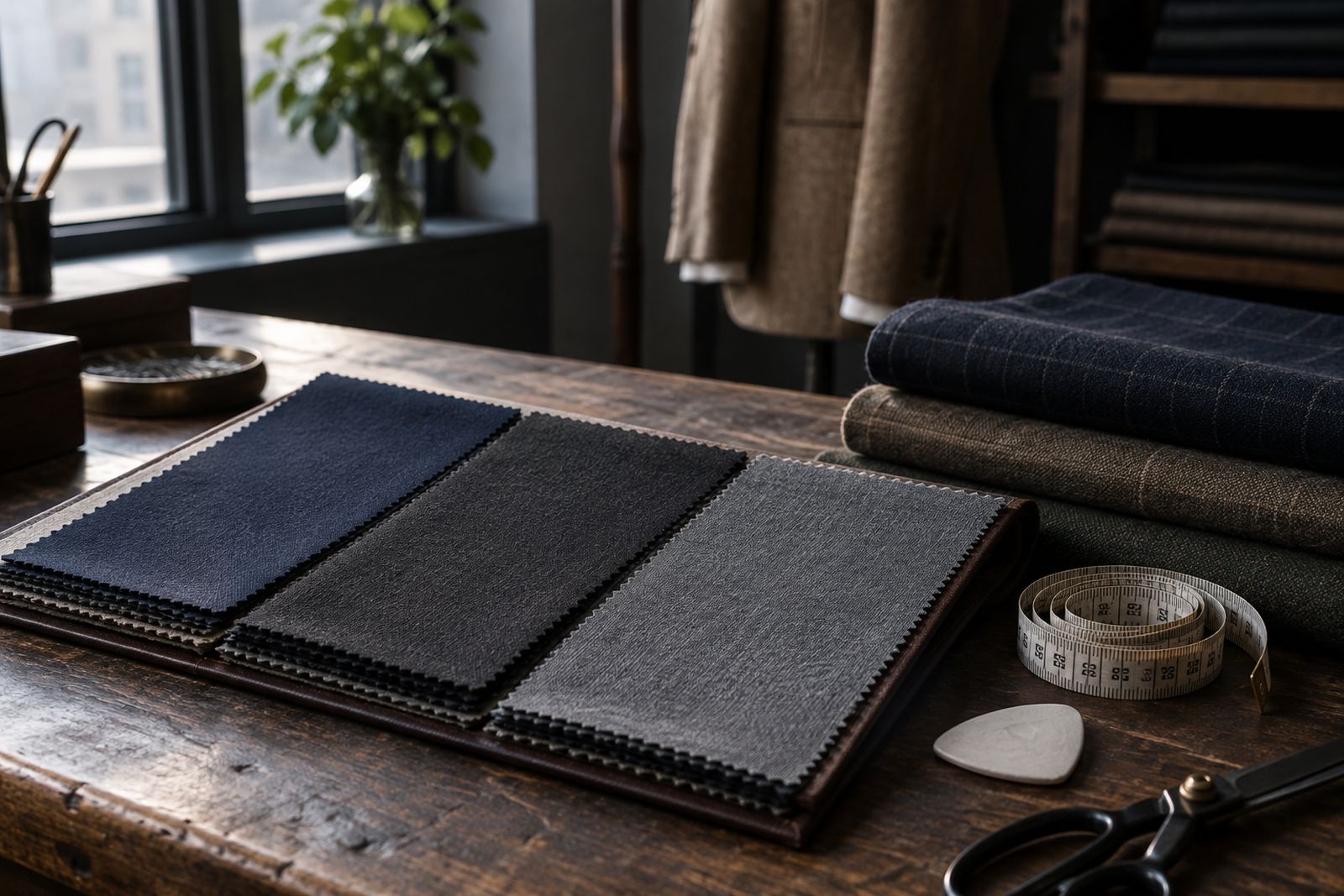
At a good tailor you will be handed fabric books (swatch books) from several mills, often dozens of pages each. A good tailor narrows the choice with questions before showing you anything. If yours does not, work through these steps.
How to choose fabric at a tailor
- 1
Start with the use
Tell the tailor how often you will wear the suit, where, and in what climate. That narrows the choice to a weight band and two or three fabric types before color even comes up.
- 2
Ask for the weight
Ask for the weight in ounces per running yard or grams per running meter. If the book does not state it, ask the tailor to look it up.
Tip: 1 oz is about 31 g, so 280 g is about 9 oz and 340 g is about 11 oz.
- 3
Crush it
Squeeze a corner of the swatch in your fist for 10 seconds, then let go. Wool and mohair should spring back almost flat; linen and cotton will hold the creases. This is how the suit will look after a day of sitting.
- 4
Hold it to the light
Look through the fabric against a window. The more light passes through, the more air will, and in heat that matters more than the name of the fiber.
- 5
Feel the hand
Rub the fabric between finger and thumb. Smooth and dry suggests a worsted, soft and fuzzy suggests a woolen, and slick and plasticky can mean polyester.
- 6
See it in daylight and at scale
Take the book to a window and hold the swatch under your chin, against your shirt. Patterns that look subtle on a small square can look loud across a whole jacket.
Tip: Many tailors can request a larger sample, called a cutting or a hanger, from the mill or merchant.
English and Italian mills
Fabric books come from mills and merchants in England, Scotland, Italy and elsewhere. As a broad tendency, English and Scottish fabrics are firmer and drier, made to tailor crisply and last, while Italian fabrics are often softer, lighter and more lustrous. Neither is better. Firmer fabrics suit structured tailoring and hard daily wear; softer ones suit lighter, less structured jackets. Ask your tailor which fabrics they like working with: they know which ones press well and which ones fight back.
What to tell your tailor
- How many days a week you will wear the suit
- The climate and season, and whether your office is heated or air-conditioned
- Whether you will travel with it
- Your budget for the fabric, which can be a large share of the total price
- Whether you run hot or cold
- Whether you want an extra pair of trousers
If you are buying one suit, start with mid-weight worsted wool and add every other fabric later, for a purpose. When you are ready to commission, our ranking of the best tailors in London shows where to find a wide choice of fabric and the advice to match it.
Questions people ask
What is the best fabric for a suit?
Worsted wool is the best fabric for most suits. It breathes, recovers from creases, drapes well and lasts for years. Choose about 9 to 11 oz (280 to 340 g) in Super 100s to 130s for a suit you can wear most of the year.
Is wool or polyester better for a suit?
Wool is better for comfort and appearance: it breathes, handles sweat and ages well. Polyester is cheaper and resists creasing, but it traps heat, can look shiny and pills. A wool blend with a little elastane or polyester is a fair compromise for travel.
What suit fabric is best for everyday wear?
A worsted wool of about 10 oz (310 g) in Super 100s to 130s, woven as a plain weave or fine twill, is best for everyday wear. It resists creasing and survives daily use. Rotate it with at least one other suit so the wool can rest between wears.
What is the most breathable suit fabric?
Linen is the most breathable suit fabric, followed closely by open-weave wools such as high-twist (fresco-type) wool and hopsack. Linen feels coolest in dry heat. Open-weave wool often performs better in humidity because it resists creasing and handles moisture well.
Which suit fabric wrinkles the least?
Among natural fabrics, high-twist wool and wool-mohair blends wrinkle the least, followed by mid-weight and heavier worsteds. Polyester also resists creasing well but gives up comfort. Linen wrinkles the most, then cotton.
Is a wool suit too hot for summer?
No, as long as you choose the right wool. A tropical or high-twist worsted of 7 to 9 oz (220 to 280 g), in an open weave and with a half-lined jacket, is one of the most comfortable things you can wear in heat. A heavy, dense or woolen fabric such as flannel will be too hot.
What does Super 120s mean on a suit?
Super 120s means the wool fibers have a mean diameter of no more than 17.75 microns under the IWTO code. Higher Super numbers are finer and softer but less durable. The number says nothing about the fabric's weight, weave or the suit's construction.
Is cashmere good for a suit?
Pure cashmere is better for jackets and overcoats than for suits, because it pills and wears through at the seat and elbows. A wool suit with a small proportion of cashmere adds softness and warmth while keeping most of wool's durability. Keep it for cold weather and occasional wear.
TailorGuide is independent. Our guides are written and checked by our team and carry no paid endorsements. How we work.